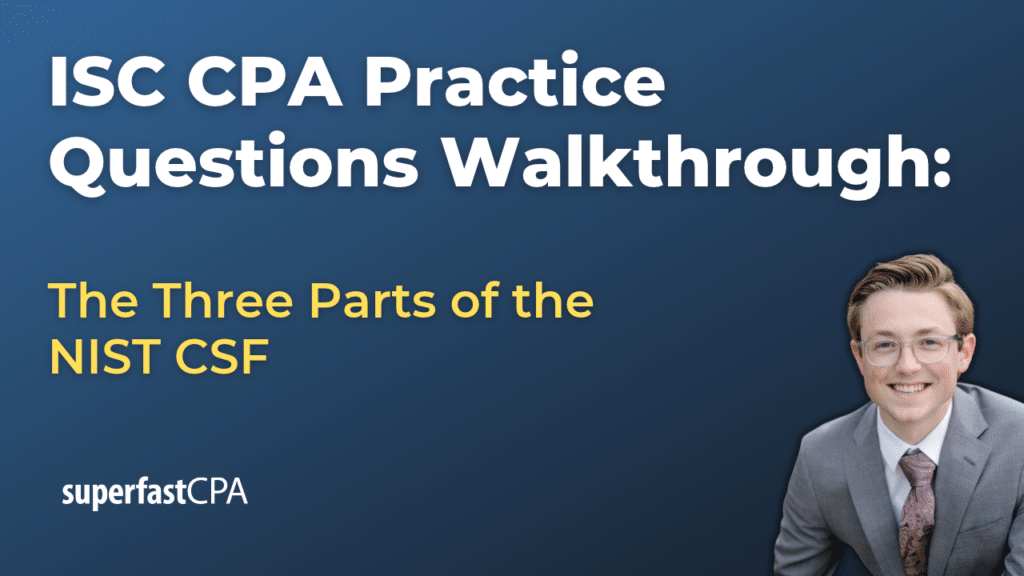
In this video, we walk through 5 ISC practice questions on the three parts of the NIST CSF. These questions are from ISC content area 2 on the AICPA CPA exam blueprints: Security, Confidentiality and Privacy.
The best way to use this video is to pause each time we get to a new question in the video, and then make your own attempt at the question before watching us go through it.
The Three Parts of the NIST CSF
The National Institute of Standards and Technology (NIST) Cybersecurity Framework, known as the CSF, is a set of best practices, standards, and guidelines that helps organizations manage and reduce cybersecurity risk. It doesn’t tell organizations which technology or tools to use. It gives them a common structure for organizing their cybersecurity work and deciding where to improve. The framework has three parts: the Core, the Tiers, and Organizational Profiles.
The Core
The Core organizes cybersecurity activities into six functions, in this order: Govern, Identify, Protect, Detect, Respond, and Recover.
Govern is the foundation for the other five. It covers the organization’s cybersecurity risk management strategy, how much risk it’s willing to accept, who is responsible for what, and the policies everyone is expected to follow. A board of directors setting the company’s risk appetite and assigning cybersecurity oversight to a specific executive is a Govern activity.
The other five functions follow the life of a cybersecurity incident.
Identify and Protect come before anything goes wrong. Identify is understanding the organization’s systems, assets, data, and the risks to them, such as keeping an inventory of servers. Protect is putting safeguards in place, like access controls, employee security training, and encryption.
Detect and Respond come during an incident. Detect is noticing that something has happened, such as an alert flagging suspicious logins. Respond is taking action once an incident is found, including containing it, analyzing it, and limiting the damage.
Recover comes afterward. It covers restoring the systems and services the incident disrupted and keeping stakeholders informed while operations come back. A company restoring its systems from backups after a ransomware attack has been contained is carrying out the Recover function.
The Tiers
The Tiers describe how formalized and consistent an organization’s cybersecurity risk management practices are. There are four.
Tier 1, Partial: Risk management is ad hoc and reactive, with no formal practices. Problems are handled as they come up.
Tier 2, Risk Informed: Management has approved risk management practices, but they aren’t applied consistently across the organization. An example is an engineering department that follows an approved vendor review process while the sales team signs up for new vendors without any review.
Tier 3, Repeatable: Practices are formally established, applied consistently across the whole organization, and updated based on lessons learned.
Tier 4, Adaptive: The organization continuously adapts its practices based on lessons learned and current threat intelligence, and risk awareness is part of the organizational culture.
Choosing the Right Tier
The Tiers aren’t a maturity model that every organization is expected to climb. Each organization selects the Tier that fits its risk environment, business needs, and resources. Each higher Tier takes more investment to maintain, and that investment isn’t always justified. A company already operating at Tier 3 shouldn’t assume Tier 4 is the right goal just because it’s the highest level.
Organizational Profiles
An Organizational Profile describes how the Core applies to a specific organization, based on its business objectives, risk appetite, and resources. Profiles come in two forms.
A Current Profile documents the cybersecurity activities the organization has in place today. This is the “as is” state.
A Target Profile documents the cybersecurity outcomes the organization wants to achieve. This is the “to be” state.
Comparing the two is how Profiles are meant to be used. The differences between the Current and Target Profiles show where the organization falls short of its goals, so management can decide which gaps to close first and where to spend its budget.