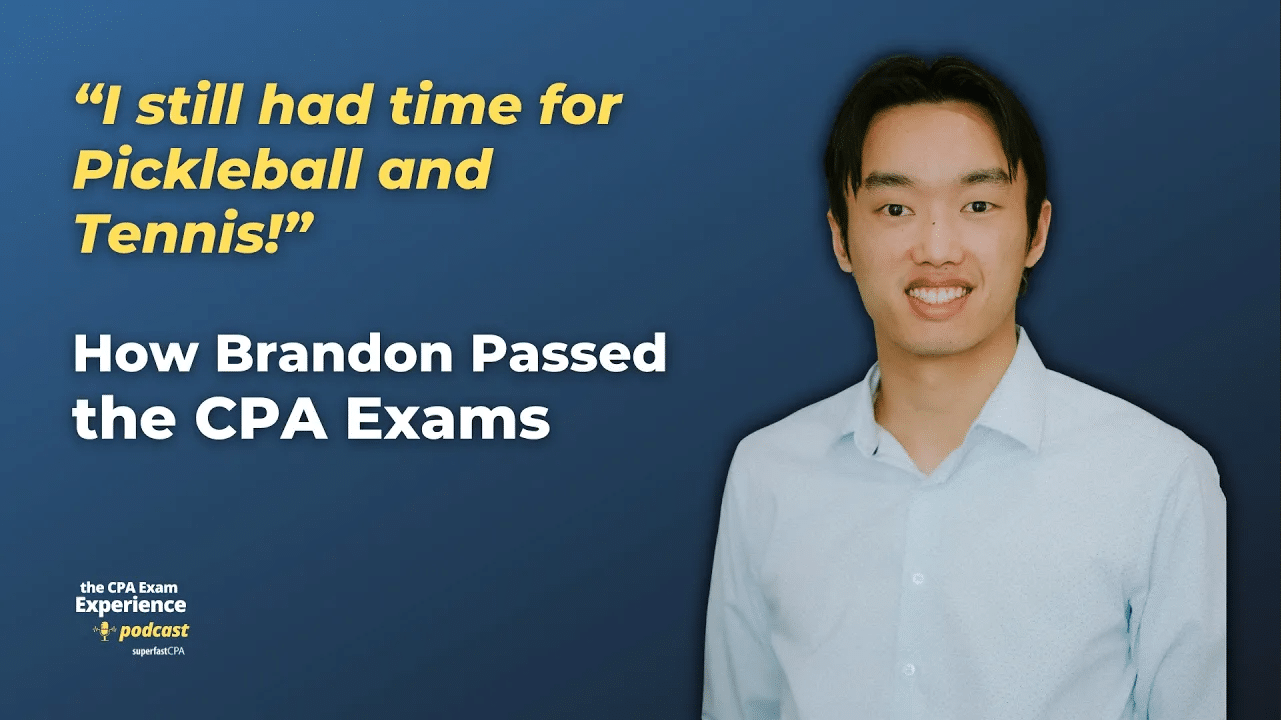
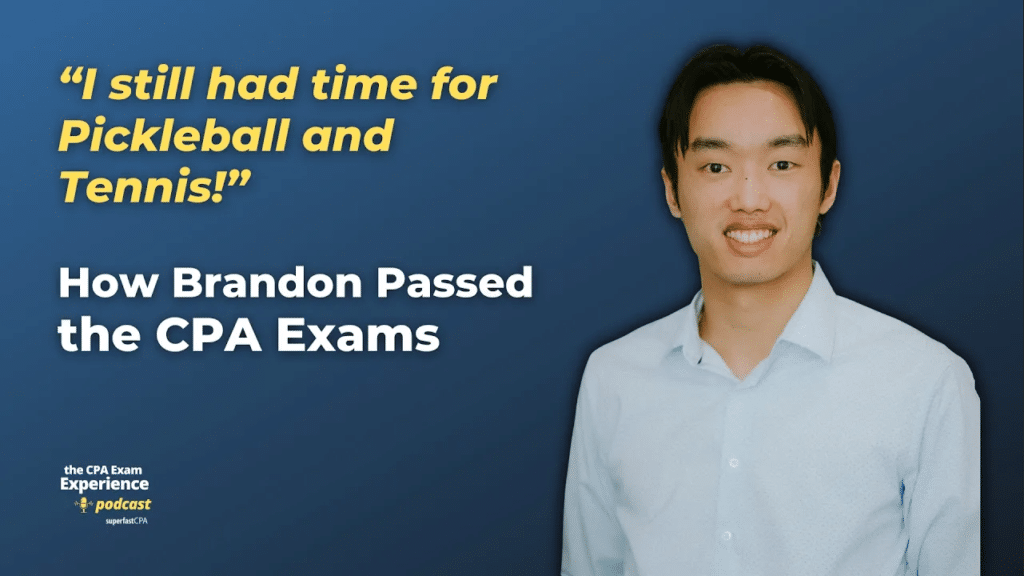
In this episode of the CPA Exam Experience Podcast from SuperfastCPA, you’ll hear about how Brandon was able to pass the CPA exams without giving up his favorite hobbies: Pickleball and Tennis. Because Brandon became so efficient and effective, most people didn’t even realize he was doing the CPA exams because he didn’t usually have to miss out.
You’ll hear how making changes like studying in the morning and focusing on the MCQs helped him to start passing exams. Brandon also joined the SuperfastCPA coaching program and really appreciated the structure. If you are someone who feels like you are sacrificing all the things you enjoy doing because of the CPA exams, yet you’re still failing, this is the episode for you.
IMPORTANT LINKS:
Master your study process by attending one of our free study training workshops:
https://www.superfastcpa.com/study-secrets/
Episode Timestamps
- 00:00 Intro
- 04:21 Original Thoughts About Pursuing the CPA
- 05:37 Brandon’s Current Job
- 06:11 How Brandon Started to Pursue His CPA
- 07:25 Why Brandon Felt SuperfastCPA Was Effective
- 09:10 Studying Before SuperfastCPA
- 10:17 The Benefits Brandon Got from SuperfastCPA
- 12:13 Studying Before Didn’t Feel Productive
- 13:57 Mini Sessions Throughout the Day
- 14:42 Used the Mini Quizzes A Lot
- 16:04 Tried REG, Then Took a Break
- 17:08 A Year Without Passing Anything
- 19:28 AUD Was the Most Difficult Exam
- 21:35 Used the MCQ Walkthrough Videos
- 24:00 Getting Familiar with the SIMs
- 26:00 Brandon’s Study Process for the SIMs
- 28:07 Prioritized MCQs
- 29:45 Brandon’s Learning Process
- 31:28 How Brandon Tackled Difficult Topics
- 32:52 Brandon’s Weekend Study Sessions
- 35:14 Using Flashcards to Study
- 36:34 Immersing Himself in the MCQs for Difficult Topics
- 37:46 Still Had Time to Play Pickleball and Tennis
- 40:12 He Didn’t Have to Miss Out
- 40:52 Work Experience Helped with the Exams
- 42:41 The Podcasts Are Helpful
- 44:13 Top Tips for People Still Going Through the CPA Exams
- 46:27 Already Got His CPA License and Looked Into Getting a License in Another State
Interview Transcript
Brandon: [00:00:00] I was like kind going between like, you know, AUD and FAR. I mean, those were kind of like probably my, you know, toughest ones.
Then I think a year, there was like a one year where I just didn’t, you know, pass any of them, Um, so it was just kind of rough.
And then afterwards I was just like, I saw your coaching program. I was like, I need to pass FAR cause it was like the, expirations were coming up. So I was like, so I was like I, I, need something, you know, to just get me going.
And then I did that and that helped me a lot better. Like with your, you know what you guys had, the resources and everything, that helped me align me up even better.
Um, so I was just, you know, get FAR done. I think I, I literally passed that right when I got your thing. I, I got it on the first try, so that helped me a lot.
Logan: Welcome to another episode of the CPA Exam Experience podcast from SuperfastCPA. I’m Logan, and in today’s video, you’re going to hear me talking with Brandon.
Brandon is someone who I had [00:01:00] in the coaching program, and he did exceptionally well. He passed all of his exams in not too long of a period of time, and he saw a huge difference once he switched to studying with SuperfastCPA, and then of course, also with the coaching program.
Brandon is someone who, you know, tried to do the CPA exams a few years ago, didn’t really go well, and kinda took a break from it because he was like, “I don’t know if I really wanna do it. This is really hard.” But after talking to some mentors and some family and friends, and even some old college professors, he decided, “You know what? I do need to go for it.”
And after a little bit, he found SuperfastCPA, and then also decided to join the coaching program. And you’ll hear the changes that Brandon made. He started studying in the morning. He started focusing on the questions. And one of the big things that SuperfastCPA was able to provide for him was helping him be so efficient and effective that he was able to still have time for the things that he loved doing. Some of the things that he loved [00:02:00] doing were pickleball, tennis, being active, and he was able to still have time for that because he was studying in the mornings, studying throughout the day with his mini sessions, and that allowed him to still have time in the evenings to do the things that he liked, again, like pickleball and tennis.
So if you are someone who has had to give up your hobbies, give up time with family, sacrifice what you feel like is too much, this is a great episode to listen to because you’ll hear how you’re able to be effective and efficient so you don’t lose those things. So make sure you listen all the way through this episode.
Now, before we dive into the episode with Brandon, I just wanna give one more reminder, as always, about our SuperfastCPA training webinar on superfastcpa.com. That is a free one-hour webinar where we will teach you the key ingredients to passing the CPA exam so you don’t waste months or even years of your time failing exams.
Seriously, it’s only one hour. It is 100% worth your time. And then after that, you’re going to want to learn more, so make sure you also check out becoming a part of the PRO course or getting our [00:03:00] supplemental study materials or, best of all, getting the Total Bundle, which includes everything.
Now, with all that out of the way, let’s dive into the episode with Brandon.
Logan: Good morning, Brandon. Is it morning for you right now?
Brandon: Uh, it just hit like afternoon.
Logan: Just hit mid- midday? Okay.
Brandon: At midday, yeah.
Logan: All right. Well, uh, I’m glad to have you on the call today. Uh, I’m really excited to talk to you, especially because you were somebody who we had in the coaching program. You did awesome.
Uh, how does it feel to be done? Yeah, it’s been, it hasn’t been too long.
Brandon: Yeah. Um, it feels great, you know, to get it off. You know, it’s, it’s always like, uh, you know, consc- conscious in the back of your mind, you know, when you’re still doing it. You wake up every morning and you’re just like, “Oh, I still have to do it, still have to study,” and all that.
But now it’s like, it’s been nice for like the past couple months, like the past month, you know, not having to study and stuff, but
Logan: Yeah. It, it feels
Brandon: A great achievement.
Logan: So nice. Mm-hmm. Yes, exactly. It, it feels great to, like, wake up and be like, “Oh, wow, [00:04:00] I don’t have to study.”
Brandon: Yeah.
Logan: Um, so we’ll, we’ll just go ahead and get into your story.
Uh, again, you were somebody who was in the coaching program, but honestly, you did really well, so we didn’t have to do too many things super in depth, cause you just kinda took it and ran.
Um, but let’s go ahead and hear, you know, we’ll start with the beginning and everything.
Original Thoughts About Pursuing the CPA
Logan: So when you wanted to go for the CPA exam, what were you doing in your life? Like, were you working? Why did you wanna go for the CPA exam?
Brandon: Yeah. So I had just, you know, graduated college in, like, 2022. So I did my master’s and everything, and then I was working full-time as well. So, I mean, at the time, honestly, my professor, he was, like, telling me, you know, ” The CPA is, you know, important. You, you gotta go for that.” I mean, it’s like, you know, part of the industry.
Um, but, like, at the time I was like, you know, I was, like, on and off about it, to be honest. It was funny because I was just like, “Oh, I don’t even know if I’m [00:05:00] gonna do it.” I was like, “I don’t know if I’m gonna really– I wanna get into it.” It’s like, it’s a lot of work and all that, but I don’t know.
Then in the end, I just ended up doing it, you know? It’s like, you know, a lot more people just telling me, “You gotta do it. You can do it. You know, you just gotta put in the time.” And then, you know, finally I, I got into it.
And then I knew it, it helps with your career as well. Um, it helps you move up. People recognize it, and they, they see you as a different person once you have that CPA and as, like, an accountant.
Logan: Yeah. Yeah, it, it, it is just like those magical three letters. You know, it’s not gonna solve everything, but it does help a lot, um, in like getting a job and things like that.
Brandon’s Current Job
Logan: Uh, were you… so you got done w-, you finished your master’s and were you… did you go into like public accounting? What, what were you doing for work?
Brandon: Yeah. So I was in public accounting, but I’m work– I was working for like a more small accounting firm. So the accounting firm may have like, you know, 20 to 25 people. Um, so pretty small, but we just, you know, a lot of tax returns, you know, there’s some [00:06:00] audits, very small audits that we did, and then a lot of reviews and comps, you know.
But I, I s- I worked at– I started a small accounting firm, and that’s where I’ve been, you know, for the past like four or five years so far.
Logan: Awesome.
How Brandon Started to Pursue His CPA
Logan: And, uh, so when you finally decided to go for, you know, like finally like really jump into it cause you were kind of, ” Eh, I don’t know if I really want to. Oh, maybe I should.” Once you decided that you were gonna do it, how did you start? Like, did you buy a review course? Did you, did you do some research? Like, how did that look?
Brandon: Yeah, I did like, you know, how I, I think everyone else does it when they first start is like, you know, you buy the Becker review course or, you know, one, one of the main ones, and then, you know, you just go through… I mean, I took a look at the, those lectures in Becker, and then I was just like, “No.” I mean, I knew that wasn’t for me.
So I kinda just like maybe read the textbook, you know, just try to go through there, maybe look at the multiple choice questions. Um, but it’s just, you know, it was tough, you know. It wasn’t really clicking. I [00:07:00] wasn’t much of a, you know, test person, you know, in college and all that. So it was just tough to, you know, get myself going, to really get myself like, you know, have a good study session.
Um, and then I think that’s where you guys helped a lot, SuperfastCPA, you know, you know, dialing it down, you know, maybe not always like doing huge sections at a time, you know, like time slots, but like, you know, having effective studying, and I think that helped a lot.
Logan: Right.
Why Brandon Felt SuperfastCPA Was Effective
Logan: And so what, what was it about SuperfastCPA that helped you feel like you were effectively studying?
Brandon: I think it was, I mean, those two-hour study sessions in the morning. I mean, I wasn’t– I wouldn’t always get up in the morning. Sometimes, like, I would feel like, you know, the brain’s not awake yet. But, like, once I actually started studying, it was like, okay, it started clicking and I think I was getting better time out of it, you know, than, of course, a- coming after home, you know, after work and you’re all tired and everything.
And I think that, I think that was a big one. Um, getting up, you know, at 5:00 a.m., going from [00:08:00] 5:00 to 7:00, you know, having good two-hour session. You don’t have to worry about anything. It’s like you just start your day with that, and then it helps with, like, the long-term memory and everything.
Um, but that was huge, and I think I really like the, the notes you guys have, everything on the app. It’s just a lot easier to use on the app than comparing to other pl- other ones. Cause everyone– cause a lot of like maybe Becker and all that, it’s just, it’s not as user-friendly in my opinion, um, compared to what you guys have. And I like the little quizzes cause that kinda stimulate your brain, you know?
Even though if it’s basic, it’s like you’re still working it, and if you get the foundation, the basics of, like, the topics, you know, then you can apply it going forward. So I think that helped a lot, you know.
You take a little, like, time, lunch time during work. You take a little break after you do assignment. I do assignment or something during work, and then I can do that. So it helps kind of like just to bring it on.
Logan: Yeah. Yeah, that, I mean, that’s the whole idea behind the mini sessions is to have that kind of constant [00:09:00] refresher, cause like you were saying, um, you know, well, without that then it just kind of fades, like you’re not really reinforcing it all the time.
Studying Before SuperfastCPA
Logan: Um, one thing that I wanted to kind of ask about, we’ll talk about the mini sessions a little bit more, but for the morning sessions. So before you started with the morning sessions, were you studying at night? Like, were, like what did that look like?
Brandon: Yeah. Honestly, I feel like I was kind of out of pl– out all over the place, ’cause like the first one I was like, “You know what? I’ll take a shot with REG, with REG,” cause I did– I was in tax, So I figured I’d take a shot with that. But like, you know, I was like studying a little bit maybe at night, and I don’t know, it was just kinda like on and off, you know?
It, it wasn’t very good. I didn’t have like a solid plan, ’cause then I lose focus and I’m like, “Ah, I don’t really want to do this,” and get disin-disinterested in stuff and then, you know, it just… it, it wasn’t like a good plan, so I was like on and off and then I just felt like I [00:10:00] wasn’t probably retaining what I needed to know, you know, I would study something, I would kind of get it, but to me I would lose it the following days.
And then plus it was like I wouldn’t, you know, relearn the stuff, you know, that I did from the past, from a couple days ago so it was like, then you forget those and all that.
The Benefits Brandon Got from SuperfastCPA
Logan: What were like, what benefits did you get from SuperfastCPA? Like
Brandon: Yeah. So I think the biggest part was like the two-hour session. So that kind of just me in the morning just start my day. It, it, it kept me like aligned, so I was able to, you know, have a plan.
You know, you get up, all right, we gotta do this, you know, go through these topics and just kind of having a on what to do each day. I think that was the biggest thing cause before, like I wasn’t really into it and like, I would just do, you know some, sections, but it, you know, and then you do a couple more the next day, but it’s just like, it was like, you know, it sporadic. It wasn’t like going very well.
So I think that was the biggest [00:11:00] thing. You know, it just starts your day and you, and you have a, you have a set plan on what to do.
Um, you know, I would plan out like each section, like, you know, do this section, then I do this section next. And then, you know, like I would also do like the re-review stuff as well. And I think that helped a lot. you know?
I think it was like maybe you do an hour and a half of like a new topic and then maybe three minutes of like, uh, a, a review practice test, Um, on like past material and So that helped a lot. And then I just think that part was good. And then, you know, for the rest of the it was using like the materials you had in the app.
Um, of people you know, have phones, so it’s just nice to be able to use like the review notes, you know, be able to look through those and they’re easy to read. You know, it was understandable. Sometimes, you know, other review courses, it’s just very detailed, like you know, too complicated and you know, there’s just like more information than you want to know. Um, and just trying to know, get like the st- like, the most important details, you know, that’s gonna be on the exam. [00:12:00] And then plus the mini quizzes as well were very good. you know, it just helps keep you going and be able to know the basic knowledge of everything.
Logan: Yeah. Yeah, exactly. Yeah, I mean, a lot of this, I, I, love all, all the things that you said there.
Studying Before Didn’t Feel Productive
Logan: And it like, first off, for the studying in the morning, I mean, it just makes a huge difference in your mentality the rest of the day where, you know, you, you got it done, you got it out of the way, and then you… cause were you studying in the evenings before?
Uh, you said it was kind of sporadic. It was maybe sometimes that, sometimes other stuff. Is that right?
Brandon: I would try to do some of my studying sometimes in the morning or like, you know, maybe like at lunch during work or, you know, whatever. But yeah, it was mostly like in afternoons I’d come back and, you know, I would, you know, try to spend time, um, you know, studying and stuff. But it, it just didn’t seem very you know, productive.
And then especially it’s like nice outside, you know, during the summer or [00:13:00] whatever, it’s like you don’t wanna, you know, be indoors like studying.
Um, but I think that’s where the morning helps a lot ’cause it’s, you know, it’s dark and you’re, like, “Okay, let’s just study and, you know, get it going.” and then when you come home then it’s like, you may just do like a little review session or whatever, but you know, you’ve done like a big two-hour session, you know, already in the morning.
Logan: Yeah. I mean, I’ve said this on way too many, uh, on ev- probably every single podcast at this point, but like it just helps you feel so different about your day ’cause you get that two-hour session done, you have your, you do your work, and then instead of coming home and being like, “Oh man,” like you’re so tired and you don’t wanna do it, instead of feeling like that, you are done pretty much.
You can maybe do a little bit of other review, a little bit more of mini sessions, but like you’re pretty much done for the day and it just feels so much better. You can, like you were saying, go outside, you can do something with friends, you can do chores if you need to, you know, whatever the case is.
Mini Sessions Throughout the Day
Logan: Um, and with [00:14:00] the, uh, mini sessions throughout the day, so you liked the mini quizzes, uh, you were mentioning those. Did you use the audio notes and the re- the, like the text review notes as well?
Brandon: Yeah, so I use the audio notes a little bit, you know, sometimes I’ll use them in the car. But, you know, sometimes for me, like I might have, you know, done a lot of like looking at the text review notes already during like the day. So it’s just like, you know, I would like to like, you know, listen to some music, you know, on my way back home or something.
Uh, you know, just to kind of like ease the brain a little bit, you know, just kind of not think too much about it. But then I, you know, go back and listen to audio notes maybe at night or something before bed and then kind of just, you know, listen to those and follow the review notes.
Used the Mini Quizzes A Lot
Logan: Mm-hmm. And would you say that the mini quizzes were probably your most used thing?
Brandon: I, use those, yeah, I use those a lot, um, because it’s just, you know, quick. It’s five, and then you guys would also have like you know, like the right, right answer, wrong answers, you know, you know, a little bit of an [00:15:00] explanation. So I think that helped a lot. Um, you know, just, I would just go through those, you know, just see like different types of questions and you know, it was a good learning material as well, you know, seeing, you know, things that I haven’t studied yet.
Logan: Yeah. Yeah, we get asked that all the time, like “is there a way that I can, uh, choose what I see in the mini quizzes? You know, because I, I’m seeing, stuff that I haven’t seen before.” And we’re like, “Well, that’s actually the point.” Uh, you know, you’re kind of, you’re getting a, if it’s something you haven’t seen before, that’s fine.
You’re just getting a preview of it. It’s not like you have to get it right necessarily. You’re just learning and seeing extra, extra stuff. And if it is something you’ve seen before, then it’s just helping being a refresher for you. But the biggest thing is the quickness of them. Like you were saying, the five questions, like, if you had to choose what you were gonna study each time, it wouldn’t be a quick mini quiz.
It would be like, you know, a few minutes of figuring out what you were gonna do, and then you take the quiz. You know, like it just, it just kinda defeats the purpose. [00:16:00] So i, I’m, I’m glad that you brought that up, like seems like they were really useful for you.
Tried REG, Then Took a Break
Logan: Um, for the, so kinda going back to your, like the actual studying, so when you were, so before you got SuperfastCPA, had you taken any exams? I think I might have missed that. Did, did you take any exams before SuperfastCPA?
Brandon: I think I took, uh, REG, that was the tax one. Um, only just cause I, I was just trying to give it a shot, you know, see how it goes. And I mean, I didn’t do like, you know, terrible, you know, for not like, you know, studying and all that, but it was like I was just, you know, seeing and I think after that, after I failed that, I just like, I kind of like, “Uh, I don’t know if I want to do it.” So I think I might have like taken, you know, six months, I don’t know, a year and not really doing it.
And then finally, you know, after, you know, talking to a lot of you know, family, you know, all that, like professors, friends, and I– then I found, okay, I, I just got to do this or else like I’m gonna like regret the rest of my life, um, so.
Logan: [00:17:00] Yeah. Yep. Uh, it’s, it’s one of those things where, like, the only way that you can truly fail is if you just stop, like if you don’t want, like you just don’t do it anymore.
A Year Without Passing Anything
Logan: Uh, so you took REG, were like, “Ah, I don’t know if I wanna do this anymore.” You kinda took a break and then, uh, you know, you got SuperfastCPA.
And at what, um… did you get SuperfastCPA, like when did you get the pro c- uh, sorry, the coaching program? Like, was that the first thing you did with SuperfastCPA or did you try like the PRO course and stuff first?
Brandon: No, I did the PRO course. So I think, I think I saw you… I got back into it, I think it might’ve been like in end of ’22, cause that’s when I took BEC and I passed that. Then I, I saw your PRO course, so I, I got that as well as like a supplement, and then I was using, so I think I was,
Logan: Mm-hmm.
Brandon: I was, going… then I did well with the REG, so that was fine. So I had like, you know, two out of four passed. And then I was like kind going between like, you know, [00:18:00] AUD and FAR. I mean, those were kind of like probably my, you know, toughest ones.
Um, but like, I think FAR, I did maybe once or twice and I was like, “Ah, you know, what? It’s not going well.” So I was like, “Let’s try AUD, and I’ll see.” And then, I did that, then I think a year, there was like a one year where I just didn’t, you know, pass any of them, Um, so it was just kind of rough.
And then afterwards I was just like, all all right, I saw your coaching program. I think that might’ve been last year. End of last year or something, depending, there or like beginning of this year. And then I was like, all right I need… I was like, I need to pass FAR cause it was like the, expirations were coming up. So I was like, so I was like I, I, need something, you know, to just get me going.
And then I did that and that helped me a lot better. Like with your, you know what you guys had, the resources and everything, that helped me align me up even better.
Um, so I was just, you know, get FAR done. I think I, I literally passed that right when I got your thing. I, I got it on the first try, so that [00:19:00] helped me a lot.
And then AUD was just kind of tough in general, I think for me. Like I, I still use it, but it’s just, you know, material and everything. Like I don’t really do much audit, so it’s like, it was tough, you know, um, just going through that, but.
Logan: Yeah. I mean, audit is like, it’s so unique. It’s totally different than the other exams. So like I’ve, yeah, I’ve seen that happen all the time where people do everything and then they get to audit and it’s just like really difficult because it’s just so different.
AUD Was the Most Difficult Exam
Logan: Um, and I remember like, I do remember you passing FAR pretty early on. So were you able to pass FAR and audit before you had REG and BEC expired?
Brandon: I had FAR, but the audit, I just missed it, because I think I passed it like months afterward.
Logan: Oh, okay.
Brandon: Um, and then so I had to take, you know, TCP. So I just took TCP because that’s what I do.
Logan: Okay, so you had take a discipline.
Brandon: Yeah, the amount of times I tried in audit was probably the same amount of times I– for the all, other [00:20:00] three tests. So it was just crazy how much time I had to take on audit. Like I s- s- I took that thing, I think like 9 or 10 times, and in total for the other ones was probably like eight or nine. So it was just like crazy.
Like that was harder than FAR for me and people are saying, you know, FAR. So I, it, I think it varies with everyone, you know, like how everyone takes it.
So like, for me, the starter was like, I was like, you know, what? I just got to get started so I did BEC, you know REG, like the ones that I felt comfortable, and then it helped me just give me some, some, uh, momentum I think.
Because I know a lot of people say, you know, start FAR, audit. I think, you know, it varies, you know, amongst everyone. Maybe if you really need a momentum booster, some motivation, then maybe try to pass some of the other tests. And then once you feel that then, I think then you can conquer like the rest of them. Because, because it’s all doable, in my opinion. You just got to put, put in the time.
Logan: Mm-hmm. Absolutely. I mean, yeah, it’s, it’s definitely doable. I mean, you’re here, you passed the exams, you g- you did it. Uh, [00:21:00] so, and yeah, it, you know, there’s different, there’s different ways you can do it, like you were saying. Like, we usually recommend doing FAR first just cause it’s still the biggest exam, um, and so getting that out of the way first is helpful for the time limit.
Um, but like you were saying, there can also be that benefit of passing REG or something that you’re a little more familiar with or that is maybe a little bit easier for you so that you have that win under your belt so that it’s just a little bit, you have more confidence going into the other exams. You, you know, you can, it can go either way.
Used the MCQ Walkthrough Videos
Logan: Um, and with, with audit, um, well, uh, more what I was gonna ask was what did you, what were the benefits that you got from the coaching program? So like, you were kinda saying it helped you be more aligned and stuff like that. Like, what was it that was helpful when you got into the coaching?
Brandon: I think, um, cause I, I mean, I know you guys had some, like the TBS stuff, and then you [00:22:00] would kind of break it down, you know, some of the multiple choice. I, I think that was really good. You know, it helps you kind of figure out how to go about, you know, solving the problems, you know, going about worrying, be more efficient, um, like a test taker because you’re going in trying to take the test, you know?
So you gotta be, find the most efficient way and try and narrow down the answers and everything. And especially for auditing, you have
Logan: Are you in our– oh, sorry, I was just gonna ask, are you talking about like,
Brandon: Yeah.
Logan: Walkthrough videos that we have, like how to break down a sim and stuff like that? Okay. Okay.
Brandon: Especially for audit, you know, sometimes you have so many documents, so it’s being able to… a lot of people just go crazy but then I think for me, it’s like I took it, so many times, so it’s like also looking at some of the sims, you’re like, okay, if you just take a little time and you know, five minutes or something, and just look at like, documents relate to like each question, cause sometimes you don’t need to know everything.
Um, and it’s kind of like you know, taking some time, just looking over information, make sure you [00:23:00] you use what you need to use.
Logan: Yep. Yeah, I mean, that’s, that’s totally… actually, I really, I’m really glad that you brought that up because a lot of times people will say, “Could you talk more about sims on the podcast?” and stuff like that. And I think what you were just barely saying there is super crucial for sims, especially for audit, cause when it comes to sims, it’s a, like, more than half the battle, I would say, is, like, figuring out what you actually need from the sim, like, what you’re supposed to actually be doing.
Uh, like, audit is notorious for, like, like you said, having, like, nine or 10 exhibits and you have to, like, read through them and try to figure out what you’re supposed to be doing. But in the end, that does save you time if you, like, read through each exhibit and see if it is pertinent instead of just kind of like, uh, like, instead of kind of being like… a lot of times people panic with the exam- with the sims.
They’re like, “This is, this is too much.” Um, so they kinda just kind of randomly click on things and they’re going back and forth.
Getting Familiar with the SIMs
[00:24:00]
Logan: Uh, but it sounds like it, you were able to kind of start being a little bit more methodical.
Brandon: Yeah, I think it’s just, you know, like the first, you know, couple times taking the exam, you’re, you’re like, ” Oh man,” you know, it’s just just like a lot and everything. And I think after taking those, those first couple, it’s like, then you’re like, okay, I mean, I know what’s– what I’m going into. I just, you know, I just gotta read the documents, you know, give myself a little more time to, um, have for the sims.
You know, like getting to the multiple choice, like how you guys say it you know, get through those you know, do those, as best as possible so you have enough time for the sims.
And then, you know, just taking your time, making sure you’re using what you need to use. And I mean, I, I wasn’t, you know, just going in, just rushing through the sims. you know? I was taking my time reading it and just once you, did that, then you’re like but it’s like maybe you only use up 10 minutes, right. Or 15 minutes. So it’s like, you didn’t spend that much time until you actually know, so it’s like gaining that focus, and I think it’s like [00:25:00] making sure you have that energy and that mental.
So even like s- if you need to take like a, that f- use that 15-minute break, right? Just to like, you know, get yourself back and just be focused for like, the next couple tests that’s afterwards. Um, just having that mental focus for the sims.
Logan: Yeah absolutely. And I mean, definitely, definitely take the break, like the, the, the ti– the untimed break, excuse me, like definitely take that. Um, yeah, I mean, I, I love what you’re saying here with the sims.
Um, they are something that people are frequently really scared of, um, but I think the, the key is, you know, like you were saying, like you were, you were talking about how getting through the multiple choice questions so that you had time for the sims, like being really good at the multiple choice questions not only makes it so you get through them more quickly, but also means that you learned the material really well from the multiple choice questions, and so you can then just, you have the time to go, to carefully put, uh, do each sim piece by [00:26:00] piece.
Brandon’s Study Process for the SIMs
Logan: And, uh, so, you know, you were doing… how would you study s- how did you study sims, like, uh, leading up to the exam? Like when did you study them and how did you study them?
Brandon: I probably studied then maybe, you know, two to three weeks before, like the exam. I, was really f- honed on like the multiple choice, because I think, you know, th- that’s like the biggest thing, making sure, you know, you can do well on those, because you do well on those that’s like half the battle.
And then like the sims is just like, a lot of material you learn from the multiple choice. I mean, you see it, you just have to apply it. Um, so it was like me– It was more like me just trying to, figure out how to go about attacking these problems and seeing, you know, how they looked.
Um, so I think, you know, when I first started, I was like, you know, seeing, looking at Becker and I’m like, “Okay, I see how these sims are.” But it’s like, I’m like also worried like I don’t know, what they actually look like on the exam. I think it could be different.
But once I saw the first couple, um, then I was like, and you [00:27:00] know, I, failed those, but like once I saw how they looked, I was like “Okay, so this is how it, is,” and I got a little more like comfortable with them. And then I, I was just like shotgunning it.
Um, so I didn’t look at them that ton, but I was, I’ll look at it if I, if it was something that was just totally different from like a multiple choice, you know, just to understand h-how it is.
Maybe like a FAR or, you know, like a REG where you have to like calculate stuff and and you know, fill in numbers. Um, cause like audit I’m pretty sure was more like they give you choices so you could kind of you know, narrow down to what could be the potential right answer.
Logan: Yeah. Yeah, that, I mean, that, um, you can do that on a l- on all the exams to an extent, but audit especially when it comes to the sims and even multiple choice questions for audit, like if you carefully read through it, it becomes pretty obvious what… There’s almost always like one or two options that are just like nonsensical. It’s like that doesn’t even make any sense. Um, and you can kinda, like you said, you can kinda narrow it [00:28:00] down. Um, and so with the, uh, so I like that y- so that was how you studied for the sims.
Prioritized MCQs
Logan: And were you, would you, like leading up to those, those two or three weeks leading up to the exam when you kind of started including sims, were you studying them every day during like your two-hour session or were they in addition? I’m just kinda trying to
Brandon: Yeah. Um, it was kind of more like in addition. Um, I, I wouldn’t say… I mean, I, I think it all depends on, like, the person. So, like, for me it was more just like I would kind of, you know, look at them, like, in addition, you know, like each day. I mean, not every day, but, you know, like three, four times, you know, with, a week, and just to kinda like get myself familiar with the sims and everything.
Um, cause I, I feel like a lot of it stems from the, you know, multiple choice. So I would… I, I did a lot more of that and then, you know, the sims maybe it was like, you know, a lot more steps involved. So then I would just go and see, you know, [00:29:00] how… if I was able to, you know, kind of go through that.
Um, but it– I did a lot, definitely a lot more, multiple choice, but I think I mean, there could be some people out there that the sims, you know they really need to, you know, do more of that then, you know, maybe they have to, you know, study more of that, you know, do more problems or whatever, you know, look at them a lot, more.
But I think for me, it was just more just getting familiar with them, so that way when I get, got into the testing day, like, I felt comfortable. I was like, “Okay, this is how it looks and how I should go about it.”
Logan: You know how to, you know how to navigate them. I think that’s like a huge, a huge part of sims is, like I, was mentioning before, like not panicking and just kind of methodically working your way through what they’re trying to have you do.
Brandon’s Learning Process
Logan: Um, you talked a lot about, you’ve talked a lot about the multiple choice questions. I w- I was curious, when you were like learning from the multiple choice questions, like during our, the planting the seeds, those 90 minutes in the morning, um, [00:30:00] what did that look like?
Were you, uh, like taking notes while you were doing it or were you using an Excel sheet? Like how did that look when you were learning
Brandon: So I used the Excel sheet like you guys talked about, I think in the, in the program. And, you know, I would just like label one, two, you know, all the questions and then, uh, any of them that I got wrong, um, you know, I would look, I would look at, try to understand what happened and then, you know, make some notes, you know, to remember what, you know, sounds important topic in my opinion.
And then I know you guys had the pillars of topics, so I would, you know, sometimes do that. Um, you know, that way you have like most important topics and these are things that you’ve really got to know for the exam, um, that are most likely going to be on it.
And then, you know, sometimes there’ll be calculation, you know, I would do that, you know, cause then that’s the biggest thing I feel like, cause there’s always problems on there that you have to calculate.
So it’s understanding how to be able to go about doing those problems. Um, so just [00:31:00] knowing like the steps and methodically how, um, to go about those types of questions.
Logan: Exactly. Yeah, I mean, from what it, it sounds like you were just, you know, whatever the situation, uh, required for the multiple choice question, you would just like learn from it in some way. Like you’d pull out something as a pillar topic or you would re-perform, like if it was a, it was a calculation question, you would do it over again so that it kind of would stick in your brain.
How Brandon Tackled Difficult Topics
Logan: Um, did you… what did you do for like, let’s say you had a topic that was really difficult for you, like whether that was during planting the seeds or maybe even more during like, your review quiz each day, um, cause, you know, that’s a part of the, you know I’m assuming that you were doing like that 30-minute review each day.
Um, what did you do when you ran into something that was extra difficult for you, that you were just kind of like, like how did you learn from those?
Brandon: So I think those topics for me, I just was like, during [00:32:00] my– that one and a half, I was like, you know, this is something I really just don’t get. Like I, I, I was like, I can’t cut through on that, on my session. So I’m like, you know what? Let’s just put to the side. I’ll keep it as notes and then I’ll look at it later.
So then I did the things, you know, try to get as much as I wanted to get into, you know. So that way I was, I was keep on going and then um, and I wasn’t falling behind, you know, on my sessions.
And then maybe like when I came back, um, from work or something, I would look at it then cause it’s just me, you know, one or two topics, you know, that that I could just focus on, you know, take my time or maybe if it was like a weekend, you know, I, I would look at it then.
You know, just kind Right
understand, you, know, really just, you know, if I need to take it, 30 minutes or an hour or whatever, how long it took to really understand how like that topic that I was having a difficult time with.
Logan: Right.
Brandon’s Weekend Study Sessions
Logan: And, um, actually kind of along with that, so, um, on the weekends, were you studying [00:33:00] extra? Like were you studying like more than two hours or was it usually just kind of the same thing and then maybe a little bit of time to catch up on topics that you were struggling with?
Brandon: It was like that session you guys were talking about. So I think, you know, starting early again, cause I mean, it’s like I’m already up early already, so it’s like your body’s used to it.
And then doing like another session, right? Like I mean, after like a two-hour break or something. And then by the time you have the whole afternoon to yourself.
So then it’s like maybe I go out, you know, hang out with friends, whatever, and you know, spend time with family and then you know, you come back, man, night’s like, all right, I mean, I’m not as tired so maybe I’ll look into some of those other topics that felt difficult.
Um, but yeah, it was more like anything that’s difficult I put to, the side, make note of it. and it’s like, I gotta get through all the material and just make I knew at least 90% of it, you know, and I, knew that one topic was very minimal right on the exam, then it’s like I, I know, at least 90, 95% of it, [00:34:00] so I should be able to go and, take the exam. ‘ Cause I feel like a lot of people just, you know, y- you’re just stuck on one topic but it’s like, it’s not just, you know? that one topic And it could be very minimal. It might not even be on there. Like, we don’t know, you know, what’s gonna be on the exam. Sometimes it’s not even on there.
But it’s like if you can know it at, you know, at just like a broad basis, right? And then just you gotta get through everything and then sometimes you just have to go take the exam to see, cause you never know I mean, you might know enough, you know, to be able to pass it.
Logan: Yeah, Yeah, that’s something that Nate says it, like, or that we say is like like the cumulative coverage is king. Like that’s the most important thing. Of course, you want to minimize having topics where you just like don’t know anything about them, ’cause that could be, could be on the exam.
Um, and but yeah, cumulative like understanding and just kind of like bringing that cumulative, uh, percentage, cause you know, we do the, you do like, like for example, you do like a 30-question quiz, [00:35:00] you want that cumulative average to be above 70, cause that means that on average, cumulatively, you know over 70% of the stuff that you’re seeing, and that’s gonna translate to test day as well.
Using Flashcards to Study
Logan: Um, and for the, and along with the like the difficult topics and things like that, did you ever make flashcards? Or what did you do for, what did you do to learn those difficult topics? Cause you said you would come back to them and stuff like that, but how would you then dig into them and really learn them?
Brandon: I do– I would make some flashcards. I didn’t use– I didn’t heavily use flashcards too much. Um, but sometimes I would for things that like I knew were, you know, definition stuff or like it’s like memorization. Um, so it just helped me, you know, just kind of understand those topics.
But those, like more difficult topics, I’d probably go back into it and I, I would just really under– I go to just like the topic itself and look at the multiple choice, I mean, a task-based [00:36:00] simulation and really understand cause I just felt like that’s what I’m taking on, on the exam.
So I was like, I just want to understand how, you know, to go about solving these problems and like different wordings, you know? ” Cause some, I mean, that’s how they get you, just trick questions and everything, putting different words. So it’s understanding how like what I’m seeing, oh, like maybe I thought it was this answer.
It could’ve been right, but it’s because, you know, they had this, they word it differently and that’s why it’s not the right answer. So I think then I, I took more time just to like, you know, go through that, topic, you know, and, and look at like various questions.
Logan: Okay.
Immersing Himself in the MCQs for Difficult Topics
Logan: So really just like if there was something that you knew you were struggling with, you would just dive into the multiple choice questions for that topic even more, just like trying to immerse yourself in it.
Brandon: Yeah, cause sometimes, mean, I have a, a set time that I was trying to get myself going, you know, in the hour and a half. So it’s like, I mean, I just couldn’t keep patient if I spend like, you know, 20 minutes just trying to really understand it or make 30, right. So it’s like then, yeah.
Logan: [00:37:00] Yeah. On one question. Yeah.
Brandon: Then I look at when I really wanted to, you know, and then you could just focus on it and just see, okay, now I understand how it works. you know, maybe after taking a little break and have more clearer mind, you know, to understand how that topic works.
Logan: Yeah, that makes sense. Uh, I, I mean, I like what you’re saying there, and, and that is like, you know, something that we talk about a lot is like flashcards. Um, and what, what it really comes down to is you’ve got to have some way of taking that topic that you have been struggling with and like sitting down with it and really like working through it so that you understand it.
Um, so it looks like, sounds like that for you was like the multiple choice questions, like just diving even deeper into them.
Still Had Time to Play Pickleball and Tennis
Logan: Um, so we’ve talked about, you know, how you changed to studying in the mornings. Uh, we talked about how you studied and prepared for the sims and how you did the mini sessions and how you worked on like difficult topics and things like [00:38:00] that, which are a lot of times kind of like the big, the big things that we like to cover but was there anything that you were able to continue doing in your life that because s- s- you know, the strategies from SuperfastCPA were helping you be so efficient, that you didn’t have to give up? Like, is there anything that you were able to keep doing that
Brandon: I was able to, you know, I’m big into, you know, pickleball, tennis, you know, outdoor activities. Yeah.
Logan: Oh yeah, I remember that. Yep. You were like, are you on like a team or something? Like, it seemed like you were
Brandon: No, I was
Logan: quite a bit. Is that right?
Brandon: With friends and stuff. Yeah, we were just playing,
Logan: Just playing a lot? Okay
Brandon: Or, you know, I’ll play tournaments. But yeah, I, you know, I was able to still do all of that. I mean, I think that’s like the biggest thing about how you guys structure it, right? It’s like, you know, each day you like two, just two hours, two hours of time, right?
And then if you consistently do that over, you know, the course of like when I was doing for FAR for like three weeks, you know, then I was able, you know, to [00:39:00] pass it.
And I, think with the re-review as well being involved, it’s like it’s possible, you know, to do all that. And because it only sucks up two hours of your time and now you have time for other things.
Um, a lot of people out there say like, “Oh yeah, you got to study like, you know, five, six hours a day.” But it’s like, I mean, you really don’t, you know, need to do, you know, all that. And then plus you spend more time on the weekends as well, then, I mean, there’s definitely enough time to be able to do other things and not, not have to give up everything.
Logan: Yep. And, and I think that’s like, to some people who have been struggling with the CPA exams, that might sound like crazy. Like, “What? You still had time to, to play tennis and pickleball, like to do the th- to those, to do those kinds of things?”
But like, that’s what it’s really all about, is structuring it and being so efficient so that you do the two-hour session, you do your mini sessions throughout the day, and then by the time you’re done with work for the day, you pretty much have time to do the things that you wanna do.
Uh, you know, maybe there’s still a couple other things that you need to do, but like [00:40:00] overall, you can go play pickleball, you can go hang out with friends, you can go do this or that. You can just watch TV if you want, whatever. Uh, but again, yeah, that structure just changes the whole, the whole thing.
He Didn’t Have to Miss Out
Logan: Um, and did you have… I don’t know if this, um, I don’t know if this happened for you, but did the people around you notice that you were more present or more available? I don’t know if that’s,
Brandon: No, not really. But, you know, they would just ask me, “Oh, how’s the CPA going? How’s the exams going?” You know, and you know, it’s just like those kinds of things. Yeah.
Logan: It’s, it’s fine. Yeah, and they don’t really know anything about it, so they’re just like, “How’s that going?”
Yeah, yeah. But that, I mean, that’s awesome. I mean, yeah, like I said, I think some people would think that’s crazy, but that really is what can happen when you get so efficient.
Work Experience Helped with the Exams
Logan: Um,
Brandon: One more, I just think another thing is like, I know working full-time is tough, you know, and, you know, provide families, but I think, [00:41:00] you know, people should also value the, the, you know the experience that they gain from work. Because honestly, that, that did help me a lot, right?
Because like, if I was in a, I’m in, I’m making, I do a lot of tax, so it’s like a lot of those things, you know, you would see there, and then I could be able to relate. And for me, sometimes it would help, like I, I relate to, to what I did with my, my clients, and then it helps me even understand the material even better.
Uh, and then, you know, FAR, same thing. Like, you know, we see financial statements. It was like, you know, sometimes you see that there and it helps you get a better idea. I’m like, “Oh, okay, I see how that’s relating to my, you know, work.” And then you can use that to tie, and sometimes when you’re taking an exam, you’re like, “Oh.”
Sometimes that help, helps click, you know, something in your brain to be able to like solve the problems and stuff.
So I think definitely people should, you know, think about, “Oh, how does this also relate to my work?” And if it does, then like, then you can kind of use that, and then sometimes it helps stem something on, when you’re taking the exam.
Logan: Yep yeah, absolutely. I mean, I [00:42:00] remember going through and I was doing my master’s degree and, and also working, and especially f- because I was doing tax, I re- I do remember, uh, like seeing things on the exam where I was like, “Oh, that makes, that makes more sense now,” or like, “Oh, I’ve seen this before,” like, you know, doing tax returns for work and things like that.
So, it can definitely help your… I mean, that’s the whole point really of the CPA exam, even though I don’t know if it’s perfectly like this, you know, to give you that actual learning that they want, but, um, just because it’s so difficult. But, uh, it, that is, you know, it’s there to help you understand those things better so, I like that you brought that up.
The Podcasts Are Helpful
Logan: Um, is there any other, like, part of your process or your story that when you, you know, before the call that you were kind of thinking that you wanted to share that we haven’t gotten to talk about yet?
Brandon: I think a lot of it was talked about, you know, in this call. Um, think it’s just like, I think the process, it just depends on each [00:43:00] person. You know, I, I think it’s good, like, I like how you guys, you know, put these videos out because then each person’s like different.
So then you kind of share how each person’s experience is and what they did, and then be able to use, you know, different things that, you know, that work for me to be able to, you know, to know that you’re really, you know, have a good plan each day.
It’s, it’s, the information’s retaining and you feel good going to the exams. So I, I think it helps, you know, all that. And I think people, you know, you just watch some of these clips, you know, it helps, and then watch some of the videos, see what works, and, and, then find that kind of mojo for yourself, and then until you, you know, it, and it just starts clicking.
Logan: Yeah, yeah abs– I mean, that’s the whole point of the podcast is to, you know, we have the whole SuperfastCPA structure that we hope people follow, but in the end, everybody has a unique experience, and there might be a couple things that they tweak or a couple things that work really well for them.
And that’s why it’s awesome that you were able to come on the [00:44:00] podcast today is because then you can share, and everybody on the podcast is able to share those things that help, and then somebody else can benefit from that.
So, I mean, I’m glad that you’re able to come on today to talk about those things.
Top Tips for People Still Going Through the CPA Exams
Logan: And as we’re wrapping up here, you know, I always ask the same last question. Um, so even if it’s something we’ve already talked about, we’ve already covered, what would be your top two or three tips to people who are still going through the CPA exams?
Brandon: Yeah, I think the one thing is, um, like don’t give up. You know, I mean, I mean, that’s what this test is. I mean, I’ve had, you know, people in my firm, you know, partners, you know, they tell me, you know, “Don’t give up.” I mean, th- this is how the exam is, right? It’s, It’s, a grind. You got to keep, you know, moving yourself.
You got to keep, you know, keep discipline, but you just got to keep pushing. I mean, th- they, do it just to, you know, they, they want to see how, if you can be resilient through it. So it’s like, just don’t give up cause it’s doable. I mean, you have all the [00:45:00] material. Y- you just got to make sure you have that right mindset once you go into that exam.
Just be like, “Okay, I’m ready for this,” and, you know, just go in and take it. Um, and I think it’s just having a good structure, um, and making sure you’re al- you’re, you’re at least looking at it. you know, every day. Um, you know, I, I, I see, you know, some of my coworkers, I mean, sometimes it’s, you know, th- it’s tough.
So I tell them, it’s like, even if you’re looking at just for like 15, 30 minutes, and, uh, cause I know you guys mentioned that as well, I feel like, and it’s like, even if you’re looking at 15, 30 minutes, it’s still good, you know? And that’s where I think it’s like, maybe if you don’t get that two-hour session, you missed that, but it’s like, if you at least look at the notes or like re-reviewing other topics and like doing mini, you know, quizzes, then it’s like at least you’re getting a little bit in there.
Um, even if it’s an hour, right? I mean, over the course of the day, you can at least get an hour or two hours just doing those things.
Like you don’t know how much time, um, and it’s like you guys said, replacing with social media, uh, cause we’re always on [00:46:00] Instagram or whatever.
So it’s like I started using, doing those instead and, you know, it, it’s helped a lot. So I, I, I think those are probably the two biggest tips, that I would give out.
Logan: I love it Yeah, I, think those are fantastic tips, and I think this has been a great call. I think that it will be really helpful to a lot of people. Uh, so yeah, I think that that’s pretty much everything. We’ll go ahead and wrap up. Thanks for being on the call today, Brandon. I’m really glad that you are done.
Already Got His CPA License and Looked Into Getting License in Another State
Logan: Uh, just I guess one last question. How much, uh, how close are you to being, like having the license?
Brandon: Yeah, I’m already licensed. So I got it issued October 1st. Yeah, it was, it was quick. Connecticut was quick. I, I got everything all set and then, I don’t know, in like a– after a couple days I submitted it, they like issued it to me. So it, it was pretty fast. So now I’m doing that and then trying to get the Massachusetts one, so… but, yeah.
Logan: Oh, are you gonna do like reciprocity?
Brandon: I looked into it. I don’t think I could because I just got my CPA, so they want like someone [00:47:00] who’s, I think, actually been licensed for four years, if I’m reading it right. So I, I’m just gonna, you know,
Logan: Oh,
Brandon: Do like initial application, do all that, um, do that again. Yeah.
Logan: Hmm. Okay. But that’s awesome that you were able to… I mean, yeah, that’s kind of how it was for me with Utah. Like, I submitted everything and I think, yeah, it was two days later I was licensed and I was like, “Oh, that was…” I don’t think it’s like that in every state. I…
Brandon: it definitely is not. Massachusetts is taking a lot time right now. But yeah, Connecticut was pretty quick.
Logan: That’s awesome. Well, again, congrats on being done. Uh, thanks for being on the call, and I hope you have a great rest of your day, Brandon.
Brandon: Thank you for having me on.
Logan: Thank you.
Logan: All right. That was the episode with Brandon. I’m sure that you found it helpful, and again, I think this is a great episode to encourage you and show you that you can still have time for the things that you enjoy. Because Brandon was able to start being so effective and efficient by studying in the mornings, doing mini sessions throughout the day, and just changing a few things about his study approach, he was still able [00:48:00] to have his evenings where he could play pickleball, play tennis, and do other things that he enjoyed doing.
And again, that might sound crazy to some people who have been sacrificing, you know, four or five hours of their evenings for months on end, but again, just make some small changes and you can turn the CPA exam experience from something that is a nightmare into something very manageable.
Now, before you go, again, make sure you check out our free one-hour webinar on superfastcpa.com. It’s something you don’t wanna miss. It will be extremely helpful in your journey. Even if you just watch that and don’t do anything else with SuperfastCPA, that one hour will be well worth your time.
And after you watch that, you’re going to want to learn more, most likely, so go ahead and check out becoming a PRO member or getting our supplemental study materials or, of course, getting the total bundle, which includes everything.
Now, as you go, make sure to like and leave a comment in this YouTube video or leave a rating in your favorite podcast app.
I’m sure you found this episode helpful. I hope it was, and I will see you in the next one.
[00:49:00]