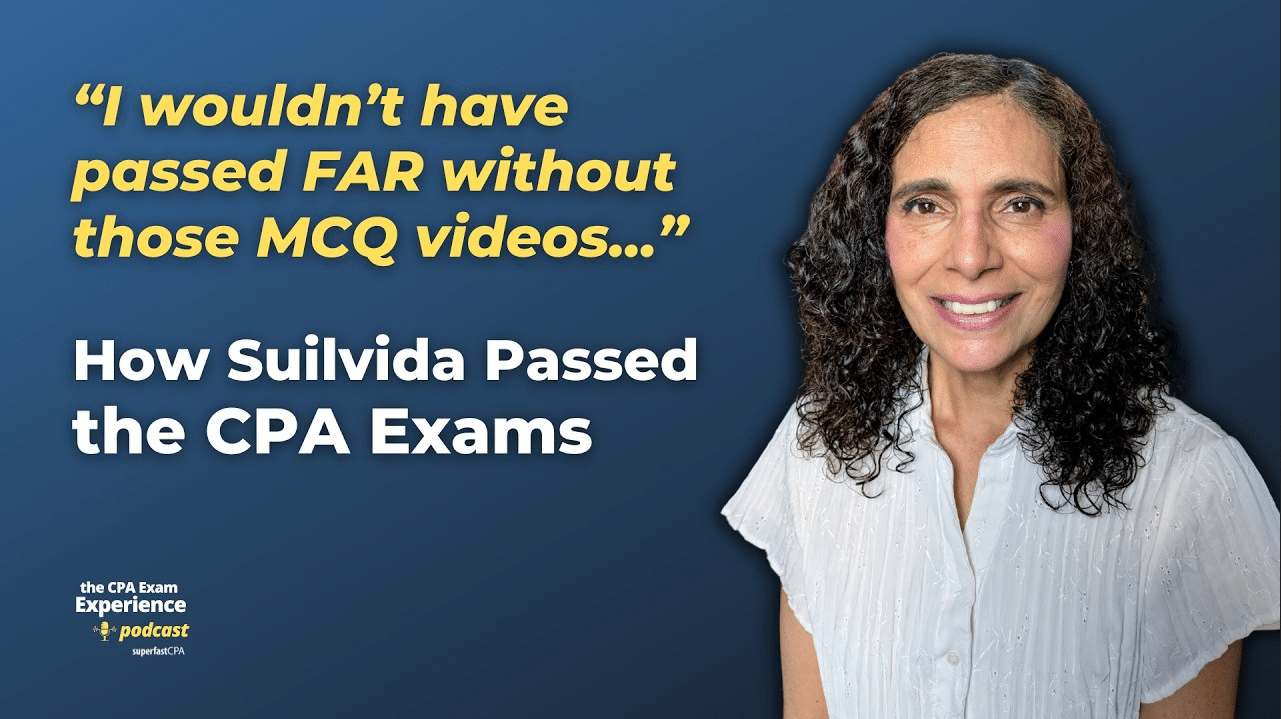
In this episode of the CPA Exam Experience Podcast, you’ll hear how Suilvida was able to pass FAR with the help of the SuperfastCPA MCQ walkthrough videos. She believes that without those to help, she wouldn’t have passed FAR.
Suilvida had been graduated for 8 years, but had never really heard much about the CPA. She took her first exam and realized that there was a lot more to it than she thought. With the right study methods from SuperfastCPA she was able to start passing exams. This is a great episode for those wanting to hear more about the MCQ walkthrough videos from SuperfastCPA, and for anyone who’s first language is not English. For Suilvida, with Spanish being her first language, some parts of the exams were extra difficult, but, she gives some great tips and advice for how she overcame those difficulties! This is a fantastic episode, you don’t want to miss it!
IMPORTANT LINKS:
Master your study process by attending one of our free study training workshops:
https://www.superfastcpa.com/study-secrets/
Episode Timestamps
- 00:00 Suilvida Interview
- 04:12 Suilvida’s Background
- 04:51 Deciding to Pursue the CPA During COVID
- 05:56 Thought That It Would Be Easy to Start Pursuing the CPA
- 08:09 Didn’t Know What It Would Take to Get Started
- 09:32 Happy That She Got RogerCPA as Review Course
- 10:08 Realization of Studying Again After 8 Years, Everything Seems New
- 11:51 Followed the Traditional Way, the Blueprints Seem Confusing
- 13:17 Went to Take the Exam and Realized That She Wasn’t Prepared
- 14:58 A Mistake Which Cost Suilvida Time and Money
- 16:46 Finding SuperfastCPA and the Reason Why Suilvida Bought It
- 19:10 Bought a Section First But Ended Up Buying Everything
- 20:04 What Caught Her Attention to Buy SuperfastCPA
- 21:12 Study Strategies That Made Sense
- 22:59 Thought That She Was Studying the Smart Way But It Took A Lot of Time
- 23:41 Why Studying with the Questions First is Beneficial
- 24:55 Only Used the Lecture or Read the Book If Need More Context on a Topic
- 25:37 Studied in the Morning and Still Able to Do Other Activites
- 27:49 Learned A Lot from Podcasts On Using the SuperfastCPA Strategies
- 30:50 Passing BEC Was Proof that the SuperfastCPA Method Works
- 32:57 Being a Good Example for Her Family is What Kept Her Motivated to Finish
- 34:12 Her Family is Supporting Her Throughout Her Journey
- 35:37 Took Four Years to Complete Her CPA Journey
- 36:17 Found FAR the Most Difficult Section in the CPA Exams
- 37:30 The SuperfatCPA MCQ Walkthrough Videos is a Life Saver
- 41:25 A Realization, The Benefits Suilvida Got from SuperfastCPA
- 43:44 The Challenges of Having English as Second Language
- 47:59 Used AI to Help Learn Topics
- 48:54 Suilvida’s Review Process with the Flashcards
- 50:39 Found the Test Exams from AICPA to be Helpful
- 51:45 Always Spend Time with Your Loved One
- 52:30 Always Goes Back to the PRO Course as a Refresher
- 54:24 Top Tips for People Still Going Through the CPA Exams
Interview Transcript
Suilvida: [00:00:00] When I am going to questions, in the moment when I read, my brain goes to its focus on finding something. While if I am reading without a question, then it’s blah, blah, blah, blah, blah, blah, blah, blah.
My brain receives a lot of information, and there is nothing that helps my brain to retain or to focus on something or go deep, which is important also. Go deep in something.
So the, the way to really understand, now I see, I didn’t see it at that moment. The way to really learn is going with questions because that help you not only to find the answer, but then that will create other questions that can help you to understand more of the topic, and that will help you further down the road.
Logan: Welcome to another episode of the CPA Exam Experience podcast from SuperfastCPA. I’m Logan, and in today’s video, you’re going to hear me talking with Suilvida.
Now she is somebody [00:01:00] who I saw frequently in the forum, you know, posting questions or posting her successes, and so I kind of already had spoken to her a few times over our chats in the forum. But it was really exciting to be able to get to talk to her over this video and really get to know her story and her process.
She is from Venezuela and she had a fairly typical experience that I think a lot of people have when they’re starting the CPA exams, where she didn’t really know what to expect. She kind of went in blind thinking that it would just be like school. You know, she had passed, she had gone through college, and she’s like, “I know how to do this.”
And so she didn’t really know anything about the CPA exam until she went in and took her first exam. And she had an eye-opening experience, And she learned that there was a lot more to the CPA exam than she had thought. And she has a really cool story of how she was able to work through it, [00:02:00] of how she found SuperfastCPA and ultimately decided to start using SuperfastCPA.
She gives some great tips about studying for the CPA exam when English is not your first language, which I know there are quite a few CPA exam candidates where that is the case, where, you know, maybe their first language is Spanish or Mandarin or something else. So listen to Suelida’s tips and advice because I think she has a lot of great things to share in this episode.
I’m excited for us to get into it, so let’s quickly go over, you know, the typical things I go over before we start an episode, which is a reminder that we have a SuperfastCPA training webinar on superfastcpa.com.
It is a free one-hour webinar where we will teach you the key ingredients to passing the CPA exam so you don’t waste months or even years of your time failing exams. And after you watch that, you’re going to want to learn more, so make sure you also check out becoming a member of SuperfastCPA by either buying the PRO course, where we explain super in depth how to pass the [00:03:00] CPA exams, basically a much more in-depth version of the one-hour webinar, or the study materials that we have, which are our supplemental study materials like our audio notes, review notes, and mini quizzes.
Or best, you could get the total bundle, which includes all of those things. So make sure you check that all out after you watch the one-hour webinar. Now, with all that out of the way, let’s get into the episode with Suilvida.
Logan: Good morning, Suilvida How are you doing today?
Suilvida: Fine, thank you. Good morning.
Logan: And where are you calling in from today?
Suilvida: I’m calling from Denver, Colorado.
Logan: Okay. Okay, awesome. And are you g- just curious, are you guys, uh, so in Utah we’re having a lot of fires. Are you guys having anything close to Denver?
Suilvida: We are not having fires, but the heat is– It’s gonna be like 95 this week, so it’s really hot.
Logan: Yeah. That’s kind, that’s kind of what’s happening here too. Well, um, I’m excited to be talking to you today.
I remember seeing a lot of your posts in the forum and kind of just, I kind of saw [00:04:00] your journey a little bit just mainly throughout the forum, and then you did occasionally send me questions. So I’m excited to get to talk to you today. So let’s just kind of get started from kind of the beginning.
Suilvida’s Background
Logan: Where were you at your life or your career when you wanted to… when you decided you wanted to get the CPA?
Suilvida: I was working. I had finished, uh, eight years ago. It has been six– eight years since I have finished my master’s in accounting. I have a bachelor’s degree in accou- in economics and a master in accounting, and I was working.
Logan: Yeah. And were you working in public accounting or what, what kind of job were you doing?
Suilvida: I was working in an investment company, in a private company, and I was mostly working in the accounts payable area.
Logan: Okay.
Deciding to Pursue the CPA During COVID
Logan: And so you’d been working for a while, you had gotten your master’s degree, and what made you decide that you wanted to [00:05:00] get the CPA? Had it been something you’d always wanted to get, or was there a point in your career where you were like, “Okay, I need this”?
Suilvida: Um, I think that education is the door to opportunities. And at that moment, it was, uh, I mean, COVID was starting, and I thought that that would be a good time for me to, to go into a CPA.
Logan: Okay. So during CO– so did you start studying during COVID? Is that what you’re saying?
Suilvida: I made the decision, yes, and I register.
Logan: Okay.
Suilvida: I tried to study while I was working, but I couldn’t do it. It was not work– it was not working for me, and because I have other obligations also. So then I decided to quit my job and work on the CPA. I had the hope that I will finish like in nine months. So I was telling everybody in my emails, “I hope in December I will have my CPA,” you know? How naive. Yeah.
Thought That It Would Be Easy to Start Pursuing the CPA
Logan: So, so you were [00:06:00] trying to study and work, but it just wasn’t working. And at that point, I’m just curious, what was, what was it a– what was it that wasn’t working? Were you trying to study in the evenings or did you just have too much going on? Like, what made it difficult?
Suilvida: Um I– between the time of going to work and working and exercising and then, uh, working again and then coming home and prepare food and all those things, really any, any attempt to study was not fruitful. And besides that, um, I knew about the CPA in this country. Where I am, it is called different, but I never– that didn’t cross my mind. To begin with, in Venezuela, which is where I am from, I, I was studying economics, and I never thought that I will study accounting.
So when I came here, I changed. I mean, no, I didn’t change. I added accounting to my education. So then the CPA show up, but I [00:07:00] didn’t have an idea how it was. I thought that was something as I’m telling you that in nine months I will be done. Uh, well, for me, that was a, a, a a time that I was willing to, to, to take, but I didn’t have an idea of what it, it involve, how was the proc- the, the, the procedure, how to register.
At the point that when I, when I paid to register and they accepted my money, I thought that accepting the money meant you are accepting the program. I didn’t know that I have to have requirements to go into the CPA.
Because eight years before when I was at school, I remember that they said, “Well, we are gonna have this extra audit, uh, class related to government so you can be ready for the CPA.” Maybe that was the first time that I, I heard CPA.
So I thought, Oh, I’m going to have this class because who knows, maybe I will do a CPA.” But I didn’t know what that meant really. So when eight years later, when I decided to, to register, I thought, [00:08:00] “I am ready.” And that’s what I said at work, “Yeah, I’m ready.” School told me I was ready, and that was not true. I had to, uh, fulfill some requirements, extra requirements.
Didn’t Know What It Would Take to Get Started
Logan: So, um, you had signed up for it and did you have to… did– were there any other, like, class requirements that you had to do, or was it more like work experience? What did you have to do to be able to qualify?
Suilvida: I had to take, uh, an extra class. And also, as I said, this was a lack of, maybe lack of coaching or, I don’t know, just was me not, not thinking that was so, so complex. So yeah, so complex. Uh, I read the material that I, the instructions about how to do it, and because I am coming from Venezuela, I thought, “I am an international student.”
That was the first thing that crossed my mind. So I applied as an international student, and that takes … It took like six months for me, for They asking me to [00:09:00] translate the, the, the, the grades, etcetera. And suddenly something hit me. I thought, ” But I, I, I made an eq- equivalence when I came here.” So the university took all my grades. I am not an international student anymore.
Well, it’s the price of not knowing, right?
Logan: Right. So, so you, I mean, you really didn’t know how you were supposed to do it. And once you changed that, um.
Suilvida: And I took the requirements then the, the next class then is when s- when I started to
Logan: Okay.
Happy That She Got RogerCPA as Review Course
Logan: And did you… What did you start with? Did you start with, like, a review course like Becker or something like that?
Suilvida: Oh, I– Yes, I took– I bought Roger RogerCPA review, which I loved. I was so happy I took that, yeah.
He has a, a– He teaches with his ex- his experience, so I could relate and it was entertaining It was like talking to someone. Many times I called my husband, “You have to hear this, Michael.” So it was just, [00:10:00] yeah, it was enjoyable.
Mm-hmm.
Logan: Okay. And is Roger now part of UWorld? Is that… Okay. Okay.
Realization of Studying Again After 8 Years, Everything Seems New
Logan: Um, so you’d been trying that, you’d been trying Roger and working and all your other, other obligations. You decided to eventually quit. So when did you take your first exam and how did that go?
Suilvida: Um, I took my first exam on January 2022. And again, I, I got the, this, the, the RogerCPA Review and he explains things very well, I’m sure. But well, you don’t get everything at the same time, right?
So then I, I, understood that, you know, when they say, ” In this test you have, we, we suggest that you take this quantity of minutes for this section and this quantity of minutes for this section because you need to distribute the, the time,” I thought it meant I only have this minutes for this section, and I [00:11:00] only have this minutes for this section. That’s what I understood.
So when, when, when I went to the first test, I- and of course, I still, at that time, I thought I could do it working and, and I was still in that, in that mood that I could, uh, study and working.
Or maybe I have quit already, but, what I ha- okay, yes, I remember now. I have eight years that I went out of school. So even though I was in accounting and I had been in accounting before, those 200 topics that are in accounting, many of them are knowing– I mean, a job is normally a few topics.
You don’t see leases and then you see a tax section. I mean, altogether it’s, it’s hard that you see all those things. So, uh, for me it was like, this is new. I, I know I, I saw this eight years ago, but this is new for me now.
Followed the Traditional Way, the Blueprints Seem Confusing
Suilvida: So I, and I started to– the only way, the only way that I knew how to study was doing the lecture first and then answer the questions. [00:12:00] So that’s what I was doing. And while I was trying to cover all 200 topics and doing those questions and not remembering because it was something that I saw eight years ago, the result of this was that I was doing, like, two questions a day.
But, but for me, well- I, I, I didn’t know the consequences of making so m- so few questions. I thought, “Well, I am progressing because at, at least I can do this,” right? Because also the blueprint, the way that it’s wr- written, the blueprint implies that you know what they are talking about.
So they tell you, this section is about this and this and this. And, but for me it was like, okay, so what, what’s hap- what’s really this about? So I couldn’t differentiate well the topics because you see inventory in the area of assets, and you see inventory in the area of cost, uh, cost accounting. So you see inventory suppose in three parts, and then, uh, in, in, [00:13:00] in other area.
So it was difficult for me to identify, uh, where, where the, the structure of the blueprint. It was a, it was a new idea for me. I had not seen a blueprint before also. And, um And of course, well, yeah, that basically.
Went to Take the Exam and Realized That She Wasn’t Prepared
Suilvida: So then I doing two questions at the beginning, and of course then I w- I started to progress, right? Uh, I didn’t know that I was too slow. I, I, I was not measuring me. I didn’t have a way to measure me. I went to take my first test, and when I went there I froze in the first screen. Uh, I have not taken many TBS at home either. So I just thought, well, I have been all this time studying, I should be well to go to this test.
And if I don’t know, well, I have to go because I already paid for that, right?
So I went. And when I went– when I was frozen, frozen like for seven minutes, and then I, you [00:14:00] know, came to myself, I thought, “Oh, I had only,” I don’t remember supposed, “25 minutes for this section.”
So I lost seven minutes or 10 minutes. I didn’t know exactly how many. So I started to clicking without even reading the question. So just to go to catch up with what I thought was the time where I needed to be in to continue the exam. And that’s what I did. And I finished my test.
I, I, I knew at that moment I wasn’t prepared for this, but I took it as an experience to see how this is really.
That was what I– how I took it. So I was grateful that I had that opportunity and went, went home and, and waited for the grade, and of course, I failed it. But then I registered it immediately again.
Logan: Okay
Suilvida: And I didn’t have Superfast yet, so I continued, did the same, but I was better now. Of course, I was better, but better doesn’t mean enough, so I failed it again.
A Mistake Which Cost Suilvida Time and Money
Suilvida: And then I did [00:15:00] another mistake, which was, um, I heard someone saying that they had… and it was not a mistake for that person, but I think I learned that we, we cannot compare with others because, well, because we are different.
We have different skills, different weaknesses, etc. Someone said that she put all her, her, her exams one after the other, and then went and pass and pass and pass and pass.
But she scheduled all of them together. And then I tried to do the same, or at least I, I, I scheduled two or three, I don’t remember. And when I went to have to take my second FAR test and I failed, now I think the smart thing would have been to continue to study and then take it again because I have all this accumulation that is kind of fresh in my mind, right, of knowledge.
But then now I had to change to the, to the next test. And the next test, all in a small period, I failed, but I couldn’t retake it because I had [00:16:00] already, as I said, two or three online in line.
Logan: Mm-hmm.
Suilvida: So that was a lesson for me that took– cost me time, but again, I learned that I had, I particularly, I had to focus one at a time. And then about that time was when I, when I, uh, bought SuperfastCPA.
Logan: Okay. And we’ll, we’ll get into that in just a second. So just to make sure I’m understanding you there, so were you studying for multiple exams at the same time, like studying for FAR and for Audit and REG, or are you saying you took FAR and then quickly studied for the next one and took it, and then quickly studied
Suilvida: Exactly. That second option is how it was. But it– that, that quick study was not enough time for me.
Logan: Right. Okay. That makes sense.
Finding SuperfastCPA and the Reason Why Suilvida Bought It
Logan: So, you know, you’d been struggling up to this point, you know, you had… I mean, it sounds like, I, yeah, like you said, if only you had had somebody who could have, like, mentored you a little bit earlier on, cause it sounds like you [00:17:00] just really didn’t know what to expect.
So, that must have been so stressful on that first one where you were like, “Oh no, I only have a certain amount of time, so I’m clicking through everything,” and oh man, that must have been, that must have been rough.
So you’ve had all these different experiences, failed all these exams, and how did you find or run into SuperfastCPA?
Suilvida: Um, I don’t know how. I, I think it, it came on a, on an advertisement
Logan: Probably.
Suilvida: I, and I read the– and I heard that, uh, I heard Nate giving like a, uh, like a little short advertisement and then he referred to that one-hour free seminar.
Logan: Right.
Suilvida: When I heard the one-hour free seminar, that made sense to me. Um, but, but I thought we have spent so much money on this already.
Logan: Mm-hmm.
Suilvida: And was not working, so I was not adding to, to, to the income for this or for other things. [00:18:00] So I just thought, I just have to push through. I– we can– I, I cannot, uh, do this. I cannot ask my husband to, to… I mean, I could, but I just felt like if other people can do it without this, we can do it. Yes, what I thought. Mm-hmm.
But then, um, one day I was reading my scriptures. I always read my sc- uh, we are very religious in my house, yeah. So I was reading my scriptures in the morning and as I said, I was not looking for, uh, any other element. I mean, another… I didn’t even call it strategy course or maybe I call it but I thought that was a luxury, sp- to pay for, for a course about strategy. So I, I was not thinking about that. I was out of my mind and while I was reading my scriptures, I heard a voice in my mind, ” You need to get SuperfastCPA.” And my experience is that that’s how God talks to me. Uh, I have, I have gone through this kind of ex- uh, experiences before so I thought… I [00:19:00] didn’t even think two times.
Maybe because I wanted in this. In the deep of my heart, I want. So when he confirms to me, I went immediately and, and I bought it. Yes.
Bought a Section First But Ended Up Buying Everything
Logan: And did you get the, uh, the f- like the total bundle, the PRO course and the extra study notes, or was it just the PRO course or just the study materials?
Suilvida: At the beginning, I, I– at that moment, I was thinking that I think I had the hope that I had passed at least one, at least one, and, and I think I, I only bought like the individual, uh, I think there was a chance to not buy the whole bundle.
So I bought less than those. And then I, I knew I didn’t pass, and then I wrote an email to Nate telling him I, I thought I had passed, but I didn’t.
Can I– And I can see that you have a, a special price for buying the whole thing. I don’t even– I don’t remember exactly how it was, but I think I know he told me, “You can get everything for this [00:20:00] price,” and it was very good. So I just get it.
Logan: Awesome.
What Caught Her Attention to Buy SuperfastCPA
Logan: Okay, so, you know, you had listened to the webinar and you’d had all this struggle period before.
So what was it about the webinar and then about, you know, the PRO course that really stuck out to you? What made a difference?
Suilvida: Hmm. I don’t remember at this time what was– what called my attention. Uh, it may have been– it, it could have been the fact that, that is a, like a space repetition, uh, sa- strategy. I think that was what, uh, probably called my attention.
And maybe the part about starting with questions could have been, but I am not sure really at this moment what was– what caught my attention the most.
Logan: And that’s okay. So, uh-huh.
Suilvida: I also know that after that I started to listen to podcasts
Logan: Mm-hmm
Suilvida: From– because they– those come even if in the– those come in the internet even if you don’t– you haven’t bought [00:21:00] anything. And listen to those– listening to those experiences was inviting.
Um, so, so all those things were like making me think, “This must be good. This must be good.”
Mm-hmm.
Study Strategies That Made Sense
Logan: So listening to the podcast and the webinar and kind of just getting into it, and what did you change once you got SuperfastCPA? Like, what did your studying look like before? I mean, we know that you were doing the lectures and doing like a couple questions and things like that. Uh, what did that change to?
Suilvida: Uh, to begin with, the, the notes gave me a context because I always need a context. Reading the notes gave me an idea of what this topic is about, and then having the context much summarized than if I go to read it in a book or to read a lecture, it was really condensed, the, the, the context that Nate, uh, put in the, in those notes.
Um, I could go to the questions and [00:22:00] f- and, and do what you said, see the questions. So I di- I, I didn’t take too much time trying to discover. I just, I don’t know, then I went to see the answer. And then also when you see the answer, there is again the context and the explanation.
So in reality, it’s smart to do that because even your review course, your review course puts the summary of the topic, what’s important about the topic in that answer.
So after, after I went to the, to the question, and as you said, may- uh, there were supposed, if there were 30 questions, maybe only 12 questions were topics. The rest were repetition of the same, of the same topic.
So if I do that every time I read that, I was like reviewing the, the, the, the, the topic again, and re- even though it was a different question, I was reviewing the same topic, reviewing the same topic. So it was a, a, a, a, an strategy that naturally took me to repetition.
Logan: Right.
Thought That She Was Studying the Smart Way But It Took A Lot of Time
Logan: Yeah, [00:23:00] and, and that was something that you had, that you’d probably struggled with before because you were just watching the lectures, doing the question, and just kind of slowly moving through the material without seeing it over again. Is that right?
Suilvida: I thought I was very smart because I wanted to see it, I, I mean, I wanted to understand it. So it was not that I was just re- seeing the lecture. I rewind the lecture
Logan: Uh
Suilvida: Whenever I didn’t understand it because I wanted to understand. I am a, a person that learns knowing the whys. So I, for me, it was important, okay, what did he say?
And then go back and try to understand it and what, what was that? And I rewind. So it took me really a lot of time, yes.
Logan: Right. Okay.
Why Studying with the Questions First is Beneficial
Logan: So, but replace that with, you know, even if it’s kind of a similar idea where you’re like trying to figure out the why, now you’re doing it in the same way that you’re going to be doing it on test day. You’re doing it in questions, which is much more useful because you’re [00:24:00] figuring it out in the same exact way you’re going to be doing it.
Suilvida: And because– and also because– uh, when, when I am going to questions, in the moment when I read, my, my brain goes to, to s- to its focus on finding something. While if I am reading without a question, then it’s like blah, blah, blah, blah, blah, blah, blah, blah.
My brain receives a lot of information, and there is nothing that helps my brain to retain or to focus on something or go deep, which is important also. Go deep in something.
So the, the way to really understand, um, now, now I see. I didn’t see it at that moment. The way to, to really learn is going with questions because that help you not only to find the answer, but then that will create other questions that can help you to understand more of the topic, and that will help you further down the road, so.
Logan: Right. Exactly.
Only Used the Lecture or Read the Book If Need More Context on a Topic
Logan: So big change was going to the questions. Uh, did you still ever [00:25:00] watch the lectures or did you kind of stop with the lectures?
Suilvida: I went to the– well, I, I did different with each exam really.
There were exams where I went to, for example, with, uh, regulation. That was a totally new topic for me in this country, so I, I needed a little more, uh, context. So I supplemented also with a couple of chapters from one book from the, the, from school.
But, yeah, mostly I went to the lectures only when, when I feel that still there was something that I, I was not understanding, I went
Logan: Right. That makes sense.
Studied in the Morning and Still Able to Do Other Activites
Logan: So you, again, you had, you had started studying with the questions. Um, when did you study in the day? Did you study in the mornings or when did that work for you?
Suilvida: in the mornings
Logan: Okay, cool. And that probably was good because, I mean, that made it so that was out of the way and then you could still, uh, you know, take care of your other [00:26:00] obligations.
Uh, do you and your husband have, have kids?
Suilvida: We don’t have kids, but we, uh, have a big family and we are very involved with family.
Logan: Inv- yeah, so you were, so you had lots of stuff to do every day, and you were also probably still able to exercise, I’m assuming, because, and that sounds like that was really important to you.
Um, was that something you were able to kind of maintain throughout the process, like still being able to exercise and take care of yourself like that?
Suilvida: Yes, because, uh, the, the, the components of the Superfast package allowed me for that. For example, uh, in other, in other case, if I had not know it, if I have not, uh, had it, I would ha- going f- to exercise outside, I would have felt, uh, guilty because, well, yeah, I need to exercise, but I am not studying. I have the test this day. But in this way, I could go and I was running or walking or doing an- whatever I chose to, and I have, uh, either the notes or even [00:27:00] mini quizzes, so I could do it.
Logan: Yeah, that’s, uh, yeah, I, I, I felt the same way where if I wasn’t doing something, I kind of felt guilty. So having the ability with the SuperfastCPA app to, you know, listen to the audio notes, take mini quizzes, read review notes at any point in the day when I had a little break, uh, just makes you feel more productive and you are learning.
Like, even if it’s maybe not as deep as the review course, it’s still a good review or still a good reminder and things like that.
Suilvida: For me it was very good. I mean, it was, sometimes it was better because I was out, no, no one asking me anything, and it was enjoyable. I
Logan: Right. Nobody demanding your, nobody else demanding your time. It’s just, just
Suilvida: Yes.
Logan: Nice.
Learned A Lot from Podcasts On Using the SuperfastCPA Strategies
Logan: So, um, you, we’ll talk a little bit more about some of the other parts of your process, but I am curious, when you went and took your next exam after kind [00:28:00] of starting with SuperfastCPA, um, what was the difference? Did you, did you pass or at least improve?
Suilvida: Well, when I get the SuperfastCPA, I only have like two weeks or I mean, I have a short term for the next exam.
Logan: Cause you already had it scheduled?
Suilvida: Yes. So I, I failed that one. But, um, but then came… I, I had to also take BEC at that time, Business Economics Concepts.
Logan: Oh, oh, BEC I see. Mm-hmm.
Suilvida: Yes. Um, there was where I, I started really to apply the, the SuperfastCPA. I remember because I also heard this, this example from someone in the podcast and I thought that was very good. I took the notes from Nate and I summarized them.
Logan: Mm-hmm.
Suilvida: I summarized the, so the na- the, the notes, I summarized them and that was kind of my review material. And yes, I went to the questions and I, I, I didn’t do like, I hear [00:29:00] some people do 100 questions, 50 question, no. I mean, my, like my magic number was like 25 where I could do 25 questions and then review them and then I, I mark the, the, the questions that were important that I wanted to go back to them.
So I even re-review, uh, and this is a, this is a, a strategy that I used in most of the exams. There were some exams, mini quizzes, multiple choice questions I mean, so not the ones from your appli- from your application, but from the, the co- review course. I mark, I flag the ones that were very good and then I went back to them later on after I have done other exams. I went back to them because those were concepts that I wanted to keep in my mind, were good problems.
Um, okay, so I did that with BEC. I, I practiced a lot. In another podcast I heard, I think it was in a podcast [00:30:00] that, that, for the composition part, the one where you have to write, uh, it was good that you knew what the keywords were for that topic and then make sure you put those in the paragraph. So then I practiced that here. So I’m telling you that the podcasts were very helpful. The podcast of the other interviewees was very good for me. I took several ideas from there.
And, uh, I practiced also that way and also I used the, the mini quizzes and, uh, what? Yeah. I, I didn’t pass that first BEC test, but I, I felt that maybe it was like my time to learn how to use your product and I felt that it was, uh, less stressful.
Like I felt that I was accomplishing, you know, that I could measure myself more.
Logan: Right. That’s awesome.
Passing BEC Was Proof that the SuperfastCPA Method Works
Logan: So you, you know, you only had like two weeks when you first started using SuperfastCPA to go and try for BEC, didn’t pass that one. [00:31:00] Um, did you end up having BEC be one of the ones that you passed or did you have to do one of the discipline exams?
Suilvida: Well, let me, let me correct what you, what I probably transmit to you. The, the two weeks or so that I have when I got the SuperfastCPA was the first audit exam, so which I failed. I took there– then I took the, the BEC exam. I failed it, but then, uh I passed it, I, I passed the, the, the BEC, yes.
Um, but not immediately. But just having used the SuperfastCPA in the BEC gave me… the next time when I pass it, when I study it, I pass it.
Which is, uh, which is very good for me because some of the exams I do, I have to take more than two times. Well, all of the exams I have to take more than two times. So having passed BEC, uh, faster was a proof for me that the, that the program was, uh, functioning.
Logan: Right. Right. So, so it was [00:32:00] audit and then you tried BEC, but you feel like that first BEC attempt was kind of like your learning experience, like applying the material, I mean applying the SuperfastCPA, and then you passed BEC the next time. So, I mean, the fact that you passed BEC means that you passed it in 2023, if I’m not wrong, um, or it could’ve been 2022. Um, and did you?
Suilvida: I passed tw– BEC in 2023 and I took that exam three times. I passed it with 83, yes.
Logan: Awesome. And did that, uh, I mean, I know that they extended the, you know, the timeframe. Were you able to have BEC stay as one of your passed exams, or did it eventually, um, did it eventually come like, um, what’s the word? Expire.
Suilvida: I lost that yes Okay. So I had to take the information system and controls discipline.
Logan: I- ISC, okay. Okay.
Being a Good Example for Her Family is What Kept Her Motivated to Finish
Logan: So I guess, yeah, like [00:33:00] throughout your journey, cause, um, it was a multiple year journey, you, and you recently posted that you passed, right? So it’s a fairly recent thing that you finished. So throughout the process, how did you keep going? How did you keep yourself motivated, you know, even if you failed an exam, even if this happened or that happened?
How did you keep going?
Suilvida: Because, uh, my, my initial reasoning continued to be true. So still having a CPA education open opportunities, is a door for opportunities, and it was very important for me because that will help me to help more of my family. I have a, as I said, I have a big family and there is a lot of young people there.
And, uh, we have a lot of examples about the importance of education in my family, and for me it was a tradition to also cooperate with that example,
Logan: Mm-hmm.
Suilvida: For the young, the younger people to know that, well, we, [00:34:00] we keep learning and, and progressing, but we keep learning. So that it is the way.
Logan: And so a big part, so a big part of it was that continuing education, that example of continuing to do that.
Her Family is Supporting Her Throughout Her Journey
Logan: Um, and along the way, what did your family think? You know, were they like getting bored of you doing it, or were they really supportive? How did that all go?
Suilvida: Uh, my husband was my, my cheerleader really. Uh, the first time that I thought like, “Wow, this is, this is really hard. Uh, we’re spending all this money,” you know? And then he, he took– he also is a, a lover of education, so he also, uh, he really practices and, and believe on that. He brought me to the internet and he looked for the history of the CPA and he said, “Look, this exam has more than 100 years in the, in the market. This is a serious exam. It’s important.”
And I felt that, well, if [00:35:00] he’s willing to, to keep, uh, holding this with me, I want to do it, so. And the rest of my family, well, they call me, “How did it go?” You know? Uh, my mom, everybody was, uh trying to see the way that they could support me.
And sometimes m- the ways they support me to was not, “Don’t ask me about it.” And I even told them that. And then they, they also, I mean, they also comply the most that they could with that because sometimes I just didn’t want to say I failed again.
Um, but, what? It’s done? I mean, I finished the test.
Logan: Yeah.
Suilvida: Mm-hmm.
Logan: Yeah.
Took Four Years to Complete Her CPA Journey
Logan: And I mean, how does that… I mean, so you started, do you know when you officially started studying for the CPA exam? Like how, how many years of a journey was it total?
Suilvida: It was, uh, four years of– since I took my first test.
Logan: Four years.
Suilvida: Until
Logan: Okay
Suilvida: My last test I took in April of this year, April 30th, and I knew I had passed [00:36:00] on June, June 23rd I knew I had passed or so.
Logan: About a four-year journey and I mean, a lot of, a big learning experience going from basically knowing nothing about the CPA exam to, I mean, figuring it out and passing each exam.
Found FAR the Most Difficult Section in the CPA Exams
Logan: Uh, you said that… well, which, do you remember which one gave you the most trouble? Which exam gave you the most trouble?
Suilvida: Yes. The, the hardest test for me was FAR, Financial Accounting Reporting. It started to be, being 200 topics, and at the end they– when they created the new disciplines, they took some topics and they redistributed, but still, I mean, 195 suppose or 190 topics. I don’t know how many.
Logan: Still a ton.
Suilvida: But it was just… so I always felt that even though I had a plan, and that was very important for me to– I always put, like, every topic of all the tests in Excel spreadsheet, and I had a plan when I was gonna do it, by when I will have [00:37:00] covered this, these topics, when I will start reviewing.
Really, organization and planification was key because otherwise it’s, um, overwhelming and it is discouraging. Without organization and planification, it’s discouraging and overwhelming.
So even though I did that, it was never enough time to either cover all the, all the topics of FAR or reviewing all the topics of FAR or feeling confident with all of top- the topics of FAR.
The SuperfatCPA MCQ Walkthrough Videos is a Life Saver
Suilvida: So the way that, uh, that, um, I resolved that was, that was the time when you started, uh, uh, writing those, uh, special, uh, videos about, about each of the disciplines. They are videos, uh, with the, with the problems, and they were small problems. They directly responded to all what was evaluated according to the blueprint.
And even it has– not only was the problems [00:38:00] attached to, to the, to the question from the blueprint, but was also at the end a summary call, uh, called, uh, pillar topics, which was kind of like a summary or even it could be a context, a context if I want it before the test. So for me, I have, like, everything there. It was like a multi-sandwich. All I have there. And of course, helped with the fact that I had already been taking other exams. I had an idea of I have to study a lot and I cannot think, “Oh, this topic is not going to show up.” No, I couldn’t take any of those risks. So I feel that with, with that part of your– that you added to the SuperfastCPA program, that, uh, that was my solution.
It was like my life sa- uh, it, it, it saved my life on that.
Logan: Salva Vida.
Suilvida: Mm-hmm.
Logan: Um, so that, I mean, that– I love hearing that. I mean, that’s been like my project for like… I’m [00:39:00] still working on those videos. Um, I’m on– working on BAR right now, and I’m very happy to hear that they were, that they were helpful. Um.
Suilvida: I don’t think I would be ha- I would have ha- uh, passed FAR if it has not been for those. That was the only way that I could in a, in a reasonable time. And reasonable time, I mean, even if I have, uh, more months trying to do it on the other ways I was doing it, I was not going to do it because for much repetition, there are so many topics that I just couldn’t, uh, maintain. So, but those were short, to the point, clear. If I have a question, you responded or the team that works with you behind.
Logan: Mm-hmm.
Suilvida: It was really, it was really like a personal coaching. That’s how I felt. It was wonderful, really. Thank you.
Logan: Oh, thank you. Uh, yeah, I mean, that’s, that’s the hope with those videos is that they can be that extra support when people need them. And, uh, I guess just for the [00:40:00] people who are listening, she’s ta- we’re talking about the, we have something that is still currently in beta cause I’m still working on it.
Uh, it, we have multiple choice question walkthrough videos that I’ve been going blueprint task by blueprint task in each of the exams and making a multiple choice question walkthrough video to teach that topic.
Uh, so that’s what we’ve been talking about, just in case anybody is wondering that. Um,
Suilvida: But it is mu- it’s much more– I mean, even though it’s short, it’s not just like a multiple choice question of the, like the ones that chose in the program review.
It is more like a, like a mix between a multiple choice question in the sense to make you feel that’s not overwhelming, but kind of like a TBS in the content of what you are trying to cover there. That’s how I felt it. Like, that helped me also to do my, my, my TBS because I, I felt like I have pieces. Though I felt that many times, like this is like a piece of a [00:41:00] T- of a TBS really. a a task-based simulation. So yes,
Logan: Yes, there were definitely, there have definitely been many times where I’ve kind of had to break it up like, kind of like that. Yeah, like this is almost like one piece of a larger problem, but we’re just gonna learn it one piece at a time.
Um, that, I mean, I’m just, yeah, that, I’m a, I’m very happy to hear that those were so helpful. Thank, thank you for t- saying that.
A Realization, The Benefits Suilvida Got from SuperfastCPA
Logan: Um, and so I guess kind of along those lines, so, you know, throughout this journey, throughout your process, we talked about the multiple choice question walkthrough videos. What, I guess, what would you say were the benefits that you got from SuperfastCPA that, you know, eventually led to you passing?
Suilvida: I feel that what SuperfastCPA did with me was teach me a new way to learn. Because I, as I said, I, I, I love learning, but I… there is a [00:42:00] moment, and this was the moment for me, when knowledge is not enough. You need strategy, and strategy is not a luxury, at least on this, it’s not a luxury.
And learning using questions at the beginning is my new way to learn, not only in, in for the CPA test, but I apply it in many other things. And I do it intentionally, intentionally now.
Maybe in the past sometimes I learn using questions, yes. But now I, I have it as a, as a clear, a clear way to, to, to learn faster and to learn better. It is with questions. And I have even tried to transmit this to other people, yeah.
Logan: Right. And, um, I
Suilvida: Which is a huge thing because this is gonna be for the rest of my life. I mean, when you– this is like when you teach someone to read, you are teaching them to read books the rest of their life. I feel that this teaching of how [00:43:00] to learn is no small thing. You are teaching people to learn the rest of what they have for life. That’s how I see it.
Logan: I mean, yeah, it is, it is such a useful skill to be able to approach things that way, to kind of go straight to the heart of it and kind of piece it together that way instead of, uh, instead of having no context.
I guess that’s like, that’s like a, one of the biggest pieces of the whole SuperfastCPA strategy is learning with context instead of not really knowing what you’re supposed to understand, and then you just read a whole bunch of information, see a whole bunch of information, and you have no idea what’s important. Um, so yeah, I think that that, I, I like what you’re saying there.
The Challenges of Having English as Second Language
Logan: So, you know, throughout this journey you… Can I, I have another question actually, and I ask this because there’s actually a lot of people, as you’ve probably seen in the forum or just in your journey, who, uh, English is their second language [00:44:00] or maybe even third or fourth.
Um, what challenges did that present to you? Uh, like for example, I have someone in the coaching program from, from Puerto Rico who, you know, English is his… I mean, they speak English and Spanish a lot there, but still English is harder for him.
Um, so what challenges did that present to you?
Suilvida: Um, the fact that the CPA CPA touches audit and accounting and the audit, well, on the, on the, uh, the disciplines that it’s touching now introduces you in, in, new worlds, let’s say.
Like, um, with, um, information and, and information systems and controls also was a whole new world. So when you go to a new world, there is a new vo- a new group of vocabulary. So then you may know English, but you don’t know the vocabulary that belongs to that.
For example, if you were going to do a study audit [00:45:00] and the, when, when we are studying, it’s like we are working in the sense that you pre- you receive situations from different kind of industries and, uh, companies that have different processes.
So then every time I have a, a, um, especially with the, with the test-ba- sim- test, task-based simulations, every time I went to one of those, reading the story of the company made me find words that I didn’t know because I may not know about, um, I don’t know, the industry of plastic and then the words that they use.
But the CPA doesn’t, doesn’t pay attention to or doesn’t consider who is the reader. They just want to expose you to all kind of industry.
So what was my challenge? I had to find out what was those words were with the, with the, i, I Google, I translate it. I didn’t put the whole, the whole, the whole, um, problem there, but the words that I didn’t [00:46:00] know, I had to look.
Logan: If there was a specific word.
Suilvida: Yes.
Logan: You would try to look it up.
Suilvida: Right. And it, that’s extra time. Of course, it is extra time, but well, it is what it is.
Logan: But you have to understand, and that’s actually like, um, as I mentioned, there’s multiple people that I d- that I talk with, especially in the coaching program who, where English is not their first language.
And that’s something that I say all the time, like it is totally worth your time to, uh, make sure you actually understand what is being said.
Like for example, I’ll have a client that, uh, Mandarin or Cantonese is their first language, and so they, they’ll translate it into Chinese characters so that they actually know what’s, what’s going on cause they’re like, “I don’t really understand what, what’s going on.” And I think that’s great ’cause you have to know, you have to understand the context, otherwise you’re just kind of, things are just gonna go over your head.
Suilvida: And im-important, uh, words. Like it’s not, not the same if it says between or above or beyond or all [00:47:00] or except for or, uh, com- uh, including. So d- you need to know every word because a word can change the answer of the question. And that happens in the small
Logan: Especially in ISC and audit.
Suilvida: In the multiple choice questions that are short. You need to know every word of that short question because that can change the, the, the,
Logan: Yeah. That’s
Suilvida: Right response.
Logan: Super true, especially with ISC and audit, like I was saying. Like, those two exams are so conceptual and so focused on if you misunderstand one piece of it, you’re going to get the wrong answer.
Um, so yeah, I was just curious, you know, how that affected you. And, um, I know that we’re kind of coming up on, uh, you know, on, coming up on an hour, so we’ll, we won’t take too much longer.
But, um, you know, uh, to me it sounds like the biggest things were, you know, how to learn, learning from the questions and things like that.
Used AI to Help Learn Topics
Logan: Was there any [00:48:00] other part of your process that, you know, before this call you were thinking that you wanted to share and we haven’t gotten to talk about yet?
Suilvida: Yes. Let me, let me touch some things. Uh, well, first I want you to know that the fact that I work with SuperfastCPA in all the previous tests at the time of taking Information System and Controls, where there are less resources in every place, um, there I turn, uh, to AI and the– but even having AI, because AI does- doesn’t know everything, right?
But, um, asking the right questions also was, um… so I, like I could, I could, I feel like I, I could put in practice that ability of asking the right questions and, um, that helped me.
Suilvida’s Review Process with the Flashcards
Suilvida: Other thing that I want to say is about the flashcards. I had a flashcard, [00:49:00] flashcard overload starting the, the, the program until I, I decided, except for inter– uh, for ISC where I really wanted to study the, the flashcards that are already prepared because those were concepts very, uh, specific and needed.
I decided like maybe in half the way that I will start using more my decks, which is the questions that I– the, the flashcards that I do myself. And w- I think it was very good for me that I– when I was doing the multiple-choice questions and not only when I found something that I didn’t understand, not necessarily when I didn’t understand it because when I didn’t understand it, I could decide to take later another test about that same topic.
But when I found something that was really important that I wanted to make sure that even if I knew it this time, I will reme- re-remember the day of the test.
I did, I did flashcards where I even put, “And [00:50:00] this concept is in this multiple-choice question problem.” So I, I attached my, my cards to the problem where, where I have found that. That was very useful for me. And then towards the, towards the review time, I kind of deleted– I was, um consistently or throughout the time trying to delete flashcards and delete, delete, and then, uh, leave a, a few ones. Uh, that– I think that was important also because at the beginning, I did a lot of flashcards, and I didn’t have time to study them, so you–
It was not a waste of time because when I wrote it, that was a he- a helper for my brain, but I couldn’t really review there.
Found the Test Exams from AICPA to be Helpful
Suilvida: I wanted to say also that it’s important to do, um, those release exams from the AICPA because they, they show you the– even though the review course shows examples of TBS, I, I feel that the TBS of the exams are, um, like [00:51:00] you need to guess more.
That’s my impression. Sometimes I thought, ” How do you want me to think?” I wanted to tell to those test, to those, uh, task-based simulations because it was not clear to me exactly what they wanted. So my way to resolve that problem, I understood, was I need to see how they do their TBS.
Not only the TBS that we practice with the review course, but go to the AICPA released tests that the review course to, to be giving you and do all the TBS that were there. That was a big help for me. Um, let me see what other thing I think basically, I think basically that’s it. I, I cannot remember at this moment any other.
Logan: That’s okay.
Always Spend Time with Your Loved One
Logan: I mean, you’ve shared some fantastic things, and I think the thing that I, um, am very impressed with is your dedication. Like, it’s a long– it can be a really long journey, um, and it’s such [00:52:00] a trying journey. Like it– you have to be working hard the whole time. So you were working for, at this for four years, and that must have been exhausting sometimes.
Uh, how, how does it feel to be done? Have you guys done anything to celebrate or are you going to celebrate?
Suilvida: No, fortunately, um, we have like in, in, in my, in my marriage, we have a tradition of doing things once a week. So for me, that is,
Logan: You’re, you’re already, you’re already doing some dates and stuff like that. Yeah.
Always Goes Back to the PRO Course as a Refresher
Suilvida: But, um, the, I, I just thought of something else
Logan: Mm-hmm.
Suilvida: I, I, and I also heard the first time in one of your podcast about Jim Kwik, Kwik. Jim Kwik, he’s like a brain trainer, a coach trai- a brain coach, and he talks a lot about the importance of, um, exercising, letting your, the, the oxygen go to your body and how you eat and all those things. And I am very grateful that I took that, uh, [00:53:00] that I, that I started to hear those, those, uh, podcasts from him at the beginning. Then once I had it in my, in my life, I didn’t worry anymore about that.
For example, I bought a Re- Rebounder, and then, uh, that little, little speech that, that Nate makes in the appli- in the, in the application where he, he, puts in a note for the Superfast, how to pass fast, I think it says. Many times because I started to, to be lazy in one, one of the components of the course, I– while I was in my Rebounder, I heard that it’s like an English camp, camp book, uh, class. You learn more every day rather than just going t- for a weekend in the camp book.
Those– the– l- listening again to that how to pass faster was like a, again, like a call to, okay, are you forgetting any of these points?
Logan: Right.
Suilvida: And, uh, And, keeping in mind that it’s important to exercise really, [00:54:00] if not– and sleep enough and eat well. It’s a take care of your body and your mind and your spirit. Take care of you so you can, um, you can face that stress and overcome those challenges. Yeah.
Did you, did you ask me a question that I didn’t answer?
Logan: Oh, no, no.
That, that was basically just, uh, yeah, we were just kinda still wrapping up, like, anything that you had wanted to cover.
Top Tips for People Still Going Through the CPA Exams
Logan: And I think that as we wrap up, I mean, you probably covered a lot of this already just barely, but I always like to ask this as the last question anyway. What would be your top two or three tips to somebody who’s still going through the exams, even if it’s something we’ve already talked about?
Suilvida: Mm-hmm. Well, if you are knowing in– if you are not someone that has been in this culture of what the CPA is, understand well things at the beginning. That’s the first, uh, my first adva- uh, advice.
Then after that, I think that organizing them– [00:55:00] organization and planification is key. You need to, you need to know what you have in front, what’s, what’s your challenge. You need to give, uh, deadlines to what you want to do, even though you are knowing to probably do– accomplish those deadlines, but have it– having them organized where you can see them, then you can move them, and it is easier than, than not having a plan at all.
Um, also for your own, to feel that you are accomplishing. For your mental health, for your emotional health, it’s important to feel that you are progressing. So that measurement is important. Being ac-accountable with the time. At what time I start studying, I did it that way. At, at what time I finished, how was this week? That, that measurement was important for me.
Um, then what this course teaches, which is that consistency beats intensity. You, you are gonna do more doing it every day, every day, every day than only the weekends, trying to do everything on the weekends.
Logan: [00:56:00] Right.
Suilvida: That’s the way to do it. And I think those are my, my two things that for… Please do not, do not underestimate TBS.
I have heard a lot that the multi-cho- multiple choice questions will prepare you for the TBS. That’s true, but the TBS is a lot of multiple choice questions with the other part that, that they, as I said, they– you need to guess what they are wanting you to do.
So then you need to do a lot of TBS.
Yes.
Logan: Right. Yeah, it, that, that’s exactly right as far as the, the simulations is, you know, multiple choice questions will teach you most of the material. They’ll, you know, th- they’re super important, but you have to also know how to approach a sim. They just feel different, and if you look at it and you start panicking or you don’t know how to do it, then all of that knowledge that you have from the multiple choice questions isn’t as useful.
So yeah, practicing sims is super [00:57:00] important so you know how to actually do it, how to approach it, how to figure out what they want. Um, I love that.
And yeah, I mean, you’ve had a lot of fantastic tips. I mean, you– it sounds like you got a lot of help from the podcast, and I think that this will be another great podcast that will help other people, so I’m glad that you were able to be on today.
Suilvida: Thank you.
Logan: Yeah, uh, so thanks for being on the call today, Suilvida, and again, congrats on being done, and, uh, I hope that you can get your license pretty soon here.
Suilvida: Thank you very much. I really– I feel that you enrich, enriched my life. Thank you.
Logan: Thank you.
Logan: All right. That was the interview with Suilvida. I hope I’m saying that right. I used to speak Spanish years ago. I lived in Costa Rica for two years, but I’ve lost a lot of it, so hopefully I’m saying that right. But that was the episode, and I hope that you really enjoyed it. I thought that she had an awesome story about, you know, going into it pretty much completely blind at first, but learning a [00:58:00] lot, learning how the exams actually worked, and then persevering through and being able to pass all the exams, even with English not being her first language.
Again, I know there’s a lot of CPA exam candidates who have that struggle where English is not their first language. I can imagine that audit would be super difficult for somebody whose first language is not English, just because audit is already super difficult when English is your first language.
So I’m really happy that I was able to talk to Sulvida and really get some good tips and advice for other people who are listening to this podcast for how to work through the exams, especially again, when, you know, Spanish was her first language.
I hope that you liked this episode. I thought there were a lot of great tips, a lot of great stories. I personally really liked her story about when she was reading scriptures and felt like God spoke to her saying that she needed to go back and reconsider and buy SuperfastCPA, which ultimately did end up being [00:59:00] something that was very useful for her journey.
So again, thank you for watching or listening. I hope that you found this episode helpful. As a reminder, just like at the beginning of the episode, I want to remind you now about the SuperfastCPA training webinar on superfastcpa.com, where it is a free one-hour webinar where we teach you the key ingredients to passing the CPA exam.
So make sure you check that out. Make sure you check out buying the PRO course or buying the supplemental study materials that we have, or of course, getting the total bundle, which includes everything.
And with all that, that is the end of this episode. So thank you for watching or listening, and we will see you in the next one.