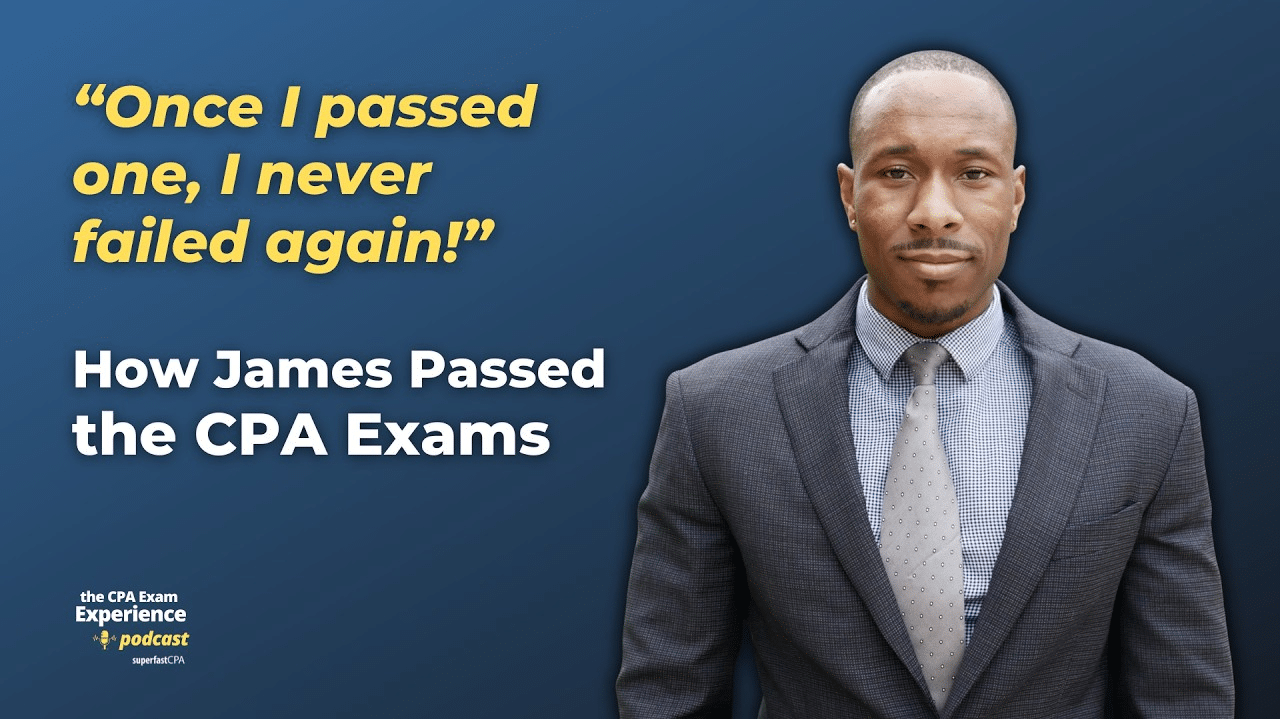
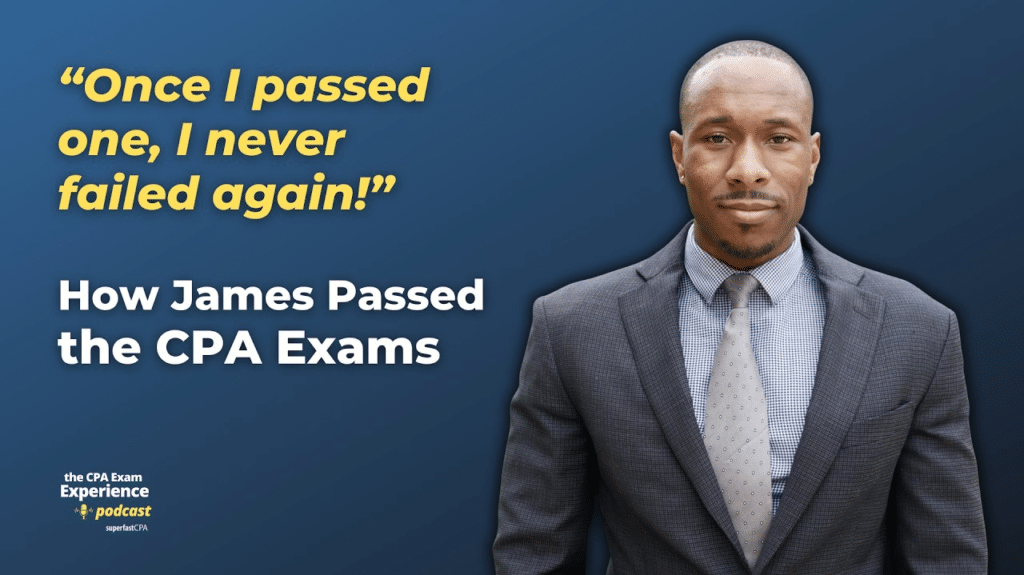
In this episode of the CPA Exam Experience Podcast from SuperfastCPA, you’ll hear about how James was able to pass the CPA exams by making some key changes to how he studied the SIMs. James kept getting close to passing the exams, but it wasn’t until he put a greater emphasis on the SIMs that he started passing.
You’ll hear how James stuck to the SuperfastCPA method from the beginning, and even made sure to study during busy season. He was still able to maintain time with friends, family, and even time to practice rap music. Once James passed his first exam, he never failed again and went 4/4. This is a fantastic episode, make sure you listen to the end!
IMPORTANT LINKS:
Master your study process by attending one of our free study training workshops:
https://www.superfastcpa.com/study-secrets/
Episode Timestamps
- 00:00 Intro
- 03:22 Why James Decided to Pursue His CPA
- 04:23 Got SuperfastCPA Before He Even Started Studying
- 05:05 Why James Got SuperfastCPA
- 05:50 Studied for a Year and a Half While Working Full-Time
- 06:28 Once He Passed One, He Never Failed Again
- 08:06 The Difference Between Really Understanding vs. Just Going Over the Material
- 08:56 SIMs Help Test if You Know the Concept
- 12:55 James’ Exam Day Experience
- 13:36 Aimed to Finish the MCQs Around the Two Hour Mark
- 14:24 Always Made Sure to Study At Least an Hour Every Morning
- 15:22 James’ “Cheat Sheet”
- 16:34 What James Wrote on His Cheat Sheet
- 17:47 Listening to the Audio Notes All the Time
- 19:16 Even Listened to the Audio Notes During Work
- 20:19 The Audio Notes Helped Reinforce Topics
- 21:00 Mini Quizzes Helped to Test His Knowledge
- 21:35 How James Used the SuperfastCPA Review Notes
- 23:12 When James Started Passing
- 23:45 Still Studied During Busy Season
- 24:42 Took Around 2 Months to Prepare for Each Section
- 25:36 Not to Losing Momentum After Passing One
- 26:34 Was Still Able to Practice Rapping
- 29:00 Found the AI Feature in Becker Useful
- 30:54 His Cheat Sheet Was His “Flashcards”
- 31:47 How James Would Learn a Difficult Topic
- 32:55 The Daily Review Was Crucial in Remembering Topics
- 35:09 Thoughts About Memorization and Understanding
- 36:11 The Major Benefits James Got from SuperfastCPA
- 38:33 Already Licensed
- 39:13 The Support of the People Around You Is Important
- 40:10 What the CPA Exams Taught James About Life
- 41:22 Top Tips for People Still Going Through the CPA Exams
Interview Transcript
James: [00:00:00] The study process made sense to me, but I think like with anything, it takes a while to find your groove and find what works for you. So I didn’t start passing right away. But I had just started in public accounting, so I was getting used to that. And the workload paired with my studying probably wasn’t the best for me.
So I really had to define, what I should key on, how could I make this tailored to myself. And once I found my groove, once I passed one, I never failed again.
Logan: Welcome to another episode of the CPA Exam Experience Podcast from SuperfastCPA. I’m Logan, and in today’s video you’re gonna hear me talking with James.
James is someone who I followed in the forum, the SuperfastCPA forum, as he was going through the process, and I remember at the beginning he was kinda struggling. He failed an [00:01:00] exam or two, and then at one point he just started passing exams, and it was really cool to be able to talk with him in this interview and hear what the change was that led to him starting to pass exams.
One of the biggest things that he mentioned was the sims. Now, with the sims, he had struggled to understand them, and he hadn’t really studied them very well at first. But when he switched to the method that he mentions in the interview where he started really focusing on the sims and having them be kind of the test of his knowledge, that’s when things really clicked and he started passing exams.
And once he did that, once he passed his first exam, he passed all of them after that. So make sure you listen through this whole interview with James. He has a lot of great tips. He basically followed the SuperfastCPA process all the way from the beginning. But again, that big change that he made with the sims was a big game changer, and it could be for you as well. So again, make sure you listen through the whole episode.
Now, before we dive into the episode with James, I just want to give one [00:02:00] reminder about our SuperfastCPA training webinar on superfastcpa.com. Again, that is a free one-hour webinar where we will teach you the key ingredients to passing the CPA exam so you don’t waste months or even years of your time failing exams.
And after that, you’ll probably want to learn more, so make sure you also check out becoming a part of the SuperfastCPA PRO course, where you’ll get access to the, again, the PRO course, where you’ll be able to learn all the details of passing the CPA exam. It’s basically a much more in-depth version of the webinar. So make sure you check that out.
Now, with all that out of the way, let’s get into the episode with James.
Logan: Hey, James. I’m glad to have you on the call today. How are you doing today?
James: Doing good. Good to be here.
Logan: That’s awesome. I mean, I remember seeing some of your posts in the forum, so we’ll, you know, I’ve seen your journey a little bit through the forum, so I’m excited to kind of get it, uh, get more into it. But, uh, just curious, where are you calling in from today?
James: Atlanta, Georgia
Logan: Oh, George. I, I have a friend who’s moving to [00:03:00] Georgia.
I don’t think that he’s moving to Atlanta, but they’re gonna… he’s moving there for a job. So, what, do you like it there? Is that where you’re from?
James: Yeah. It’s all I’ve ever known, so.
Logan: So hopefully you like it.
James: Yeah.
Logan: Um, well, I, again, I’m excited to be on the call with you today and to kind of just hear your story and see what we can talk about that could be helpful to other people so, let’s just dive into everything.
Why James Decided to Pursue His CPA
Logan: So, you know, you recently, not too long ago, finished the CPA exams, but let’s go back to where were you or what were you doing when you decided, ” I need to go for the CPA exams”?
James: Well, I wanted to get my CPA to have the credential, uh, so that no one would be able to kinda rebut anything I did in the profession. And after I finished my master’s program, I knew that I wanted to go and sit for it, but I didn’t know how to go about studying. Then I saw the SuperfastCPA ad. Um, it was kind of [00:04:00] sketchy to me at first, but then after I listened to the inform- uh, infomercial with Nate kinda explaining how everything was going to break down, it made complete sense, so I just hopped right in.
Logan: Okay. So did you start pretty soon after your master’s degree then? Like, kind of just not too long after?
James: Yeah, about a month.
Logan: Okay. Yeah.
Got SuperfastCPA Before He Even Started Studying
Logan: And so are you saying that you found SuperfastCPA, like had you already bought a review course at that point? Or had you tried studying yet? Okay.
James: I had seen the ad and I kept it in the back of my mind, um, to look into. And as soon as I graduated, I looked into it and, uh, got it. At first I just got, I think, part of it, but then I emailed you and I asked you can I get the full course if I pay the extra amount, and you allowed me to, which allowed me to do the full course.
Logan: Okay, so you eventually not [00:05:00] too long, like ended up with the total bundle, you know, the PRO course and the study materials and everything.
Why James Got SuperfastCPA
Logan: So what was it, you know, you hadn’t even really started studying yet it sounds like. What was it that kind of piqued your interest or made sense to you?
James: The fact that you can start with the questions as opposed to actually just studying a lot of material to try to decipher if you can do the questions. It makes sense to do the questions and then have that inform what you actually study.
Logan: Right. Right.
Oh,
James: I thought that was ingenious.
Logan: Mm-hmm. Yeah, you thought that was ingenious.
So you had, so it sounds like you pretty much had that right from the start, and then what did you, what review course did you have alongside SuperfastCPA?
James: Had Becker
Logan: Becker, okay. Yeah. Tons of people have Becker. It’s pretty normal.
Studied for a Year and a Half While Working Full-Time
Logan: Uh, and at this point, were you, uh, were you, did you have like a job in accounting, like, or were you just studying? What would, what did that look like?[00:06:00]
James: Yeah, I was working full-time while studying.
Logan: Okay, nice. And about when did this start? Like, when did you finish your master’s degree? How long has this been going?
James: Uh, it had been going for a year and a half, but then I started in May, um, or in June right after I graduated. So I was studying from June until December of the following year, so about a year and a half.
Logan: Okay. Okay.
Once He Passed One, He Never Failed Again
Logan: And so let’s kind of dive into, you know, you had Becker, you had SuperfastCPA from the beginning, and how did it go when you first started? Like, did it kind of click and make sense, or was it a bit of a struggle to kind of get rolling?
James: Um, the study process made sense to me, but I think like with anything, it takes a while to kind of find your groove and find what works for you. So I didn’t start passing right away. Um, but I had just started, um, in [00:07:00] public accounting, so I was getting used to that. And the workload, uh, paired with my studying, uh, probably wasn’t the best for me.
So I really had to define, you know, what I should key on, how could I make this tailored to myself. And once I found my groove, I would say maybe March and April of the next, following year. So say 2005, March of 2025, I really started. And once I got… once I passed one, I never failed again.
Logan: That’s awesome.
So, so March 2025, you feel like it kind of, you kind of hit your stride, and then from there it just, just went from there. You passed all of them after that. Is that right?
James: Right.
Logan: And I, I think, I think I remember that, like seeing in the forum, like I remember some posts where you were kind of like asking questions, like maybe struggling a little bit. But then once you passed that first one, ev- almost every post after that was just you saying, “Oh, there’s [00:08:00] another one down. There’s another one down.” Um, so that w- that was part of the reason why I was excited to, to get on the call with you.
The Difference Between Really Understanding vs. Just Going Over the Material
Logan: So when you, when you’re talking about, you know, kind of struggling to juggle work and, and studying, what was one of the most difficult things about that?
Was it like, was it working extra hours or was it like finding a time to study? Like what, what was the difficult part about that?
James: I think what was difficult is because you think you’re studying so many hours, but it’s really not important how many hours you’re studying. It’s really how much you’re retaining and understanding. And that was the major, uh, difference between when I was passing versus when I was failing because I was stu- I was always studying,
Logan: Mm-hmm.
James: But it’s that difference between do you really understand what you’re doing and are you just going over the material?
SIMs Help Test if You Know the Concept
Logan: So let’s kind of like contrast that. Like, so [00:09:00] when you were studying at first, what did that look like? ‘Cause like, you know, why was it at first that you weren’t really fully understanding the material, and then was there something that you changed to understand it?
James: Well, I was doing well as far as the multiple choice, and I think the- I just thought, you know, get the multiple choice down, you go into the exam, you’re gonna do well. But the first couple exams I was doing well on the multiple choice, but then I got to the sims and I froze, cause it’s like, whoa, I’ve never seen anything like this.
So that made me key in, you really don’t understand the concept if you can do the multiple choice but you can’t really do the sims.
Logan: Right.
James: So that’s, that was the major difference.
And what I did, um, when I was passing is if I know I’m struggling with a particular subject, I would do some sims every day in that particular subject, and I made that more, I did more and more.
[00:10:00] And I know Nate usually says to do sims on the weekends, but I would do maybe two every day, and then I would do a lot on the weekends, um, to really feel comfortable, like there was nothing I couldn’t handle.
But I would do that once I had 80 or 90% on the MCQs, I wanted to make sure that I, that was not a issue.
Logan: Right. So just to make sure I’m getting you there. So you would still mainly focus on the MCQs at first, like until you got to the point where you, like you were saying, 80 to 90%.
And then at that point, you would start incorporating sims pretty much every day to kind of prove to yourself or solidify that you did understand the concepts more than just in the MCQs. Is that right?
James: Right. And there’s also like little nuances between the different rules or your, different parts of your understanding that it refined within the sims. So of course you can get [00:11:00] the MC, uh, MCQs, you’re done.
But if you get to a sim, you don’t really know what it’s talking about, um, that’s a major issue. So I had to kinda refine that, and really do a lot of reading. I think reading helped as well.
Logan: Right. Yeah, I think that the, the, like being able to have that reading comprehension of the sim and like understand what does it want you to do. Um, cause multiple choice questions most of the time it’s pretty clear. Like, it’s like just here’s the question and figure it out. But with sims sometimes it’s like figure this out but it doesn’t tell you how, like where you need to go to figure it out. You might have like eight exhibits and you don’t know where the information is that you need. So you gotta like learn how to, uh, and that seems like what you learned how to do was kind of learning how to read through it and sift through it to be able to apply the concepts that you had learned. Is that right?
James: Exactly.
Logan: Right. So, that was, so it sounds like that was [00:12:00] like a big difference maker. So you were, cause you were always studying, you were, you know, doing the multiple choice questions, but once you kind of focused on not only doing the multiple choice questions but proving that you understood the material by also being good at the sims, that’s when you started seeing results. Is that right? Okay.
So I mean, that’s really helpful. And I mean, there’s some people, you know, it varies per person. Some people are like, “I never did sims,” and you know, sometimes you can do that. But in my opinion, for the majority of people, you have to practice sims.
You have to be able to navigate a sim because you’re not gonna know, you’re, you’re gonna get to the sims like you said on test day, and if you haven’t practiced them, you’re gonna freeze cause you’re like, “Oh, whoa, this is a lot of information. I don’t even know what I’m supposed to do here.”
But probably because you had practiced it so much, you were able to kind of like take a breath and just work through it.
James’ Exam Day Experience
Logan: Um, was, what was your experience like on exam day? Like, with the multiple choice [00:13:00] questions and with the sims? Like, how did they feel?
James: It felt pretty good. I always felt good with the multiple choice questions. Um, and when I started testing I felt good with the sims, felt comfortable. There was probably one or two that I would guess, second-guess myself on, but I learned, uh, just doing the SuperfastCPA way how to pace myself and how long, generally how long I should be on a question, which gave me enough time at the very end to go back and double-check some.
So I knew that I had a good chance of pass, passing.
Logan: Right.
Aimed to Finish the MCQs Around the Two Hour Mark
Logan: So when you say that like, like a, like a good pace, was that, does that mean that you were finishing the multiple choice questions around like the middle mark, like the two-hour mark, or what did that look like?
James: Um, I would definitely fi- uh, if I didn’t finish at the two-hour mark, I’d probably finish a little bit before, cause I wanted to give myself more than enough time to do the sims.
Logan: Right. Yeah. [00:14:00] I mean, two hours is the max that we tell people, like that’s the max amount of time you want to spend on the multiple choice questions. But if you can be done with them in like an hour and a half, that’s even better, you know?
Um, and so let’s kinda, uh, did you, is that how you felt on your first exam too? Like even going into the first exam you still felt good about the multiple choice questions?
James: Yeah, I felt good
Logan: about
James: them.
Logan: Cause you’d already been practicing them so much.
Always Made Sure to Study At Least an Hour Every Morning
Logan: Um, I kinda wanna talk about your study day. Like what did your typical study day look like?
Did you, were you applying like, you know, the two hours in the morning and mini sessions and stuff like that? What did that all look like?
James: Yeah. Um, I would wake up two hours early and then study. And then even if I couldn’t get the full two hours, I would at least get an hour or maybe an hour and a half.
Logan: Mm-hmm.
James: And then I would always be listening to your voice or Logan’s voice.
Logan: Yep. Yep. It’s too much huh?
James: So I would always [00:15:00] be reviewing, and then I would also have Quizlet, so where I would be reviewing flashcards. And then what really helped me was the cheat sheet that I made. I was always making the cheat sheet, but when I was passing, I was putting it more into my own words and giving really detailed examples as to concepts that were difficult.
James’ “Cheat Sheet”
Logan: So when you say cheat sheet, kinda walk us through what you mean by that.
James: So Nate usually, or did a video on cheat sheets where you have an Excel spreadsheet and you’re kinda going through all of the questions, um, and you’re also putting definitions at the very top about what each term means and breaking that down into your own words.
And then you would also, um, if there’s a difficult calculation, you would list out all of the steps of the calculation.
And I think that was very helpful for me because, [00:16:00] um, I would review that a lot too, and it just became part of how I thought about the question. And since it was in my own words and not technical terms, it was easier to understand.
Logan: Yeah. I, I do think that’s a key thing about notes and flashcards is putting it in your own words. I don’t think it’s that helpful to just kinda copy and paste whatever your review course is saying cause you’re not internalizing it as much.
So, sounds like you found that when you were writing things out in your own words, it helped you to kind of really internalize it.
What James Wrote on His Cheat Sheet
Logan: And, um, so throughout the day you were, just make sure I’m understanding you there, are you saying that eventually you would kinda be studying your cheat sheet along with the mini sessions throughout the day? Is that right?
James: Yeah. Um, so I would probably study the cheat sheet later on at night.
Logan: Okay.
James: After I’ve gone through all of the problems. But I would definitely, while I was studying, I would go through and put, um, certain [00:17:00] things on a cheat sheet. Whether I was answering a question on the app and I missed something and I didn’t understand it, I would say, “Oh, that was the answer. This is why it was correct,” and I would put that on the cheat sheet.
And I would go through. And another thing that would help is to have the cheat sheet on Google Drive, so it’s a Google Sheet, so you can put that, you can use it on the go, and you don’t have to wait till you get home to put everything down.
Logan: Yeah, it’s, like it’s automatically saved wherever you’re looking at it. Yeah, we, we frequently recommend Google Sheets just because of that ability, like look at it on your phone, look at it on your computer, it’s, and it stays the same. Um, I really like that. And so, you would do that kind of towards the end of the, towards the end of the day.
Listening to the Audio Notes All the Time
Logan: And throughout the day, kinda, I would love to hear kind of how you incorporated the mini sessions. You know, you talked about how you listened to the audio notes. Um, when would you listen to the audio notes? When [00:18:00] would you do mini quizzes? When would you read review notes? You know, how did you fit that into your workday?
James: Pretty, I would pretty much listen to the audio notes all the time. Like when you’re in your car, there’s no reason why you should be listening to music if you’re trying to pass this thing quickly. So if you’re in the car, listen to the audio notes. If you’re working out, listen to the audio notes. If you’re cleaning, listen to the audio notes.
Pretty much any time you’re not, um… you’re awake, you’re listening to the audio notes. Pretty much 24/7. There’s never not a reason to be slacking off and not listening to it, so.
Logan: Yeah. I mean, I, I, it, I totally understand it can get a little stale, a little old to listen to, at this point, it’s my, it’s my voice on all the audio notes, but before it was Nate and my voice. Um, but yeah, the, the great thing about the audio notes is, you know, when you really think about it, probably most people, they’re constantly listening to [00:19:00] something, whether it’s, you know, music on Spotify or a podcast or an audiobook or something.
They’re listening to something on their phone, and just take all that time that you’re doing that stuff and convert it to that audio notes, and that’s just so much extra study time.
Even Listened to the Audio Notes During Work
Logan: How many, just take a guess, you know, uh, how many hours do you think you were listening to the audio notes maybe a day?
James: At least eight hours a day.
Logan: Eight hours.
James: At least.
Logan: Were, were you listening to them at work too?
James: Yes.
Logan: Okay. Okay. And just curious, like, do you feel like, do you feel like, you know, ’cause you’re at work, you’re probably trying to focus and, and do stuff like that. Do you feel like you still benefited from listening to them at that point, even though you were probably not listening to them very carefully if you were, like, focused on a task? I’m just curious about that.
James: Yeah, let’s not get crazy. Like, if you’re doing something that’s very, uh, critical thinking, focus, turn it off for a second and do the task and then [00:20:00] hop back into it. But while you’re working, if you’re doing something that’s very menial
Logan: Mhm.
James: That doesn’t require a lot of thought, just turn it off.
Logan: Yeah. That’s awesome. I mean, I apologize that you had to listen to all that for so much, but, uh… and would you say that it– I mean, obviously you did it.
The Audio Notes Helped Reinforce Topics
Logan: Do you, do you think that it was helpful? Like, what did you find when you did that?
James: Absolutely. Um, um, it’s a lot easier than trying to read all of these different subject matters and material. So if someone is giving it to you while you’re doing something else that you need to do, that takes a lot off of your plate. So of course you’re gonna read, um, cause I would read before every, uh, study session.
I would read the section that I was doing. But, you know, it’s just that extra reinforcement, and you wanna reinforce it as many times so it’s, it’s in there come test day.
Logan: [00:21:00] Yeah.
Mini Quizzes Helped to Test His Knowledge
Logan: And you, you were mentioning reading the notes. So, oh, how did you incorporate the, like, the mini quizzes and the review notes? So you were listening to the audio notes, but when would you do the, the mini quizzes and the review notes?
James: Uh, I would listen. I would do the quizzes, like when I was in line for food for lunch or I was waiting for something or, you know. I was basically anytime I had downtime and, you know, I felt like I was, had enough, retained enough information from the audios, I would just test it throughout the day by doing quizzes.
Logan: Okay.
How James Used the SuperfastCPA Review Notes
Logan: And for the reading, did you mainly just read, and when I say review notes, you know, the text version of the, of the SuperfastCPA notes, were you mainly just reading that, like, as a primer before you started studying, or did you also read those throughout the day?
James: I would usually use it as a primer before the study session throughout the day. But the last cram session, [00:22:00] I would just completely read through the review notes.
Logan: Okay. Yeah. And that is something that we recommend for like the 48-hour cram session, trying to read through those all the way through. It’s a little bit harder now cause they are longer than they used to be, but, um, which is something that Nate and I are trying to figure out, like if we can get them to be similar quality but somehow shorten them, but we’re working on that.
Um, so I mean, it sounds like you were, I mean, just think about like, you know, you’re doing like a two-hour session most of the time, if not, you know, maybe an hour, hour and a half, and then, you know, you’re listening to audio notes all day long, doing some mini quizzes, doing some review notes.
By the end of the day, you’ve got like, I don’t know, 6 to 8 to 10 hours of studying. Even if it wasn’t all like 100% focused studying, it’s still in, you know, you’re just totally flooded with that information all the time. I mean, there’s no way that you could say that that’s not going to benefit you, that that’s not going to improve your chances, [00:23:00] right?
Um, and especially once you started making sure that you really understood the stuff w- by doing that practice with the sims, it makes sense that you kind of really started seeing those passing results.
When James Started Passing
Logan: What were your exam scores looking like before you kinda made that switch? Were you scoring in like the 60s or was it like, what did that look like?
James: Yeah, it was, uh, high 60s. It was right there. I think it was 67, 69. Always around there. Um, but once I made those adjustments as to the active studying and really diving deep into the sims, I just started passing because I was just right there. I was right on the, on the cusp.
Logan: It was just that small little tweak.
Still Studied During Busy Season
Logan: Um, and I kinda, I, I think I kind of asked this, but I wanted to talk about it more. Like, how did you… So w- I guess one question, w- are, you’re in, are you still in public accounting? Or I guess at the time, were you doing tax or audit?[00:24:00]
James: I was doing audit and I left public accounting.
Logan: Okay. So did you have… I mean, I’m assuming you did. Did, did you ever study through, like, a busy season in audit, like an extra busy time?
James: Yeah, I did.
Logan: Okay. And how did, like, did you have to adjust very much, or was it still just like, just get the two hours but then just work a longer day? Like, how did that look?
James: I was pretty much dedicated, so I would… o- of course you can’t always do two hours in the morning during busy season, um, but you try to find time throughout the day, and I would always find time on, at night or during the weekends to study.
Logan: Okay.
Took Around 2 Months to Prepare for Each Section
Logan: So once you, I guess, uh, so, uh, another question that I had was like the study timeline. Did you find that you were– About how long did you take to study for each attempt?
James: I would say two month, two and a half for FAR. I think [00:25:00] about two, roughly two for FAR. Um, and then about two months for everything else.
But I took a little bit longer for FAR just to make sure, cause I was so tired of taking it.
Logan: Yeah. Yeah, cause I mean, y- let’s talk about that a little bit. So what exams had you taken? Has– Was it FAR every time or had you tried any other exams that you failed, I mean?
James: FAR twice and then I took AUD once before passing everything.
Logan: Okay. And what was the first exam that you passed?
James: Uh, at FAR.
Logan: Okay. So FAR was the, FAR was the one that you finally got under your belt.
Not to Losing Momentum After Passing One
Logan: And, uh, so once you’ve got that first passing score, was that like a… did you just kind of just rinse and repeat? You just kind of did the same thing after that because you’re like, “I knew that worked,” or was there anything that you had to kind of keep doing or like was there anything else that you had to change along the way to be able to pass the other exams? Just curious.
James: No, once you got the formula down, you just keep doing it, [00:26:00] and I didn’t want to take too long in between tests because I knew that, um, the likelihood that I would continue would be less and less, so I just kept going to, I… so.
Logan: Yep. Yeah, I mean, when it, once it starts just taking… I mean, there are, you know, there are people who are, have been doing it for years, like literally for years, and, uh, it gets really, um, d- what’s the word? D- like discouraging to be doing that. So like, kind of staying on top of it and just never letting the, never letting it stop, uh, I think that was a good idea.
Was Still Able to Practice Rapping
Logan: Uh, so with the… I get, so one, another question that I kind of wanted to ask was, you know, because of the way that you were studying through SuperfastCPA, what kind of things were you still able to have or to do in your life? Like, you, what did you not really have to sacrifice because of how you were studying?
James: I was still able to go to work out. I was still [00:27:00] able to make music and, um, hang out with friends from time to time and go to certain family events. So that was definitely, uh, a great thing. Of course, you’re, you’re dedicated to studying, but your whole life isn’t studying, so.
Logan: Right. And, and you know, I’ve said this before, but like that might sound crazy to some- to someone who’s been just, you know, studying four or five hours every night for months and months on end, and they’re just missing out on everything. But, um, when you do the hour studying in the morning and then you, you know, you do those audio notes and everything throughout the day, by the time you’re done with your day, you know, it still might not be like totally normal, but you still get to do a lot of the stuff that you like to do. And something you mentioned there, so make music. What, what, uh… are you a musician? Are you in– like what does that look like?
James: Yeah, I rap, I sing, and I’m trying to learn how to play, produce. So I play the keyboard as well.
Logan: That’s awesome. Is [00:28:00] that something that you’ve been doing for like a long time or is it something that you’ve recently gotten into?
James: Yeah, I’ve been doing it since I was 17, so, over 10 years now.
Logan: That’s awe- that’s really cool. And, uh, so what does that look like? Like, were you going, like, are, is that time for you to just, um, like, work on your own stuff at home? Or are you going out and performing? Like, what does that look like?
James: Oh, no performing, just going to the studio.
Logan: Okay. All right. Someday or no?
James: Um, yeah, def- definitely. But, um, definitely when I was studying, there’s no time to practice,
Logan: Mm-hmm.
James: Yeah, re- or rehearse, so I was just dedicated to studying.
Logan: Yeah. But that, I mean, that’s really cool. And I mean, it’s so important to be able to still have the things that you love. Otherwise, it becomes just a, it just becomes totally miserable. Um, so that’s awesome that you were able to, to keep some of that stuff [00:29:00] going.
Found the AI Feature in Becker Useful
Logan: So are there any, like, you know, we’ve talked about how you were, you pretty much followed the process, you know. You know, you were studying in the morning, you were doing the mini sessions throughout the day. You did, had a big focus on sims, especially once you started passing. Um, what other things were you doing, if there is anything, that you wanted to talk about on the call that we haven’t really gotten to talk about yet?
Like, what things worked for you?
James: I think the major things that worked for me we’ve already talked about, which was really diving deep into the sims and reading the explanations of the sims.
I I think a good feature that, um, Becker has just started, which was the AI thing that you can click on. So if it gives you an explanation as to what’s going on and you don’t understand it, you can easily type, “Can you say this another way?”
And it’ll feed back, um, different ways of saying it, and it asks you, “Do you [00:30:00] understand?” So that’s a good feature that I think is new now. I don’t know what else is new, uh, with Becker, but that was good. I, I think they instituted that, like, halfway through my studying, so that was interesting when it came out.
Logan: So the way that you would use that, like, you know, you’d use it to kind of ask it in a different way or have it explained in a different way. And then where would you go from there? Like, would you then, like, take that and try to apply it to the question, or would you make notes? Like, how did you use the AI from there?
James: From there, once you understand what it’s saying and you can kind of ask it, “I think this means this, is that correct?” And it verifies it, you take that, and I would just put that in my cheat sheet, in my Excel file, um, as a definition or a key concept.
Logan: Okay.
His Cheat Sheet Was His “Flashcards”
Logan: And talking about key concepts, you know, you t- you mentioned your, you know, your cheat sheet, and I think [00:31:00] we, I think you mentioned a little bit the flashcards. Did you use flashcards very much? What did, what did that look like?
James: Yeah, I used flashcards a lot in the beginning, not so much towards when I started passing, simply because I had everything already on my cheat sheet so there was no need to kinda rewrite all that stuff but, yeah, I
Logan: So would you, would you say that the cheat sheet was a bit more your version of like of a flashcard? Like that’s what you would review in the evening kind of a thing, right?
James: Yeah, I liked it because it was a little bit more dynamic. Uh, of course you can’t fit everything on a flashcard, but you can go a little bit more in depth and got a lot more space and a lot more tabs in, in the sheet, on the Excel spreadsheet.
Logan: Yeah. Right, right.
How James Would Learn a Difficult Topic
Logan: Um, so I mean, uh, I guess another thing that I wanted to ask about, and we kind of already talked about this, but just to make, just to get dive into it a little bit more.
When you ran [00:32:00] into– like let’s say you were going through planting the seeds, you know, learn from the questions. What would you do when you ran into a topic that you were struggling with, like that you, that didn’t really make sense? Was that where you would pull out the AI or what, like how would you work through a problem that you were struggling with?
James: Of course you would look at the MCQs first, but if you still don’t understand it, I would just dive right into the sims. Just pull up the sims and do one. Of course, you don’t have to do it perfectly if you’re pressed for time. But just see what the answers are, watch the video, see how they do it, and then work your way through it, and write those answers down in your cheat sheet.
And then you’ll remember it when you come back to it.
Logan: Right. So, so, and you, again, you kind of already mentioned this, but it, you, if there was something you were struggling with, you would try to go to the sim to kind of just get a deeper dive into a deeper understanding of it.
The Daily Review WasCrucial In Remembering Topics
Logan: Um, and I’m assuming you were also doing your, like a [00:33:00] daily 30-minute review. Is that right? Like, where you were kind of going over everything that… uh, did you find those to be helpful?
James: Yes, very important because, um, like anyone knows, if you’re going through all of the material throughout a 60-day process, you’re not gonna remember all of the material. So it’s good to at least get, remember the easy stuff or remember the generally easy stuff, and you can flag one or two of the difficult questions.
And once you’re done, you know you already got 80% on most of them, just go back to those two that you are having trouble with.
Logan: Right. Yeah. I mean, it’s, uh, you know, it’s something that a lot of people don’t think about, but it’s just so key to just constantly be seeing, ” Okay, am I still good on this? Okay, no, I don’t understand this as well as I thought I did.” And would that, would you also, like, use your cheat sheet at that point, like during your daily review as well?
Like, something that you were struggling with, you would write it down in [00:34:00] there?
James: Yeah. And the, the key part is, like, once you’re reviewing the cheat sheet, it becomes a lot easier because no matter what they throw at you, once you understand what they’re trying to ask you or what they’re looking for, you can just answer it. It doesn’t matter if they say Sarah, Paul, Mike, you just answer the question the way they want you to answer it.
Logan: Yeah. Yeah, I think that’s just so important as far as, I think that what can happen really easily is if you’re doing so many multiple choice questions, you can kinda get into this bad habit of being reliant on the specific questions like, like you were saying, like that specific question that always has that name or that exact wording or anything like that.
But when you really understand it, understand the concept, you know, by doing the things that you were doing, like doing that cheat sheet and the sims and everything, once you really internalize it and understand it, it doesn’t matter what the question looks [00:35:00] like cause you can understand what it’s asking you and you know how to apply it. And did it, did it feel like you got to that point, like where you were just like, “I, it doesn’t matter what I see”?
Thoughts About Memorization and Understanding
James: I think what you just said is very important because, um, sometimes in the exam material and sometimes in the quizzes, there’ll be questions, uh, that are very similar and they’ll have like one nuance. And because you’ve been through it so many times, you already know the answer because you’ve answered it so many times.
So it’s easy to memorize what answers are what. But to actually understand what it’s asking and to directly address that, that’s a key difference between doing well on the practice test and not passing, and actually passing the exam.
Logan: Yep. I think that, like, yeah, that pretty much summarizes, like, kind of the whole point of most things that we want people to do in SuperfastCPA. It all comes back to [00:36:00] focusing on what’s gonna actually get you to pass the exam, which is, again, being good at multiple choice questions, being good at sims, and understanding the concepts that are in those multiple choice questions and those sims.
The Major Benefits James Got from SuperfastCPA
Logan: Um, now, I mean, I, I feel like we’ve gotten some really good thing, we’ve talked about some really good things. You obviously had, uh, like a really good study process, especially once you started passing exams. But if you could, uh, like say or summarize what were the major benefits that you got from SuperfastCPA, even if it’s something that we’ve kind of already talked about?
James: All right. So I would give you my top three. So one, it gives you structure. Two, it makes things very convenient. Um, it gives you quizzes you can do on the go, audio notes that you can use on the go, and it, it breaks it down into simpler terms when you’re reading the material. Um, as a– even though Becker is good, um, CP- uh, SuperfastCPA is a little bit better [00:37:00] at making the terms a little easier to understand and giving concrete examples or simpler examples.
And three, um, it just also provides a good community as well. When you’re going through the questions, you never feel like you’re on your own.
Uh, I don’t know how it is with other materials, but Becker doesn’t, doesn’t do that at all. Um, but you have that community you can go to, to say, um, “Maybe you should do this different. Have you tried this? Okay. Keep going.” And that’s very important because every time you pass, you’re like, “I passed.” And everybody’s like, “Yay.”
Logan: Yeah. Yeah.
James: You don’t know how important that is because, um, whenever you fail this test, it’s very deflating, especially when you’ve dedicated so much to doing it. You’re working full time.
Life events happen, so you’re gonna need that extra encouragement. You’re gonna need that extra support system, especially for [00:38:00] something that’s difficult as this.
Logan: Yeah. Yeah, I, I, I found the forum when I was going through the exams, the SuperfastCPA forum was awesome. Like, I loved seeing the support and I was always excited to post about something that I had passed and give encouragement to people who, uh, hadn’t quite passed that time.
It just, yeah, and I, and again, I remember seeing you in the forum and I loved seeing the, like once you started passing, like seeing that you had passed your exam, like you were passing your exams. It was just, it’s just awesome.
Already Licensed
Logan: So, as we’re kind of wrapping up here, I just wanted to ask before I ask, you know, the ending questions and stuff like that. So obviously you finished the exams. Uh, are you a CPA at this point? Like, did you get the license?
James: Yeah, I did.
Logan: Awesome. Awesome. And did you do anything to celebrate? Like do anything, buy anything, go anywhere?
James: Yeah, I went out. I went out to a local cocktail bars called [00:39:00] Mojo’s. Or not Mojo’s. It’s right here in Colony Square, um, Jojo’s, that’s I
Logan: went.
Okay, cool. And you went out with some friends or to like celebrate, is that right?
James: Yeah, it was pretty cool.
Logan: Nice.
The Support of the People Around You Is Important
Logan: And, and actually just curious about that, like what, what was your network around you like? Did people understand what you were going through or was it kind of just like, ” Oh, how are those exams going?” Like, you know, d- did you feel like you had some support?
James: Yeah, I definitely had some support. I have a older cousin who’s a CPA, so I talked to her about certain things and, um, she was excited for me. And then also whenever you’re in a public accounting firm, everybody’s kind of pressed to do the CPA, and you see people passing the CPA. You’re like, “How did you do that?” Like, we have like
Logan: for
James: assignment.
But, um, yeah, just having that support was fairly cr- very crucial.
Logan: Nice. Uh, well, like I said, [00:40:00] as we’re… I mean, congrats on being done. I mean, it’s a huge… I mean, it must have just, must just feel like a huge weight off your sh- shoulders, uh, especially after a year and a half of going through it.
What the CPA Exams Taught James About Life
Logan: Uh, is there anything that, like, passing the CPA exam kind of taught you? Like, as in even outside of accounting, like, what did you learn about yourself going through this?
James: This is gonna be very cliche, and I’m sure many people have already said this on the podcast, but literally whatever you put your mind to, you can do. And really just being very stubborn about your goals, um, you can accomplish it. Doesn’t matter how many times you fail, um, you can get back up and just tweak what you’re doing.
The major thing, um, that stops people is you keep going at it, but you keep going at it the same way. If something is not working, you need to make an adjustment. Um, so that was the major difference, and what it taught me [00:41:00] is, um, that I really can do what I wanna do, so-
Logan: Yeah. A- and, you know, whether it’s cliche or not, I mean, I think that is one of the greatest things about accomplishing something like this, you know, CPA exam or something similar, is it just shows you that you can be dedicated and you can accomplish what you wanted to do.
Top Tips for People Still Going Through the CPA Exams
Logan: Um, so as we’re, you know, as we’re wrapping up, I always like to ask the last question, same question that we ask on every, at the end of every podcast. Uh, so even if it’s something that we’ve already talked about, I still want you to kind of reiterate it, but if you could give your top two or three tips to people who are still going through the exams, what would be, what would those be?
James: Okay. Do the MCQs or MCQs every day. Do at least the th- uh, set of 30, um, and try to do that at least three times a day, two or three times a day. Um, maybe a little bit less when you first get started, but when [00:42:00] you get closer to the exam day, you wanna do that as much as possible. Um, if you’re ever struggling, the t- number two tip would be, if you’re ever struggling with a particular subject matter or module, you wanna do as many sims on that module as possible.
Um, you can do two a day, but during the weekend, you wanna do maybe four or five and pick the ones that you’re really struggling with the most, the hardest ones, cause you’re gonna get the most benefit out of those. And once you’re going through those, put them on an Excel spreadsheet, um, the concepts that are key.
And you just keep going like that, and as soon as you know it, you’ll have all of these concepts. You’ll be reviewing them. And the MC– you’ll not have a MCQ that you don’t completely a- at least know what they’re looking for. You may not know exactly how to get the answer, but you’ll know what they’re looking for.
Logan: Right.
James: My third [00:43:00] tip would be to give yourself a break. Um, of course, do everything. Get… What I did was I got there two hours before the exam. I studied as much as possible before that. But remember just to give yourself a break because your brain needs that. Um, this test is stressful enough. Try to get as much sleep and water and exercise as possible.
Logan: Yeah, absolutely. I mean, the, I think that’s one of the biggest reasons why people struggle so much with the exams is they’re doing it, they’re, they’re basically causing burnout by the way that they’re studying. You know, like studying four or five hours till like 11:00 or midnight, not getting enough sleep. Uh, it all comes to, you know, it all kind of affects everything. Like when you, when one thing is ha- uh, when you’re not getting enough sleep and you’re studying at night, it all kind of affects everything.
Um, anyway, thank you for being on the call today, James. I think that it was an awesome call. I think that this will be really helpful to a lot of people [00:44:00] and, uh, yeah, congrats on being done.
James: Thank you.
Logan: All right. That was the episode with James. I really enjoyed talking to James and hearing about how he was able to pass the exams, that change that he made to be able to understand the sims, which ultimately led to him passing the exams. It was also pretty cool to hear that he is practicing rapping, and that’s something that he wants to, you know, keep getting better at.
I love to hear about the different things that people enjoy outside of the CPA, because it helps us all know that we’re all people, we’re all going through this together, and no matter what your interests are or your hobbies are, you can pass the CPA exam.
Now, I’m sure that you found this episode helpful. Before you go, make sure to like and leave a comment in the YouTube video or leave a rating in your favorite podcast app. As one last reminder, make sure you go to superfastcpa.com and sign up for our free one-hour webinar if you haven’t seen it before. That’ll give you a great path to becoming a part of SuperfastCPA.
Thank you for watching or [00:45:00] listening, and we will see you in the next episode.