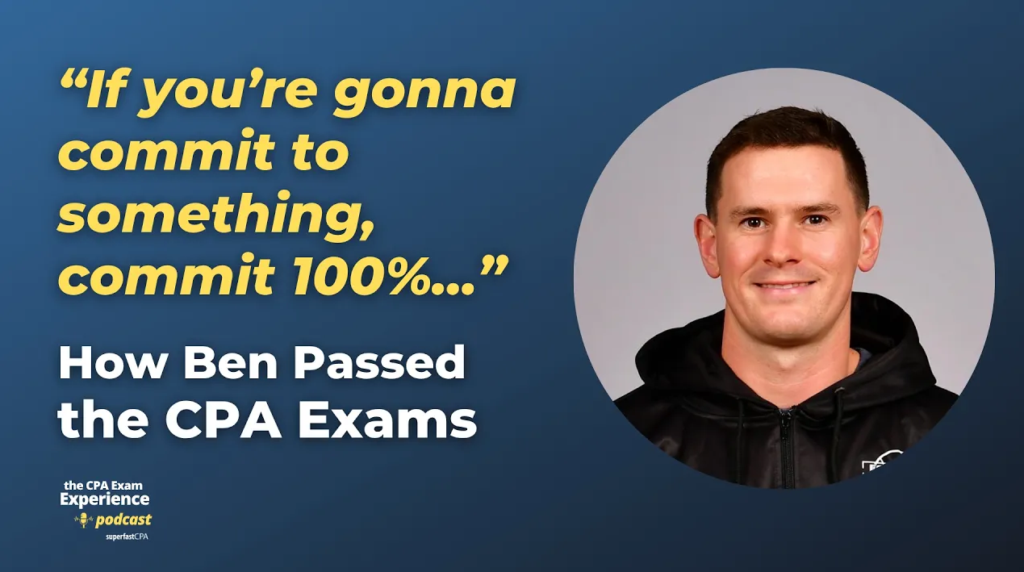
In this episode of the CPA Exam Experience Podcast, you’ll hear how Ben was able to finish the CPA exams even while busy as a tank platoon leader in the military and as a new father of twins.
Ben attempted the Audit exam with the normal way of studying and learned just how difficult the CPA exam was when he found out he failed it. With some tweaks after watching the SuperfastCPA training webinar, Ben was able to pass ISC. After that, he purchased the SuperfastCPA study materials and passed all of his exams first try. Ben has a lot of great tips and advice, this is an episode you don’t want to miss!
IMPORTANT LINKS:
Master your study process by attending one of our free study training workshops:
https://www.superfastcpa.com/study-secrets/
Episode Timestamps
- 00:00 Ben Interview
- 03:45 How Ben Started His CPA Journey
- 05:41 Was An Auditor Before Going to the Military
- 06:40 Initially Thought That Having a Review Course Would Be Enough
- 07:27 The AUD Exam Was Brutal, It Was a Huge Wake-up Call
- 08:55 Made a Mistake of Studying for REG, Not Knowing If He Passed
- 09:42 Studied for ISC Next and Came Across SuperfastCPA and Passed
- 11:22 Why Ben Didn’t Feel Prepared Going Into the ISC Exam
- 12:40 The Reason Ben Bought SuperfastCPA After ISC
- 14:19 Focused on Deep Diving the Questions During Morning Sessions
- 15:21 Ben’s Daily Study Sessions
- 16:57 Able to Continue Studying in the Evenings Because He Already Started in the Morning
- 18:28 Lost an NTS for FAR Due to Military Training
- 20:10 Buckled Up and Decided That Now Would Be the Best Time to Pass the CPA Exams
- 21:24 Dedicated All of His Time to CPA Study
- 23:03 Took Four to Five Weeks to Study for Each Section And Passed Them All
- 23:47 Had Twins While Studying for FAR
- 24:30 Ben’s Situation with His Wife
- 25:35 Wasn’t Able to Do Weekend Study Sessions But Relied on SuperfastCPA Materials
- 26:22 Printed Out the FAR Review Notes
- 28:07 Utilized AI with Surgent to Make Flashcards
- 29:13 Studied the AI Generated Flashcards Mostly in the Evenings
- 29:44 He Didn’t Focus on the Sims
- 31:36 Thoughts About the Sims
- 32:06 Passed All Sections in the 70’s
- 33:17 The Feeling of Finishing the CPA Exams
- 34:08 Ben Relates the CPA Experience with His Army Experience
- 35:24 How It Has Been After Finishing the CPA Exams
- 36:17 Ben Was a Tank Platoon Leader in the Military
- 38:05 Walking the Dogs Is One of the Things He Enjoyed
- 38:45 The Confidence to Take the Exams is the Biggest Benefit Ben Got from SuperfastCPA
- 41:24 Passed All Four After Getting SuperfastCPA
- 42:35 You Need to be Committed to Studying for the CPA
- 44:27 Top Tips for People Still Struggling with the CPA Exams
Interview Transcript
Ben: [00:00:00] The free access video made sense and I understood at that time that, because I’m in the military, I go to, go into work at 5:30 in the morning, so I was having a hard time doing early morning study sessions, but I understood that anybody who understands that you’re better earlier in the morning, that’s what I needed to do.
I needed to get to that point, because I was just so burnt out at night, I was really struggling. So that’s what really, I understood that the, whatever this process is, it’s built around very common sense doing the practice questions first because I’d already tried the other way and I was working pretty hard at it, but it wasn’t it wasn’t working.
So I knew that ISC, I know the past results and I know that FAR was gonna be significantly harder than ISC, and so I knew that just doing Surgent and doing kind of a parallel was not gonna get me over the line. I needed the Superfast method to be what I based my study session on, so.
Logan: [00:01:00] Welcome to another episode of the CPA Exam Experience Podcast from SuperfastCPA. I’m Logan, and in today’s video, you’re going to hear me talking with Ben.
I really liked Ben’s story. He had a lot of great tips and a lot of great advice, and something crazy that happened while he was doing his process, his wife was pregnant with twins, and they had to live in two separate states.
I think he was in North Carolina and she was in South Carolina because they are both in the military. And so she was there pregnant with twins, and he was in a different state trying to do military work and also trying to get the CPA exams done.
And it’s a cool story on how he was able to finish that up. And by the end of it, he was doing his last exam with FAR, and they had, had the twins. So he was studying for FAR while having the sleep deprivation of having twins. So, you know, that makes a big difference.
And he still passed, so that just goes to show that at that point, he [00:02:00] had the process down, and even though he wasn’t getting very much sleep, he knew what he was doing. And that’s kinda the whole point of the SuperfastCPA process, is to get you to the point where no matter what’s happening in your life, you have the skills and the ability to work through material and learn it, even if life is busy, even if things aren’t going perfectly as planned.
Ben has a lot of great advice and a lot of great tips, so make sure you listen to the whole episode. Now, before we dive into the episode with Ben, I just wanna give one more reminder about our SuperfastCPA training webinar on superfastcpa.com. That is a free one-hour webinar where we will teach you the key ingredients to passing the CPA exam so you don’t waste months or even years of your time failing exams.
In fact, Ben used the free webinar and our study materials, not the PRO course, to be able to pass the exams. So it just goes to show how much we’re giving you in the free webinar. If you want to learn more and you want even more benefits after you watch the webinar, make sure you check out becoming a SuperfastCPA PRO member.
They get access to something called the SuperfastCPA PRO [00:03:00] course, where Nate goes extremely in depth on how to pass the CPA exam. It’s basically a much more in-depth version of the one-hour webinar. So again, after you watch the webinar, make sure you check out becoming a SuperfastCPA PRO member.
With all that out of the way, let’s dive into the episode with Ben.
Logan: Thanks for getting on the call with me today, Ben. I’m super excited to hear more about your story and, uh, I’m glad that you emailed us about passing, because otherwise I might not have known. How are you doing today?
Ben: I’m doing great. I’m doing great. How are you?
Logan: I’m doing good. Uh, it’s a Monday, so, you know, there’s that, but, uh, I’m glad to be on the call with you today. So you emailed in pretty recently, kind of letting us know about you passing and everything. So I’d love to just kind of dive into everything.
How Ben Started His CPA Journey
Logan: So when you … Where were you in your life, in your career, when you decided to go for the CPA? You know, like, what were you doing for your job and things like that?
Ben: So I have a little bit of a unique backstory. So I graduated with my [00:04:00] bachelor’s in 2020 and, uh, COVID hit and,
Logan: Hmm, yep.
Ben: So I was working in accounting then and I had started to think about taking the CPA exam, um, but I was kind of taken aback by, you know, I lost my job during COVID. And so, uh, I’d always wanted to serve in the military, so I joined the military in 2020 and I’ve been doing that for five and a half years now.
And, um, so that’s what I was doing at the time. Basically, I got the idea, I mean, I always wanted to have my CPA, but in about 2022, I decided I was gonna go for it. And I, I mean, this story is basically me making a ton of mistakes.
So I was in Kansas at the time, stationed there. I’m from Tennessee, but I went to school in Missouri. So that’s three different kind of jurisdictions that have three different hours requirements.
So my first attempt to get registered for the exam, I tried to go in Kansas, which had different, obviously, requirements than where I went to school [00:05:00] at, and I was actually short classes. So that was my first kind of hiccup in my journey was I got denied and as you know, it takes, it takes some time for them to actually get back to you.
So then I found out I was getting deployed, um, so I had to put that on hold for at least, I knew I was gonna be at least a year. So I decided I was gonna go get my credits that I needed while I was overseas. So I went and took online courses, um, while I was overseas. I ended up getting my MBA with a concentration in accounting.
And so by the time I actually was able to sit for the exam, it was 2022, close to Christmas. And that’s when I first got, that’s when I first really started studying.
Logan: Okay. Okay.
Was An Auditor Before Going to the Military
Logan: So you, you know, you just finished your bachelor’s, but then COVID hit. And with joining the military, how did that work with … Like, what were you working in when you lost your job and then decided to go into the military? Like, what’s your interest in accounting?
Ben: So [00:06:00] that, that was what I studied in and I went into auditing. Um, so I was an auditor for, uh, up until kind of COVID shut everything down. And then I, before I left in the military, I had started a job at the Department of Energy, so I was doing governmental auditing and, uh, at the time that I got the job, I didn’t realize I was going to the military, um, because I was, I, I had applied for, uh, something called OCS, which is you go and you can become an officer in the military, but I already kind of had a job at the Department of Energy, so I chose to go to the military and, um, try to serve in that regard, and I walked away from the job of the Department of Energy.
But long story short, I was, um, an auditor for most of the time.
Logan: Okay. Okay.
Initially Thought That Having a Review Course Would Be Enough
Logan: So, you know, all that happens with the military, you get deployed, and that’s pretty cool that you’re able to finish your MBA while you’re overseas. Um, you come back and then you’re finally kind of getting serious, getting ready to study. So how did that look? Like, what did you start with? Did you get a review course?
You know, how did that all look when you first started?
Ben: So [00:07:00] I went and got, while I was in school, when I first started thinking about the CPA, I went ahead and got Surgent. Uh, that was big at our school because obviously it doesn’t expire. Um, so that was, that’s what I had at the time. And so when I got back, I originally thought I have Surgent, I have an exam, I’m good.
I don’t need, I don’t need anything else. And so I registered for audit in, um, January 2024.
Logan: Okay.
The AUD Exam Was Brutal, It Was a Huge Wake-up Call
Logan: So, and so were you, had you been studying for about a year off and on? Like, what did that look like? Or did you not really dive into it until 2024?
Ben: I didn’t really dive into it until I got back and really started working on it. Um, of course, I had taken, at that point, a couple auditing classes, so I was kind of, um, I was pretty confident that I could pick up the information quickly, and so I really didn’t, I hadn’t been studying. I studied, I started studying in November, December 2024,
Logan: Okay.
Ben: 2023, this would be 2023.
Logan: Okay. All right. And so how did that go? [00:08:00] What, what happened with that exam?
Ben: I showed up to the first exam. I had done all 2000 practice problems, um, had done the traditional, it really worked for me in school that I would just study and then I take the test and you just kind of remember what you studied and if you don’t, you don’t get it. And I got into auditing and it was a huge wake up call because a lot of the terminology I was kind of familiar with, but I was nowhere near ready to take the test and be confident in my answers.
So there was a lot of second guessing. It was a pretty brutal first test experience. Um, and
Logan: Do you remember what the score was? Oh, sorry.
Ben: So while on top of that, I had to wait for the, uh, for the exam results to come out
Logan: Because it was 2024, yep.
Ben: Exactly. So I had, um, three months away, but I ended up getting a 69 I think on it.
Logan: So, I mean, that’s pretty good for not having, like, super deeply studied, you know, but it stinks that you had to wait for so long to find that out.
Made a Mistake of Studying for REG, Not Knowing If He Passed
Logan: Like, what were you doing in between? Were you continuing to study or were you [00:09:00] just waiting?
Ben: Like I said, I’ve made a lot of, uh, strategic mistakes, so I went right on to REG. My whole process was I, I’m gonna pass all of them on my first try, so I’m just gonna continue on to the next one. So I went right into REG, and thought that I could do the exact same thing, and, um, took about six weeks, studied, did all the practice problems, did the exact same process, and tested again and got a 71.
And so at that point I was down two exams with no results pretty much.
Logan: A- and did you find the, out those scores around the same time? Uh, probably because, because it was at the beginning of 2024, right?
Ben: Yes, it was, it was close to the same time.
Logan: Yeah.
Studied for ISC Next and Came Across SuperfastCPA and Passed
Logan: And so, at that point, you know, you’ve studied, you’ve done everything that surgeon tells you to do, and you got pretty close, but still nothing to show for it. Uh, so at, at that point, what were you thinking?
You know, at, at what point did Superfast CPA come into the picture?
Ben: Well, [00:10:00] my mom was telling me the whole time, because I was telling her about how hard I was studying, and she kept saying, “Your process, there’s something wrong with your process.” It’s not work ethic, but I was pretty stubborn. So ironically, I started coming across this Surgent, um, the Superfast videos, and I was, I was going on to ISC, but I didn’t want to invest the extra money into that, um, for ISC.
So I kind of wanted to see, like, okay, I’m going to start to listen a little bit to what they’re saying, but I’m going to try to still do my own thing.
So I did kind of Superfast method a little bit, and I took ISC, and that was not because of anything Superfast, but it was because I, I think it was because ISC was new.
The review course, I do not feel like prepared me very well for it at all. I mean, I was in that test pretty much completely blindsided by half the stuff that was in there, but I got the results back and I passed and I only, it’d only take me about three and a half weeks, but it was the, I think it was the method of [00:11:00] just learning how to go about the process of answering a question.
So that’s when I really bought in and I, and I realized like the Surgent or the Surgent may not, it was, it’s a fine. I don’t hold, I mean, it was my fault for pa- failing or passing, but the Superfast method was something that worked. So I went and bought the Superfast for FAR immediately and started working on that.
Logan: Okay.
Why Ben Didn’t Feel Prepared Going Into the ISC Exam
Logan: So, so let me make sure I understood you there. So, you went for ISC, studied only, like, three and a half weeks, and you, even when you went into the exam, you felt like, I don’t know, like, half of it you didn’t know, but you still were able to pass it. I mean, I have heard that a lot with ISC, um, like, a lot that people are, like, my review course didn’t prepare me for this very well, and I wonder if, when they’re gonna remedy that, but yeah, I’ve heard that a lot.
So, I have, I’m curious about that. What did, what was that like? You know, was it just that, was it totally new information that you had never seen before in the exam, or was it [00:12:00] just asked in a weird way? What did that look like?
Ben: It was, I think it was just weighted differently towards information that was either not covered as much or not emphasized as much. Um, but once again, you know, I’m not a genius and I am fully, like, I take acceptance that I was not ready for it and that may not have been Surgent, you know, that may have been myself.
So I’m not saying that it was necessarily the review course was horrible, it just, I went in there and I was pretty blindsided. I was surprised that I passed.
Logan: And do you remember what you passed with?
Ben: It was the 76.
Logan: Per … Hey, you know, that’s all, that’s basically, that’s almost perfect. 75 is perfect.
The Reason Ben Bought SuperfastCPA After ISC
Logan: Uh, so, you know, at that point, you still passed ISC, even though it was a surprise. So what was it that really kind of spoke to you about SuperfastCPA at that point? You know, why did you buy into it at that point?
Ben: Well, the, the, the repetition of how they present the [00:13:00] information, especially in the, like, the video, um, the kind of the free access video made sense and I understood at that time that, because I’m in the military, I go to, go into work at 5:30 in the morning, so I was having a hard time doing early morning study sessions, but I understood that anybody who understands that you’re better earlier in the morning, that, that’s what I needed to do.
I needed to get to that point, um, because I was just so burnt out at night, I was really struggling. So that’s what really, I understood that the, whatever this process is, it’s built around very common sense, um, doing the practice questions first because I’d already tried the other way and I was working pretty hard at it, but it wasn’t kind of, it wasn’t working.
So I knew that ISC, I mean, I know the past results and I know that FAR was gonna be significantly harder than ISC, and so I knew that just doing Surgent and doing kind of a parallel was not gonna get me over the line. I needed the [00:14:00] Superfast method to be what I based my study session on, so.
Logan: Right. And so, and you mentioned the free one hour webinar so, you watched that and is that how you kind of got introduced to SuperfastCPA when you were doing it with ISC?
Ben: Yes, yes. That’s, I had watched a little bit of it, and then I went back to it after ISC.
Logan: Okay.
Focused on Deep Diving the Questions During Morning Sessions
Logan: And so, it sounds like one of the biggest things that you tried to implement was studying in the morning. So, how did you go about that? Cause you said you had to go into work at 5:30 in the morning, so what time were you having, like, like, how did you figure all that out?
Ben: So the, I would do some practice problems first thing in the morning, and I was, I was focusing more on, one of the great things about Superfast is that they focus more on the quality, not so much the quantity, um, because Surgent has great quantity. I mean, they have thousands of practice problems, but I wasn’t doing enough time reviewing.
So I would take, instead of trying to do 100 practice problems in the morning, I would cut it down to 25, but I would really try to understand what I was [00:15:00] missing. And then the biggest thing, I mean, that’s why I feel like I know you so well, is because I was doing the video, uh, the audio lectures on my way to work, and then you just, whenever you have time, you do the audio lectures, so that, the repetition and repetition was what I focused on.
I couldn’t really change giving myself an extra hour in the morning, but I could try to use the time a little bit more effectively.
Logan: Okay.
Ben’s Daily Study Sessions
Logan: So, what did your time look like in the mornings? Like, how did you move through new material and how did you review? Cause you mentioned, you know, you kind of toned it down to, like, 25 questions. Uh, was that 25 new questions or was that 25 review questions? I’m just kinda trying to figure out what you mean there.
Ben: So how I would do, I’d usually wake up about 4:30, and then what my, my morning sessions was all new stuff, um, because that’s, I felt like that’s how my brain, if I couldn’t get it when my brain was fresh, then I definitely wasn’t gonna get it later on in the evening.
So I would do about 25 just randomized questions, and then I would try to take notes of [00:16:00] what I was, what I was missing, um, and then in the evening times, that was more for the review of what I did that morning, and then the review of what I had done so far, like a cumulative review.
Logan: Okay. So, you would do new questions in the morning, um, but most of the time was spent on, you know, kind of just diving into it, learning from it, and then in the evening, you would maybe dive a little bit more into the review for those, and then especially you would do your, a daily re-review. Is that right?
Ben: Absolutely.
Logan: Okay. So, you were studying, like, about an hour in the morning, and then how much in the evening? Like, another hour or something like that?
Ben: It would probably about an hour to an hour and a half in the evening.
Logan: Okay. And I mean, yeah, that makes sense. I mean, of course, the goal is to get the two hours done in the morning, but when you are already having to wake up super early for work, that definitely makes things a little bit more difficult, but I like that you were still making an effort to at least get the fresh stuff done in the morning when your mind is freshest.
Able to Continue Studying in the Evenings Because He Already Started in the Morning
Logan: And did you find that that kind of helped [00:17:00] you feel a little bit better about your studying in general? Like, you know, you’re like, “I know I made some progress this morning, no matter what else happens, I already got something done.” Did you find you felt that?
Ben: I, I, in my opinion, a lot of the studying about the exam is about momentum, and it’s about feeling, you know, you can either be kind of anxious all day, or you can feel like whatever I’m doing in the evening is kind of just a continuation, but I’ve already done some stuff for today. For me, I think the hardest thing to motivate when I’m anxious is that initial just breaking the ice, sitting down, opening the book up, or opening the web app up, but when you break that first thing in the morning, I just felt like it was easier, it was easier the more that I studied, to study more, than it was to start studying.
I don’t know if that’s a common thing for everybody, but that’s what I felt was that the less anxiety I had about studying, the more I actually found time to do it.
Logan: Yeah. I, I actually, I [00:18:00] think that that’s 100%, that’s probably the case for most people. You know, just that initial first step. Just doing it that first time in the morning makes it way easier throughout the rest of the day. You’re probably more likely to do your mini sessions, you’re more likely to study in the evening a little bit more if you need to, you know, just getting it done and started right there at the beginning of the day, it sets the tone for the rest of the day.
That, uh, that seems to be kind of what you’re saying.
Ben: Exactly. Exactly.
Lost an NTS for FAR Due to Military Training
Logan: And what did your mini sessions look like? Well, at this point, what were, were you still working in the military? Like, as in, what, what, what were you doing at this point for your job each day?
Ben: At this point, I was, uh, I was a tank platoon leader, um, so I was pretty, pretty busy with that, um, and then I switched over to be in HR and, um, so kind of what happened during this time was I was studying and I was building some pretty [00:19:00] good momentum, but we were going to a training exercise and it ended up being about six and a half weeks and it, I thought that I had already bought the, um, notice to schedule for FAR, but this training exercise pretty much threw off that entire thing, um, and kind of cut off my ability to take the exam.
I thought I could study, I thought I could do the mini sessions while I was training, but it didn’t work out like that. And so I ended up lapsing an entire NTS while I was there. So at this point, I had taken four NTS and I still only had one test to show for it. Um, but I didn’t give up. I knew that the process was working.
It was just the schedule was completely untenable to take the test. Um, so at that point I was still working in the military, doing very much military training, but I was kind of cut off from my ability to take any tests.
Logan: Yeah. That, I mean, I would assume that they keep you quite busy, quite scheduled when you’re [00:20:00] at, like, a training or something like that. And yeah, so it makes sense that they wouldn’t, like, just let you, you’re like, “Oh wait, just let me hurry and pull up my phone for a second you know, and do a mini session.” So that, that makes sense.
Buckled Up and Decided That Now Would Be the Best Time to Pass the CPA Exams
Logan: So after that, um, you know, how was the rest of your process? Like, how did the re- the other exams go? Did you have any more times where it kind of, you kind of had to set it aside for a second, or did the rest of it go a little more smoothly?
Ben: So as soon as I got back, that was kind of, when, when I, when the NTS lapsed for FAR, it was kind of a make or break. Um, at that point I knew like, you know, I was starting to lose momentum. Um, I didn’t realize if I was ever gonna get a chance to have a time to sit down. Um, me and my wife were, uh, at the time, we were going to different captains career courses, so she was gonna go up to Virginia.
I was gonna go down to, uh, South Carolina, so we were gonna move across the country and move to separate places again. And then we found out we were pregnant, and so she was up in Virginia, she was pregnant with, with [00:21:00] twins, and I was down in South Carolina, and that was the time where it was, I absolutely knew that there was, this is it, this is the absolute window that I have to take these exams while we’re both apart from each other, and that’s when I really, I bought, um, I went to do retake audit, and then I was gonna do REG again, and then I was gonna do FAR, and I was gonna do it in straight succession, and there was just total focus.
Dedicated All of His Time to CPA Study
Ben: So I got this Superfast for, uh, the study notes, or study materials for, um, audit, and I would listen to them, and I would do, um, basically what I would do is I’d do all the note cards in the evenings, and I would do practice problems in the mornings. And then I realized, as I was doing that, that the note cards were really taking up a lot of time, and I didn’t feel like I was recycling the information enough.
So what I did is I took the study notes, and I made, um, automated note cards out of them. Uh, basically I would put the questions, I would use AI, and I would use, put the information, and then kind of the answer. So it’d be like a [00:22:00] question and then answer, and then I would cut them up, and I would fold them in half, and I could do that much quicker than I could make a study card for myself.
So I found myself going through the information a lot more, and then I was just listening, I would listen to audiobook, I would listen to the audio notes, walking the dogs in the morning, at night, every time I got in the car, I wouldn’t do anything with YouTube or Facebook or anything. It was all audio notes, or I was doing mini sessions in class, or I was doing in mini sessions, and I, so I was getting up to, I mean, at least 20 or 30 mini sessions a day, plus the audio notes, plus, um, plus everything in the evenings, my study time and my surgeon study time.
So I was just completely, it was all CPA all the time.
Logan: Totally focused on it. Wow. So, I mean, that’s quite the situation. So, you and your wife were in two separate states, is that right? And, and she was pregnant with twins. That, I mean, that’s crazy that.
Ben: Yeah.
Logan: And, uh, and so you were [00:23:00] just, you’re like, “This is my chance.” You were totally focused on everything.
Took Four to Five Weeks to Study for Each Section And Passed Them All
Logan: So how did, what were you, like, how quick were you doing these? Like, how much time were you giving yourself to study for each of the exams?
Ben: I had about, um, four weeks to study for audit. Um, that’s how much, that’s about how much time I gave myself, maybe about 30 days, uh, and then went right into REG. Uh, well, I, I waited a little bit, I waited just a little bit to study for REG because I, I, that at that time, I could get the results back in about, you know, 10 days or so.
So I did actually wait that time to see if I passed, and then immediately went on to REG and that was about four to five weeks.
Logan: And so, did, how did these three, these last three exams go? Audit, REG, and FAR? Did you pass all of them?
Ben: I passed, yes, I passed all of them.
Logan: That’s awesome.
Had Twins While Studying for FAR
Ben: And FAR was a little bit of a different experience because, at that time, so we had to move again. So this time, I moved from Captain’s Career Course where I am now in North Carolina, and then my wife, and we obviously gave birth, and we moved [00:24:00] her to North Carolina, so there was a whole, another gap, and so FAR I took when I had the twins, and that’s my whole study process I did when I had the twins.
But at that point, obviously I had full faith that Superfast was like if I just followed that routine, that I was gonna pass. And I, of course, you don’t sleep when you have twins, so you don’t have to worry about that. So, uh, I was able to pass all three in straight successions after failing two, and then not being able to take a third one.
So it’s pretty, pretty.
Logan: I mean, that, that is quite, that’s pretty crazy.
Ben’s Situation with His Wife
Logan: I mean, can you explain again, like you don’t have to explain crazy in detail but like, why was it that you have to live in two different states? Was she doing some kind of schooling and you were doing something, like how, what was it?
Ben: We’re doing two separate jobs, so we’re, we have to go to different schools for the separate jobs, and it’s not easy to necessarily get stationed in the same place. Um, so that,
Logan: Are you both in the military?
Ben: We are, yes.
Logan: Okay. Okay. And how, how are you gonna, is that gonna be something that [00:25:00] happens again? Or is that kinda like, yeah, or will always be able to stay together now?
Ben: Now I’ll, I’ll be transitioning out soon, so I’m, I’m, you know, a career changer into accounting. Um, so that, you know, won’t happen again, but it was, it was definitely a challenge.
Logan: That, yeah, that sounds crazy. I can’t even, I mean, your poor wife being pregnant with twins being, and being there alone, I mean, did she have any family or friends or support or anything like that, or was she just going at it?
Ben: Not there. She, we, we have family that’s kind of halfway in between.
Logan: Okay.
Ben: She has her family.
Wasn’t Able to Do Weekend Study Sessions But Relied on SuperfastCPA Materials
Ben: So that’s another thing is, you know, the weekend study sessions weren’t really a thing because I was having a dri- I was driving up there to go take care of her on the weekends, so that just made it that much more important than the Superfast materials that I couldn’t rely on a marathon, five, six hour study session on the weekends, but when I was driving up there, I was listening to the audio notes,
Logan: Yeah. How long of a drive was it?
Ben: About three, three and a half [00:26:00] hours.
Logan: Okay. Okay.
And, um, I think that, just to make sure, just to make sure it’s clear, so did you only buy the SuperfastCPA study materials? You never bought the PRO course?
Ben: I just bought the study materials, yes.
Logan: Okay. Okay. And hey, that’s still, like, I mean, that’s awesome that you’re able to do it without, uh, buying the PRO course.
So basically, you did this with the free webinar and the study materials, and then, of course, Surgent.
Printed Out the FAR Review Notes
Logan: Um, and so, and then you’re, you guys had the twins, and what did studying look like once you had, I mean, because I’ve had, I’ve had three, we have three children, but we’ve all, we only had them one at a time, and I hardly got any sleep at that point, so, like, I can’t even imagine twins.
You, like you said, you just probably didn’t sleep at all, right?
Ben: Well, I mean, I really, I couldn’t have done it without my wife. I mean, she not only did the whole pregnancy pretty much by herself most of the time, but when we had the twins, she was, I mean, she was going through it and still she knew I was pretty much at the finish line.
And so even, [00:27:00] even the night before the exam, um, she put me in a hotel, uh, she was like, “You go to the hotel, don’t stay here, like, I’ll take care of the twins tonight so that you can go take this exam and you can be fully well rested.”
And I know how, like, I mean, I don’t know the other stuff, but I know the sleep part of it, that she’s just not sleeping, and so I couldn’t have done it without her, but really what I did differently on FAR is that I took the study notes and I, I made a, I went to Office Depot and I made a book out of it, um, so I wasn’t on my phone as much because when you’re tired, like I just, my eyes were just glazing over every time I looked at my phone.
So I got the actual book and I studied that way and I did like traditional highlighter and, um, FAR is, is difficult, but it’s closer to what you would, what my education, it’s closer to intermediate accounting and what I’d done in my MBA, so it was a little bit more familiar, um, but that test was, I mean, extremely difficult, difficult.
Logan: Yeah, uh, FAR is, is a beast, uh, it’s just so [00:28:00] much. It’s still, e- even though they changed it, it’s still, I think, one, has the most material and it can be really difficult for sure.
Utilized AI with Surgent to Make Flashcards
Logan: Um, so just making sure I got you there. So you had two separate things. So you printed out the review notes physically, and then you had kinda had that as a booklet.
And then I wanna go back to what you were mentioning before where you had the flashcards that you made basically with AI. Can you explain that again? So was that based off of the SuperfastCPA review notes, or how did you do that?
Ben: So, and one big thing that has, has helped, and I think this is to Surgent, has really improved, is that their study notes and their app is much better. So I would take the notes off of there, I put them into a, uh, basically an AI generator, and then I would take scissors and I would cut them and fold them.
And that just to me, that was the, I didn’t, obviously writing the notes down helped a lot, but it helped me go through the notes much quicker because I wasn’t taking as much time to [00:29:00] write them out. So it was, for me, that worked.
Logan: Right. Okay. So, so you were taking the Surgent notes and kind of using AI to kind of make simple note cards or flashcards, and you’d cut them up and use those throughout the day.
Studied the AI Generated Flashcards Mostly in the Evenings
Logan: So, and did you use, actually, I guess, did you use those throughout the day, or was that more of like a, you did that in the evening or something like that?
Ben: Um, I think when I was, so when I was in my army school, um, the people would look at me and I would, you know, I was working obviously on my army school, but I, I always had it with me. I just did giant stack of notes and anytime there was a break or anything, I was going through them and I got a lot of questions of, “What are you doing right now?”
But I just, I just cycled them as much as possible. Mainly in the evenings though, mainly in the evenings.
Logan: Okay.
He Didn’t Focus on the Sims
Logan: So, and, you know, like you said, you didn’t really have too much time for the weekends, so most of your studying was just, you know, morning and the evening. So how did you incorporate the sims? Cause normally we have people study sims [00:30:00] like extra on the weekends, so did you incorporate the sims?
Ben: So the sims, um, from my first couple exams, um, I didn’t really feel like, because I had done all the SIMs the first time I took audit. I think I’d done most of the simss the first time I took REG and they did not, they did not help.
Um, and the main thing was I didn’t have a grasp of the underlying material, so I was just banking on the sim being pretty much the same as I had taken.
So my, my whole thought process for FAR, now, disclaimer, I didn’t score a 99 or anything like that. I was scored, you know, below 80 in all of these, so I barely passed, um, these exams, but what got me over the line in the sims was I knew that if I knew the underlying material, that I would know what to do when I got there.
So I took, you know, I would do, um, a few sims here and there towards the end, but I didn’t really, I didn’t really focus too much on the sims.
Logan: Okay. And yeah, we’ve heard that from quite a few people. I mean, this is not me saying nobody needs to practice the sims, but you, you do need to look at the sims a little [00:31:00] bit differently than how they’re typically looked at.
A lot of people think I have to do every single sim in my review course and I have to, you know, know exactly how to do it, but in my experience and with a lot of people, it seems like sims, it’s a lot more about just taking the knowledge you learn from the MCQ’s and being able to kind of work your way through it and apply it.
So, I mean, to me, it seems like the most important thing with sims is knowing the material from the MCQs and then being familiar with sims, you know, knowing how to navigate them and how to work through them.
Thoughts About the Sims
Logan: Uh, so you at least knew how to, you know, work through a sim because you had already seen them, is that right?
Ben: Yes. Now the first time I took a sim, I was, you know, wondering what I was looking at, but by the time I was towards the end, I, I kind of understood, you know, and I’m not saying that they’re trick questions, but you look for a lot of kind of operative wording and a little bit of trickery there. Uh, so I kind of, I was a little bit better now, like I said, [00:32:00] I’m in no way an expert or anything like that, but that’s what works for me.
Logan: Yeah, and I, again, I, I, that seems to work for quite a few people.
Passed All Sections in the 70’s
Logan: Um, and, and by the way, I mean, no shame in getting just barely above the 70. I mean, that, I, I have no shame in saying that I, and I’ve said this a whole bunch of times, I didn’t score above an 80 with any of them either. I got like a 78, a 79, a 75, and a 79, like that and it, I, but I didn’t care because I passed. So, you know, it, uh, it doesn’t matter in the end.
Did you say that you kind of got in the 70s each time?
Ben: Yes, yes. Between 75 and I think my highest one was probably at 78.
Logan: Hey, but you know what? It doesn’t matter now. And are you, um, are you licensed at this point or are you still, waiting for that?
Ben: I’m still need some hours and experience. Um, so I’m gonna, once I transition out, I’ll finish up the licensing process.
Logan: Okay. So it’ll still be a little bit, but you’ve, you’ve done the hardest part. You’ve done the hardest part, which was passing the exam.
Ben: Yeah, yes.
Logan: Yeah. [00:33:00] And, uh, have you and your, when did you pass? Like, when did you officially finish the exams?
Ben: This was in September. I think September 24th was my last exam.
Logan: Of 2024 or 2025?
Ben: Oh, sorry, sorry, sorry, 2025.
Logan: Of 2025. Okay. So it’s been just a few months.
The Feeling of Finishing the CPA Exams
Logan: Um, and how has that felt like, uh, what’s the feeling being done with the exams now?
Ben: Yeah, I mean, it’s, it is a huge weight off the shoulders. Um, I’m lo- I’m very happy that I will never have to see, uh, the inside of a study session again. Um, but no, it definitely, it’s definitely a good start, but obviously, you know, not necessarily, I worked in the field years ago, now I’m getting back in the field.
Obviously passing the exam is only a step in the journey, but I feel like it is a huge, I mean, the amount of work that it takes and for anyone who’s passed or for anyone who’s going through it right now, you kind of, you get so used to the lifestyle of hours and hours a day, [00:34:00] and then once you finish, you look back and you think that is pretty crazy to work is that hard for something, but it’s worth it.
Logan: Yeah.
Ben Relates the CPA Experience with His Army Experience
Logan: And it, and it, uh, I was talking to someone recently on the, for, it’s a different podcast episode that’ll be coming up that it almost … I don’t know if you feel like this, but it almost doesn’t even feel real. Once you finally get through it, you’re like, “Did I really do that? Like, I can’t believe that I worked that hard for it. It, it almost feels like a dream.” Did, have you felt like that at all?
Ben: Well, I, I kind of compared sometimes, like, in the army when you do land that at night and there’s so many places where you could go wrong and, you know, you’re running through the woods and you’re trying to figure out what, what way you’re going and you somehow get to the end point and you, but, but when you actually look back and you think, “Wow, that could have gone really poorly.”
There’s so many things like that when you sit for the exams, there’s so many problems that are, it’s either A or it’s C, and you’re sitting there and you’re like, “I, I’m just gonna trust my training, trust my gut.” [00:35:00] And there’s hundreds and hundreds of times that happens throughout your journey that an answer here like, you know, like me, you know, a couple questions and I would be still taking the exams if I hadn’t gotten the right.
So to me it’s just, it’s incredible the journey that it takes, but how, how you could be derailed so easily and somehow s- you know, still be here.
Logan: Right. Right.
How It Has Been After Finishing the CPA Exams
Logan: And, uh, how has it been at, at home? Like, are you, um, like, how busy are you right now? Like, are you still, do you kind of have normal work hours or are you doing trainings again?
Ben: So I have been gone, um, since probably about October, uh, and kind of getting back from parental leave, I, between October and April, I’ll have been gone two or three months out of the six month timeframe.
So you’re gone about a third to half the time, um, and then you work, I mean the hours, it’s, it’s pretty long hours, um, but, you know, it’s, it, it is what it is, you know, [00:36:00] it’s, it’s a good, like I said, it was a huge motivator when I was taking the exams too because, um, you know that you don’t pass, you may not get the opportunity to do a CPA and, and CPAs, a lot of people are, work long hours in accounting too, but it is, pretty significant hours.
Logan: Mm-hmm. Yeah. Yeah.
Ben Was a Tank Platoon Leader in the Military
Logan: Uh, and so, and you were, uh, and I kind of wanted to ask about this, this is going back, you said you were a tank platoon leader. Is that what it was?
Ben: Yes.
Logan: So what does that mean? Does that mean you were in charge of directing the tanks or were you in, like, what what does that even mean?
Ben: So it’s, it’s kind of, um, so a tank, a tank platoon has four, four Abrams tanks in it. So I was the tank platoon leader and so you have your platoon sergeant and you have two section sergeants. Um, and so you were kind of, you are directing them, but in reality, um, you’re maneuvering that platoon to whatever objective it is.
And I work with the best people in the world, I mean, my NCOs, [00:37:00] which are the other, um, tank commanders, um, you’re pretty much just working alongside them, whether it’s in gears, because we’re not at, you know, we’re obviously in peace time right now, uh, for the most part.
So we’re doing a lot of training and you’re doing, you keep track of all the property and so you’re signed for it, so you have to keep track of all the, all the stuff that goes on the tank and you do training and you do like, you try to do fun stuff along the way and then you get deployed and you’re doing stuff in different countries, but, uh, you’re basically just trying to be, um, you’re trying to safely conduct training and prepare for if there is any, you know, kinds of
Logan: If there’s any need.
Ben: And then in the meantime, you’re just having fun. I mean, my tankers were the best, best time in the world. I mean, I hope that when I transition to accounting, I’ll have a good time like that, but, um, it’s, it’s an incredible experience.
Logan: That’s awesome. That, I mean, maybe that, maybe that’ll be the, the title of this, of podcasts at Tank Platooner, uh, it, becomes a [00:38:00] CPA. Um, but, uh, yeah, I mean, it’s been pretty cool talking to you about all this.
Walking the Dogs Is One of the Things He Enjoyed
Logan: Uh, as we’re kind of wrapping up, um, I ju-, there’s a few different questions that I usually like to ask. Now, you were very busy, so maybe this question isn’t very, in fact, I was gonna ask if there’s anything that you were able to continue doing, like, uh, like hobbies or anything like that, but I feel like you probably had almost no time to do very much besides work and family and CPA. Is that right?
Ben: Pretty much, I, I, I have two dogs, um, and so when I was in South Carolina, walking the dogs was not only great for them, but it was the catharsis of taking a break. So yeah, I mean, I do have hobbies, just limited.
Logan: More limited. Yes. Yeah. Yep.
The Confidence to Take the Exams is the Biggest Benefit Ben Got from SuperfastCPA
Logan: Uh, so if you could summarize the benefits that you got from Superfast CPA, what would you say were the main benefits that you got?
Ben: Um, the number one thing is confidence. [00:39:00] Uh, you want to be confident, like you said, whether you score 75 or 85 or 100, um, you want to walk into that test room knowing that you are prepared, because if you don’t, and I have experienced this, it is, um, almost kind of a little like mental torture to go into something thinking that there’s a large chance that I’m, have just wasted the last six to eight weeks to three months of my life.
So I, once I started Superfast, I never felt that way again. I always felt like if I have a bad day, that’s on me, um, but I have everything that I need in my brain to pass. Um, so that’s the number one thing. The number two thing is the process that Superfast gives you is streamlined, it’s not, um, you know, sometimes people will tell you, “Well, you work an hour a day and then next week you work three hours a day and then you work five hours on the weekend.”
The way that Superfast does is very consistent and so you’re not, uh, you know, “Hey, you know, pregnant wife, need to, [00:40:00] I need to study three hours today, but tomorrow I’ll spend some time with you. ” And then the next day I was studying for five hours a day. No, it’s very, you study, it’s a very, um, consistent process that is predictable.
And I think predictability is the best thing that you can provide for your family, um, because they will, I think most people’s spouses or their kids, they understand that it’s a short time and it’s not going to be like that forever, but if you can give them a streamlined process that they are not guessing what it’s going to be like every time you go to take the exam, I think that’s another huge thing.
And the third thing is, um, the results. I mean, at the end of the day, uh, I wouldn’t be sitting here talking about it if it didn’t work, so.
Logan: Right. I mean, I love, I, I agree that the process like the consistency, I always come back to that with pretty much everybody I talk to or coach like the consistency is so important.
You need to know everyday, this is what I need to be [00:41:00] doing lke you know, what ever else happens in the day, you know, cause there’s variabilities throughout the day but if you wake up and know I’m gonna get some studying done in the morning and then I’m gonna get some mini session lke you just know what’s gonna happen everyday, it really changes the process.
And like you said, it leads to predictability like I’m probably going to pass because I know that this is working and things like that.
Passed All Four After Getting SuperfastCPA
Logan: And if I’m not wrong you passed all four onced you got into SuperfastCPA? Because you passed ISC, you then missed your NTS for FAR but then after that you took AUD, REG and FAR and you passed them all, right?
Ben: That’s right. That’s right. All four of them, as soon as I got Superfast, I pass all of them.
Logan: That’s awesome. Uh, and how does, uh, how, how is your wife feeling about it? Does she feel like y- happy that you’re done?
Ben: She’s very happy. She’s very happy. The kids can’t talk yet, but I think they’re happy too.
Logan: Are, are, are, is it twin, boy, girl, both?
Ben: It’s a boy, girl.
Logan: B- Oh, that’s so cool.[00:42:00]
That’s so cool. I mean, with my wife and I, we had a boy and a girl, and they’re only about 17 months apart, and everybody thinks they’re twins because my son is, even though he’s a year and a half younger, he’s taller than his sister, so they’re always like, “Oh, hey,” like they look anyway, so, but that’s so cool.
I mean, you got it, you got it done right away, even if you don’t have any more. You got the boy and the girl, that’s great.
Ben: Yeah, that’s right. That’s right.
Logan: Um, so, I mean, it’s been awesome talking to you today, Ben. I, I think you have an awesome story and, um, just last couple questions that I really, I like to ask.
You Need to be Committed to Studying for the CPA
Logan: Is there any other part of your process or your story or anything like that that before the call you knew that you wanted to talk about, but that we haven’t gotten to? Just checking.
Ben: Um, so, I mean, the biggest thing, um, yeah, a lot of it’s vision. Um, so when I first, and I can say that, you know, for Superfast, when I bought the Superfast, I didn’t buy the bundle. I bought one at a time [00:43:00] because I hadn’t really committed in my brain that I was gonna do that, the whole process, and there’s a cost, I think, to not setting your mind wholeheartedly to something that I feel like that kind of, that was part of it.
Superfast was a large part of it, but also just flipping the switch. So I would say is, if you’re starting this process, you need to have a vision and, like, if you’re gonna commit to something, commit 100% and, um, work ethic is one thing and working and putting you in the hours, that’s, that’s a good thing.
But having the vision of I’m not gonna quit, um, because if I didn’t have that, you know, missing an NTS, um, you know, family members get sick, you know, there’s always an excuse not to do it, but if you commit, you’re, you, it’s gonna work much better for you.
Logan: Yeah. I, I whole, I wholeheartedly agree. Um, you know, shameless plug, uh, I would highly recommend to everyone, if you’re gonna buy Superfast, just buy the full bundle or buy [00:44:00] the PRO course and the study tools because it’s cheaper and also that way you know what you’re gonna be doing the whole time. You have the same materials and the same process the whole time. And that’s kinda, that seems to be kind of what you’re going for, like, just commit all the way, is that what you’re saying?
Ben: Absolutely. Buy it, save the money, and don’t, don’t, um, you gotta trust the process, really, it comes down to.
Logan: Yeah, exactly. And we say that all the time to people. Trust the process, do it, and it will work out.
Top Tips for People Still Struggling with the CPA Exams
Logan: Um, so, yeah, I mean, again, it’s been great talking to you. Last question, I always like to ask this, so even if it’s something that we’ve already talked about in this call, what would be your top two or three tips to people who are still going through the exams?
Ben: Um, my number one thing would be, um, if, if something’s not working for you, um, even if it’s something maybe that Superfast recommends or something, your way of studying is very unique. Um, we grew up in America, we all go to schools, we all have to go to college, then everyone who takes a CPA exam has to go [00:45:00] to master’s school, um, and it’s a very streamlined process.
For me, like, doing the note cards, I had done my whole life studying, I had done note cards, written note cards. When I went away from that, um, it was a huge, it was a change for me. It may seem like a small thing, but it was a huge change for me not handwriting notes down, but that allowed me to access the notes three, four, five times as much because I’m a slow writer.
So that’s something that’s unique to me that the next person might say that’s dumb, and it may not be a good idea, but whatever that little quirk is for you, you’d be surprised over the course of six weeks, how much those little quirks add up if you will tailor your study.
So I’m not saying don’t do the process, I’m saying there may be something that you may not be a morning person. For me, getting up at 4:30 in the morning was not sustainable for a lot of the time, so I woke up at 4:30, but I knew that I can’t do this for eight weeks, so I need a four week study window [00:46:00] to turn and burn, and then take rest. But I can’t be doing, you know, getting five hours of sleep for three months at a time.
So that would be my number one thing is still, it’s still your study process. Your name is the one that’s on the certificate at the end of the day, so be comfortable making it yours.
Um, and then the second thing I would say is, um, the biggest gift you can give to your family, I would say is time and, um, you know, I know people say quality time, quality time, but I would say just quality time and the quicker you get through these exams, the better.
Um, that being said, it’s not your family’s exam, it’s your exam. And so, you know, like with my pregnant wife, that was a huge transition I had to make. You can’t go complaining to someone who’s going through a lot of pain and discomfort about how hard it is, how hard my little exam is. So you got, you kind of have to understand that it’s yours and don’t, don’t take that stress and make it a part of, compartmentalize it, get through it, and [00:47:00] give your family time back on the back end.
But that being said, invest in something, whether it’s Superfast, I, I highly recommend Superfast, and like I said, commit, commit, commit.
Logan: Yep, I love it. And yeah, you’re right. It’s like, you can’t go talking to your pregnant wife with two, with two twins, I mean, with twins where it’s like, “Oh, man, these exams are so hard.”
But, uh, but I love it. Yeah, I, I agree with what you’re saying. And I, I mean, of course, like, with, uh, the process, uh, we try to have people do the whole process exactly as we say, but there is always a caveat that as long as what you’re doing is working and you’re passing exams, that’s what matters.
And I had to tailor a couple things when I was doing the exams. I did it pretty close to the, to the SuperfastCPA way, but I didn’t really study sims on the weekends because I was just, it was too difficult for me to do that, so I added that to my final review. You know, you tweak things so that you take the framework from [00:48:00] SuperfastCPA and you use it until you figure out the best way for it to work for you, and then you pass exams. Uh, so I like that you said that.
Um, so yeah, I think that’s, that’s pretty much everything that I wanted to talk about today, Ben. So thank you for being on the call today. I w- you have a great story. I love that you’re in the military and that you have twins. Those are really cool things and, uh, and that you passed all of them first try once you got SuperfastCPA. So yeah, thanks for being on the call today.
Ben: Thank you. Thank you for the opportunity.
Logan: All right. That was the interview with Ben. Again, I thought it was an awesome episode. I love that he was a tank platoon leader. That’s not something I would’ve even thought about. But he was able to pass the CPA exam while he was a tank platoon leader, and he also was able to pass the exam while his wife was pregnant with twins, and then they had twins, and he still passed the exam.
So it just goes to show, again, how important doing things the most efficient and effective way is, because no matter what’s happening in your [00:49:00] life, if you have an effective and an efficient study process, then that will allow you to still pass the exams, even if you’re a tank platoon leader who’s super busy and you have twins.
So hopefully you liked this episode. If you did, make sure to like it and leave a comment in the YouTube video, or leave a rating in your favorite podcast app.
This podcast is one of the best free resources out there for CPA exam candidates. So make sure you share this with people around you who are going through the CPA exams.
If you liked this and you want to learn more, again, make sure you check out our SuperfastCPA training webinar on superfastcpa.com. And after that, check out becoming a SuperfastCPA PRO member, where you get access to a lot of great stuff, including the PRO course, which is a much more in-depth version of the free one-hour webinar.
So again, check that all out. Thanks for watching or listening, and we’ll see you in the next episode.
[00:50:00]