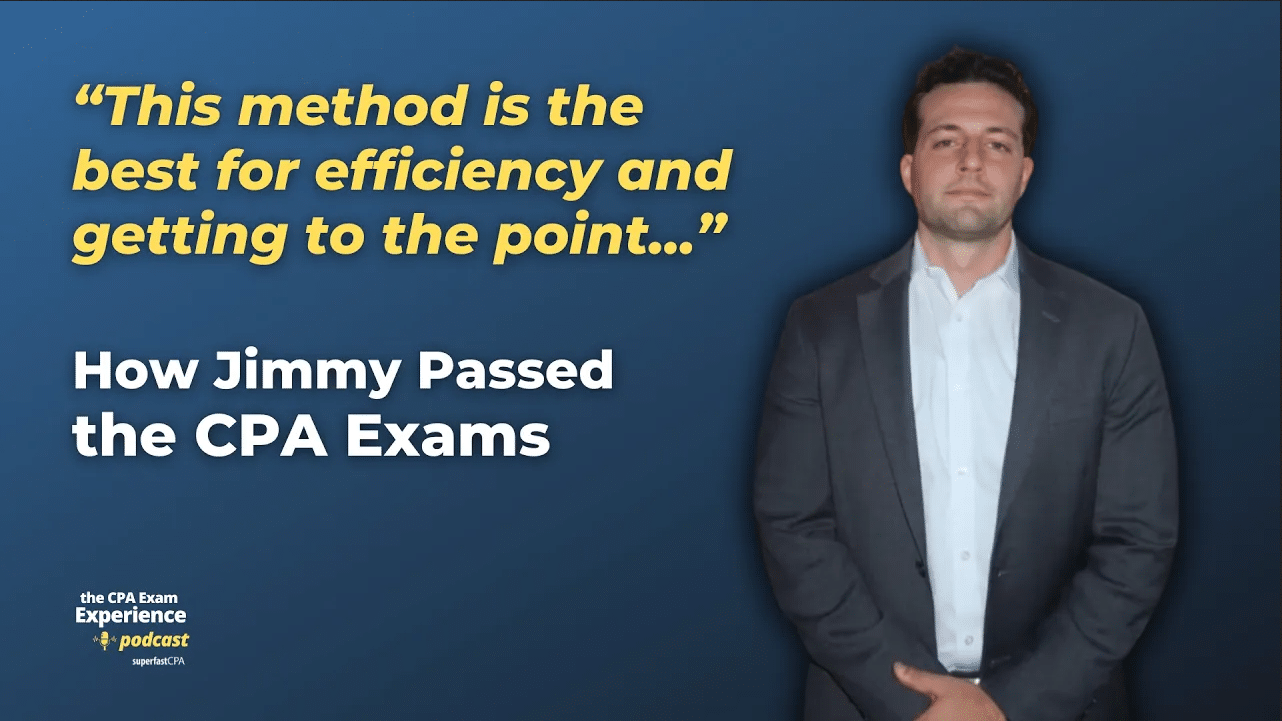
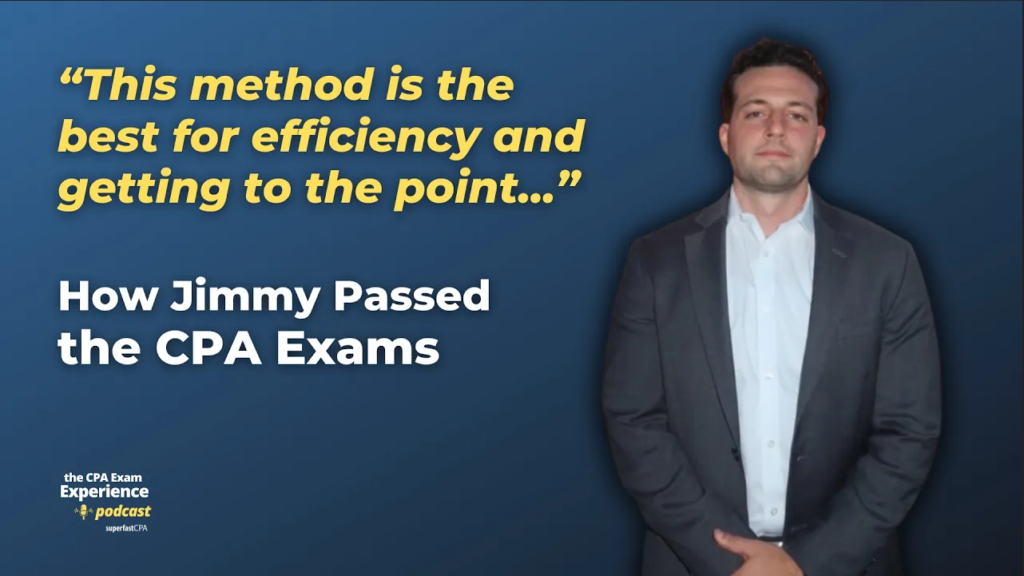
In this episode of the CPA Exam Experience Podcast, you’ll hear how Jimmy was able to pass the CPA exam by making small changes to his study process after his first CPA exam. Jimmy found SuperfastCPA right from the beginning, but didn’t quite implement all the strategies until after his first exam.
You’ll hear how Jimmy made these small changes, like studying in the morning and increasing his focus on the multiple choice questions, which led to him passing all 4 exams over the course of one year. Jimmy felt that he learned how to study efficiently and effectively, and his results show that. Jimmy lays out exactly how he passed the CPA exams, so you’ll want to listen all the way through this one!
IMPORTANT LINKS:
Master your study process by attending one of our free study training workshops:
https://www.superfastcpa.com/study-secrets/
Episode Timestamps
- 00:00 Intro
- 03:11 Son of A CPA That Ended Up Taking the Same Path
- 04:48 Pursued His MBA and Decided to Take the CPA Exams
- 05:50 Found SuperfastCPA Through the Podcast
- 06:28 Got the Total Bundle and Becker Even Before He Started Studying
- 07:09 How Jimmy Studied for His First Exam
- 09:07 Jimmy Passed His FAR Retake
- 10:08 Found That Switching to the Mornings Made Studying Easier
- 11:36 Getting Up Early Made it Easier to Establish a Study Routine
- 12:52 Studied the Questions First
- 13:52 The Time It Took for Jimmy to Perfect His Study Process
- 15:49 Made a Daily Goal for His Study Sessions
- 17:38 Practicing Sims Near Test Day
- 19:05 Jimmy’s Process for Learning the Sims
- 21:12 His Study Process As Time Went On
- 21:58 Doing Mini Sessions Through the Day Became a Habit
- 24:24 How He Learned Best
- 25:41 The Benefits Jimmy Found from Using SuperfastCPA
- 27:27 Getting Time Back for Other Things
- 29:10 Switching from Evenings to Morning Made Studying Less Stressful
- 30:14 The Reason Why Jimmy Thinks He Failed His First Exam
- 31:26 Being Consistent Helps With the Overall Study Process
- 33:08 Advice From His Dad
- 34:40 Finishing the CPA Exams
- 36:40 Felt That He Overprepared for TCP
- 37:23 Almost Ready to Get His CPA License
- 37:55 Plan Your Discipline Section
- 39:31 Top Tips For People Still Going Through the CPA Exams
Interview Transcript
Jimmy: [00:00:00] Yeah. I still, I mean, regardless of what time of day I was studying, I was doing the MCQ first method where I would, you know, go in, plant the seeds, all that stuff, come back, review every day. I, I thought that was genius from the start. I mean, I know Nate has that video where he’s like, “If you’re gonna learn how to shoot a basketball, what would you do? Shoot a ba-” And it, with me, that just stuck right away.
I was like, “Yeah, that makes sense. I’m gonna, I’m gonna go with this.” Because I mean, you know, with Becker, they really do push the lectures and sitting there and highlighting the textbook, and at the end of the day, that’s only gonna do so much for you.
You are not a computer. You are not gonna be able to memorize every single little thing you highlighted. And they go into extensive detail, which just isn’t needed for the exam.
Logan: Welcome to another episode of the CPA Exam Experience podcast from SuperfastCPA. I’m Logan, and in today’s video, you’re going to hear me talking with Jimmy.
Now, I really enjoyed my [00:01:00] conversation with Jimmy, and it was awesome to hear the big changes that, or really the little changes that led to his success, like studying in the morning, focusing on the questions, doing the things that really matter for exam day.
And Jimmy is somebody who pretty much started right away with the SuperfastCPA method, and he was doing most of it but wasn’t quite doing all the pieces of it, and he failed his first exam, but he wasn’t too far off. So he knew that the process was working, but he needed to commit fully, so he switched to studying in the mornings and doing all the pieces of the process.
And you’ll hear how Jimmy was able to pass each exam in only about a year. And something that I really liked was that he was talking to his friends, and he and they couldn’t believe that it had only been a year ago that he had started, and then now he was finished. It was an awesome episode with Jimmy, and I think you’re really gonna like it.
Now, before we jump into the episode, I just wanna give one more reminder, as always, about our SuperfastCPA training [00:02:00] webinar on superfastcpa.com. That is a free one-hour webinar that will save you literally months and months of studying and failing exams, because we will, again, teach you the key ingredients to passing the CPA exam. It’s not something you wanna miss, so make sure you check that out.
And then after that, you’ll probably wanna learn more, so make sure you also learn about becoming a PRO member or getting our supplemental study materials or, if you wanna be like Jimmy, getting the total bundle and just making the whole process a lot easier. So make sure you check all that out after you watch this.
Now, let’s get into the episode with Jimmy.
Logan: thanks for getting on the call today with me, Jimmy. How are you doing today?
Jimmy: I’m good, man. Good. Just, you know, riding that high from, uh, the last week of passing the exams, you know, just living life finally, not having something glooming over me.
Logan: Yeah, exactly. Yeah, that, uh, the, it’s such a crazy feeling, especially if you’ve been doing it for a while, like it just is so, so, such a good feeling. So I’m excited to talk to you about [00:03:00] that and, uh, I’m, I’m actually, I, I’m always excited when we get to talk to people kind of pretty soon after they have finished, because that way it’s really fresh and everything, you know?
Son of A CPA That Ended Up Taking the Same Path
Logan: Uh, so let’s go ahead and just get into kind of your story and the thing I always like to start with is where were you in your life or your career or, you know, whatever when you decided to start going for the CPA exam? Like, what were you doing?
Jimmy: Yeah. So to start out, um, I am a son of a CPA, so that was always something that was pushed since I was maybe five years old. Uh, you know, went to college, ended up actually being a finance major, believe it or not. So, but believe– after that, I ended up with a job in private accounting, you know, did an internship my senior year, got a job full-time, and then I was at kind of a crossroads where I was like, you know, am I just gonna do the accounting thing for a year and then maybe pivot out into financial, finance type role, or am I gonna stick with this accounting thing?[00:04:00]
So I end up, you know, making a decision to go back to school, do my MBA part-time while I’m working. So that took a couple of years out of school. And then directly after that, I started studying for the CPA exams while I was still working full-time. So that’s how all that happened.
Logan: So, so I mean that, that was something that you knew about from the beginning. So like that’s, I mean, most people like that I’ve talked to, that’s not the case. They’re like, “I was doing this and then this kinda happened,” you know? But, uh, that’s c- that’s kinda cool that your dad w- so what did he think about the…
Well, we’ll get into that. W- um, so when you started with the… or was it your mom?
Jimmy: Oh, it was my dad.
Logan: That was your dad. It was your dad. Okay. Okay. Um, uh, I think you said that it was your dad, but then anyway, sorry, my, my bad.
Pursued His MBA and Decided to Take the CPA Exams
Logan: Uh, so you start going for the CPA exam after you get your MBA, and what did you do to start? Like, how did you start studying for the CPA exam?
Jimmy: So, [00:05:00] b- so I actually stumbled upon you guys before graduating from my MBA. Like my final months I was like, “All right, what are, what are my next steps here? Like, am I gonna do this thing?” I was kind of like, “I don’t know.” I would like talk to my dad. He’d be like, No, you’re, you’re taking it. You, you got this far, you might as well finish the job here.”
‘Cause I think one of the things you guys push is like make your master’s degree worth it, and I think this absolutely is something that elevates you when you do pass it.
Um, so made the decision to do that, found you guys pretty early on. I took the advice of do 90% of what I say and 10% of what you say a little too literally, and I maybe took that 10% and made it to 50%. So I think we’re gonna get into the nooks and crannies of like the actual study process I did originally, but, you know, started out I think that May after I graduated.
Logan: Okay.
Found SuperfastCPA Through the Podcasts
Logan: So you had already, you had found SuperfastCPA from the beginning. Most people don’t. So did you… well, I guess, how did you stumble [00:06:00] upon it? Was it like a YouTube video or what was that from?
Jimmy: Um, I think I was just, I was actually looking up podcasts. Like I was looking, cause like I think I was, you know, just surfing Spotify or whatever looking for like CPA exam podcasts to see like what it’s like. Like if there’s anyone out there to like share their story and, you know, thank God you guys do this cause I found a bunch of stories from other people who went through your guys’ program, all that stuff. So, you know, that’s how I I, found you guys.
Logan: That was your introduction.
Got the Total Bundle and Becker Even Before He Started Studying
Logan: And did you purchase like the total bundle or the supplemental study materials or the PRO course? Like what did you have?
Jimmy: So at the time you guys were doing some type of deal, so I was like, no-brainer. It’s like one-time payment for everything. So I just got it all. I went through the whole, like, how you like teach you how to study, all that stuff. I had the audio notes, I had the, the multiple choice questions going, so I had everything.
Logan: So you had everything, okay.
Jimmy: Yeah, I start, I got that before day one. Like I was ready to go.
Logan: So yeah, before you even started studying, you had that. So, [00:07:00] and then what review course did you have?
Jimmy: Uh, I use Becker.
Logan: Okay. Yeah. Most people do. That’s just like the one that’s kind of pushed. So you had Becker, you had SuperfastCPA.
How Jimmy Studied for His First Exam
Logan: So let’s go ahead and get into like how you studied. So you were kinda mentioning that you personalized it a lot. So I guess we’ll talk about if that ended up being a good thing, uh, but how did, how were you studying when you first started? Like what did that look like?
Jimmy: so I am not a morning person whatsoever, so first thing off the bat I was like, “I’m not waking up at 5:00 AM. There’s no way.” So, I decided to start doing it after work, which big- I mean, like it, it was okay. Like I, I would say I probably got higher quality reps in the morning for sure.
Uh, but my first go around with FAR I did, um, afternoon studying or after work. Um, and then on the weekends I just studied, I guess, like when I would wake up or whenever I had time.
Logan: Yeah.
Jimmy: It was, it was one of those things and trying to figure [00:08:00] it out with like my life. And then also a big part of it was the amount of time I spent. I think I didn’t give myself enough time at first, like in terms of like weeks.
So I think I, I did like an eight-week study period for FAR, and during that time I also had a trip to go on, so I was like, “You know, I’m gonna, I’m still gonna do this and I’m gonna try to pass FAR at the same time.”
I remember actually being on that trip and like whipping out my laptop and doing like some multiple choice que- it was a bachelor trip, so like, you know, we’re, we’re having a good time. We’re, we were in Austin.
Um, it was definitely pretty tough to get some study time in during that week. It was, it was only f- it was only from like a Thursday to a Sunday, so I mean, I didn’t lose too much time, but definitely more than I would’ve liked for a test like that. Um, ended up just short by maybe six points my first go around, which
Logan: So like a 60– high, in the high 60s or something like that?
Jimmy: I think it was literally 69. [00:09:00] Like it was, it was right there. So it, it definitely commun- it like told me like, “Okay, you’re right there. You just need like maybe a few more weeks.”
Jimmy Passed His FAR Retake
Jimmy: So actually, you know, thankfully you guys have the retake thing that I could look up and kind of follow that, and only, I think I only studied an additional two, three weeks and ended up passing with a 82.
So this thing worked and the thing I did switch during my retake was study in the mornings. I was like, “All right, if I’m gonna commit to this, I’m gonna do it the right way.”
So I started waking up, I think originally because my job starts at, or at that time started at 8:00, so I would wake up I think 5:00, 5:30 around then, study for two hours and go to work.
Logan: I mean, that– I really like– I wanna talk about that switch because that’s something that a lot of people just don’t even really think about. Like, you know, and I actually think that part of the reason that the fail rates are so high is because people are studying when they’re not ready to study.[00:10:00]
As in, they’ve just been working for 8 to 10 hours using their brain and then they’re gonna try to study. You know, it just is, it’s just hard.
Found That Switching to the Mornings Made Studying Easier
Logan: Even if you’re a mor- even if you’re a, even if you’re a night owl, like even if you’re awake and that’s fine, but you’re mentally already kind of spent, you know? Um, and did you find th- that, that to be the case? Like when you switched to the morning you were like, “Wow, I’m retaining this better”?
Jimmy: Yeah, definitely felt a lot fresher every morning with the questions. Like after work, you know, there– like some days, yeah, great, like you have the energy to do it. Like you, you feel okay, like I’m gonna be up late anyway, whatever.
But there were days where like you would come home from work eight, 10 hours, whatever the case may be that day, and you’re like, “This is the last thing I want to do. There’s no way I’m sitting down and grinding through some questions or sims or whatever I had planned for that day.”
Um, but yeah, I, it definitely, it, it really does like, like you should do this when you’re fresh. You [00:11:00] shouldn’t do this when you’re, you know, depleted from the day.
Logan: Exactly. And, and something that I, I, I, you know, I’ve hit on this so many times, but I’m just gonna hit on it again. I think a big reason that studying in the morning is helpful isn’t just the waking up and being fresh, but it’s also the mental load. Like, if you are going to go to work and then you have to sit there thinking about, “Oh man, I have to study for like two or three hours after work,” that’s way more stressful than you just wake up, get it done, and then you can go to work and then come home and relax. You know, it’s just this totally different feeling.
Getting Up Early Made it Easier to Establish a Study Routine
Logan: Uh, and did you find that not only were you fresher, but did it change how you felt about the exam? Like, I’m just curious if that’s how y- if, if you noticed that.
Jimmy: it definitely helped me solidify routine because there would be days I’d come home from work and then there’s something going on at home or, you know, I have maybe plans and I’m like, “Okay, I’ll just study like late.” Like stuff like that. Like things [00:12:00] pop up at night. In the morning at 5:00 AM no one’s bothering you.
You’re not getting calls. Nobody’s barging into your room asking you about something or whatever the case may be. So like you were, you were by yourself. There, there’s very, there’s not a lot of people up at that hour.
Logan: Yep. And if they are up, they’re probably up doing something too, you know, they’re li- they’re not gonna go bother you. They’re probably running or something, you know, I don’t know.
Jimmy: Yeah.
Logan: But,
Jimmy: Like working out.
Logan: Yeah, I mean, yeah, I really love that you said that ’cause, and I mean, that’s how the world works, you know. The world revolves around, we all have like our workday, and then after work, we do all our other stuff.
And so that’s when everybody else is gonna be trying to do stuff with you, but then you have to go study and that just sucks. Like it just makes a huge difference to study in the morning. So I’ll, I’ll get off my little soapbox there and we can, uh, talk about other parts of your process.
Studied the Questions First
Logan: So were you studying the MCQs as your main studying from the beginning because of SuperfastCPA?
Jimmy: Yeah. [00:13:00] I still, I mean, regardless of what time of day I was studying, I was doing the MCQ first method where I would, you know, go in, plant the seeds, all that stuff, come back, review every day. I, I thought that was genius from the start. I mean, I know Nate has that video where he’s like, “If you’re gonna learn how to shoot a basketball, what would you do? Shoot a ba-” And it, with me, that just stuck right away.
I was like, “Yeah, that makes sense. I’m gonna, I’m gonna go with this.” Because I mean, you know, with Becker, they really do push the lectures and sitting there and highlighting the textbook, and at the end of the day, that’s only gonna do so much for you.
You are not a computer. You are not gonna be able to memorize every single little thing you highlighted. And they go into extensive detail, which just isn’t needed for the exam.
Logan: Yeah. I totally agree with that. And yeah, I mean, that’s awesome that from the start you were doing the MCQs and, uh, you know, it made sense to you from the beginning.
The Time It Took for Jimmy to Perfect His Study Process
Logan: How long would you say it took you to kind of like, kind of like have that click, like to where you were like, “Okay, yeah, I’m learning really well from [00:14:00] these multiple choice questions”?
Jimmy: So it took– so in total, it took me six tries to get four done. So I think after my– when I took audit twice and FAR twice, so of course the two beasts gave me a problem. Um, but after my, like, audit retake, I didn’t fail a test after that. Um, so I think at that point in my process, I was like, “Okay, I know what I’m doing,” ’cause then I knocked out REG, I knocked out TCP.
In TCP, I actually ended up with a ninety-three or something like that crazy, and that was, yeah, smoked it. Absolutely smoked it. So I think at that point, I, like, really got into the process and, like, knowing where I should be spending my time, what I should be doing, you know. And I think one of the biggest things that I did that really helped was just finding, trying to do as many unique multiple-choice questions or sims as humanly possible.
Like, I would even buy, like, new test banks. Like, I would do Becker and then I would buy Ninja’s test bank and start doing their questions [00:15:00] just to see different looks. ‘Cause, you know, they can only ask a certain type of question certain type of ways. Like, yes, there’s test questions that may throw you off on the test, but, you know, there’s– they gotta be fair at the end of the day, and they gotta, you know, the ones that do count towards your score gonna be pretty similar to what you’re seeing in Becker.
Logan: Yeah. Yeah, I mean, everything in all the review courses is super heavily based on AICPA questions. So like, whatever you’re seeing in Becker, whatever you’re seeing in Ninja, even if it’s slightly different between the two, it’s based off of the same thing.
So again, yeah, just like seeing it in all those ways and preparing, yeah, then you go into exam day and you’re like, “I’ve seen something kind of like this and I know how to do it.” It just makes a huge difference, like focusing on the multiple choice questions.
Made a Daily Goal for His Study Sessions
Logan: And you mentioned the sims as well. Um, what was your strategy with sims? Did you study them on the weekends like we kind of recommend, or like how did that, how did those [00:16:00] go?
Jimmy: So the way, I think this was a big part of me, like when I passed my like retakes of FAR and audit, I think I just had to bake it into my review every day. Just make sure I do at least two, three sims. Like I would, like especially once I get closer to the test or I was done learning, like I would start baking it into like my reviews.
Like I would make sure, uh, whatever, 30-some multiple choice and then two sims, and like make sure I, I hit the two sims. And, you know, I, I didn’t really, I know it’s like recommended like two hours or what- whatever your guys’ recommendation is, but I usually, my goal would be the amount of questions and sims for the day.
If I’m able to accomplish that and make sure I go over those as well. That was another thing. I wasn’t very proficient at reviewing what I got wrong my first go around FAR.
Logan: Hmm.
Jimmy: Like I, I really did like, like I would look for shortcuts really. Like y- like people online will always say like, “Oh, this isn’t really [00:17:00] tested much.” It actually bit me pretty bad in the, in the butt when I took, uh, FAR for the first time, ’cause I thought ratios weren’t gonna be there and,
Logan: And they were.
Jimmy: Yeah, they showed up. They showed up all right. Um.
Logan: Yeah that, just a note on that, like there’s frequently, not frequently, but there have been times where I’ve been asked like, “Okay, what do I focus on? Like, what’s the most important things?” And I’m just like, ” That, everything.” Like, there’s no way you’re gonna know what’s on the exam. Yeah, some things are more heavily tested, but you still gotta know everything ’cause you don’t know what you’re gonna see.
So I like that you said that.
Practicing Sims Near Test Day
Logan: Um, and then so you were doing multiple sims every day, especially as you were getting close to the exam, and were you doing just random sims or were you focusing on like areas that you struggled with or how did you do that?
Jimmy: It kind of, like most of the time it was just random. But if there was like a particular topic like I just couldn’t get or like I just didn’t understand, I [00:18:00] was like, “I want to go through a sim watch.” ‘Cause Becker, the one thing Becker does have and the w- thing I did watch of theirs is their walkthroughs of their sims,
Logan: Mm-hmm.
Jimmy: You know, they show you exact…
Logan: Skill builder, is that right?
Jimmy: Yeah, I think so. Um, they walk through exactly how they get their numbers most of the time. Some, some of the videos are a little like, “Oh, yeah, it’s supposed to be this,” but whatever. Um, try- not trying to take them down or whatever. They’re, they’re actually a pretty good program out there. They’re the most popular for a reason.
Um, but either way, um, you know, watching those videos and like making sure I’m like actually understanding each step of the process and why they got this or why they got that, um, was a big help too. But for the most part it was, it was random just trying to see different looks, like just the same ideology as I use for the multiple choice, just seeing it, seeing as, uh, many sims as humanly possible before I sit for my exam.
Logan: Yeah. And j- just [00:19:00] curious ’cause I, you know, sometimes I feel like I don’t break down sims enough with, with people on the podcast.
Jimmy’s Process for Learning the Sims
Logan: Were you– When you were doing a sim, how did you learn from it? Did you, like, try to finish it or did you just submit it and start learning from it? How did you learn from sims?
Jimmy: Right. Um, so it depended how much I knew. Like you guys do a really good job telling people like, “Don’t waste your time and try to like piece something together that’s completely wrong and it’s probably gonna confuse you more.” Um, so if I didn’t know it, I would submit it, look at the video, see how they solved it, and I’d be like, “okay, take everything away, solving it myself.” And I would just go down and, and run through it.
I mean, sometimes you remember some of the numbers that helps you out a little bit in the problem, but for the most part you’re like going, running through all the steps like how they would do it. So it still helps.
Logan: Yeah. So, so basically what you’re saying is like if you knew how to do it, you would try to do it. I mean, actually just a quick question with that. Did you actually even do those ones that you knew or did you kind of just be like, “I know this,” [00:20:00] and move on? Just curious.
Jimmy: I would just do them just for good practice. I mean, it’s not, yeah, not bad for like muscle memory or whatever. If like I knew exactly how to get it done, then I would just run through it
Logan: Okay. And then, but for the ones where you’re like, “I either don’t know how to do this,” or maybe you’d get stuck, you would just submit it and learn from it, learn from the skill builder. And then the key thing that you mentioned, you would re-perform it. That’s what you’re saying, right? And that’s like the key, that’s so key right there.
There’s– And that’s key with multiple choice questions too. There’s a difference between, you know, reading through the explanation and being like, “Oh yeah, okay, that makes sense. I get it,” and then going to the next question. Compare that to, “Okay, I think I get it. That makes sense. Now I’m gonna do it again without any help.”
That’s a huge difference, and it really shows you what you actually know. It really helps solidify if you actually know anything or, you know, it just [00:21:00] totally changes your learning, um, like the amount of learning that’s happening from a sim or a multiple choice question. Uh, anyway, that was just super key that you mentioned that there. I’m really glad that you said that.
His Study Process As Time Went On
Logan: Uh, so sounds like sims, you definitely practiced, practiced them a pretty good amount. You did multiple choice questions and were y- and you said that you were doing something that you changed was you were reviewing every day as well, right?
Jimmy: Yeah, I think my review became more thorough as my process went on. Like, I was doing the review, but like sometimes I’d be like, “I don’t really wanna look at them today. I’m just gonna move on.” So it, it was like a kinda half-ass version of, uh, you know, me doing it. ‘Cause like you have to look at them. If you’re not looking at them, there’s no point of
Logan: Yeah. Why did you even do the quiz? Yeah.
Exactly. I, I– that’s perfect. Uh, s-sorry, I didn’t mean to cut you off there. Uh, so with the– so that, that’s kinda like the main session that we’ve talked about.
Doing Mini Sessions Through the Day Became a Habit
Logan: So how did the rest of your [00:22:00] day go? So, you know, you do this studying in the morning, and then what did the rest of your day look like with like mini sessions and stuff?
Jimmy: Right. Um, so two hours, got it done in the beginning of the day, at least for all other attempts except the first one
Logan: Yeah, after that first one. Yeah.
Jimmy: Um, I would go to work. I would try to… My goal was always like, I think like five to 10 multiple choice, uh, things a day. Um, I really liked those. Those were probably the thing I used the most.
I, I did dabble in the, the audio notes a bit. Like, I- would use them sometimes when I was in the car, but I- the main thing I used from you guys was, uh, the multiple choice. Just again, my ideology was just trying to see as much as possible.
Um, so I would try to get those done during the day, whether I’m, you know, it’s a little slow at work or, you know, I’m going to the bathroom, whatever the case may be.
Um, even like at home, like if it’s, I’m at, I’m watching something and a commercial comes on, um, trying to [00:23:00] get something done between that. Just those little pockets of time where you c- you have like two minutes, like. And it, it’s, it’s funny ’cause I, I just remember, I just had like a memory pop up of like me like a year ago.
I was at a… Ah, what, what was I doing? Uh, I think it was a wedding actually, and we were like sitting at the table like waiting for our food. I’m like, “You know what? Let me do a multiple choice quiz.” And like, like I’m like with my girlfriend, Jo. I’m like, “Do you, do you know this?” And then she would like, you know, be like, “No.
Like how the hell, how the hell would I know, um, you know, anything about depreciation or, or income statements? Like what, what are you talking about?” And you know, stuff like that where I would just like ran- I was just so used… It just became such a routine that I would pull it out in random places. I, I specifically remember being out with like friends, pulling it out.
Like, it, it just, it just became a habit. It just became a habit. And like, you know, anytime I had time, I would try to just get it in my face and get it done.
Logan: I, I love it. That, I mean, [00:24:00] that’s the exact goal. That’s what we want people to be trying to shoot for is anytime they are doing something on their phone, they’re doing some kind of mini session. And for you, it was mainly the, uh, the mini quizzes. And, uh, I mean, yeah, that’s exactly what we want. You know, you pick up your phone to look at a text, “Uh, I’ll do a quick mini quiz,” or, you know, in between… yeah. I mean, you, you explained it perfectly.
How He Learned Best
Logan: Um, did you use the– So you used the audio notes a little bit. Did you use the review notes at all? Like the, the text version?
Jimmy: no, not, not really. It was never, so yeah, no , uh, no offense, but it was just not the way I learned. It just, you know, I, I was never a big like, like even when I would do like sessions and I would get something wrong, right, I would always just write things down. I would never go into that document, read it.
I would, I would just write it. I wouldn’t really look over it. I would just write it down, ’cause, you know, the mind connection [00:25:00] thing. Um, it was just, I don’t know, here and there I would try to look at things, but it just never, I felt like stuck as much as me actually actively doing a question or a sim or even like, I mean, I, I recommend this to people if like you’re really having a tough time with certain subjects, like watching a YouTube video and like trying to work with them through it or something like that.
I mean, again, you could go to Becker SkillBuilder, but you know, if you want to see something different, like go online and try to find a different type of sim.
Logan: Yeah. I mean, yeah, I, I can’t really, uh, add anything to that.
So, you know, we’ve talked about the mini sessions and we’ve talked about your, like the morning routine and the multiple choice questions and the sims.
The Benefits Jimmy Found from Using SuperfastCPA
Logan: Um, something I wanna ask as we’re continuing to go through this, if you could describe the benefits that you got from SuperfastCPA to somebody or to us, of course, how would you– like what would you say? What were the benefits?
Jimmy: I think it saved me a lot of time. I think you guys do an excellent job of [00:26:00] just pushing efficiency really, ’cause at the end of the day, there’s countless people out there. There’s a ton of, uh, you know, people doing the traditional, “I’m gonna watch a lecture. I’m gonna answer the question. I’m gonna do this.”
Like, that is very time-consuming. You know, you could, on one module or whatever in Becker, that could be four or five hours, you know? And if you’re trying to do that in a certain period of time or whatever the case may be, you’re gonna be either spending a lot of time upfront, meaning you’re gonna be spending four or five hours a day for four weeks or six weeks or whatever, or you’re gonna be spending four or five hours a day for 12 weeks or a little less, maybe three hours.
So I think you guys, your method is the best in terms of efficiency and just getting to the point, you know? ‘Cause at the end of the day, you’re gonna end up just doing the questions at some point. Like, even, even if you do start out watching the lectures, doing all, doing all the right things, [00:27:00] right, that you learn how to do in college, you are gonna end up at the same point as somebody who starts this way.
Logan: Mm-hmm. Exactly. I mean, yeah. You’re gonna end up having to do the same thing, and why not just cut to that thing? And also, that’s the thing you’re gonna be doing on exam day. You’re not being tested on how well you can watch a lecture, how well you can read a textbook. You’re tested on, “Can I answer these multiple choice questions?” So like, that’s what you sh- should be spending the majority of your time on.
Getting Time Back for Other Things
Logan: Uh, now, uh, I wanted to ask, this is something I like to ask sometimes, was there anything that you were still able to do because you were being so efficient? Because you were talking about how we push efficiency so much. Did you feel like that efficiency led to having more time in your life for other things?
Jimmy: Um, yeah, absolutely. I mean, I was still able to spend time with friends and family and my girlfriend, you know, maybe not as much obviously, I mean
Logan: Mm-hmm. Still a little bit of a sacrifice.
Jimmy: But yeah, of course. Like, you [00:28:00] were– like, I could still go see everybody. I could still make sure I’m spending time with people. Um, w- going to the gym was a big thing for me.
Uh, I was still able to do that. Um, maybe not as much as I did when I didn’t have the CPA exam looming, but definitely enough where I was like, “Okay, I’m still going consistently. I’m not like, you know, skipping weeks or, you know, not going less than like three or four days a week,” something like that. So it was
Logan: And would you go in the evening? Oh, sorry
Jimmy: Uh, y- yeah, I would go into e- those were tough days for sure. Um, I would… Yeah, I, I’m glad that, like, I don’t go to the gym that tired anymore ’cause I would, it would just be t- they were not great workouts most of the time. But I mean, I showed up. Uh, that, that was, that was the thing I was happy about, that I was still trying to have some remnants of my life.
You know, it doesn’t, doesn’t have to be something that, like, just takes over your life and, you know, you can’t do anything [00:29:00] anymore. Like, it’s not that, not that kind of thing. But, uh, yeah, like it definitely gave me some time back to, you know, use your guys’ method and, you know, go through my life like that.
Switching from Evenings to Morning Made Studying Less Stressful
Logan: And now just curious, like compare that first FAR attempt to the other ones, like where you switched from studying in the evening to the morning. Did your family or friends or even girlfriend notice like, “Hey, you’re around more”? Like did anybody ever mention that kind of a thing?
Jimmy: Um, I think it was kind of similar for the most part. Like I would, I don’t know. I mean, maybe. I, I didn’t think, I don’t think anybody said like, “Hey, you’re around more.” But like I
Logan: Nobody even noticed.
Jimmy: I, I think personally I noticed the difference ’cause, you know, my evenings were now like, like I’m, I can do whatever I want.
Like I, I can actually unwind after work instead of, you know, having to worry about my study session and then maybe trying to do something after that or whatever, call whoever. Like it was just [00:30:00] a lot less stressful. It’s definitely more tiring. Like I was definitely a lot more tired and I hated that, but it was less stressful so I’ll take it.
Logan: Yeah. I mean, stress is the real killer, uh, for these, for these kinds of exams, you know.
The Reason Why Jimmy Thinks He Failed His First Exam
Logan: So you kinda mentioned earlier that there was, you kinda personalized a lot of it. Were you talking about just specifically that first FAR exam, or was there anything else that you kind of changed and personalized throughout the exams?
Jimmy: Um, I’m trying to think here. I think a lot of it just had to do with not studying in the morning for me. I mean, I know that’s like you guys are like, “Well, like, as long as you’re doing the same thing, it doesn’t really matter what time of day you do it realistically.”
But it had to do with that, and I think just, know, I think just the discipline of like my review was also something that like I didn’t, I didn’t take it as seriously as I should have because that was just genuinely the most important part of it, and I kind of felt like if some days if I half-ass it, it’s not a [00:31:00] big deal. But
Logan: Yeah.
Jimmy: Clearly it, it bit me, so I’m not gonna… I’m gonna tell everybody out there to definitely review your, your questions that you got wrong and review them good. Don’t, uh, don’t discount that.
Logan: Yeah, exactly. Yeah. That’s a big, a huge part of SuperfastCPA. In fact, I would say that’s kinda like, you know, the MCQs and constantly reviewing, it’s kinda like the basic crux of everything that we teach, you know?
Being Consistent Helps With the Overall Study Process
Logan: Um, so I mean, honestly, sometimes these podcast episodes, I feel like we got to the heart of your stuff really well, and you, you were really, you know, you just kind of talked about your strategies really well.
Is there anything that we haven’t talked about that was a part of your process or even like a story or anything like that, that we haven’t gotten to talk about that you want to share?
Jimmy: Um, I think the one thing we didn’t hit on yet was, uh, the fact that you should never skip a day. Like, I really did live by that. Um, I’m trying to think. There– [00:32:00] I definitely did. Like, don’t get me wrong, I’m being a hypocrite right now. It definitely happened. But if you have the mindset to never skip a day, there will be very few days that you skip, um, if that makes sense.
It’s kind of like shoot for the stars and land on whatever cloud. I don’t know. I don’t know what I’m saying, but you know what I mean. Like, you, you should aim to never skip a day, ’cause the real, the real thing that drives you and gives you a lot of momentum going into the exam is just being consistent.
And, you know, that’s with anything in life, you know. It doesn’t have to be the CPA exam. Uh, consistency is key. Discipline is key. Like, those two things really do, you know, define what it is to be a CPA. Like, you need those things. So, you know, showing up every day is good
Logan: I, I love that. Yeah, I mean, and I, yeah, I think I only missed like two days in my process. One I was really sick and one was Christmas, and I was like, “Yeah, I’m not gonna, I’m not gonna study on Christmas.” But, um, yeah, I mean, it just, it’s [00:33:00] that hardcore mindset that like, I am going to do whatever it takes to pass this e- to, to finish this exam so that I can just be done.
Advice From His Dad
Logan: Um, and another thing that I kind of, kind of switching gears a little bit, but, um, I remembered that we talked a little bit about like your dad being a CPA kind of at the beginning. Did, was he a part of the process at all? Like, did he give you any advice or how did that go?
Jimmy: Um, I’m gonna try to tell this story the, the most PG version possible, I mean, it’s not that bad. But, uh, so originally, like I kind of mentioned like how I was like, “Yeah, I don’t know if I want to take the test or not.” Uh, when I told him that, um, I don’t think I could say what he told me, but he said something along the lines, “Don’t be a wimp and, uh, go ahead and take the test.
Like, don’t, don’t say you’re lying. Like if you use all this ener-” Like his big thing, and he told me this again when I failed my first exam, um, “If you spent this energy of [00:34:00] you whining, complaining, wanting to go file like a, you know, whatever, a review of your score or whatever, like if you use that energy that you have right now whining about that into study, you would pass.” those are, those are some good words of advice for anybody right now that’s frustrated with this process, because I’m sure there’s a ton of people out there right now that are frustrated, mad even.
Um, just use that, use that anger, use that anger, get back at it, wake up tomorrow, get after it. And you know, those were key to my retakes, you know, a lot of anger into those study sessions to get over the hump.
Logan: You, you gotta ch- you, you channeled that anger. I, I… that’s awesome.
Finishing the CPA Exams
Logan: And so, and when you finished, I mean, you just barely finished, so you, I don’t know if you’ve gotten to do anything yet, but do you have any plans to celebrate or anything like that?
Jimmy: I mean, so last week I was actually sick. I– s- when I found out which, yeah, which sucked ’cause I was like, the first thing I wanted to do was go, like, [00:35:00] grab a beer with my buddies.
Logan: Uh, so just, uh, I mean, in case anybody notices that it looks slightly different, his laptop died, but we’re just getting right back into it with the phone.
Jimmy: I mean, you know, finishing the CPA exam within a year, like studying full-time is an achievement within itself. Uh, you know, I think, um, I’m, I know there’s people on here that like knock it out in like six months, but I, the one thing I blame is the discipline score release, cause I took discipline last.
So, um, I, I don’t know if I advise taking it first, ’cause usually it’s the easier one. I, I like, I like that I finished up with the easiest one, at least ’cause it was just the least amount of content.
Logan: Oh, yeah. Well, no, TCP really is like, and I’m– it is still a hard exam, like it’s still a CPA exam, but has the highest, highest pass rate, has way less material than like the core exams. Like, uh, yeah, if you wanna save something a little simpler for the end, TCP or ISC might [00:36:00] be a good idea.
And the way that you did it, getting FAR and Audit out of the way, again, like that makes it so that the hardest stuff is out of the way at first so that you’re not like up against that wall trying to finish up in time, like when you ha- when your scores are about to, to expire, you know? Uh,
Jimmy: Right
Logan: So, and, uh, and that’s kinda how I felt too. Like when I was, the, the discipline exams didn’t exist when I was doing it, but I, I finished like the year before they started and, uh, but I did REG last, which was, I was working in tax at the time and I, so it just like, and I’d passed the other three and I was like, “I, I got this.”
Felt That He Overprepared for TCP
Logan: And it, you know, wasn’t as bad as the other ones. Um, and I mean, you crushed TCP, right? You got a 93?
Jimmy: Yeah. Yeah, no. I mean, I think I overprepared for sure. Like, I was at a point with my multiple choice questions, like I was doing my, my sessions of those and the sims and like I was scoring 90s on them. I [00:37:00] was like th- I’ve never felt this good going into an exam. Obviously, it’s confidence boost, number one, but like, you know, I was just like, “I can’t prepare any more for this than I’m already like,” You know.
Logan: Yeah.
Jimmy: I could’ve, could’ve maybe took like less, like a week less, but, you know, better to overprepare
than, yeah.
Logan: In the end it doesn’t matter ’cause you’re done now.
Almost Ready to Get His CPA License
Logan: Uh, so what do you have left to officially become a CPA? Do you just have to submit all your stuff or do you still have like the ethics exam?
Jimmy: Um, so I’m in New Jersey, so there is no ethics exam. I think there’s like a CPE course I might have to take.
Logan: Okay.
Jimmy: I still gotta, yeah, I gotta submit my experience to the board, NASBA, all that lovely stuff, more waiting. Love, yeah, just th- this, this whole process is just waiting. Like, that’s what, like, yes, there’s a lot of studying going into it, but most of it was just waiting.
Plan Your Discipline Section
Logan: I mean, especially for that la– how long did you have to wait for your discipline score [00:38:00] to come out?
Jimmy: So I, the way it lined up, I took REG in March, got my score in April, and April was one of the discipline windows. I was considering doing like a three-week just head down, nothing else is going on in my life except TCP. But I was like, “You know what? I deserve a little bit of a break, and I know this isn’t recommended.”
But I had a va- like, I had like a trip coming up in April anyway, so I was like, “All right. You know what? I’m gonna take my time. I’m not gonna rush it. You know, there’s a, a chance I rush it and then fail, and then I gotta do it again in the summer, and I’m gonna be miserable.” So I was like, “Okay, let me take this time.”
I took like maybe like a few months off, and then I came back, smashed TCP in early July. It was like July 2nd, so I had like a 10-week wait in between me the test.
Logan: Yeah.
Jimmy: To yeah, like I, I counted the days, don’t worry. Like, I, it was one of those where I, I was just so mad ’cause I was like, “I, I wish I could [00:39:00] just find out maybe like a little bit after July was over. Like, that would be more reasonable, but hey, I’m, I’m not, you know, it’s out of my hands.”
Logan: Yeah. And now you don’t have to worry about it anymore. Well, you have to worry about some other waiting, but, uh… yeah, I mean, I think that we’ve covered pretty much everything that, that I usually wanna cover. So, I think that we’re, we can kind of finish up here. It’s been awesome talking to you. And I, I mean, I, I saw your post in the forum and I was instantly just like, “Gotta get this, gotta get him on.”
Top Tips For People Still Going Through the CPA Exams
Logan: Um, so to finish up, I’ll ask the same question I always ask and that i- and even if it’s something you’ve already talked about or we’ve already talked about, but if you could give your top two or three tips to people that are still going through the CPA exam, what would you tell them?
Jimmy: Uh, the number one tip that I would probably give people is to, uh, you know, never skip a day. Um, you, uh, you gotta be consistent. You gotta aim to, you know, keep reviewing [00:40:00] every day. Don’t, don’t skip that. Again, review, review, review. Um, you should not, you know, take that, that session that you do at the end of your study sessions lightly.
That should probably be the thing you’re spending most of your time on, the thing that, you know, you’re gonna be doing every day. It’s, it’s a building block. Like, you keep building every day, and you get closer and closer to your goal.
Um, I think general test day advice, because I was rattled the first day I ever in a Prometric center. I didn’t know what to expect. They’re, they’re fingerprinting me. I’m giving their m- my social security number, all that stuff. Like, all this in- I don’t know if you give them your social there, but whatever. You know, they’re,
Logan: It feels a little intense, that’s for sure.
Jimmy: Yeah, like I, I probably did on accident because I was so scared. But but, um, yeah, um, what was I saying?
Logan: Yeah, just like Prometric, yeah.
Jimmy: During, the test, like it is, it is key to, uh, just be okay and, you know, not let a few bad [00:41:00] multiple-choice questions get you down or make you feel like, “Oh, I’m gonna fail this. This is over. It’s done,” or a bad sim even. Um, use your break. Go into the bathroom, but like, whatever you gotta do.
Like, take your break, you know, don’t, don’t sit there and just– ’cause I feel like if you sit, at least for me, I, I’m always moving, so like I need to like get up. Like, sitting there for four hours straight is torture. I can’t do that. Um, you gotta take your break. You gotta, you know, refresh, get back into the session.
Um, but yeah just don’t, don’t let things get you down during the test. You just gotta be confident you know what you’re doing and, you know, make your best guesses.
Logan: Yeah. And yeah, and I mean, you’ve prepared so much up to that point that you, you know what you’re doing, or at least probably know what you’re doing for most of it. So just trust that you knew, you know, enough to get a 75 because you’ve been preparing that way the whole time, you know? Um, [00:42:00] and I, I like what you said. I always took my, I think everybody probably does, but I always took that 15-minute break where time wasn’t running. I mean, it’s just such a relief to just take a second.
Uh, those were very good tips and advice, and I mean, yeah, don’t skip days. Always do your re-review every day. Just those are some great tips.
Well, it was awesome talking to you, Jimmy, and, uh, yeah, I’m just excited that we were able to get you right after you finished your exams. Congrats on being done, and hopefully the rest of it doesn’t take too much longer.
But yeah, for on the call today.
Jimmy: Yeah. Good talking to you.
Logan: All right. That was the episode with Jimmy. Again, I thought it was a great one. He really just kinda talked about everything that you do in the PRO course. Everything that Jimmy did is pretty much something that we talk about in the PRO course, and he followed it, and he passed his exams, and it’s as simple as that.
Was it easy? No, these exams are not easy. [00:43:00] But he was able to pass the exams even with a couple fails, and he did it in about a year, which I think to a lot of people sounds crazy. They think, “I’m gonna take all 30 months,” or it used to be all 18 months, to do this, when you can really do it in a year, six, seven, eight months, you know, something like that.
It’s totally possible when you follow the right strategies and when you are efficient. And that is the whole point of SuperfastCPA. So make sure after you watch that and listen to that with Jimmy, that you go check out our SuperfastCPA training webinar on superfastcpa.com. Again, just like I said before, it’s a one-hour webinar for free where we will teach you the key ingredients to passing the CPA exam.
We give incredible tips there that you probably will be like, “Oh, that is so obvious, but I never thought of that.” Probably like some of the things you heard in the interview with Jimmy today. So make sure you check that out. Then also make sure you check out becoming a PRO member or getting the total bundle, which includes the PRO course [00:44:00] and our supplemental study materials.
I think this episode with Jimmy was great. I hope that you liked it. If you liked it, make sure to like it and leave a comment in the YouTube video or leave a rating in your favorite podcast app.
Thanks for watching or listening, and we will see you in the next one.