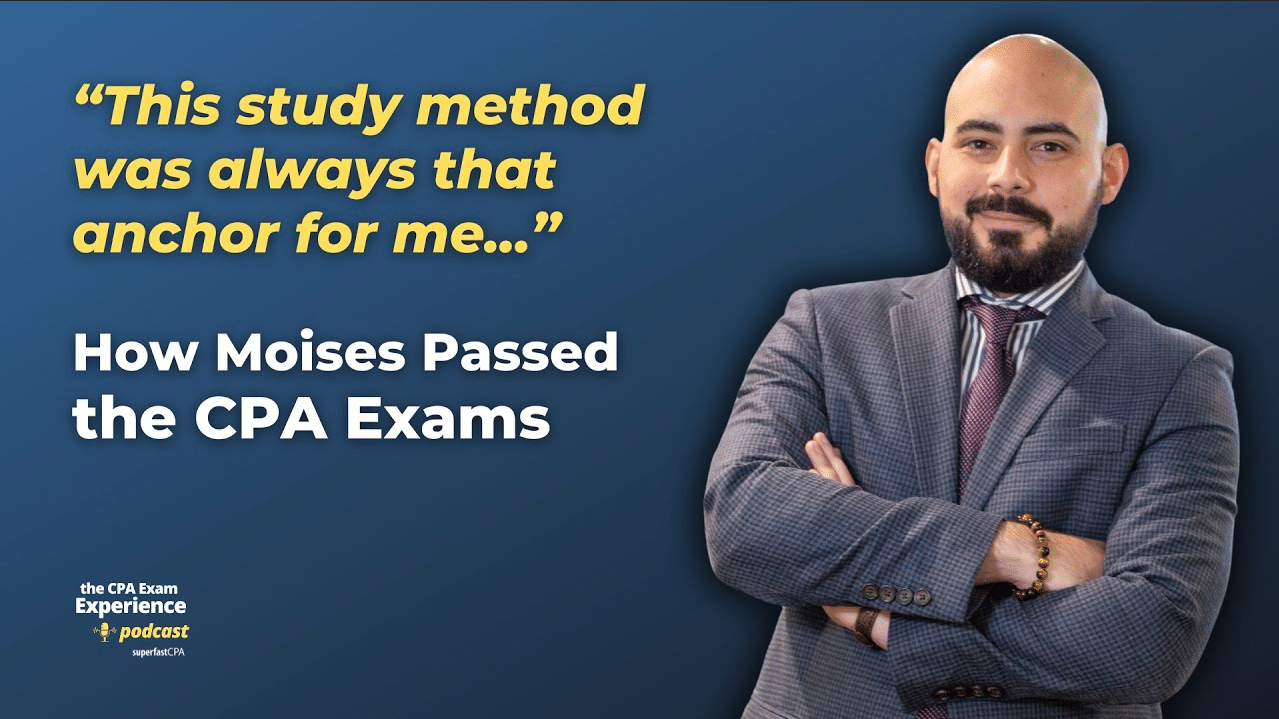
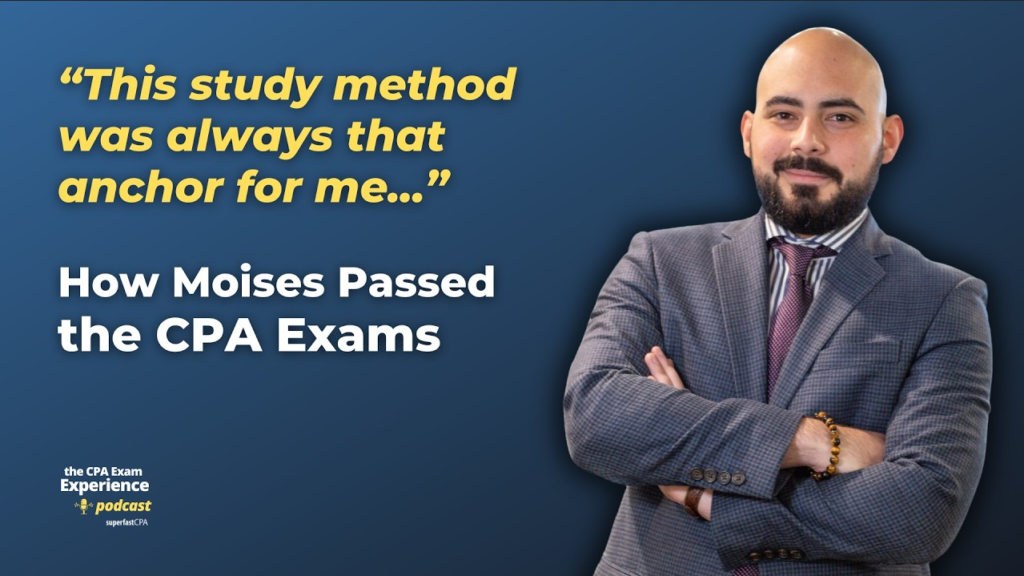
In this 200th episode of the CPA Exam Experience Podcast, you’ll hear how Moisess was able finally put the CPA exam behind him with the help of the SuperfastCPA coaching program. Moises went from struggling off and on for almost 10 years, to passing all his exams in about a year and a half.
You’ll hear how Moises was able to change his focus to the multiple choice questions, which made a huge difference for him. Another important thing to pay attention to was how Moises overcame his discouragement. At one point, after passing some exams, he failed an exam he was expecting to pass. For a time, this really discouraged him. Listen for how he overcame this feeling, because it happens to people all the time! Moises’ story is a great encouragement, make sure you listen to the end!
IMPORTANT LINKS:
Master your study process by attending one of our free study training workshops:
https://www.superfastcpa.com/study-secrets/
Episode Timestamps
- 00:00 Moises Interview
- 04:53 Had a Lot of Side Quests, Didn’t Take the CPA Exams Seriously
- 06:30 Felt Obliterated after Taking His First CPA Exam on FAR
- 07:43 A Point in His Career Where He Couldn’t Progress Anymore
- 09:11 Spent Around 10k Worth on CPA Prep Review
- 10:18 Switched Studying to AUD and Finally Passed
- 12:08 Retook FAR and Failed Again Then Found SuperfastCPA
- 14:18 The Feeling of Studying Ineffectively
- 16:51 Going Through the Whole PRO Course Was A Game Changer
- 20:02 The SuperfastCPA Method Helped Build His Study Routine
- 22:34 The Consistency of Studying 2 Hours Built Up Through Time Made Studying Easier
- 24:35 Was Able to Be Present with Family When He Gets Home After Work
- 26:49 Glad to Have Learned this New Way to Study
- 29:26 Sold on Studying the Active Way of Learning Through the CPA Exams
- 30:49 How Moises Tackled the Sims
- 34:12 Manage Your Test Time to Maximize Your Chances of Passing
- 37:12 Alloted a Fixed Amount of Time per Testlet
- 42:19 Some Tips That Helped on Test Day
- 47:15 Reviewing The Notes from the Weekend Cram Session Before Exams Helped
- 48:35 Studying for the Difficult Topics and Getting Help from AI
- 53:02 How Moises Used AI Tools to Help Him Study
- 54:24 Getting Out of the Fatigued Mental State
- 57:16 Going Back to His Why is What Got Him Over the Bump for His Final Section
- 01:02:49 The Feeling of Finally Being Done with the CPA Exams
- 01:04:48 Knew That He Needed Accountability to Get Through the Exams
- 01:07:11 Top Tips for People Still Going Through the CPA Exams
- 01:09:04 Took 11 Years to Finally Finish the CPA Exams with SuperfastCPA
Interview Transcript
Moises: [00:00:00] I got to the point where I knew I needed that accountability for myself to get to that next level and getting through the exams.
And I just really appreciate, I don’t know how you guys targeted the ads or whatever. It was right on time because I felt that I needed that accountability.
My wife, I think, tried to be my accountability partner in that CPA sense, b-but it’s just different when you have someone who has gone through the process and they know how hard it is to get in that mindset.
And it’s really just getting to the point where you know you’ve had enough of it living in your mind and then, and being a place of burden that you just get serious and lay that foundation and then have those people around you that can anchor you back and bring you back when you start feeling discouraged or lose confidence in that.
I think, Superfast definitely provided that in in those ways and then more when, especially when you get to the point of you failed one or two or whatever, [00:01:00] knowing that process is can be relied on to, to get you over the hump. It’s just a matter of knowing why you’re doing it, and you guys provide the how, so.
Logan: Welcome to another episode of the CPA Exam Experience podcast from SuperfastCPA. I’m Logan, and in today’s video, you’re going to hear me talking with Moises.
Now, Moises is somebody that I had in the coaching program, and it was really awesome to be able to work with him throughout a lot of his process, and I actually started helping him towards the very end of his journey. It had been a long journey, you know, a lot of people experienced this, where he had been trying for a long time off and on, I think it was about 10 years, of not really having very much success, and so he eventually decided to go for SuperfastCPA.
He tried that for a little bit, and then he joined the coaching program, and we were able to work together, and he was able to start seeing results.
[00:02:00] Now, Moises has a lot of awesome tips and a lot of awesome things to say. Something that really helped was, of course, switching to the mornings. Another thing that really helped was focusing on the questions.
Again, he has a lot of great tips, and I think you’re gonna wanna listen all the way through this episode, because he is someone who is similar to a lot of people. He struggled with the exams for a long time, and then he was able to make some key changes and start passing exams.
And actually, another thing that is going to be very helpful about this interview is there was a point where Moises was very disheartened. He failed an exam that he didn’t expect to fail, and it really set him back. It really made him really discouraged, but we were able to talk through it, and he was able to keep going, and then he was able to pass the exams.
So again, listen to this episode for some encouragement because failing an exam can feel really horrible and it can make it very difficult to continue, but you can keep going and you can pass these [00:03:00] exams. Moises is proof of that.
I’m excited to share this episode with you. Now, before we dive in, just one quick reminder about our SuperfastCPA training webinar on superfastcpa.com. That is a free one-hour webinar where we will teach you the key ingredients to passing the CPA exam so you don’t waste months or even years of your time failing exams.
And then there’s a lot more to SuperfastCPA, so you’ll be able to learn more after you watch that webinar. That’s the best place to start, and then you can look into everything else. Now, with that, let’s dive into this episode with Moises.
Logan: Good morning, Moises. How are you doing today? I guess, is it just barely afternoon for you right now?
Moises: It is. It is. And by the way, I wanna give you props for pronouncing my name, right off the bat, first time, like didn’t need to coordinate or anything like that, so I appreciate that. Yeah.
Logan: Yeah. Uh, I lived in Costa Rica for two years, so the Spanish names usually aren’t too, too hard for me. Uh, so yeah, Moises. Uh, so I’m, yeah, I’m excited to talk to you on the call today.
Uh, just a heads-up to people who are [00:04:00] listening, Moises is somebody that I had in the coaching program, and so I was able to work with him, and it was awesome to, like, see his progress. So we’re gonna talk about all that today.
Um, where are you calling in from today?
Moises: Uh, Orlando, Florida.
Logan: Oh, Florida. Okay, nice.
Moises: Pretty hot. Hot and humid.
Logan: it’s been… We’ve had a lot of rain randomly here in, uh, Utah, and it’s, like, way more humid than it normally is, and it’s really, like, bothering me cause I’m used to the dry heat.
So I’m sure Florida would be, like, even worse.
Moises: It’s crazy. Humidity is intense and then we, uh, recently, uh, obviously the famous afternoon showers kinda get us. So it’s been, it’s been… I feel like it’s pretty wor- it’s, it’s gotten worse since, uh, this summer for some reason.
Logan: Well, at least you get to enjoy the rest of your summer cause you’re done. So let’s kind of dive into, you know, your story.
Had a Lot of Side Quests, Didn’t Take the CPA Exams Seriously
Logan: So again, you were in the coaching program, but let’s kind of talk about what happened before that. So where were [00:05:00] you in your career or your life or however when you decided you wanted to get the CPA?
Moises: Man, uh, when I, when I came to you guys through, uh, through advertisements and all that kind of stuff, I had, had, had thought through what had gotten to the, gotten to me, gotten me to this point. And I can just say that my l- my, my life and career up to that point has been full of side quests. So I was always kind of half in, half out with, with accounting and specifically with the CPA.
So I, uh, out of college, um, I went right into Big Four accounting, uh, busy season, and that was a, a big transition just going from like regular, you know, school work hours to then just full-bore, uh, busy season grind. And ended up finishing that internship not feeling like Big Four was gonna be, uh, the path for me.
I took some time away and found myself in a mid-size [00:06:00] public accounting firm. And all throughout that time, the CPA was just pushed pushed pushed and pushed and encouraged.
And at the time, I was just kind of, you know, uh, maybe 22, 23 at the time, just kind of wanting to experience life. And when I say side quests, I, I, I found a girl, got married, did all of the, all of the things, traveled, did all of those things in between and never really gave a full-hearted attempt to the CPA course.
Felt Obliterated after Taking His First CPA Exam on FAR
Moises: So I probably started right out of college, r- right after the… I got into my internship. They paid for Becker, and I made the fatal mistake of planning all my exams back to back to back to… like, I had no, no concept to what the CPA was or, like, what I was getting into. Just knew that, like, “Oh, I passed my accounting classes. I should be ready to go for, uh, the CPA.” I had the credits to sit for it, so I was like, “Let’s just bang this out.”
I think I took on FAR first, [00:07:00] and that first year out of college and in, in my internship. And when I tell you I got chewed out and just got wrecked, it’s an understatement. I, I was obliterated and so was my confidence.
And so not only did I have that, but I had, like, all three of my other tests scheduled right after. So they all lapsed within that, that i- incredible explosion of just, uh, not really understanding what the CPA was, not really, uh, trying to research, like, what it was gonna take. Even though I had the, the prep software, the Becker, um, it was just, it was just a, a, a, a combination of just inexperience and, and, like, just not taking it serious.
A Point in His Career Where He Couldn’t Progress Anymore
Moises: So after that epic failure, there was a lot of, um, half in, half out mentality where I was like, “Okay, maybe I’ll revisit this again.” Or I was thinking maybe we’ll see how this public accounting thing goes. Maybe I’ll only be here a couple years, so maybe, [00:08:00] maybe the CPA won’t really impact my, my career path.
Um, so I kept doing this half, half dance where I was half in studying a little bit, half not. And so it never really gained traction. So what ended up happening was it just kept eating at the back of my mind. Always the CPA, always the CPA as I progressed through the years in, in public accounting.
And at the job that I wa- that I wa- that wa- that I was at, I essentially worked there for 10 years and got to the level where I was capped. I was hard capped. And that whole time I was just kind of putting off the CPA, putting it off. It’s not, you know, I won’t see myself here long term and, and it happened.
Logan: And then it was 10 years.
Moises: 10 years kind of flew by and I have a, a family, kids. I, I have three kids now, uh, obviously with my, with my beautiful wife.
Uh, you know, buying a house, doing all the, the life things and never really giving the, the time or the space for the CPA. [00:09:00] And so I found myself kind of progressing through the ranks, and I’m at a point where I can’t progress anymore in the career, uh, that I was seeing myself in without the CPA.
Spent Around 10k Worth on CPA Prep Review
Moises: So then I said, “Okay, something’s gotta give. Something’s gotta happen.” So I worked as a audit supervisor and, um, I took just on a whim, I was like, all right. I kept trying FAR. So FAR was like my, my… became my big monster that I could never get over. It became this huge monkey on my back, and I always kept trying again, again, again for, for FAR.
So I said, “All right. Let’s just clear the slate. Let’s try for audit and let’s just see what happens.” I studied for audit kind of on my own using, uh, Becker. In, in the meantime, by the way, in those years, Becker had a time lapse, so my Becker course expired.
Logan: Oh, so you had to rebuy.
Moises: I, I had to… I bought Surgent and I didn’t like Surgent and then ended up back on [00:10:00] Becker. So if you add all of that up, that’s probably more than like 10K worth of just study, study prep material.
So this was adding up and this was becoming, like I said, this was becoming more than just career progression. This was like life. I need to show that I can do this.
Switched Studying to AUD and Finally Passed
Moises: So clear the slate. I was using Becker again and I said, “Okay, I’m gonna take audit and see what happens.”
I studied for audit and by the grace of God got a 76, like what, what I needed for just enough to build up my confidence to be like, “Okay, maybe this is manageable.” Uh, wasn’t expecting to pass at all. Like I said, my, my confidence and like the, the place that I had gotten to, uh, career-wise just was never lending itself to good, uh, confidence building for the CPA.
So I was- wasn’t really expecting it. Got a 76. I was like, “Okay, now the timer’s on. Now let’s see what we can do.”
Logan: At, at that point, was it a [00:11:00] 18-month timer or a 30-month? Like had, had it switched yet?
Moises: Yeah, it switched. It switched. So we had the 30… so this is probably like a year and a half now because I started, uh, Superfast maybe like, um, I transitioned into a new path, a new c- a new job in pr- in private, uh, company. So I left public accounting into a private company, which I think in hindsight really lifted the burden of like busy season hours, busy season… like, it’s always grind mentality now all of
Logan: And also the crushing, like probably the, like you’ve gotta get your CPA, you’ve gotta… like, that probably was heavy as well.
Moises: Exactly. Yeah. And so I went into a company where my first thing I told my CFO was like, “Hey, by the way, I passed one of my exams.” And he kind of just like, I was on the phone with him and he was like, ” Okay. Yeah, great. Good for your…” Like, complete opposite demeanor, not saying that it was, uh, frowned upon, but it was just like a whole different, uh, mindset to what it meant [00:12:00] to get the CPA. So a lot of those weights, like you said, just lifted, and so I started studying for FAR again.
Retook FAR and Failed Again Then Found SuperfastCPA
Moises: So after Audit, I was like, “I’m gonna try FAR.” And, um, maybe a couple of months into my new job and this new rhythm of life, I took FAR and got a 72, I think. And so e-either 72 or very close right there.
And that’s when I kept seeing, uh, Superfast just being advertised. Superfast every other YouTube video, right? And I had actually subscribed and, um, to, like, the newsletters and stuff like that. So I kept getting these emails every so often of a, of, of a round robin of, like, spots open for Superfast training, coaching, accountability. And so there were specific windows that opened up.
And so I, every so often I would see that email and just a little bit more interest. I was like, “Man, maybe I should try that.” So [00:13:00] after this failure, I actually, what I did is whenever the, the spots had opened up, I had clicked the link to the portal, and so the portal would either be open for the spots or it would be closed down for that season.
And so I re- I bookmarked that page, so I stopped looking for the emails and I just kept refreshing every so often on that, on that website, and one day out of the blue, I was able to get to, like, the registration.
And so I registered, but I don’t think I was formally part of the, the onboarding group. I think I kind of like slipped in by, again, I kind of call it like, you know, God, God working there and s-somehow he knew I needed it at the time.
So I was able to sneak into the program, and then I start getting these communications with you and, uh, a-and Nate and the team. And so that’s when we started to really kind of buckle down on strategy, the Superfast method. Um, you know, [00:14:00] it, it was also encouraging to hear both you and Nate kind of voice notes kind of encouraging me and building up my confidence, so to speak, and saying like, “Dude, you’re so, you’re so close. We’re gonna see great… like, you’re the perfect…” You know, kind of, kind of reinforcing that, like, I had made a good decision to kind of start this coaching program.
Logan: Yeah.
The Feeling of Studying Ineffectively
Logan: So, so one thing I kinda wanted to, like, ask about as a contrast. So just to make sure I’m understanding you, so way at the beginning, you had all of those exams, like, right next to each other. So did you only take FAR and then that one scared you so bad that you didn’t even take the other ones, or did you still try the other ones and the, and you failed all of them?
Moises: Oh, I, I tried. I
Logan: Okay, so, so you tried all.
Moises: It was horrible.
Logan: Okay. Okay. And then..
Moises: I figured stopped at two. Yeah, so at the… I, I think I tried REG and then was like, “Okay, my confidence is shot here.”
Logan: Yeah. And so, and then over the years, you were… did you keep, uh, taking exams over those years? Or again, was it kind of just like study for [00:15:00] FAR but then never take it, or what was that like?
Moises: There was a combination of the two. So there were moments where I w- I felt kind of inspired, motivated, right? That, that initial burst of energy that you get when you’re trying to get back on that horse, and then I would either fall short and like not even sit, or I would, I would study and then that energy kind of faded out to where I wasn’t studying effectively and I… or I would lose track of like the Becker, you know, tracker. I, I was trying to do the whole Becker, like how they suggest, right? The linear approach, the watch every single video, watch every, do every simulation, you know, try to get that meter fully complete.
Logan: Get the green check mark.
Moises: Exactly. Exactly. So I was very much trying to do that, and then ultimately falling desperate and, and, and, and, and almost, it was almost like a self-fulfilling prophecy ’cause I wasn’t fully committed.
So I kept reinforcing that, that, um, negative perspective and that negative confidence, um, when I [00:16:00] didn’t fully commit. And so I maybe sat for it maybe two or three separate times, but I almost don’t count them because they, they weren’t like the study method. Yeah. Yeah. I wasn’t really going after it the way I did when I passed audit, right?
And so I had that phase where I was studying for FAR and kind of, again, did it the linear method. Um, a little different, but did it the linear method and was actually really trying, and I still, you know, fell short. So I was like, “Okay, something, something’s gotta give.” And I’ve always been
Logan: And so that’s first made that change. Okay.
Moises: Yeah. So I’ve always been someone that, that needed some type of different type of structure or, uh, always willing to try new, new methods to just get this thing done. And so, uh, I mean, SuperfastCPA obviously, you know, you, you guys targeted the right audience there, and so that’s, that’s how I came along.
Going Through the Whole PRO Course Was A Game Changer
Logan: So what intrigued you about, like, I guess what changes helped? Like contrast, you know, before where either [00:17:00] you weren’t fully studying, fully committed, or even when you were, it sounds like you were just doing the normal way of studying, so, you know, lectures, textbook, all that. Um, so contrast that with what changes happened when you got SuperfastCPA.
What were some of the big changes that really made a difference for you?
Moises: Uh, I, I, I really appreciated that, uh, the first thing that was kind of suggested was to go through the full video library of the, the mentality of SuperfastCPA, what it actually means. Yes, the PRO course, yeah. And so what it actually means to, you know, really commit. There– I think there was one… I revisited the videos a handful of times too, which was good, and I think Nate even said it in some of his videos that like, “Hey, you’re gonna come back to these videos and it’s encouraged.”
Um, just some of those laid the groundwork really well of like, “Okay, this is why you’re doing it. Like, don’t forget that big why.” And I think, Logan, you and me revisited that when I was like kinda on that last exam and just kind of [00:18:00] felt that hurdle or that fatigue maybe. Um, but just always refocusing the mindset and, and kind of renewing the mind of like, “This is the big why.”
And obviously, I had my wife and the pressures of life kind of like bearing down of like this i- it’s, it’s a now or nev- the responsibilities are only gonna continue to grow. Um, and so a combination of all those things just made it to where, all right, I, I need to lock in and, and, you know, so Superfast gave a very tight way to do that, a, a really easy way to kind of check the box, right?
Of like, “Okay, I did, you know, my two-hour session in the morning. Check. I did my, my multiple choice and my, uh, you know, uh, audio, uh, um, learning session.” So I’d be able to check the box. It gave you a really firm structure to like if all else fails and like, you know, you’ve tried the linear way and all these kind of things, if you commit to this process, just showing [00:19:00] up and actually putting the reps in, um, over time it’s gonna, it’s gonna show. So I think that was the biggest thing.
Logan: Right. Yeah, I mean, that, I mean, and you know, as you mentioned in the coaching program, that’s something that I really hammer a lot is the consistency with the process. Like, you know, every piece of the process has a point to it, and doing it consistently, you know, doing it all every day, those two things really kind of start cementing your, uh, your knowledge and your ability to pass the exams.
Even if you maybe still don’t pass each exam first try, you’re still making a lot of progress, and it’s like tangible progress. And I saw that with you. I mean, like, you came in, you’d already passed audit, and then, and you’d had that close score with FAR, and I remember, like, reviewing your stuff, like your, uh, your assignments and things like that, and I was like, “Okay, yeah, you’re, you’re getting it.” So I knew you were [00:20:00] on the path to finishing the exams.
The SuperfastCPA Method Helped Build His Study Routine
Logan: Um, j- just one question with the… So w- when you were studying before, were you studying in the evenings, like after work? Like, or were you studying in the mornings?
Moises: And that’s another thing that probably helped the structure of like, hey, you know, prioritizing the mornings over, or, or not even that, but like just having a time that you know that like this is the time where you dedicate to studying. Um, I was all over the place. So I was, you know, and during busy season even got more volatile, right?
So like, uh, a lot of the times it would be evenings or even like if I got out of a meeting or something like that and I had a few extra, extra spare minutes, I would try to squeeze in some, some time. But it wasn’t consis- it wasn’t built up over time like this method, right? The, the, the, the study method that Superfast offers is that there’s always that anchor, and as long as you’re consistent with that anchor, all of the other stuff is just [00:21:00] reinforcing that anchor that you are establishing.
So if you commit to the process and like, uh, obviously the mornings worked for me when I made that transition. It, it was hard for sure. I think I, I, I messaged you a couple times of like kind of falling out of missing a couple mornings or, or something like that. But going back to like, okay, don’t, don’t stray away from it.
Let’s just try to build back that momentum, that, that consistency. Um, either, you know, if the mornings didn’t work for me, your encouragement was always all right, like find another anchor point in the day, but you have to have that dedicated time where you’re consciously like everything is
Logan: Yep. This, this is the time that I’m studying.
Moises: Yeah.
Logan: Yeah, yeah and that’s something that, I mean, for the majority of people studying in the morning, whether you’re a morning person or not, is what I tell people because life is so busy. I mean, I mean, you, you have three kids, you have a wife, you have a job, you have [00:22:00] probably a ton of other commitments, and most of those commitments happen later in the day, like during the day and in the evening. Um, you know, pretty much everybody who’s taking the CPA exam has a busy life.
And so doing it in the morning, you know, set aside the freshness of the brain, whatever, you know, set aside those things and just making sure that it gets done before your myriad of other things that you need to be doing was, is the big reason why we push that. Like, just get that done so that you don’t have to worry about it the rest of the day.
The Consistency of Studying 2 Hours Built Up Through Time Made Studying Easier
Logan: Um, and did you find that that, like, you know, when you were consistent with those two hours, did that make it so that, you know, the rest of your day went a little more smoothly? Like, you would have work and then you probably still had time with your family. Is that right?
Moises: For sure, 100%. Uh, it definitely, when I was really in the flow state, like I could definitely recall for like, I mean, for all of the rest of the, of the sections that I had for, I, I [00:23:00] did, uh, ISC, um, obviously REG and, um, what was the other one? FAR. Right. So in each of them, I kind of reached a, a flow state, so to speak, where it was like so consistent that I almost looked forward to like checking that morning session off the list because it became something that like, “Okay, I got this done,” and like if the day goes horribly, I know I had, I had this time.
Or, you know, there would be moments where my wife would check in on me and she would be asking like, “Hey, how, how was your study session or what’d you do?” And just to be able to tell her like, “Yeah, I, I knocked out two hours,” or like, “I, I really made progress in this area.” Um, what was really great towards that, that phase where, um, it usually kicked in around maybe like two weeks to three weeks out before the exam.
That’s when it really started hitting, where it almo- almost every time without fail, it kind of a culmination of like the consistency plus the material [00:24:00] finally clicking, that it was like, “Oh, I’m on a roll. Like let’s, let’s go.” And it almost was like you’re not, you’re, not that you want to study every morning, but it was like, I got it.
Like, you, you got into that rhythm where it wasn’t as discouraging as like, you know, doing a session and, you know, bombing all of the multiple choice, right? You know how the methodology has worked and you know you have historical evidence to show that it’s been working before, so it just kind of keeps you in that state.
So for sure, I look forward to, uh, crossing it off the list in the morning.
Logan: Yeah.
Was Able to Be Present with Family When He Gets Home After Work
Logan: And did you, um, did your family notice a difference in this way of studying compared to before? Like, did you, were you able to have more time with them?
Moises: Yeah, for sure. I mean, uh, it– towards obviously the, the tail end of, like, when the actual exam day happened, I, they, they noticed a, a ramping up of, like, me just… And it wasn’t just, like, your sessions, but it was just me, like, [00:25:00] “Okay, I gotta make sure that I cram as much as possible in this week’s span.” But, you know, I was able to knock it out in the mornings.
Logan: Right
Moises: Yeah, a-and kind of sprinkle it throughout the day. So I wasn’t really anxious when I got home, and was able to really be present with my family and not really have to be thinking in the back of my mind like, “Oh, I gotta open my textbook,” or, “I gotta open up a Becker session when I get home and, and try to catch up.”
And I think even in the beginning, Logan, I may have messaged you when I was getting used to the program. I had, had gotten into a bad habit of, like, leaving some of, like, the multiple-choice stuff, like the mini quizzes, towards the end of the day. And it’s like, no, no, no, you don’t wanna accumulate. You wanna, like, kind of spread it out.
And so implementing that made it easier to be more present cause I’m, again, I’m not, I’m not thinking so much of, like, carving out that time when I already kind of established it early on. Yeah.
Logan: Exactly, yeah. I mean, that was one of the things that I loved so much about [00:26:00] the process when I was doing it was, you know, I was so busy. I was going… I was doing my master’s degree, I was working, and I had two babies at home, and I was… but because I got the two hours done in the morning and then did the mini sessions throughout the day, I was able to still go home and, you know, even at least spend like an hour with my family before I maybe had to go do homework or something like that. Whereas I, I just like imagine like, what if I had saved my CPA studying either for, either just never did it during that time, and then I would’ve had to deal with it after my master’s program, or, you know, studying for like three hours after work and after school and everything, probably never getting to spend time with my family like, it just makes a huge difference. Um, so I really like what you were saying there, like just it made, made it so you were able to be more present.
Glad to Have Learned this New Way to Study
Logan: And so you also changed, you know, you not only were you studying in the mornings, but you probably changed your focus, right? You weren’t watching the lectures, you weren’t, [00:27:00] uh, reading the text, but you were specifically going to the questions.
Did you, was it hard to get used to that, or did that feel kind of natural pretty quickly?
Moises: I think it felt natural pretty quickly. And to be honest, like I- I’m reflecting back, I’m like, I feel like I kinda learned a new way to learn, if that makes sense. Like you are, uh, attacking the exam at, at where exactly you’re gonna be. And like Becker’s great program because it’s literally looks exactly like the test.
So like if you, you know, you’re getting familiar with the question format, you’re getting familiar with how the questions get presented and like the nuances. So like, it’s almost like, like I said, it’s, it’s, it’s a newer approach to learning, which I hadn’t ever really adopted prior to Superfast. So to be honest, it kinda helped me feel like, okay, I’m getting prog– I’m getting these reps in with the questions, right?
Which before I’d be like, “Oh man, I really gotta check off that check mark that shows that I’d watched all of the videos.” [00:28:00] And like half of the time I’m just… it’s almost performative. I’m just doing it just to say that I watched three hours of video, which is like, you know, eating up your time and like eating up your mental space, and then it gives you a false sense of security later cause you’re like, “Oh, I, I watched all of this content. I should have, I should have everything I need,” right? And so
Logan: I did, I did something similar with my, uh, with my first, with my first exam with audit. Um, it took me a while to finally kind of implement the strategies, and I remember that even after I, like, finished, like, I, like I, even after I started applying the SuperfastCPA strategies, I, uh, wanted to see the green check mark so bad that I literally went to the, all the lecture videos and just clicked through them.
I didn’t even watch them, but I just like, just clicked to the end of each one so that it would show that I had even though it literally didn’t mean anything. And, you know, it’s almost the same [00:29:00] mentality of like, like you said, like you feel like you have to. You’re wa- you’re like, “I have to watch these, otherwise I’m not gonna be prepared.” And, but then after you watch them, you’re not really that much more prepared, and then you still have to go practice the questions and, um, and kind of work through that anyway, cause the questions are totally different. As, as I’m sure you can attest, like you watch the lecture and then you go to the question and it’s just a totally different way of applying the concept.
Sold on Studying the Active Way of Learning Through the CPA Exams
Moises: Yeah. I, I, I definitely think Nate also hit on it too. It’s a, it’s a much more active way of learning when you’re like going through the questions and like some of the tidbits. I mean, I don’t know if I can share some of the secret, but like reading it out loud and like working through it, w- working through it and like, I must have sounded like a crazy person in my office sometimes when I’m like talking through some of the questions and explaining it to myself, like, uh, you know, how I got to a certain answer is it’s a way more engaging… uh, to be honest, it’s, it’s a little bit more fun than like [00:30:00]
Logan: Mhm
Moises: Taking notes and like regurgitating or, or things like that. It’s a, it’s a lot more active.
Logan: It’s more, it definitely makes it more interesting. Like, you know, I don’t know if you can ever say that the CPA exam’s fun, but, um, but it definitely, like you were mentioning, you can get into that flow state of where you almost enjoy or look forward to your study sessions because you are doing what’s effective.
Like, you’re jumping straight into the questions and you’re like, “I know this is exactly how I’m s- like what I’m, I’m practicing what I’m going to see on the exam.” So it’s almost a little exciting or it just keeps it interesting because you’re like, “This is exactly what I need to be doing.” Um, and like you said, it’s more engaging so that keeps it more interesting because you’re like, “Okay, this is how this all works together.”
How Moises Tackled the Sims
Logan: Um, and did you find that with the, uh, sims as well? How did you study for the sims?
Moises: Uh, so to be fair, I– it, it [00:31:00] wasn’t until REG that I paid attention to the sims too much. So in the disciplines I did ISC, and so ISC was, because it’s newer, it’s a newer discipline, the, the resources for the sims weren’t nearly
Logan: There’s only like… eight sims right?
Moises: Yeah, it’s not really that robust, and when I sat for the exam, it was completely, like, completely different.
So, um, and then for FAR, I found, heh, I had taken the exam so many times, I almost, I almost knew the types of q- like I knew there was gonna be a statement of cash flow. And then everything, everything else was… So I, I kinda made sure that I, I looked at the sims for the cash flow, make sure I knew that, you know, front and back or whatever.
Um, so I don’t know if it was just me in particular that FAR liked giving me s- uh, statement of cash flow question sims, but literally every exam, I must have taken it, like, I think five times, and statement of cash flow, like, always showed up.
Logan: Every time.
Moises: Yeah, every time without [00:32:00] fail. So, and that was kind of like my, my, my, my view if, like, I knew I got that statement right, I was like, “Okay, I’m in good shape. I’m kinda like, I’m close.” Um, so I didn’t really use it too much until I got to REG. When I got to REG, I don’t know if it’s just the way that they ask the questions or the way how the rules are s- you know, specifically defined that you need to be looking really, uh, in detail at some of the source documents, but I found myself going to that a lot more, specifically in, like, the separately stated, um, items for, for K-1s and things like that.
Um, so that’s when I, I used the sims and, um, I would just re-watch the ones that I knew. There’s actually a way, uh, for me, for Becker, there’s a way to see the sims, uh, when you do, like, a set. In the sims, they will identify the ones that are, like, AICPA authored as opposed to, like, ones generated from Becker [00:33:00] themselves, and so it’ll say AICPA authored.
So, like, for the multiple choice, I think they’re, like, 90%, almost all of them are AICPA authored. But for the sims, I found out that there’s only, like, a handful of actually AICPA authored sims that, like, are implemented in, in the REG software. So out of the 50, I think maybe 10 or 12 were, like, AICPA authored sims, so I, I looked through those.
Um, so I spent some time looking at that. So I don’t know if that helped me or, or, or anything. I mean, it did help obviously cause I, I passed, but just the, just getting used to the format I think helped, um, specifically for REG. And so that’s, that’s how the sims kind of helped me.
Logan: Right. Right. So you, so just making sure I understand you there. So you focused on the sims once you got to REG that were made by the AICPA, kind of just assuming that if this is from the AICPA, it’s probably fairly similar to what I’ll actually see on the CPA exam. Is that kind of your thought process?
Moises: Yeah, [00:34:00] and then I, I think I ended up taking REG maybe two or, uh, three times in total. So the third one is when I got the pass. But, uh, the other two
Logan: Was that, that was the last one you passed, is that right? Just barely? Okay, okay
Manage Your Test Time to Maximize Your Chances of Passing
Moises: Yes, So I, I got REG on the third try, and the first two attempts, I noticed that I was, like, leaving too much time on the table, so I wasn’t dedicating that time to sims, um, like I should have.
Um, because as soon as I changed that formatting of adjusting the time, I was able to, to, you know, pass. So I, I passed, uh, REG with that. So I had some reps in with the actual CPA exam for REG, so specific sections that I knew I had problems with. Um, I think it’s R3, the biggest one with the, with the, um, LLC and, and what’s separately stated and things like that. So,
Logan: Yeah
Moises: Yep. So that’s really the area that I kinda dedicated a lot of, like, my sim time to.
Logan: Okay. [00:35:00] And let’s kind of talk a little bit about that, about, um, exam day timing. So when you’re saying that just, you know, for anybody who maybe hasn’t really thought about the timing for the CPA exam, you’re mentioning that you would get through these multiple choice questions in a good amount of time, but then you wouldn’t s- like, kind of like, you weren’t diving into the sims.
You were kind of may… I don’t know if this is the right word, but rushing them a little bit, cause then you would have time left over at the end of the exam that you could have spent perfecting the sims a little bit more. Is that kind of what you’re getting at?
Moises: Basic– Yeah, that’s exactly what it is. So up until prior to REG, um, uh, with FAR, I had literally… I used up all of my time. And so I, you know, the, the obviously the multiple choice are, are rigorous, so when I got to the testlets, they, they also kind of take up a lot of time. So my mentality was, because I was using all of the, the, the time on those sections, I didn’t really think [00:36:00] about like breaking up the, uh, the… when I say breaking up, it’s like I, I wrote down right before the exam like, “Okay, testlet one, I’m dedicating this amount of time. Testlet two, this amount of time. Three, this amount of time. Four and five…” Laying out like the markers, the flags that I should be looking for to move on to the next one. With, with FAR, I had done that, but I was always pretty good with keeping up with the trend, so I never really,
Logan: Okay. It kind of just happened naturally.
Moises: Yeah, it kinda happened naturally. And then with ISC, ISC honestly was my highest scoring one. Um, and the sims were a lot, to be honest, it was a lot simpler, so I, I didn’t question whether they were, they were incorrect or not, to be honest. So I had plenty of time to review each of the multiple choice, each of the sims, like really well.
So I wasn’t… I didn’t have an issue there. But with REG, um, I was ki- I got into the rhythm of the multiple choice, so I like flew by [00:37:00] the multiple choice and was comfortable with them. And so then when I got to the sims, I was like, “Oh, I need to make sure I leave enough time for…” I always thought there was gonna be a, a more harder sim coming up.
Logan: Yeah. bigger sim. Okay.
Moises: Yeah.
Alloted a Fixed Amount of Time per Testlet
Moises: So, and, and obviously the way the CPA exam works is once you submit a, one testlet, you can’t go back to that, so you gotta optimize the time that you have. So what really was the breakthrough for me is that I said, “I am not moving from this testlet or this sim until I use this exact amount of time.”
So for the multiple choice, the last time I sat, um, I, it had it- the multiple choice questions, and so if I got through it in like- 30 minutes. I did not move on until I used, I think it was like 35, uh, I think maybe, I forget the breakdown. I think it was maybe 45 minutes for the, for the MCQ and then a little bit more time on the sims.
So if I got it done in 30 minutes and I still had 15 on, on, on the, on the radar to, to moving, [00:38:00] until I get to move on, I would use those time like, all right, stay there, review all of the questions and then if you feel certain and you’ve, uh, you went through all of the flags, um, that’s another thing that I would do is flag, you know, if there was anything that it took more than 10 seconds to understand what that question was asking, I’d flag it and just do all of the easy, the layups is kind of what I called it.
And, and so, so I made sure that I stuck to the allotted amount of time for each testlet. So that prevented me from rushing. And so then when I got to the sims, I knew, okay, 50 minutes on this sim, that’s it. Like, even if I finish it in 25 minutes, the other 25 minutes is just even redoing it to make sure that I, you know, didn’t miss something.
And so I remember on the last testlet for REG, I may have caught like two or three things that I don’t know if it contributed to passing, but I caught two or three things that I was like, “Oh, if I, you know, if I didn’t carve out that [00:39:00] time, I probably wouldn’t have caught it.” And so yeah, so it was definitely for REG, I think I got into the, the rushing mode and then didn’t flesh it out, and I think REG is one of those sections that like very nuanced. So if you, if you,
Logan: Miss one thing, messes up the rest.
Moises: Exactly. Exactly. So,
Logan: Yeah. Yeah. That, I mean, that, that’s definitely true for REG, like with the tax returns and th- and things like that. Like, you mess up one part of it, and then the ending tax is messed up and the other calculations are messed up.
Um, and you know, th- this kind of all goes back to something that we’ve talked about a million times on the podcast and, you know, we talk about in SuperfastCPA in general, but, um, just how important the pacing is for the exam, especially being really good at multiple choice questions. Uh, like you said, you were, you had, you had the multiple choice questions down and you, it sounds like you were getting through them in like an hour, hour and a half,
Moises: Yeah, they were really quickly.
Logan: Yeah. Um, and you know, [00:40:00] our, our recommendation is max two hours for the multiple choice questions, cause that’s way, that way you still have two hours to do all the sims. Um, but again, if you get so good at the multiple choice questions that not only are you doing them quickly, but you’re doing them well, like you’re getting good points, like you said, they kind of become easy points if you know what you’re doing a lot of the time. So, you know, that’s, that makes it so that you’re done with the MCQs by like hour, hour and a half, maybe two hours, and then you still have two, two and a half, three hours to work on the sims, and that made it so that you could take the time to really make sure that each sim was done, which is a huge difference maker, you know, like you’re saying.
Moises: Yeah. And, and recognizing the pattern too for the sims, so like I think REG is two, three, two. So in, in, in the past for the sims, like I didn’t even think about like this one ha- only has two versus this one has two. I like really made sure that I knew, okay, I have two sims here. I’m gonna, you know, [00:41:00] I’m gonna dedicate the, the allotted time for it.
And so that forced me to slow down, exactly what you’re saying, pacing. It, it, it’s all about giving yourself that, that grace to be able to look back and like you could have overlooked something. And so the last, um, time I took REG, I went from like last two times that I had failed, I had left like an hour on the clock, and that was my flag.
I mean, I probably should have caught it on the first fail, but, you know, you live and you learn, uh, that I was leaving too much time on the table. So it was don’t, don’t let it, don’t rush it and just let it trust the process that you’ve built out for yourself.
Logan: Right. Yeah. And, um, you know, that’s not to say that, cause there definitely are times where I’ve seen people who, there was one person I had on the podcast, her name was Samantha, who she finished every exam in under two hours, the entire exam. [00:42:00] And I was just like, “Geez.” But, and she passed them. So like, you know, it depends on the person, but overall, the most important thing, like we’ve been saying over and over again, is the pacing.
Like, you don’t wanna make it so that you only have 10 minutes to do three sims. You, you just can’t do that. Um, so anyway, that’s why that’s also important.
Some Tips That Helped on Test Day
Logan: But, um, and kind of still talking about test day, were there any other things that you found to be helpful? Like any tips or advice that you have for like being in the exam or kind of like prepping right as you’re about to go into the exam?
Moises: Uh, for me, I definitely really appreciated Logan, uh, I mean, Nate has a video that has kind of like a prep on exam day, which is, I always found pretty helpful, which was showing up an hour, maybe even an hour and a half before the exam. So that would force me, you know, uh, to get there early enough to not be, like, rushing.
So, like, I remember times for, like, FAR [00:43:00] or audit that I would get there, like, right as the time starts, and so I was, like, kind of just dropped in and, like, “Go, go take this exam.” So it- it’s almo- it’s almost like it’s easier, and I had been studying before, but, like, just arriving to the s- test center and, like, making sure you have everything kind of in almost, like- a pre-checklist before you go in just kind of puts you in the right mindset.
And there were definitely times at the testing center where just some things you can’t even control. Like, there was one session that I went to where, uh, the person– like, you’re supposed to arrive 30 minutes earl- you know, on the notice it says you should arrive 30 minutes before the actual exam starts.
And, um, it just so happened that day there was, like, a new person starting at Prometric or whatever, and she was a real stickler for this 30 minute, arrive 30 minutes before the exam. And I was like, “Am I even gonna be able to sit?” Cause she was just very, like, [00:44:00] I can’t belie- you know, she– I think I may have arrived, like, 15 minutes before the window.
So instead of being 30 minutes early, I was 15 minutes ear- right. And so she made a big deal about it being thir- no, it has to be 30 minutes. Um, so if you arrive early, right, you kinda save yourself from things that you can’t even control or can’t even fathom.
Another thing, another thing that I did was made, made sure hydration, right? Uh, I think there was another time where same person, the same session, I had to use the bathroom, and I, I did, like, an optional break. And the person, again, was newer. Yeah. Yeah. Yeah, yeah. So I did an optional break, and I stepped out. Well, that person was like, “Wait a second. You did a break without…” She thought that I wasn’t allowed to step out of the room.
So there was, like, 10 minutes I’m sitting there, and I didn’t pass this time, so, you know. I didn’t pass
Logan: It could have that.
Moises: It could’ve been that. Uh, but I was, like, 10 minutes in trying to figure, you know, with the proctor trying to figure out, [00:45:00] like, did, you know, did he or did he not use his bathroom break appropriately, right?
So, like, if you get there early and you, you know, use the bathroom when you need to use the bathroom, make sure everything, uh, you know, you’re good, and sometimes you can’t really prevent that. But, like, doing, getting there early really solves a lot of that issues, right? A, a lot of those issues.
Um, I think another random thing is I always wore a hoodie. So if you wear, like, a jacket, they make you take off the jacket, and you can’t, you have to leave it in the locker. But if you have a hoodie, you, there’s no easy way to take it off, so you can leave it on for the exam, and then if you get hot, you can take it off. But the Prometrics that I had been to had always been really cold, so I almost had a, a ritual outfit that I would wear for the exams. So I
Logan: You wouldn’t have to be worrying about the cold,
Moises: Yeah. Yeah, yeah, yeah. Yeah, yeah, exactly. I had a specific hoodie. I had a specific outfit that I would wear for all my sections. Um, so that’s,
Logan: I did that too. I had a Metallica shirt that I wore to every exam.
Moises: [00:46:00] Nice.
Logan: And, and yeah, talking about the, the, the timing. Well, actually just kind of in general, like with test day stress, I think that one of the best things about practicing so much before the exam with multiple choice questions and with sims is that it really helps you kind of stay calm in the situation because you’ve been doing it for weeks.
You’ve been doing the exact same thing, and I remember similar thing to y- like there was somebody who had just started that day. This was my last exam too. Um, and I really had to go to the bathroom at night. It was one of those optional breaks, and I went out and I was like… And she was like sitting there like, like, “I don’t know, like is thi-” And I was like, “Listen, I have been here four times. I know that I can do this. Just give me the dang…” Like I didn’t say it, but I was just like, “Just give me it and I will go.” And she was like, “Oh, okay.” And like, uh, but yeah, like you can’t really control those situations.
But again, what I’m trying to say with this is [00:47:00] even though that was a little bit annoying, when I came back, I wasn’t stressed or flustered by the exam cause I still knew what I was doing.
Um, and did you kind of feel that somewhere, like you’d gotten to the point where you’re like, ” I just, I know what I’m doing, like”
Moises: Yeah, yeah.
Logan: “I know how to do this.”
Reviewing The Notes from the Weekend Cram Session Before Exams Helped
Moises: 100%. Yeah, yeah. And unfortunately, you know, I think with the exception of, I think ISC, which I passed on the first time, I th- and, and, and audit. Um, the other two, REG and FAR, I had multiple, multiple attempts o- on it, right? But, but it definitely was that thing of like, you’ve done it over and over.
You’ve had those reps and, um, another thing that I had obviously right bef- on, on exam day that, you know, uh, right before sitting in with some of your notes, your like ke- notes or flashcards, I think at the end of my process, I had just handwritten notes of like all of the questions that I knew I had gotten wrong from like that weekend cram session.
I think Nate also made a great suggestion to [00:48:00] schedule your exams every Monday, um, o- on a Monday. So obviously, my PTO took a, took a hit on those days, but it was great in the sense that I like had two full days, a, a full weekend to really just eat, sleep, breathe this exam, and then on Monday, just dump it all out there and, you know, le- let, let that, let that be what it is.
Logan: Leave it on the table, yeah.
Moises: Yeah, yeah.
Logan: And actually I was going to ask about that. So like this is something that we recommend is, you know, studying your flashcards and stuff right before you go into the exam.
Studying for the Difficult Topics and Getting Help from AI
Logan: So in general, not just on exam day, but like in a, as a whole, what did you do when you were going through the material to kind of help difficult topics stick? Like how– did you do flashcards? Did you take notes? What did that look like?
Moises: So for me, it was, uh, I definitely took handwritten notes, so it got to the point where I would, I would use some of the suggestions that you ha– I [00:49:00] think for FAR, I had an Excel that had like all… cause there’s so many different types of questions in FAR, so I had kind of an Excel for each of the modules, and I had kind of broken out by s- by module where my hard points were. And, um, I would either do a flashcard in FAR, but on REG, I ended up handwriting a lot of the rules and, and, and, uh, little nuances.
Um, so the things that would help me, it, it was actually one of the newer things that they added, some of the AI implementation. Like, there’s an AI in Becker, but there’s also… I mean, if you go, yeah, if you go on ChatGPT too, uh, uh, as well, you can… I would take screenshots of my question, and, like, if I got it more than o- more than once incorrect, like if I saw it again at a, in a different session and I got it wrong, I would kind of plug it into the ChatGPT and just be like, “Dude, I would, I’m, I don’t get this. Explain it to me like I’m five, and then give me something to reinforce it.”
[00:50:00] Or, um, I would tell it to, um, uh, kind of make it stick. So I would kind of tell it specifically, like, “I need to be able to remember this on exam day. Like, how do I make a quick e- either rule or mnemonic or something like that?” And, and nine, maybe like seven out of 10 times, ChatGPT would come up with like a really good idea.
But to be honest, sometimes it would just come up with like a ridiculous way to remember it. And it’s almost like in that silliness, you’re reading and reviewing it, it’s almost like you’re, you’re, you’re, you’re getting that, the, it’s, it’s all about that exposure, that rep, and it’s explaining it in different ways to where you’re like, okay, you’re seeing different angles of the, of the question.
And like obviously, it, it, you know, on that ChatGPT side, I would ask it to formulate different types of questions of that same type and, um, you know, so I’d be able to like hyper-focus on, on those.
Um, I will say that sometimes there w- I think [00:51:00] f- there was one of the sections on REG, I may have leaned on it a little bit too much, so there’s precaution there not to, not to let ChatGPT become your tutor.
Uh, because, uh, I don’t know if it’s like a memory thing or like just an issue with how it processes some of the historical information, but sometimes there’s gaps on like the types of s- you know, I, I kind of used it to try to track how, um, how I’ve been improving and things like that, and sometimes ChatGPT just doesn’t, doesn’t track that. Um,
Logan: Yeah. It’ll, it’ll be like, “Based on what you’ve said in the past,” and then it says something totally irrelevant.
Moises: Yeah. Yeah, yeah, yeah. So, you know, it– there’s, there’s caveats there, but I definitely try to use as much of different resources or like different ways to like write it out. Um, I even was like talking through the questions with myself at one point. So like just really trying different ways when I did see a topic that just kept reoccurring over and over. Just trying different ways to, [00:52:00] to get different angles on.
Logan: Right. Yeah. And, and, you know, kind of expanding on that a little bit, I mean, um, I, I used to have a, like a don’t use AI kind of a thing, like a while ago, but I, I think that if you use it wisely, it can be very helpful. Um, like you said, though, the thing that I think I always get nervous about with it is when people basically use it as almost as their second brain.
Like, they’re like, “Oh, I’ll just– ChatGPT said it, so therefore I must know it,” instead of them actually, like, internalizing the information. So, you just gotta be careful with AI, like use it mo- in my opinion, use it more of as like a clarification tool rather than a teacher. Um, or like, yeah, that’s kind of my th- cause that sounds kinda like what you’re doing, like, “Hey, explain this to me in a way that I can understand it.”
But then you didn’t just leave it at that. You know, you would still go back and, like, make [00:53:00] sure that you understood it, explain it to yourself.
How Moises Used AI Tools to Help Him Study
Moises: Yeah. And there was, there was times– So I think when I was using it, ChatGPT, and I, I think I used Gemini too, was a little limited. So, like, they wouldn’t let me have full-blown conversations. But what I was doing sometimes is, like, if I saw a question and I’m like, “Okay, this is a problem area,” I would speak to it as if I was explaining it to someone else, and I would tell it, “Hey, is there any, like, faultiness in what I’m say- on how I’m elaborating this?”
And try to see if they would give, get feedback as to like, “Oh, you, you know, you explained this well, but, like, you needed to clarify these rules,” or something like that. Or even if like, um… I think I caught it once on, um, I think it was, like, uh, a tax regulation rule where it gave the very general, uh, ruling, but then I knew, I knew the exception, so I, like, followed up and said, “Except when you do this, this, and this.”
And then ChatGPT was like, “Oh yeah, you’re [00:54:00] right. Yeah, you’re the… yeah, that’s, that’s exactly right.” And so, yeah. Yeah, I remember that. So yes, 100%, it’s not a end-all be-all to, like, replace anything. It’s more of, like, if you know what you’re looking for and how to use it, then it could be a useful, useful tool.
Logan: Yeah, exactly. Cause in the end, who has to go in and take the exam? You, not, not AI. So you have to know it.
Getting Out of the Fatigued Mental State
Logan: Um, talked about quite a few different things throughout this, and I don’t wanna take up too much more of your time, but, um, kind of as we’re wrapping up here, I, something that I did wanna talk about with you was your mo- like motivation. Um, cause I know, ’cause, you know, you passed audit, then struggled with FAR, then joined SuperfastCPA, and it seems like to me, in your mind, even though you still had to take FAR one or two more times, it wasn’t as discouraging cause maybe you just kind of looked at FAR as like, it’s hard anyway, so I need, eventually I’ll pass it.
And then [00:55:00] ISC, you passed it, but then with REG, I remember you had three passed, y- and then you failed REG for that first time, and it really seemed to just shatter your confidence a little bit, um, and especially the second time that you failed REG.
Moises: Yeah, yeah, yeah.
Logan: Kind of walk us through that, like, you don’t have to go into super big detail, but like, you were really unmotivated, and then how did you kind of come out of that and finally pass REG? Like, what was that process like?
Moises: It, it’s definitely one of those things where, like, in hindsight, you’re like, “What were… like, come on, you’re three, you know, you’re three-fourths of the way there. What– there’s no way you c- you could ever possibly run out of, like, motivation to, like, push you through.” But I think it was a combination of, like, fatigue and then, you know, it was almost like I started questioning, like, man, is the… do I needed something new to replace this process? Like, why can’t I get over the hump? Or like, what’s, what’s going on that I can’t [00:56:00] fully gra- you know.
Uh, REG was also kind of like the area that I wasn’t familiar with. So I worked in audit, so, like, that covers audit, ISC, and then a, a lot of FAR, right? Is, like, all what I work in, in, in the audit space.
So with tax, it just was a lot of, like, newer information that I hadn’t seen in years. And so, uh, I think what ended up clicking is, unfortunately, because I had those reps, I had seen enough of the material that I was really comfortable with it. Like, I think that first fail was really kind of demoralizing, where I was like, “Okay, I st- I studied this way on the CPA method, and I didn’t pass. Like, what’s going on?” Um, and so that’s when I started to kinda question, question that, and I think that’s when we started going back and forth on like, “All right, let’s refocus on the why.” Like, let’s, let’s- eliminate all of the other things that are kind of going through my head and, like, let’s just keep it simple to, like, what [00:57:00] has worked.
You’ve already seen the historical proof that it has, like trust, recommit yourself to the po- process. And that, coupled with the fact that I was, you know, getting more, uh, familiar with the, with the material being shown.
Going Back to His Why is What Got Him Over the Bump for His Final Section
Moises: And then I think even my wife made a comment, um, when I was studying for REG. It’s like she kind of felt like I was running out of, out of, running out of steam, running out of gas cause it wasn’t as engaged as I was when I was, like, so, like, laser-set.
So I think a lot of it came back to maybe some fatigue. I hadn’t really gone back to, like, the things that we spoke about at the beginning, those foundational pillars that, like, make CPA, you know, SuperfastCPA good in that it, like, keeps grounding you. So I needed to have that reminder of, like, all right, what is this process?
Why am I, why am I going through the CPA, SuperfastCPA process in the first place? Like, re-reinvigorating that. And then [00:58:00] once I started doing that, I’m like, okay. It… so I definitely had a, uh, had a period, and I, and I know you know about that cause we, we messaged every week, of, like, there was a period where I just wasn’t on that consistency.
I just had fallen off, and it was just got to that point where it was harder to get back into the rhythm. And I think, um, it was just a lot of, like, trying to, okay, what’s going on? Like, how do we get back? And it, uh, it, it just took a little bit more of a, a real solid look at, like, the why. You know, I think it started with that refocus of the why.
Conversations with my wife of, like, refocusing, kind of kicking my butt a little bit of, like, “Dude, you’re, you’re, like… remind yourself where you’re at. You’re right there. There’s no way.” There’s no way I was gonna give up at, at any point, but it was just like that, like, ah, again. And I think it also hurt a little bit, um, when I did take some of the sections.
There was a break between, like, finding out the score and finding [00:59:00] out the, um, you know, finding out the score. So in that week period, you know, as much as, you know, you and me, Logan, we talked about, “All right, let’s stay on it,” I definitely,
Logan: Oh, yeah.
Moises: Took… Yeah, I definitely took time off and was like, “Wow, this is what it could be like without the CPA.”
And then, I mean, without the CPA prep. And so it kind of felt like the rug was just ripped out from under me, right? Yeah. Yes, exactly. Exactly. And then especially that second time too, I, I really thought I had done it because I felt so confident in at least the multiple choice piece. And I think I got a 69 on that sec- on that piece, but that’s because I had left an hour on the table.
So it was again, you know, that second time wasn’t as bad as the first, but, uh, you know, cause I felt confident in the material. And then that second time was like, man, I just think I, I, I rushed through it, and I didn’t dedicate the time that I needed to on, on that last piece. So it was kind of like assembling the puzzle of like, [01:00:00] okay, what are the missing pieces for me to get that pass?
Logan: Right. And I, if I, if I’m not wrong, at some point either after the first fail or the second fail of REG, like, you were just talking to me about how unmotivated you were. It, like, I could tell you were really down.
Um, and if, uh, I think that what we did is I had you go back and look at your motivation sheet that we do, um, and like, you know, either redo it or at least look at it, and I think you even sent it to me, and I just like looked over it and was like… and yeah, the big reminder, like you said, I was just like, “You are so close. Like, this is not the time to stop ’cause you’re so close.”
And, uh, but it was awesome, like seeing that turnaround, like you were super down after, especially after the first one. Um, and then af- even after the second one, you, it was different. Like you said, you were kinda like, “Okay, I think I know what is wrong.” Um, and then you went in and passed. And that was only just barely, right? Like you just found out how many days ago?
Moises: Yeah, so it was like [01:01:00] two… And that’s probably the other thing too, of like recognizing when I was close as opposed to like needing to restudy, you know, restudy the material. Um, so I got my results in like June 15th or something like that, like in the middle of June, and I was like, “Man…”
That was the, that was that second time that I was like, “Man, I really thought I did well on the multiple choice. I think it’s just the sims that I need to kind of work through and, and get that timing right.” So my question to you, and I had asked, you know, other, other people around me of like, “Should I just push it, push to the 30th?”
And I scheduled it for the 29th, I think. And everybody was kind of like, “Dude, you’re right there.” Especially, you know, it helped to have others that had gone through the process. I, I bonded with a coworker of mine, uh, from that public accounting firm who was like a very similar position to me. I don’t think he went through the SuperfastCPA process, but like had family, had gone through like the same almo- It, it was weird that we mirrored so, so much of each [01:02:00] other.
But he was like, “Dude, go all, just like get, push to the 30th.” And I think the material cha- ge- gets updated
Logan: Yeah, it, it changed on
Moises: Exam in REG. Yeah, so I even had more incentive to like, get, get, get it done. And I think my wife even made a comment after that, that second fail. You know, she was just kind of like how you’re saying now, um, that she was like, sensed that I wasn’t… uh, obviously I was bummed, but I wasn’t like I completely lost the, the faith or that I was losing momentum. She’s like, “I really feel like you’re studying like I did for like FAR,” right? So like, those were a lot of the, the, the, the flags that indicated to her that I was like really putting in the effort.
Logan: Mm-hmm
Moises: And so, yeah. So that’s, that’s, that’s really kind of how we got there.
Logan: Yeah.
The Feeling of Finally Being Done with the CPA Exams
Logan: And, uh, I just have two more questions, but first, how does it feel to be done? I’m sure you’re still on like cloud nine.
Moises: I, I still… So my kids, [01:03:00] uh, all, all three of my kids ended up getting sick the week I found out, so they got like the stomach bug. I haven’t, I haven’t been able to like celebrate, um, able to like a formal, yeah, a formal dinner or anything like that to, to celebrate.
Um, and then, um, my partner, the partner at my, my public accounting firm who was like a big encourager to like get my exam, she is having like, she had surgery the day that I told her.
So like, nobody was giving me like the, the, the big ups. I, I mean, I, I downplay, I definitely did get calls and stuff like that of like celebrating with me. Um, so I say all of that to say it hasn’t like fully sunken in. Um, I think it won’t really hit until I get that certification in the mail with the like, the thing that I can frame up, uh, on the wall.
So, you know, it’s, it’s slowly processing. I think one of the best feelings was this, you know, this past weekend [01:04:00] where I’m like, don’t have a, a, a guilty thought in the back of my mind of like, “I need to be studying right now,” or like, ” Maybe after this, after I put the kids down for a nap, I can study a little bit,” right?
So that’s just gone now, and it’s just like I’ve had it on the back of my mind.
Logan: For a long time. Mm-hmm.
Moises: To, to now be able to say that I’ve conquered it, I mean, it’s just, yeah, it’s hasn’t fully hit yet, but.
Logan: I mean, it’s just after such a long journey, it has to feel just like unreal.
Moises: Yeah, yeah.
Logan: Is it actually done, you know? Um, yeah. I mean, I’m s- I’m really happy for you, Moises, and, uh, like I said, I did have two last questions.
Knew That He Needed Accountability to Get Through the Exams
Logan: Um, first is, is there any part of your process or your story or anything like that, you know, before the call, you probably were thinking about things you wanted to say.
Is there anything that we haven’t gotten to [01:05:00] talk about that you did want to talk about?
Moises: Uh, I don’t… I think we, we touched on a lot of the things that, you know, we had, you had listed out some things that we were gonna be discussing and, and I think we, we hit on a lot of things. I think the main thing is probably, for me, it just, I got to the point where I knew I needed that accountability for myself to, to get to that next level and, and getting more pa- you know, getting through the exams.
And I, I mean, I just really appreciate, I don’t know how you guys targeted the, the ads or whatever. It was right on time because I, I, I felt that I needed that accountability. My wife, I think, tried to be my accountability partner in, in that CPA sense, b-but it’s just different when you have someone who has gone through the process and, and, and they know how hard it is to get in that mindset.
And it’s really just getting in, getting to the point where you know you’ve had enough of, like, it [01:06:00] living in your mind and, and then, and being a place of burden that you just kind of get serious and, and lay that foundation and then have those people around you that can anchor you back and bring you back when you, when you start feeling discouraged or, or lose confidence in that.
Um, I think, you know, Superfast definitely provided that in, in, in, in those ways and then more when, you know, you just get to the p- uh, especially when you get to the point of, like, you failed one or, or two or whatever, knowing that that process is, uh, can be relied on to, to get you over the hump. It’s just a matter of, like, knowing why you’re doing it, and you guys provide the how, so
Logan: Yeah. I mean, and yeah, I– it was, it was a, you were a great person to work with in the coaching program, and I mean, really in the end, of course, it all comes back to you, like you were able to do it, and it was just awesome to be able to see that. And I’ve really enjoyed [01:07:00] talking with you. I mean, this is the most we’ve talked like,
Moises: Yeah.
Logan: In a r- in a row, ’cause, you know, with the coaching program, we do messages and voice messages mostly. Um, but yeah, this has been really awesome.
Top Tips for People Still Going Through the CPA Exams
Logan: And as we’re wrapping up, you know, if you’ve listened to any of the other podcasts, you already know what I’m gonna ask, but the last question that we always like to ask on the podcast is, what would be your top two or three tips, even if it’s something that we’ve already talked about, two or three tips to people who are still going through the CPA exams?
Moises: All right. So two or three tips I would definitely say is constantly remind yourself of the why. Surround yourself with those that know the mission and that are going to en- not only encourage you, but have you be able to, like, get into the nitty-gritty. Like, to be able to discuss, like, ” Dude, this stu- this particular study session, like I, I… wasn’t clicking for me.” Like, be able to talk to those individuals that are just know the process.
[01:08:00] So surround yourself around that, that positive thinking and that positive encouragement that’s gonna keep you grounded to your why. And then once you commit, your mindset, commit to the, to the process, and that’s, that’s what’s gonna get you.
That, that showing up consistently every day. I promise it wor- it happened to me multiple times in the sections where I didn’t think thing was, things were clicking, and then all of a sudden one week just hit and averages started shooting up on like multiple choice, and the rhythm just… it happened without fail.
That, that rhythm get you, get there, but it takes that consistency and that showing up even when it’s like, even when you don’t feel like you’ve made any progress or, you know, that score didn’t look the best that day. It’s all about incremental 1% increase. So yeah
Logan: Show up, show up every day and just do it every day. I, I mean, that’s just, [01:09:00] um, that’s kinda like the base. Like you said, that’s kind of the foundation.
Took 11 Years to Finally Finish the CPA Exams with SuperfastCPA
Logan: So, uh, yeah, I mean, you had a lot of fantastic tips today, Moises, and awesome story, and congrats on being done with… How long was the journey total? Like, was it 10 years? More than 10 years?
Moises: Was, uh, if, if you… Yeah. I… It was a year and a half of taking it to the grindstone serious with the SuperfastCPA and my whole… you know, the actual exam component was a year and a half. Uh, journey in total was probably 11, 11 and a half years. Like, that… I, I almost feel sickening to, to say that. Uh, but it took some maturing on my end, finishing some side quests, like, like I said, but, uh, we got there, so.
Logan: Yeah, you did it. And yeah, I mean, congrats on being done. I hope that everything goes smoothly with, you know, finishing the rest of the licensing, but you did the hard part. So yeah, congrats and thanks for being on the call [01:10:00] today, Moises.
Moises: Thanks for having me, Logan, and thank you Superfast.
Logan: All right. That was the interview with Moises. Again, that is a great episode, and actually, just in case you didn’t notice, this is our 200th episode, so that’s pretty amazing. Having 200 episodes, mostly interviews of people who have been able to have success using the SuperfastCPA method to pass their exams.
I mean, that’s incredible. Again, not all of them are interviews, but the vast majority of them are interviews with people who have had success. And it was awesome to be able to talk to Moises for that 200th episode and hear how he was able to make some changes and pass the CPA exam. It was awesome having him in the coaching program, and I hope that this episode was helpful to you.
Now, before you go, just a reminder to go to superfastcpa.com and sign up for our free one-hour webinar training. That is a free one-hour webinar where we will teach you the key ingredients to passing the CPA exam so you don’t waste months or even years of your time failing exams.
And again, that’s the best place to start. Then you can learn more [01:11:00] after that about maybe the PRO course or our supplemental study materials or getting the total bundle.
Now, make sure to like and leave a comment on this YouTube video if you found it helpful, or leave a rating in your favorite podcast app. Thanks again for 200 episodes, and we will see you in the next one.