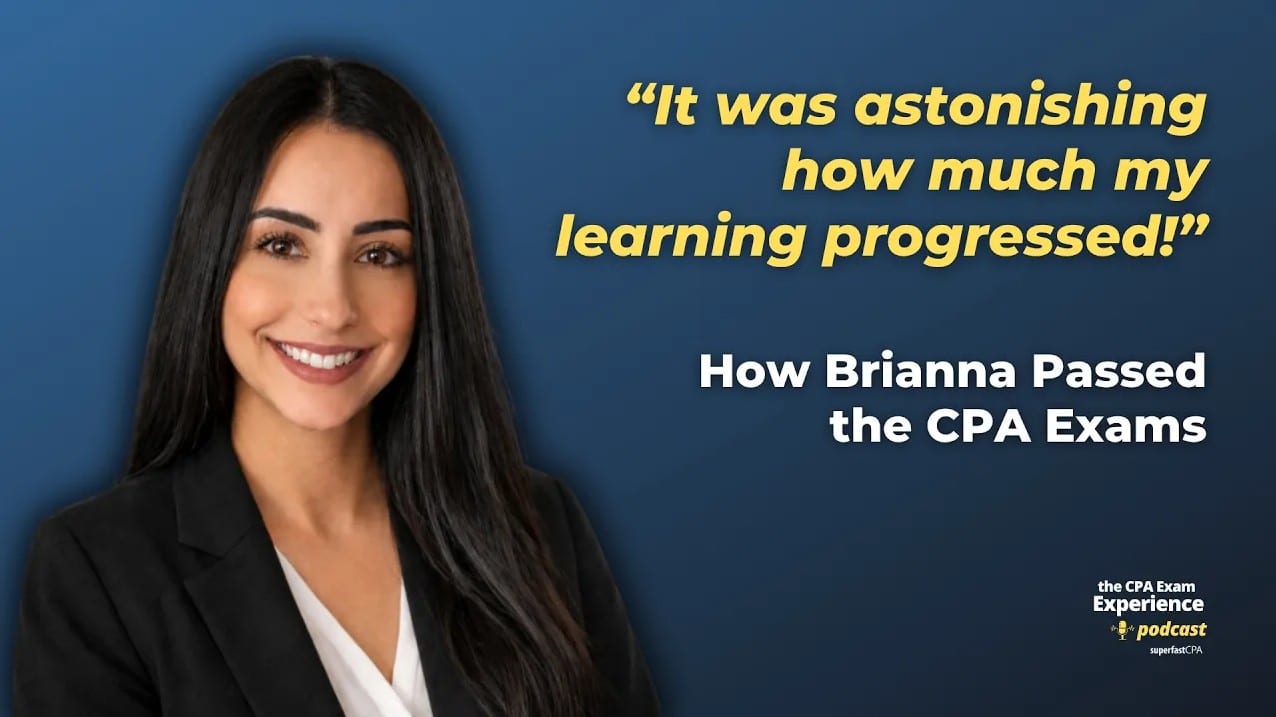
In this episode of the CPA Exam Experience Podcast, you’ll hear how Brianna was able to change and adapt the SuperfastCPA study strategies in a way that worked for her to be able to pass the CPA exam.
Brianna had a lot of worry and self-doubt around taking and passing the CPA exams. She felt like she would never be able to do it, or that she wasn’t good enough, or that the SIMs were just too hard. But, she showed up to study every day. She never gave up, even when she felt like it. And, with that determination, she DID do it, even though she thought she never would. This is a very encouraging episode, make sure to listen all the way through!
IMPORTANT LINKS:
Master your study process by attending one of our free study training workshops:
https://www.superfastcpa.com/study-secrets/
Episode Timestamps
- 00:00 Brianna Interview
- 03:24 A 2 Year Long CPA Journey, Finally Done
- 03:52 Pursued MBA Right Out of College
- 05:05 How Brianna Prepared to Pursue the CPA
- 06:19 Finding SuperfastCPA and Using It from the Start
- 07:59 Deciding the Order to Take the CPA Exams In
- 09:43 Failed Her First Exam But Knew the Process was Working
- 11:06 Adjusted the Study Process to Fit Her Style
- 12:59 Used the Mornings to Warm Up for Her Evening Study Sessions
- 14:46 Daily Study Sessions
- 15:50 Don’t Be Too Strict with the Schedule, Just Be Diligent in Studying
- 17:35 Setting Up a Schedule and Goals That Worked for Her
- 20:27 Used An App As A Reminder of Her Daily Checklist
- 21:32 Slowed Down on REG , Took 6 Months and Passed First Try
- 23:51 Why Brianna Took 6 Months Studying for REG
- 25:36 How Brianna Delt with SIMs
- 28:53 Brianna’s Exam Experiences
- 31:01 FAR Took Three Tries
- 32:27 Got A Tip from A Podcast Episode and Improved the Second Try
- 33:43 Committed to Her Weaknesses and Finally Passed FAR with a 75
- 35:23 How It Felt Finally Passing FAR, Her Final Exam
- 36:18 The Relief and Sacrifice She Had to Make to Pass FAR
- 37:56 Having a Life While Studying for the CPA Exams
- 39:46 Grateful That She Had a Circle That Supports Her
- 41:10 Brianna’s Note Taking Process
- 44:28 The Benefits That Brianna Got from SuperfastCPA
- 46:12 Brain Dumping Things Down on a Paper Helped with Active Recall
- 47:21 Utilized AI in Her Studying
- 48:57 Studying with the Note Cards
- 50:09 Top Tips for People Still Going Through the CPA Exams
Interview Transcript
Brianna: [00:00:00] I watched a lot of your guys’ tutorials on how to reverse engineer them, and that was the golden ticket for me.
So kind of just, yes, using your methodologies, but making it fit my learning style and my circadian rhythm, honestly. Because waking up early just did not work for me.
Logan: Welcome to another episode of the CPA Exam Experience podcast from SuperfastCPA. I’m Logan, and in today’s episode, you’re going to hear me talking with Brianna.
Brianna has a great story. She was someone who initially out of school didn’t really want to go for the CPA exam, but as time went on, she decided she wanted to do it.
And she got SuperfastCPA pretty early on in the process, and she struggled with the first exam. She failed with a 65, but she felt like the process was working. The thing that I most want you to pay attention to in this episode [00:01:00] is how Brianna was able to overcome the feelings of uncertainty and self-doubt.
She had a lot of self-doubt about not being able to pass the exams, not being able to do it, “Oh, I can’t do this sim,” but she was doing it. She kept showing up every single day, and she kinda chipped away at it. It took Brianna two years to pass the CPA exams, and she has a lot of great tips.
One of the things that she talked about was she felt like she was being too rigid with the SuperfastCPA strategy. She was trying to follow it so exactly that that actually became a hindrance, and so she kind of had to loosen up a little bit and use it to the best of her ability, use it in a way that worked best for her.
And, you know, this is just a framework, a structure, a process that we tell people and teach people, and they can then take it there and use what works the best way possible for them.
So make sure you listen to the whole episode so that you can hear how Brianna kind of tailored it to her so that she was able to pass the exams.
This is gonna be a great episode. I think you’re gonna love it. [00:02:00] Now, before we dive in, I just wanna give one more reminder about our SuperfastCPA training webinar on superfastcpa.com. That is a free one-hour webinar in which we will teach you the key ingredients to passing the CPA exams. Again, it’s free, it’s only one hour long, and we will show you how to pass the CPA exams.
And after you watch that, you’re going to want to learn more, so make sure you also check out becoming a member of SuperfastCPA by either becoming a PRO member, where you get the PRO course, or purchasing our study materials, which are our supplemental study materials.
Or, of course, getting the total bundle, where you get the PRO course and the study materials. That’s the best deal. That’s the best value right there, by the way.
So make sure you check out using SuperfastCPA. We will help you pass the CPA exam more efficiently and more effectively.
Now, with all that said, let’s dive into the episode with Brianna.
Logan: Good morning, Brianna. I’m so excited to be on the call with you today. I guess it’s morning for me, but it’s not morning for you. Is that right?
Brianna: Right. It is noon here. I’m in New York.
Logan: Oh, New York. Okay. Uh, so, uh, [00:03:00] it– What’s the weather like in New York right now? Cause we just barely had snow here today in Utah.
Brianna: Oh, wow. It’s really warming up here. It’s been like 82 degrees.
Logan: Oh, that’s nice.
Brianna: But last week it was like 30 degrees at night, so it’s a weird season right now.
Logan: Lots of jumping around. Uh, well, I’m excited to be talking to you today. I know that you are very excited to be on the podcast cause you’re done.
A 2 Year Long CPA Journey, Finally Done
Logan: How’s, how’s it been feeling to be done?
Brianna: It feels surreal, and I’m sure we’ll get into it, but it was a two-year-long journey for me, so it almost feels like I’m still waking up from like a fever dream kind of.
Logan: Yeah. Yep, I– that makes sense. Like, it still hasn’t really hit you that, “Oh, wait, I don’t have to do that anymore.”
Brianna: It hasn’t. Not yet. I’m slowly coming out of it.
Logan: Yeah. Well, yeah, let’s, let’s dive into everything.
Pursued MBA Right Out of College
Logan: So you said it was kind of a two-year journey. So at the beginning, where were you in your life or your career that [00:04:00] made you want to start the CPA?
Brianna: Yeah. I, I chose not to do the CPA right out of college. I really had a lot of mixed feelings on it. I knew it was super difficult, and sometimes I struggle with memory retention all throughout school. So I was like, you know, there’s just no way I could do that. So I chose to get my MBA right after my undergrad in accounting, and I figured, okay, at least I have the credits and the education, and I’ll get the work experience so that one day if I land in that position, I could just start with it.
So fast-forward, and I ended up at a job, um, with a team where the, the senior leadership, they are CPAs, and it’s not quite a requirement. I work in private. I don’t work in public. Um, but I do plan to advance into senior leadership one day, so I [00:05:00] really wanted to obtain the credential to set myself apart.
Logan: Okay. Yeah, that makes sense.
How Brianna Prepared to Pursue the CPA
Logan: So, wasn’t your original plan or maybe it was kind of something maybe you would do someday, but then it came to the point where you’re like, “Okay, I wanna advance in this job, so I should get this certificate.” So how did you start? Like, what did it look like? Did you get a review course? Did you know anything about the CPA exam?
Brianna: Yes. I did some research and my, um, direct supervisor at work, she had just finished her CPA, I think a year maybe or two before I started. So she was a wealth of knowledge for me and just kind of talking me through the real and raw parts of the process, and I can say she was 100% right. It was a mental and emotional journey, but very rewarding at the end.
So I followed suit with a lot of her tips. I know she used [00:06:00] Becker. Um, our CFO, I believe he used Becker, so I got Becker, and that is, that’s just how I started out. I did a lot of research on the Reddit subthread and, um, I eventually found Superfast, which we can get into, right when I started to study.
Logan: Okay.
Finding SuperfastCPA and Using It from the Start
Logan: So you had Becker and then you found SuperfastCPA right at the beginning, is that right? Like right at the beginning of studying? Okay. How did you, do you remember how you found it?
Brianna: I do. A-as I was doing that research, I was like, “Okay, I’m going to do this, but I can’t be sitting and watching lectures.” Like, it’s just not how I learn. So I was Googling, quote, “the MCQ-only method,” just a Google search, and that’s when Superfast came up. And I went on your website, I signed up for the, the free webinar, and I decided, yes, I can do this.
I st- I’ve always studied by active learning, [00:07:00] questions, write- rewriting things, talking things out. This sounds like something I could do, but only if I could do it this way. That’s how I’ll succeed. So I’d say Superfast really solidified my decision, and I did use it from the start.
Logan: Okay. And that’s pretty cool that you s- so you s- you had never heard of SuperfastCPA, you just searched MCQ first approach or something like that. And did you search that because kind of like you were saying, is that, that’s kind of how you learned in school? Is that right? Kind of going straight to the questions?
Brianna: Always. Yeah. Um, passive learning really doesn’t work for me. I mean, even in my professional life, I am a, I have to do it
Logan: Mm-hmm
Brianna: And take a stab at it to learn it, yeah. So the methodology just really aligned with how I learn.
Logan: That, that’s perfect. And I think that most people can, will find that it’s very, it’s one of the best ways to learn, you know?
Deciding the Order to Take the CPA Exams In
Logan: So [00:08:00] let’s jump into you getting started. So you had Becker, you had SuperfastCPA, you had this, uh, supervisor who was kind of your, you know, in your corner, and how did it go when it started?
I mean, I’m sure it was kind of a shock, the, all the information.
Brianna: Yeah. Yes. Uh, so my order of the exams, intentionally I did Audit, um, ISC, REG, and FAR. So I knew from the start, again, I’ve never worked in public accounting, and I don’t intend to. So I’ve, I’ve never been an auditor, but I find it very interesting, the information. So I started with something that I felt was more interesting to me intentionally to gain confidence.
And I know a lot of people take FAR first, but I told myself, “No. If you start with FAR, you’ll probably give up.” Because it’s, it is, to me, it’s, it was the hardest exam, so I needed to do it last to know [00:09:00] that I can do these tests. And FAR, I will conquer it on its own, not with three other exams ahead of me.
Yeah, so that’s the order I chose. And Audit’s very… sometimes Audit’s the hardest for people. It’s very conceptual. But that, starting with Audit really got me into the groove of reading explanations, understanding, digesting, and I’ve never done so much reading in my life. I would just read it over and over and over again.
Um, so that’s how I started, and I did use Superfast from, from the very first day. And then we can get into, I did fail my first attempt.
Logan: Yeah. Yeah, let’s definitely dive into this.
Failed Her First Exam But Knew the Process was Working
Logan: So, you know, how wa– how did it feel studying for the first time leading up to that exam that you failed? Like, what do you think led to that even though, you know, you were using the process from the beginning?
Brianna: So looking back, I was too rigid. So I think I was forcing [00:10:00] myself into boxes that quite didn’t fit me. So I know a lot of people, they’ll wake up two hours early and get it done in the morning. I tried. I even set a timer on my phone, had the 90 minutes, and I was so focused on the, um, schedule versus that I wasn’t even absorbing material.
It was like a checkbox thing.
So I failed I got a 65, which I was proud of only being like 10 points away on my first ever test. So after that, so I studied exactly eight weeks. Um, didn’t even… I, I wasn’t ready, but I was like, “You know what? Let me try it out.”
Then I got my score back, and it was in 2024, so I had waited
Logan: Like the worst year you could possibly start, yeah
Brianna: Yes, a long time. Um, in between, while I was waiting, I actually studied and passed ISC in five or six weeks. [00:11:00] So I knew the process would work. I just had to apply it differently.
Logan: Mm-hmm.
Brianna: Um, so.
Adjusted the Study Process to Fit Her Style
Logan: So what did you change?
Brianna: So ISC was different. It was very new. It had like just come out maybe that January, and I took it in July. So there were not very many sims to practice.
Um, it, it really, Becker just really was much like the exam. So I passed it, and I, I forgot about the strict schedule and I was like, “You know what? I am a night time person. Let me try studying at night. Let me not try to read the review notes. Let me do audio, um, because I’m a visual and audio learner.” So that’s what I did, and it worked.
So I was like, “Okay, let’s not give up. Let’s apply this to audit now,” which is a hard exam. And I took another eight weeks for audit. I [00:12:00] studied at night, I did audio notes, and I passed with a 77. So that I, I attribute it mainly to going back on sims a lot.
Logan: Mm-hmm.
Brianna: I watched a lot of your guys’ tutorials on how to reverse engineer them, and that was the golden ticket for me.
So kind of just, yes, using your methodologies, but making it fit my learning style and my circadian rhythm, honestly. Because waking up early just did not work for me.
Logan: Yeah. Yeah. The, you know, we recommend people wake up early, uh, mainly cause, you know, a lot of people, they’re working, they might have a family and kids and stuff like that. And so, like, by the time you’re done with the day, it’s so hard to get to studying.
But there are, of course, situations where as long as it’s working, I don’t really care. I just want you to pass the exam, you know what I mean?
Used the Mornings to Warm Up for Her Evening Study Sessions
Logan: [00:13:00] So, w- what time would you, so what did your schedule look like then? So, would you still wake up kinda early or just had a normal morning and then you’d study at like 7:00, or what did that look like?
Brianna: So, I mean, so my day would start really, my husband works, um, in office and I have a hybrid schedule. So every day, even the days when I was working from home, I would still kind of be up when he leaves at like 7:00.
I would wake up, but I wouldn’t force myself to go sit at my computer and type on Excel. I would, you know, sit on the couch and I would do mini quizzes.
I would kind of warm up my brain, um, or I would put my headphones on and put the audio notes on and just start cleaning around the house very early in the morning. Um, so I guess I did do some form of studying in the morning, but it wasn’t the main session. It was more of like an absorption, just getting myself in the rhythm for the day.
Um, [00:14:00] and I found that very helpful to be, it sounds funny, but tactile while I was listening, like folding
Logan: Doing something.
Brianna: Yeah, something about that just helped me absorb and focus better than just sitting and kind of staring.
Logan: Yeah, no, I, I, there, that, that, that happens for me too because it’s almost like if I’m just sitting and listening, my brain isn’t, uh, active enough. Like, it’s like, I, like my– it starts getting bored of just listening, but if I’m doing something like driving or doing the dishes or the laundry or whatever, it takes that extra part of my brain and focuses on that, and then I can still be listening and catching something.
So I totally, totally get what you’re saying there.
Daily Study Sessions
Logan: So would you do that on the days you went into office as well, or was, would you more just like listen to audio notes on your commute?
Brianna: Yeah. So the days that I would go in the office, which was one to two days a week back then, um, and still [00:15:00] is, I would do the audio notes while I’m getting ready, um, packing my lunch for the day, audio notes, and then audio notes on the way to work.
The days where I got to work from home was more of when I would have extra time to sit on the couch, do some mini quizzes or, or review answers from questions I had done the night before.
So again, it was more of a, I guess you could say passive learning that early in the morning for me. And then, um, if I was home, like on my lunch break or after work is when I would get into the main session.
Logan: Okay. So it wasn’t like extremely strict like at 7:00 I will start my main session. It was more like some days you did it at lunch, some days you did it after work.
Don’t Be Too Strict with the Schedule, Just Be Diligent in Studying
Logan: Um, did you still always do the like 90 minutes of planting the seeds and like a half hour re-review or what did that look like?
Brianna: Yeah. Yeah, I guess I could [00:16:00] use this point to encourage others, um, to not get too lost in timing your sessions or, I mean, if you do need to be strict like that, go ahead. But honestly, I’ve passed all these things and I was not strict like that. I was like, you know, if it’s 9:00 PM and I’m sitting down, that’s it.
If it’s 10:30 PM, that’s when I would get to it. Um, I really, I still prioritized, prioritized my house and, um, being married and going out to dinner and seeing friends, doing the dishes, just making sure my environment was clean and kind of
Logan: having a
life.
Brianna: yeah, a safe mindset to sit down and then re- relax and study.
So that’s what every day was very different for me, and I think my brain kind of craved that on such a long, tedious process. I gotta put some fun where you can and, and make everything look kind of different.
[00:17:00] So, um, some days my– some days I wouldn’t listen to audio in the morning. I would listen to a fun podcast and then I would tell myself, “Okay, at lunch break, we’re gonna go outside and take a walk, and that’s gonna be my audio note time.”
So I would make it look different each day, but they were always there, the components.
Logan: Right. And, you know, that’s like the, the recipe is mainly about the components, is about using each piece of it, because if you use all of them together, even if it’s at different times, that’s where it all starts clicking.
Setting Up a Schedule and Goals That Worked for Her
Logan: So, you know, kinda diving back into audit. So you changed up these things, you got a 77, and what do you think, what do you think was the difference?
Was it changing those things, or did you also change anything about your learning approach?
Brianna: Yeah. Yeah, I, I, so I, um, made the schedule work for me, and I also set goals per day. So I [00:18:00] would, you know, divide up the audios by seven days in the week and made sure I got through, like, four or five chapters, whatever it was at the time, and also mini quiz goals. I would do at least, um, 10 a day. I believe it was 50 Superfast MCQs a day, um, and try to digest them as well.
So once I set goals for myself, it was, like, astonishing how my learning progressed. The first eight, eight-week block where I failed, I wasn’t… I was like, “You know, if I can do 10, um, Superfast multiple choice, fine.” It was like, no, you have to set a goal for yourself and don’t beat yourself up if you can’t quite get there, but try that and be consistent every single day.
And then in doing that, the more exposure I got, it, it really helped me connect everything. So say I would hit a chapter in [00:19:00] Becker that day, then I would go to the Superfast multiple choice and I would see a question that correlated or hear an audio chapter that correlated, and it would tie it all together, and the information was just constantly getting into my brain one way or another. Every single day.
Logan: Yeah, and for two years, I mean, that it, it probably feels good to not be listening to me and Nate every single day anymore.
Brianna: Yes, no offense, it’s amazing.
Logan: No, I, I get it. I remember, uh, I think in my final post in the forum when I passed my last exam, I was like, “I’m gonna go listen to an audiobook now. So thanks, Nate.” Like,
Brianna: Yeah, done. Done
Logan: Yep. Uh, so I mean, that’s, I l- I really like what you were saying there because you’re really getting at the heart of what a lot of people struggle with, which is the consistency.
The, you have to be tr- actually trying every single day. Uh, [00:20:00] like what I tell a lot of people is you really gotta just look for the opportunities instead of passively waiting for yourself to want to take a mini quiz or want to listen to the audio notes. Just put it in your brain that when I have this break or when I’m in the car, or every time I do this, I will do a mini session of some kind. So I really like what you’re saying there cause that’s how you were able to really start having it all click together, right?
Used An App As A Reminder of Her Daily Checklist
Brianna: Yes. And I did use the, I, I think it’s called the Reminders App on the iPhone. I, every single morning, I would list out what I was gonna do for that day. It was the same thing every day: Superfast mini quizzes, audio notes, and Becker, I would call it Becker learning module, new material, and then re-review.
And the act of just listing it out every single morning too was, it just became a habit. Like, by the time I go to bed tonight, all these will be [00:21:00] checked off. Doesn’t matter when, just matters that I do it. And having that flexibility kind of took my mind out of this rigid prison almost, of this is what you, you have to do, and it just, it just becomes a part of your life after, and you have no choice just to get through these things.
Logan: Exact. Yeah, I mean, the sad truth is if you really want to pass these exams, it kind of has to be in everything you do. Even if, you know, even if you still have a life outside of it, it’s still there all the time.
Slowed Down on REG , Took 6 Months and Passed First Try
Logan: Um, so you passed audit, which is awesome, and you had also already passed ISC. So pretty quickly, you had already passed two exams, you know, fairly quickly. So how did REG and FAR go after that? Cause you said it took two years, so was there some difficulty with those?
Brianna: Yeah So I started in, like, April 1st, 2024. I had passed… I got my passing score for Audit by October 1st, I think, of 2024. [00:22:00] Took a little bit of a break, um, just like the rest of October. I was pretty burnt out after those two. So then I picked up REG. It was the holiday time, so I had my firm purchase. I did, like, the single course sections for each one.
Logan: Oh, okay
Brianna: Yeah. And so I had them purchase REG around the holiday time, and at that point, I still had a, a year and a half, two, no, maybe two years. Yeah, cause
Logan: Yeah, Yeah, cause I think it had been extended at that time. Yeah.
Brianna: Mm-hmm … the 30-month rule right before I began,
Logan: That’s awesome.
Brianna: Cause I needed it. Um, and I took it really slow. Again, I was really intimidated by REG because of the, you know, formulas and all the, the tax laws.
Tax accounting in college was really hard, so I was pretty intimidated, and I took it very slow, which is another thing I would say, if it doesn’t affect you, I know some [00:23:00] people only take six to 10 weeks to study cause they start forgetting material.
I was very opposite in that way, where I was very slow.
Like, it took me a long time to absorb, and I also needed that time. Like,
Logan: Mm-hmm.
Brianna: The material needed to be like a second lang- like a fluent language to me to be able to go into the testing center. So yeah. So I did pass REG on the first try.
Logan: Oh, that’s awesome.
Brianna: Um, yeah, so ISC and REG first try. I’d say I took about six months with REG.
It was, yeah, I, I re- really started my routine January of 2020, honestly, I the years at this point, maybe it was 2025. Yeah. And I had passed it by July of 2025. So I took my sweet time, and that was just something I came to terms with.
Why Brianna Took 6 Months Studying for REG
Logan: And with the, you know, with you taking your time there, were you still doing like, you know, all the things that you laid out every day, like, you know, [00:24:00] the full session, main session and everything, or were you doing it a little bit less? Like, I’m just curious,
Brianna: Yeah
Logan: w- like what were you doing that made it take a little bit more time?
Brianna: Yeah. I’d say, uh, for none of the sections I was not– For any of the sections I was not doing 30 re-review a day. It was just too much overload for me. I’d say 15 to 20 was my sweet spot, and also kind of like a dopamine hit.
Like, okay, I finished this 15. I could go and do another. Yeah, and sometimes I would. Sometimes maybe if it was audit, I, I might have done 60 a day, but I’m never sitting in one shot and doing 30. And I always did them in learning mode, so I did not do them in exam mode. It was too nerve-wracking. I’d rather answer it, see if I’m right or wrong, and then just kind of move on. So my re-review and my main [00:25:00] session was like really
Logan: Mixed together? Yeah
Brianna: So I was doing less, um, full force multiple choice per day than probably most people. And then with sims, I mean, I really just struggled with them, and I did not study them as I was going through the material. I would wait until I felt like the material was a second language to me, then I would go in and do sims, which added more weeks to my process. That’s why I was slow at it.
Logan: Okay. No, that, and I mean, you passed so that, that’s all that matters with REG.
How Brianna Delt with SIMs
Logan: So with, uh, so, so you would save the sims until basically you’d been all through, through all the material or at least understood it well, and then would you do sims every day or did you still just save them for the weekends? What did that look like?
Brianna: Again, I struggled not only with doing sims, but the mind- and even getting myself to sit in front of one.
Logan: They are [00:26:00] intimidating.
Brianna: They’re the scariest thing ever. Um, I remember posting in the forum, I mean, there’s hundreds in Becker depending on what section you’re in, and it was just like, ” There, there’s no way I could do this.”
So my, my approach was very different. Not only did I use Becker, but, um, I’ve used Ninja, I’ve used I-75, I’ve used Universal CPA. It took a village to pass these exams. So I-75, they don’t have like sims that you actually solve in the interface, but there’s a lot of videos on how to solve them.
So I would never, ever sit down and solve a sim.
I would submit it, and I would watch the video. Then I would take a few days where maybe I didn’t practice sims, just doing multiple choice. Then I would go back and reattempt those sims and see what I had [00:27:00] absorbed.
So yeah. So, um, you know, some sims that weren’t so math-heavy, I would just do them and submit and usually get them all right, like more conceptual.
But the math ones, I really had to take my time with them.
Logan: Yeah. Yeah. no, sims are like a totally different beast, a totally different half of the exam. And I like what you said there where it was more about just like, “I don’t care if I’m getting the sims right, I just need to learn from them.” Cause you would just submit it right away ’cause you’re like, “I don’t know how to do this,” and so you just learn,
Brianna: They were, they were terrifying to me. So, I mean, I would say if anyone’s out there and you’re like, “There’s no way I could pass these exams. I’m horrible at sims,” well, I did it, and you can too because it’s really about the… something I loved about Superfast was you, you preach learning the material through the MCQ, and I’m fully in agreement [00:28:00] with that.
I learned that material like the back of my hand through multiple choice questions and reading the explanations why something was right, but also why it’s wrong, um, which was a little bit harder in material like REG and FAR. It’s kind of like, well, you either know the formula or the law or you don’t.
Logan: Yep
Brianna: Um, but that translated very well to solving sims on exam day
Logan: Right. Yep. I mean, you’re just preaching everything that, that we say right there. You know, the best strategy for sims is multiple choice questions, which kind of sounds backwards, but just like you said, you learn pretty much everything you need to know from the MCQs.
You learn the whys behind it, and when it comes to test day, if you’re crushing the multiple choice questions, it gives you time for the sims.
Brianna’s Exam Experiences
Logan: Uh, and I actually am kind of curious about your exam day experiences, cause, you know, sims are [00:29:00] half of the exam. So how, you know, having practiced them the way that you did, when it came to actually doing sims on exam day, how did that feel?
Brianna: Terrifying.
Logan: Still Terrifying.
Brianna: It, it, went well because, um, that second attempt at audit, I focused more on watching a lot of… if you have Becker out there, they have
Logan: Yeah, the like
the
Brianna: skill builder
Logan: something like that?
Brianna: I had used I-75. They have a lot of tutorials. Um, so that was very helpful for me t- for solving sims. Um, ISC and… ISC I felt like Becker modeled it really well, and I was able to translate it to my exam.
REG was actually a test where I finished with an hour and a half, I think, left on the clock, which is not common for me. I’m, I’m a pretty… I’m a good test taker, average test taker, but I usually take all of the time.
Logan: Methodical. Yeah,
Brianna: Yes, I take all the time. I say good test taker because I [00:30:00] really don’t get… I mean, of course these are nerve-wracking, but I don’t… some people have to walk out of their exam. Yeah, some pe- I’ve read stories of people panicking and just forfeiting their exam. So you can’t panic.
Logan: Yes.
Brianna: so that was kind of my test day experience. So REG, I had studied them, I mean, six months. I was like, “I’m almost getting nauseous reading these questions now. I need to go take my test.” And the same for FAR, which we, we could get into my FAR experience if you’d like.
Logan: Yes. Uh, just so, uh, just before we move on to FAR, what did you score on REG after those six months?
Brianna: Yeah. So ISC I got an 84 and REG I got an 84.
Logan: Oh, nice. Yeah, those are great scores. Uh, so y- yeah, you definitely knew your stuff for sure when it came to REG. So, and I mean, I remember seeing a lot of posts throughout your journey, um, and you would, I remember you asking questions like about the sims or like, “How am I supposed to get through the multiple choice [00:31:00] questions?” And things like that.
FAR Took Three Tries
Logan: Um, I can’t remember though, did you post anything about FAR? Like what was your experience with FAR?
Brianna: Yeah. A lot of my posts were, yeah, they were directed at sims and more to say like, “Are we doing all the sims in our review course? What, what do I focus on?” There’s just so much. So a lot of the people were very helpful and just, you know, on the Reddit forum or in the Superfast forum, just giving tips on what are the heavy-hitting topics that you possibly are most likely to see.
Um, with FAR, now I passed FAR on my third try. Um, first, and I, again, I don’t want to discourage anyone. I took extra long on the exams and you do not have to. You don’t have to. I just chose to, to be more comfortable and fit them into my life.
Um, so FAR probably was a six to eight-month process again for me just cause I had the time. I [00:32:00] had like a year left on the t- time clock and it was a hard exam. So the first time I took it, I did not finish all the material in Becker.
Wasn’t ready, knew that, and I scored a 66. So I wasn’t too far off and I think I guessed on six of the seven sims. Like it did not go well. did not practice any sims.
I just went in blind just to see if I could have a chance.
Logan: See how it would go. Yeah
Got A Tip from A Podcast Episode and Improved the Second Try
Brianna: Yeah second time, I was feeling very burnt out, discouraged, like there’s just, there’s no way I’m gonna do this. I’m gonna forfeit the whole journey. I’m three out of four. This is it. So I would listen a lot in my spare time. When I needed a break from audio notes, I would listen to your podcast.
And I believe there was someone recently named Jordan that you had on where he switched to Universal CPA because he was saying how he was a visual learner.
And I [00:33:00] was like, “I’m desperate. I’m a visual learner. Let me switch.” So I did. I switched and I really accredit my passing to that. That just, Universal CPA with Superfast for someone like me who is a kinesthetic, um, visual learner, it was the recipe for success.
So I went back, tested again. I got a 74, which was heartbreaking.
Logan: But that’s, that’s more– that’s worse than a 66. Ugh.
Brianna: Gut. It was. It was gut-wrenching, but I was, again, you really need a mindset when you’re going throughout this. I was like, ” I can do this though. I can do this.” I got my score report. It was the sims. I still hadn’t committed to them.
Committed to Her Weaknesses and Finally Passed FAR with a 75
Brianna: So I took another, I think like two and a half weeks. I just told myself, “I’m gonna test every single window in 2026 till I pass this.”
I’m so far in at this point. So I took those two and a half weeks, um, again in [00:34:00] Universal, and what I did was focus on… I have just like one content area that I struggled in, and I focus on multiple choice, yes, but sims. And again, I still wasn’t solving sims. What I would do every day or every night was open them up, at least one or two, two or three at the most, read them.
I would read the prompt. I would open all the exhibits, read them through, look at all like the cells you had to fill in. I would attempt some of it, but then submit it and watch, um, Universal has a video for every single multiple choice and every single sim, which was really nice. Yeah. So I would just watch the video and just really work on the strategy.
I felt like at this point I had, I had the content, yeah, in my head, but I really needed help, like what, what to look on in the exhibit or how to [00:35:00] prepare this financial statement the way they want it, and that helped me. I got a 75. So,
Logan: That’s awesome.
Brianna: That one point. I also went in with the mindset of like, I don’t, I’m not striving for 100 or a 90.
I’m striving for that one point, and I know my weakness is sims, so let me figure out how to tackle them at least.
Logan: Yeah.
How It Felt Finally Passing FAR, Her Final Exam
Logan: And that, so went from 66 to 74 to 75 with FAR, and then you were done. W- how did it feel to get that 75 and know you were done? Like, that have must have been crazy.
Brianna: I, I swear like on the score release day, my, I was cold to the touch. I was like shaking because I felt like the sims went very well that day. I probably was confident on like four or five out of seven of them, and even the other two, like at least a 50% chance. So I was like, I think I passed because I had a shot at those sims and I passed.
And I was also like, you know, there’s n- [00:36:00] there’s no other option. Like I have to pass because I am struggling mentally. So yeah. It was just a lot to keep up with work, um, advancing in my career, CPA, family life. After two years, the burnout was very real.
Logan: Oh, yeah.
The Relief and Sacrifice She Had to Make to Pass FAR
Logan: So, did you do anything when you– I mean, it hasn’t been that long since you found out. Have you done anything to celebrate or anything?
Brianna: Yeah, it hasn’t even been a month. But, um, that night I went out with my husband, his mom, and, um, we celebrated. From the beginning when I started, I told my husband, ” I really want the balloons that spell out CPA when I’m done.” And he came home from work on the school release day and he brought balloons, and it was just a really sweet moment that I feel like he was so invested in, my in-laws and like everyone was just so invested.
And just seeing how… I mean, the relief [00:37:00] my husband has felt too, because it was just all-consuming. It was constantly. I will say, um, I lived life throughout the exams. We went on a cruise where when I was studying for REG, I brought my iPad. Like it was never an issue until I got to FAR and I had to make it my issue because that is just the way personally I told myself, ” If you wanna pass FAR, you have to immerse yourself.”
And I did start saying no to some social things by choice. You don’t have to, but for me personally, I needed to just be done.
Logan: Yeah. It was like, “Okay, I, I’ve got to buckle down and get this done so that I can leave this behind.” Yeah, that makes total sense.
Brianna: That’s the only reason why I chose to start saying no to social events and just, I was just home in my office room.
Logan: Just, just alone in your office, yeah.
Having a Life While Studying for the CPA Exams
Logan: The… so, through actually kind of talking about, uh, [00:38:00] something I like to ask, and you just barely mentioned this. So, what things or what hobbies or things like that were you able to still maintain throughout this process because you were able to still prioritize that as long, as well as the CPA?
Brianna: Oh, yeah. I am an avid, um, gym goer, so I never stopped going to the gym. But your h-hobbies might look different. You know, I, I would cut my sessions down, um, in the gym. You know, instead of an hour, maybe you’re there 30 minutes. I also am that person, I brought my note cards. I brought them to the gym. I would walk on the treadmill.
It gave me something, you know, moving my body and flipping through the note cards. I probably looked a little bit odd doing that, but I honestly don’t care cause I passed. Um, I picked up walking. I, I love being outside and walking. I mean, I would just go out in my neighborhood an hour, for an hour and a half sometimes, get [00:39:00] through so many audio notes, and it just felt so productive.
But also it was a mental health break to be outside, get fresh air, break up, you know, if you’re working from home, break up the day. To just switch from work computer to personal computer and start on sims right away, that is a recipe for disaster.
Logan: Yeah.
Brianna: Well, I still saw friends. Um, we, we went on a cruise. We went on… I went on maybe three trips in total while I was studying. Um, pack my laptop with me, and it was just part of my… It was just something I did. All my friends knew it. Everyone knew it. That’s what she does.
Logan: Now they’re probably like, “Oh, wow. You don’t have it anymore.”
Brianna: Yeah, exactly.
Logan: It’s probably gonna be weird.
Grateful That She Had a Circle That Supports Her
Logan: Uh, and so I just have a couple questions based on what you said. So for- first off, so when you were traveling, were you still studying? Like, you said you took your iPad or your laptop.
Was it still like full-on studying or was it more [00:40:00] like kind of light review?
Brianna: Yeah, it was, I was more light, so I’d always have my audio notes. Um, my AirPods were always in my ear or with me.
Logan: Mm-hmm.
Brianna: I would do mini quizzes a lot because they are just so easy to access and standing in line for dinner on the cruise or waiting for the show to start. You know, I felt bad a lot cause I was in a social setting, but I think I was surrounded by a lot of supportive people that also wanted this journey to end, and they were, like, willing to just give me a pass.
Logan: Yeah. Like, “Oh, she’s on her phone studying”
Brianna: “She’s corner doing mini quizzes. Let her.”
Logan: Yeah. That, that, I mean, that’s awesome. And, you know, that, that’s something that I try to say a lot in this podcast is you’ve gotta have that support system.
Even if people don’t really understand the CPA, like if they’ve never really done anything like that. Still having people in your corner that can be like, cheering you on [00:41:00] and, you know, talking to you about it, uh, as much as they can, uh, I think that’s just super helpful. So I’m glad that you were able to have that support system throughout it.
Brianna’s Note Taking Process
Logan: Um, and one more question that I had, kind of going back to your note cards that you were talking about. So are you referring to flashcards? Like did you make your own physical flashcards? Is that what you’re saying?
Brianna: Yes. So my, my note t- I’ve never been a heavy note taker throughout school. Um, even at work, I’m, I am all digital note taking. So I did a mix of BrainScape, which is, is the online digital. Flashcards didn’t really work for me. I don’t know why. It was just so easy to ignore, like another app. So I took to my paper flashcards and I’ve, I, I mean, for some reason I haven’t been able to throw them out yet.
Like I’m like scared I’m gonna need them for some reason. But I will, I will purge them, but I mean I have a huge stack. Any [00:42:00] question… and I would save my note-taking for really the end. So I wasn’t doing it all throughout, otherwise you’re gonna be writing everything down like a book. I really would save it.
Um, again, visual learner, so I would draw charts, transaction cycles, formulas. Um, again, with the charts even I could just kind of memorize and picture where certain information was in certain categories.
So the note cards were very helpful with formulas, um, definitions, and y- it forced me to put a rule in my own words.
Cause if you’re just, if you’re just copying the Becker explanation, your brain’s not gonna make the connection. No, so force yourself to, um… I would talk out loud a lot to myself. Um
Logan: It’s a good thing you were alone in your office, right?
Brianna: Yeah. I mean, there was so much talking out loud. And another thing I [00:43:00] wanted to note was I wasn’t doing my, my flashcards every day.
Like, I wasn’t re-reviewing them. Really the week before or the two weeks before my exam is when I would hone in on the sims and every night just flipping through my flashcards.
And sometimes that even felt intimidating, so I would just tell myself, “Just read them. Just read them. It’s not gonna bite you.” And it, it would seep into your brain after a while.
Logan: Yeah, no, the, uh, basically a lot of what you just said right there is exactly what we say about flashcards is, like, the act of figuring it out for yourself and putting it on that flashcard is a huge part of it. You know, of course, reviewing them is extremely important as well, but forcing yourself to get to the point where you’re like, “I actually kind of understand this,” and, like, putting it in a way that makes sense is a huge part of the process. And I really like what you said there about, you know, you’re a visual learner, [00:44:00] and I think that I am to an extent too, because I remember when I would take notes, I would write it out in a very, like, structured way, and I could remember the order of things when I was doing it on the exam. I’d be like, “So that was on this line.”
And, you know, like, that kind of thing, uh, is really helpful, so I love that you said that. I think a lot of people could benefit from that. Um, and I mean, you’ve mentioned a lot of awesome, excuse me, a lot of awesome tips.
The Benefits That Brianna Got from SuperfastCPA
Logan: And, uh, kind of as we’re wrapping up here, as I’m asking the last few questions, you know, with everything that you’ve mentioned, what would you say was the benefit or the benefits of having SuperfastCPA from the beginning?
What benefits do you think that gave you?
Brianna: Oh, yeah. I mean, Superfast gave me the, the structure, like the template that I needed. I, I honestly feel like I would’ve been lost without the audios and the mini quizzes because without [00:45:00] that, you are not having constant exposure.
You’re maybe having an hour or two in Becker. And while Becker’s great, it’s not talking back to you, audio notes.
It’s not giving you quick-hitting questions that get definitions and formulas in your brain. So having that, it sounds kind of sad, but constant exposure throughout the day, um, it was just mandatory for me to pass these and kind of the, the roadmap that you need. And the forum was really helpful cause sometimes, I won’t lie, you do feel like it’s a very isolating experience.
Um, so having the forum to read through and be like, “Okay, I’m not going crazy here. Someone else is feeling this,” or, “This person struggled, but they passed,” was really helpful.
Logan: Yeah. I, the forum was [00:46:00] really helpful for me as well. Um, So I’m glad that that was able to be… and I remember seeing your posts in the forum and responding to some of them and trying to, you know, trying to be as helpful as I could. And I know a lot of people in the forum do the same thing.
Brain Dumping Things Down on a Paper Helped with Active Recall
Logan: So, uh, now, uh, we’ve, again, we’ve talked about a lot of things. Is there anything else about your process or your story that we haven’t gotten to talk about that you thought, “I would like to share that,” you know, before the podcast? Is there anything like that?
Brianna: Sure. I do have a huge tip that helped me, um, that I kind of discovered on my own. So I would go on a lot of side quests while I’m studying. So I didn’t confine myself to my course. I, um, I would use Google, I would use Reddit, I would find study guides online. I’d make my own. I’d draw, um, I would use eight, eight and a half by 11 computer paper, and I would draw everything out.
Draw if it was like a chart or write. I would [00:47:00] just do constant brain dumps, especially before my exam, and that kind of, um, active recalling gave me the confidence of I can go in and take this test. I also have papers now. I would bring them with me to the testing center, flip through them before my exam, and just go in.
Utilized AI in Her Studying
Brianna: And a lot of that too was I utilized AI. Like if you have Becker, their Newt tool, their in-house AI tool was extremely helpful, but kind of, it was very text-heavy, so I would outsource to ChatGPT, and I had the app on my phone, and I had it pinned on my work computer and my personal computer. I would type to ChatGPT like we were texting friends all day long.
i, I set it up so that I asked it to correct my statements is how I worded it. Correct my thinking if I’m [00:48:00] wrong. So I would even, it sounds funny, but if a random thought would pop in my head throughout the day, I like had to, I had to understand it. I would type in chat, “Correct my thinking. Show me the journal entry for this. Is this right? Do I understand this?” Constantly. And it was such a helpful tool. Like I honestly think that’s, that helped me to pass, especially with FAR. Um, learning journal entries and mechanics of everything through ChatGPT was very helpful to remember on test day.
Logan: Kind of having that sounding board to always be correcting yourself off of, is that right?
Brianna: Yes, but also the act of physically typing it out,
Logan: Mm-hmm. like putting your thoughts out
Brianna: Writing, yeah. It was like writing those note cards again. So that was another active learning tool that really helped me.
Logan: Right.
Studying with the Note Cards
Logan: And so, and, um, and going back to [00:49:00] those, uh, like note cards, so you would kind of like summarize or brain dump all the things that you maybe had from your flashcards or all of your knowledge onto like those big pieces of paper, and that’s what you would take to the testing center, is that right?
Brianna: Yes, I would. For example, with FAR, um, I would draw a lot of charts, bonds, leases, amortization tables, all the ratio formulas. Each topic had their own designated little paper, and again, that helped me to just visually split everything up because with FAR, it’s a really tricky exam to study for. The sheer amount of topics you could… I mean, I struggled a lot with feeling like I was wasting time focusing on bonds cause it, it might not even show up.
Logan: Yeah.
Brianna: having those papers and kind of having… FAR was different for me when studying. I would dedicate certain days [00:50:00] to, like, two or three topics and rotate throughout the week to maximize my learning on that. But the, the active recall was very helpful with that.
Logan: Yeah.
Top Tips for People Still Going Through the CPA Exams
Logan: Uh, so yeah, like I said, you’ve had a lot of great tips. You have an awesome story, and it’s– I’m so glad that you’re done. So, uh, as we’re wrapping up, you know, I’ll ask the same question that I always ask everybody, even if it’s something we’ve alr- we’ve already talked about. What would be your top two or three tips to somebody who’s still going through the exams?
Brianna: Sure. I would say, um, do not give up. Something I would read a lot online was you only fail the exams when you quit.
Logan: Mhm
Brianna: Um, getting the failing score is gut-wrenching, but use it as your mo- kind of like a temperature check
Logan: Mm-hmm.
Brianna: of where you are in the study process. It, it doesn’t end there. Yeah, you have to pay another $400 to take the test, but it’ll all be worth it one day.
Um, use [00:51:00] SuperfastCPA and, and just use their methodologies. Fit it, fit studying into your life. Have it be like another muscle that you’re building. And consistency. Sit down for that day, and if you only have 10% to give, that’s what you can give. If you can only do 10 Becker questions, it’s better than nothing.
Some days I really struggled. I was exhausted, not feeling well,
Logan: Mm-hmm.
Brianna: Did not want to do this anymore, but I just kept slowly chipping away and focusing on really have goal… Have a goal. Have a note card. Write it out. Stick it on your fridge. Um, my husband actually, we had like a Bible verse that was very encouraging to me during this time, and he made me stick it on the fridge, and every day I would go and read it.
Just have something that’s really encouraging to you and do not lose sight of it.
Logan: What, uh, what’s the Bible verse if, if you don’t mind me asking?
Brianna: [00:52:00] Yeah. It was about, um, kind of taking every thought captive and demolishing the strongholds and because I would, I would do a lot of negative self-talk during this. Like, “I, I cannot do this. I, I can’t do a sim. I’m never gonna know this.” But in the meantime, I was doing it, but it’s so easy to get lost in that mindset.
Logan: Yeah. I, I love it. Uh, yeah, the, i- it’s so easy to, especially when you’ve been doing it for so long, to just feel like it’s never going to end, you’re never gonna pass. It’s easy to get into that mindset. But like you said, if you have those goals, even based off of failures, it’s always something that can fuel, fuel you and get you, keep you going. So I, I think those are fantastic tips.
Uh, I I really enjoyed talking to you today, Brianna. I am so glad that you’re done. Are you, uh, fully done or do you still have to get like, a couple other things done for the licensing?
Brianna: Everything’s submitted. Now I just [00:53:00] wait. I think it could take like, it could take a few months, especially in New York, so.
Logan: Oh, okay. Yeah, that, that’s too bad. I think that in Utah when I finally got everything submitted, I think it was like two days later that I got my license. I was like, “That’s crazy.” I w- I didn’t think it would happen that fast. So hopefully, maybe it’s a little bit faster than you’re hoping, th- than you’re thinking in New York.
But, uh, that’s awesome. I mean, you’re fully done.
Brianna: Thank you.
Logan: Uh, yeah. Thanks again for being on the call today, Brianna. I think this is gonna be a very, very helpful podcast episode, and I hope you have a great rest of your day. Congrats on being done.
Brianna: Thank you so much for everything you guys have done. Thanks.
Logan: Of course.
All right. That was the episode with Brianna. Again, I thought it was a great episode. I loved that she was able to talk about, you know, openly about her struggles with feeling like she was able to do it. She struggled with feeling like she was enough, feeling like she was doing it right, feeling like she was never going to be able to pass the exams.
But she made it through, she kept going, she showed up every day, [00:54:00] and that is what ultimately led to her success. You know, the strategies, of course, I’m sure were helpful, and they were a big part of it. But if she hadn’t decided to show up every day, even on the days she didn’t want to or didn’t feel like it, then she wouldn’t have passed the exams.
So consistency and perseverance really are a huge part of this process. I hope that you liked this episode with Brianna, and I hope that you found it was helpful.
Now, before you go, make sure to like and leave a comment in the YouTube video, or if you’re listening to this as a podcast, leave a rating in your favorite podcast app.
This podcast is one of the best free resources out there for CPA exam candidates. So make sure you’re sharing this with people around you, listening to it yourself, and, you know, maybe one day you can be on the podcast as well to share your story.
Make sure you also check out our free one-hour webinar training. We’ll teach you the key ingredients to passing the CPA exam.
With all that said, thanks for watching or listening, and I will see you in the next episode
[00:55:00]