Table of Contents
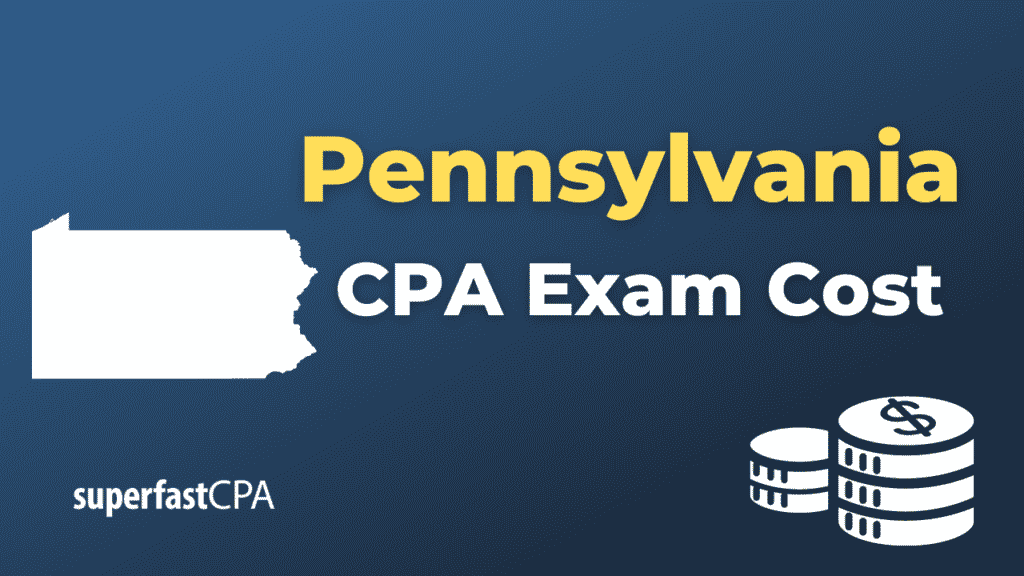
Pennsylvania CPA Exam Cost
The Pennsylvania CPA exam cost consists of five main fees: an education evaluation application fee of $96, an exam application fee of $96, and $262.64 per CPA exam section, totaling $1,050.56 for all four sections. As for licensing, the initial CPA registration will cost $65 and the biennial CPA license renewal fee is $100.
This article will help you to become a CPA in Pennsylvania and is a requirement for you to take the Pennsylvania CPA exam.
How to Save Yourself MONTHS of Time and Frustration
Keep in mind that the CPA exam is the one part of getting your CPA license that you can control how long it takes. The education and experience requirements take as long as they take, but the CPA exams can take you as little as 6 months, or as long as multiple years… depending on how effective your study process is from the beginning.
Learn how to study strategically so you can save yourself tons of time and retake fees with this free training…
Pennsylvania CPA Exam Cost Breakdown
| Education Evaluation Application Fee | $96.00 |
| Exam Application Fee | $96.00 |
| Auditing and Attestation (AUD) | $262.64 |
| Financial Accounting and Reporting (FAR) | $262.64 |
| Regulation (REG) | $262.64 |
| Disciplines (ISC, TCP, or BAR) | $262.64 |
| Total for all 4 CPA Exam Sections | $1,050.56 |
| Initial CPA License Fee | $65.00 |
| Biennial Renewal of License Fee | $100.00 |
Summary of Pennsylvania CPA Requirements
| Credit Hours to sit for the CPA Exam | 120 |
| Bachelor’s Degree to sit for the CPA Exam | Yes |
| Total Credits Hours of Accounting and Auditing, Business Law, Finance or Tax Subjects for the CPA license | 24 |
| Credit Hours to receive CPA License | Minimun 120 |
| Work Experience required to receive a CPA License | Minimum 1 year or 1,600 Hours |
Education Requirements
The academic criteria will qualify most of your time and effort in the licensing application. Before beginning a course of study, make sure you know the Pennsylvania CPA education requirements to be on track for licensing. Applicants will need to hold a bachelor’s degree or have 120 semester credits from an accredited college/university. Pennsylvania now has three CPA licensure pathways for education backgrounds: a bachelor’s degree with fewer than 150 semester credits, a bachelor’s degree with 150 semester credits, or a master’s degree or other postgraduate degree. All are required to have at least 24 semester credits in accounting/auditing, business law, economics, technology, finance, or tax
Credit Requirements to sit for the CPA Exams
Pennsylvania allows candidates to sit for the CPA Exam with a bachelor’s degree or 120 semester credits from an accredited college or university.
Credit Requirements for Oregon CPA License
Pennsylvania now has three CPA licensure pathways for education backgrounds:
- Bachelor’s degree with 150 semester credits
- At least 24 semester credits in accounting/auditing, business law, economics, technology, finance, or tax
- Plus an additional 12 semester credits in accounting/auditing or tax
- 1 year / 1,600 hours of qualifying experience.
- Bachelor’s degree with less than 150 semester credits
- At least 24 semester credits in accounting/auditing, business law, economics, technology, finance, or tax
- 2 years / 3,200 hours of qualifying experience.
- Master’s degree or other post-graduate degree
- At least 24 semester credits in accounting/auditing, business law, economics, technology, finance, or tax
- 1 year / 1,600 hours of qualifying experience.
Despite the fact that the Pennsylvania CPA exam requirement is only 120 hours, you should consider pursuing a master’s degree after completing your bachelor’s degree. Continue your accounting studies with a Master in Accountancy (MAcc) or a Master of Business Administration (M.B.A.) degree that includes enough accounting courses to satisfy the Pennsylvania board.
Pass the Uniform CPA Examination
The “Uniform CPA Examination”, which is a 4-part exam, is developed by the AICPA – the American Institute of Certified Public Accountants and administered by NASBA – the National Association of State Boards of Accountancy.
The Three Core Exam Sections
Auditing and Attestation (AUD)
The Auditing and Attestation (AUD) section of the Uniform CPA Examination (the Exam) tests the essential knowledge and skills a newly licensed CPA must demonstrate when performing audit engagements, attestation engagements or accounting and review service engagements.
Newly licensed CPAs are required to:
- Demonstrate knowledge and skills related to professional responsibilities, including ethics, independence, and professional skepticism. Professional skepticism reflects an iterative process that includes a questioning mind and a critical assessment of audit evidence.
- Understand the entity including its operations, information systems (including the use of third-party systems), and its underlying business processes, risks, and related internal controls.
- Understand the flow of transactions and underlying data through a business process and its related information systems.
Financial Accounting and Reporting (FAR)
The Financial Accounting and Reporting (FAR) section of the Uniform CPA Examination (the Exam) assesses the knowledge and skills that a newly licensed CPA must demonstrate in the financial accounting and reporting frameworks used by business entities (public and nonpublic), not-for-profit entities and state and local government entities.
The financial accounting and reporting frameworks that are eligible for assessment within the FAR section of the Exam include the standards and regulations issued by the:
- Financial Accounting Standards Board (FASB)
- U.S. Securities and Exchange Commission (U.S. SEC)
- American Institute of Certified Public Accountants (AICPA)
- Governmental Accounting Standards Board (GASB)
Regulation (REG)
The Regulation (REG) section of the Uniform CPA Examination (the Exam) tests the knowledge and skills that a newly licensed CPA must demonstrate with respect to:
- U.S. federal taxation
- U.S. ethics and professional responsibilities related to tax practice
- U.S. business law
The Three Disciplines
The three new disciplines in the 2024 CPA Exam, part of the CPA Evolution initiative, are designed to allow candidates to specialize in areas that align with their career interests and the demands of the modern business environment. Here’s a more detailed look at each discipline:
Business Analysis and Reporting (BAR)
Objective: This discipline focuses on higher-order skills needed in financial statement analysis, business reporting, and the strategic role of the CPA in business decision-making.
Key Topics:
- Financial Statement Analysis: Understanding and interpreting financial statements to assess an entity’s financial health and performance.
- Performance Management: Developing and using key performance indicators (KPIs) to measure, manage, and improve business performance.
- Data Analytics and Visualization: Utilizing data analytics tools to analyze business data, and effectively presenting data to support business decisions.
- Strategic Planning and Risk Management: Involvement in the strategic planning process and identifying, assessing, and managing business risks.
- Business Processes and Controls: Understanding and evaluating business processes and internal controls to improve efficiency and effectiveness.
Information Systems and Controls (ISC)
Objective: This discipline is tailored for those interested in information technology, data security, and controls. It addresses the increasing role of technology in accounting and auditing.
Key Topics:
- IT Governance and Risk: Understanding the frameworks for managing and governing enterprise IT; identifying and managing IT-related risks.
- Information Security and Cybersecurity: Knowledge of cybersecurity principles, data protection laws, and the steps necessary to protect information assets.
- System and Organization Controls (SOC) Reporting: Understanding the requirements for SOC reports and the role of CPAs in assessing controls at a service organization.
- Data Management and Privacy: Managing data effectively and understanding privacy regulations.
- Business Continuity and Disaster Recovery: Planning and strategies to ensure business operations can continue and recover from disruptive events.
Tax Compliance and Planning (TCP)
Objective: This discipline focuses on tax compliance, tax planning, and tax strategy, suitable for those who aim to specialize in taxation.
Key Topics:
- Individual Tax Planning and Compliance: Understanding tax laws affecting individual taxpayers, including income, deductions, credits, and tax planning strategies.
- Business Tax Planning and Compliance: Knowledge of tax considerations for different business entities, including corporations, partnerships, and S-corporations.
- Estate, Gift, and Trust Taxation: Understanding the tax implications and planning strategies for estates, gifts, and trusts.
- International Taxation: Knowledge of taxation issues related to cross-border transactions and multinational enterprises.
- State and Local Taxation (SALT): Understanding the complexities of state and local tax laws and their impact on business and individual tax planning.
Tips for Passing the CPA Exam
The CPA exam covers so many topics that you will need to study specifically for each section, usually for 6-8 weeks per section. Even a master’s degree in accounting doesn’t adequately prepare you to just walk in and pass the 4 CPA exams.
You will need a full review course such as Becker, Wiley CPA, Gleim, Roger, etc, and you will need to dedicate several hours a day over the course of months to even have a chance at getting passing scores.
How to Save Yourself MONTHS of Time and Frustration
Keep in mind that the CPA exam is the one part of getting your CPA license that you can control how long it takes. The education and experience requirements take as long as they take, but the CPA exams can take you as little as 6 months, or as long as multiple years… depending on how effective your study process is from the beginning.
Learn how to study strategically so you can save yourself tons of time and retake fees with this free training…
Pennsylvania CPA Ethics Exam Requirements
While most states require ethics before licensing, Pennsylvania candidates can become a CPA without it as there are no Pennsylvania CPA ethics exam requirements. However, part of the Continuing Professional Education (CPE) requirement is to attend 4 hours of acceptable professional ethics.
Pennsylvania CPA Experience Requirements
To meet the Pennsylvania CPA experience requirements, candidates require to complete at least 1,600 hours of qualifying experience during the 60-month period immediately preceding the date of application. Experience should include providing any type of service or advice involving the use of accounting, attest, compilation, management advisory, financial advisory, tax or consulting skills which were gained through employment in government, industry, academia or public practice. The 1,600 hours of qualifying experience shall be acquired over a period of not less than 1 year.
Apply for Your Pennsylvania CPA License
After passing the Uniform CPA Exam and meeting Pennsylvania’s work experience requirement, you will be certified and licensed to practice in the state. Use this checklist to see if you’ve done every one of the required tasks so far:
1. Checklist
- Complete 150 semester hours of education and receive a bachelor’s degree or higher with 24 semester hours in accounting.
- Apply and take the Uniform CPA Examination
- Fulfill the necessary practical work experience requirements of 1600 hours (one year) of work experience
- Complete the Verification of Experience Form, give it to your supervising CPA to complete, and make sure your supervising CPA . mails the form to the Pennsylvania State Board of Accountancy
2. Submit the Pennsylvania Certification Application.
Before this document may be submitted, all conditions listed above must be met. Begin by obtaining the Certified Public Accountant Certification Application from the Pennsylvania State Board of Accountancy website. The state of Pennsylvania refers to obtaining a CPA license as “certification.” Once certification is obtained by meeting all of the state’s requirements and completing this form, licensure is accepted.
How to Save Yourself MONTHS of Time and Frustration
Keep in mind that the CPA exam is the one part of getting your CPA license that you can control how long it takes. The education and experience requirements take as long as they take, but the CPA exams can take you as little as 6 months, or as long as multiple years… depending on how effective your study process is from the beginning.
Learn how to study strategically so you can save yourself tons of time and retake fees with this free training…