
Studying for the CPA exam during busy season? Learn how to stay consistent, protect retention, and avoid burnout with a realistic routine.
Why Busy Season Makes CPA Studying Feel Almost Impossible
Studying for the CPA exam during busy season feels different from studying during a normal work schedule.
On paper, you might think, “I’ll just study after work.”
Then busy season actually starts.
You get home later than expected. Your brain is fried. You still need to eat, answer messages, maybe spend time with your family, maybe get ready for tomorrow, and then somehow sit down for three or four hours of highly technical CPA material.
That is where a lot of CPA candidates start losing momentum.
Not because they are lazy. Not because they are not smart enough. Not because they “do not want it badly enough.”
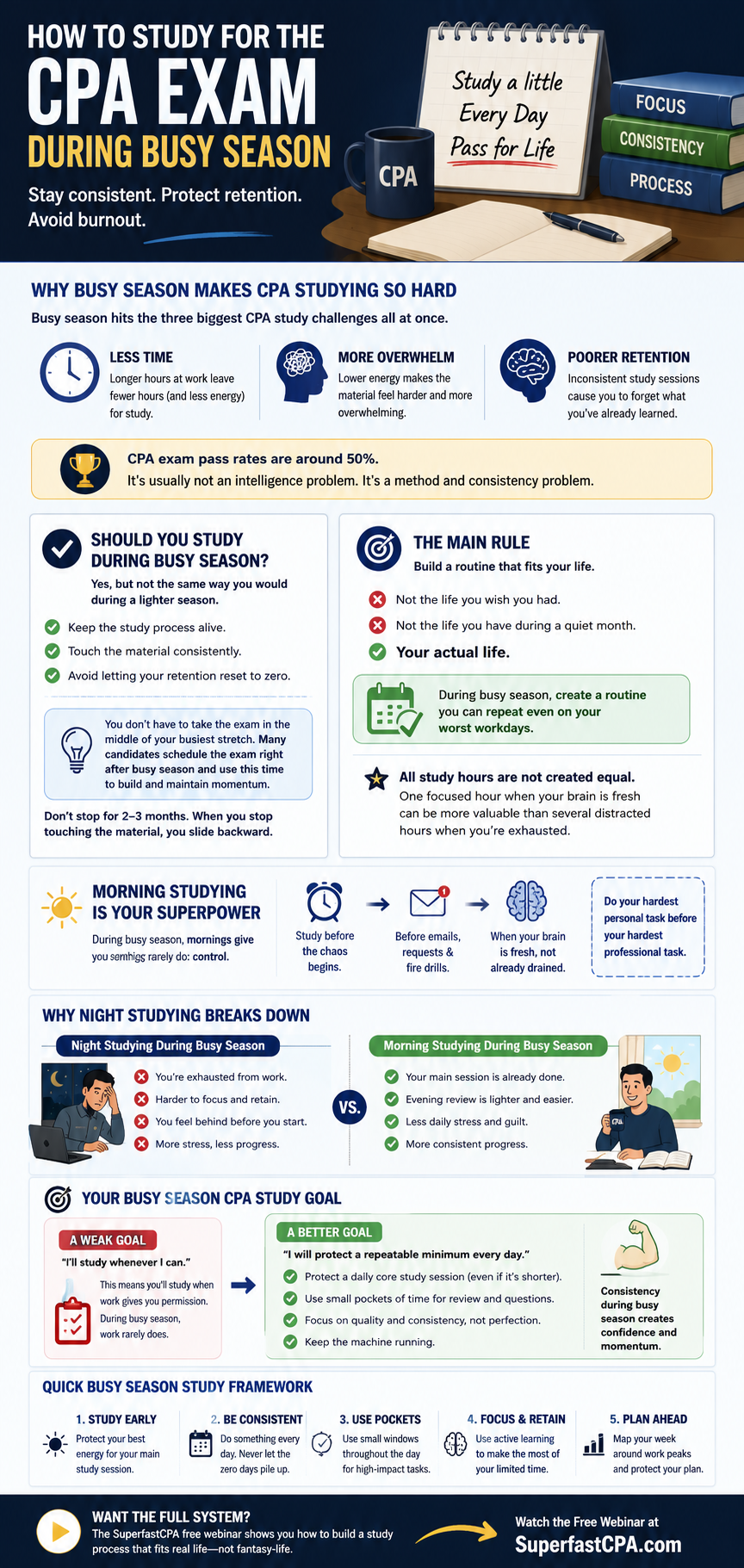
It happens because busy season attacks the three biggest CPA study problems all at once: time, overwhelm, and retention.
You have less time. The material feels more overwhelming because your energy is lower. And because your study sessions become inconsistent, you start forgetting what you already covered.
That is the trap.
And it matters because CPA exam pass rates sit around 50%, even though the people taking these exams are already educated, capable candidates with accounting backgrounds or the required credit hours. The issue is usually not intelligence. The issue is method.
What worked in college does not automatically work on these exams, especially during busy season.
Should You Study for the CPA Exam During Busy Season?
Yes, you can study for the CPA exam during busy season, but you probably should not use the same plan you would use during a lighter work schedule.
The mistake is trying to force a normal CPA study plan into an abnormal work season.
Busy season is not the time to build a study plan that depends on perfect evenings, long uninterrupted sessions, or unlimited willpower. That kind of plan looks good on Sunday night and falls apart by Wednesday.
A better goal during busy season is this:
Keep the study process alive, keep touching the material consistently, and avoid letting your retention reset to zero.
That does not mean every busy season candidate should take an exam right in the middle of their most brutal work stretch. Sometimes it makes sense to schedule the actual exam shortly after busy season ends, when you can use the final stretch to sharpen everything.
But even then, completely stopping for two or three months is risky. When you stop touching the material, you do not just pause your progress. You often slide backward.
The better question is not, “Can I study four hours a night during busy season?”
The better question is, “What routine can I actually repeat while work is at its worst?”
The Main Rule: Busy Season Requires a Routine That Fits Your Life
The most relevant SuperfastCPA principle for busy season is simple: build a routine that fits your life.
Not the life you wish you had.
Not the life you have during a quiet month.
Your actual life.
During busy season, the traditional plan usually looks like this: work all day, come home exhausted, then try to grind through lectures, textbook reading, notes, and questions late at night.
The problem is that all study hours are not created equal.
One focused hour when your brain is fresh can be more useful than several distracted hours when you are exhausted. That is why a busy season CPA plan should usually be built around your best available energy, not your leftover energy.
For many candidates, that means moving the main study session to the morning.
Not because waking up early is fun. It usually is not.
But because the morning gives you something busy season evenings rarely give you: control.
Before the emails, client requests, review notes, last-minute fire drills, and late nights begin, you have a window where your brain is not already worn down.
Why Night Studying Breaks Down During Busy Season
Night studying sounds reasonable until you live it.
At 6 or 7 PM during busy season, there are usually two versions of your life.
In one version, you are staring down a long night of CPA study after an already draining workday. You feel behind before you even start. You bargain with yourself: “Maybe I’ll just watch one lecture.” Then one lecture turns into half-attention, half-scrolling, and not much retention.
In the other version, your main study session is already done. You may still do a small amount of review later, but the biggest task is not hanging over your head all day.
That second version changes everything.
It does not make busy season easy. But it removes the daily emotional burden of knowing you still have to start your hardest personal task after your hardest professional task.
That is the busy season “aha”: the study plan is not just about hours. It is about when those hours happen and whether your routine can survive a hard workday.
This is one of the reasons the free SuperfastCPA webinar is worth watching before you try to build your busy season plan. It helps you stop thinking only in terms of “more hours” and start thinking in terms of higher-leverage hours.
What Your Busy Season CPA Study Goal Should Be
During busy season, your study goal should be realistic but not passive.
A weak goal is: “I’ll study whenever I can.”
That usually means you will study when work gives you permission. During busy season, work rarely gives you permission.
A better goal is: “I will protect a repeatable minimum.”
That minimum may not look impressive. But repeated daily exposure beats occasional marathon sessions, especially with CPA material.
Remember, one of the core problems with the traditional approach is that candidates often cover a topic once during the lesson and once again during final review. For dense CPA material, that is usually not enough.
You study a topic, feel okay about it, move on, and then weeks later you realize you forgot half of it.
Busy season makes this worse because inconsistency stretches the gap between exposures.
So your goal is not just to “get through modules.” Your goal is to keep the material warm.
That means your busy season routine should include some exposure to new material when possible, but also repeated contact with what you have already studied.
Do not let your plan become a long chain of new topics with no review behind it. That is how final review becomes a frantic relearn.
Do Not Try to Win Busy Season With Marathon Sessions
A lot of candidates try to compensate for missed weekdays with huge weekend study blocks.
There is nothing wrong with using weekends. During busy season, weekends may be necessary.
But if your entire plan depends on massive weekend marathons, you are building a fragile system.
First, busy season weekends are not always free. You may still work. You may have errands, family obligations, or basic life maintenance that got pushed aside all week.
Second, marathon sessions often feel productive but do not always create durable retention. You can sit for six hours and still walk away with weak recall if your brain is overloaded.
Third, if you miss the big weekend session, the whole week feels like a failure.
A better busy season plan uses weekends as support, not rescue.
Your weekday routine keeps the process alive. Your weekend gives you a chance to catch up, organize weak areas, and build momentum. But the weekend should not be the only thing standing between you and complete study collapse.
This is where the “discipline sets you free” idea becomes practical. A disciplined routine is not about making your life miserable. It is about preventing your study plan from taking over every available corner of your life.
Use Small Windows Without Pretending They Replace Deep Study
During busy season, small windows matter.
A few minutes before a call. A short lunch break. A commute. Time waiting for a meeting to start. A walk. A few minutes before bed.
These are not always good times for heavy learning. You probably are not going to master complex consolidations or partnership basis in a three-minute gap between client emails.
But those small windows are useful for keeping topics familiar.
Think of it like learning a language. You do not become fluent from one perfect lesson per concept. You improve because you keep hearing it, seeing it, and using it over and over.
CPA review works the same way.
You need repeat exposure.
That is why the webinar’s five-pillar system includes more than just the main study session. A morning routine is powerful, but it becomes much stronger when it is paired with small review touches throughout the day.
For a busy season candidate, that matters because you may not be able to find many new hours. But you can often redirect small pieces of time you already have.
Be Careful With Lectures During Busy Season
During busy season, lectures can become a comfort trap.
They feel productive because you are “covering material.” But if most of your limited study time goes to passively watching lectures, you may not be building the skill you need on exam day.
On test day, you answer multiple-choice questions and simulations. You do not get points for recognizing that a lecture sounded familiar.
That does not mean lectures are useless. It means they should not consume your best study hours by default.
The SuperfastCPA principle here is “do what matters.” If your time is limited, you need more of your study time pointed toward the activities that most closely resemble the exam itself.
A useful analogy from the SuperfastCPA framework is basketball: you do not improve your jump shot mainly by watching shooting videos. At some point, you have to put up shots.
For CPA study, that means you need enough active practice to expose what you know, what you do not know, and what the exam is actually asking.
During busy season, this becomes even more important because your study time is too valuable to spend most of it in passive mode.
Should You Take the Exam During Busy Season or After?
This depends on how intense your busy season is and where you are in the study process.
Taking the exam during busy season may make sense if you are already close to ready, your work hours are demanding but manageable, and you can protect your final review window.
But if your busiest weeks are truly brutal, it may be smarter to schedule the exam shortly after the peak period ends.
The danger is scheduling too far after busy season and mentally checking out until then.
A good compromise is to keep studying through busy season at a sustainable pace, then use the period after busy season for a sharper final push.
That way, you are not starting over. You are building from a base that stayed active.
Ask yourself:
Can I protect a consistent morning routine during the worst weeks?
Can I keep reviewing old topics so I do not forget everything?
Will my final review happen when I have enough energy to actually benefit from it?
If the answer is no, adjust the exam date. But do not use busy season as a reason to disappear from the material entirely.
What to Do When You Miss a Day
You will probably miss days during busy season.
That does not mean the plan failed.
The real problem is not missing one day. The problem is turning one missed day into a full week of avoidance because you feel behind.
When you miss a day, do not try to repay the entire study debt immediately. That usually creates a punishment cycle: miss one session, plan a giant makeup session, dread the makeup session, miss that too.
Instead, return to the routine as quickly as possible.
Your goal is to keep the chain from breaking for too long.
Busy season requires a plan that assumes interruptions will happen. If your plan only works when every day goes perfectly, it is not a busy season plan.
The Real Busy Season Win: Staying in the Game
The biggest win during busy season may not be finishing an entire section at record speed.
The win is staying in the game.
If you can keep studying consistently while work is intense, you avoid the worst-case scenario: stopping completely, forgetting a huge portion of what you learned, and having to emotionally restart from zero.
That restart is expensive.
Failing or delaying a section can cost you months. And beyond the calendar, it costs confidence. You start wondering if you are the problem, when often the real issue is that your method was not built for your life.
A routine that fits your life changes that.
It gives you a way to make progress even when conditions are not ideal. It helps you protect your evenings when possible. It reduces the sense that the CPA exam has taken over your entire identity.
And it gives you a more realistic path to the finish line.
One Customer Story That Matters for Busy Season Candidates
One SuperfastCPA customer story that fits this topic is Coral’s.
She was a senior at a public firm with a young family. According to the SuperfastCPA webinar brief, partners had hinted that maybe the CPA was not for her, and her husband gently suggested giving up. But after changing how she spent her study time, she passed all four exams.
That story matters because busy season candidates often reach the same emotional place.
You are working hard. You are trying to study. You are exhausted. And eventually, “maybe this just is not for me” starts to sound reasonable.
But many candidates do not need more raw effort. They need a better structure for using the limited time and energy they actually have.
Studying for the CPA exam during busy season is possible, but only if your routine fits the reality of busy season. The key principle is to stop depending on exhausted night sessions and build a repeatable routine around your best available energy. But that is only one pillar. The full SuperfastCPA training walks through all five pillars, how they connect, and how to use them as one complete study system. Register for the free webinar here.