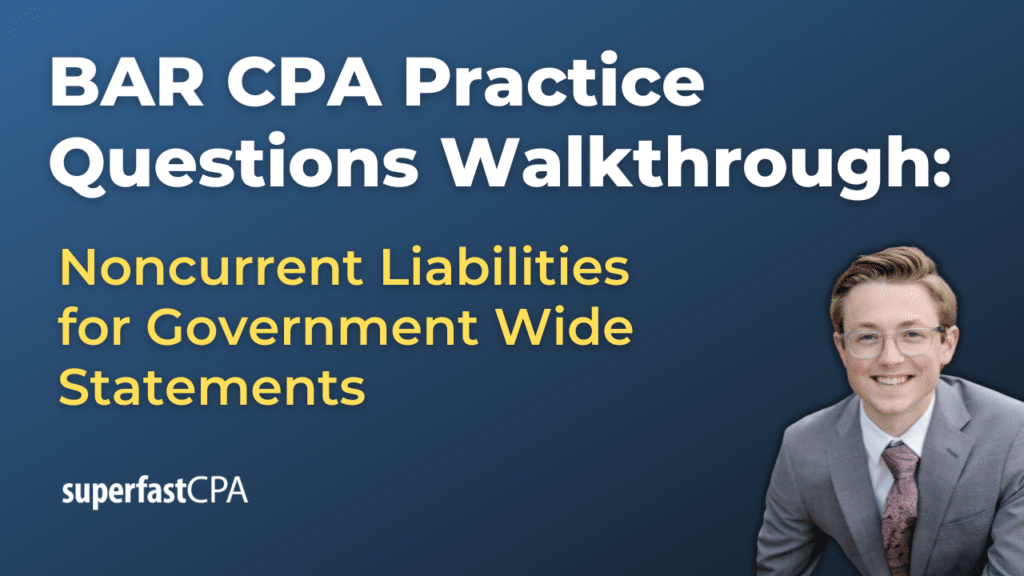
In this video, we walk through 5 BAR practice questions on noncurrent liabilities for government-wide statements. These questions are from BAR content area 3 on the AICPA CPA exam blueprints: State and Local Governments.
The best way to use this video is to pause each time we get to a new question in the video, and then make your own attempt at the question before watching us go through it.
Noncurrent Liabilities for Government-Wide Statements
In state and local government accounting, the government-wide financial statements present a broad, full-accrual view of the primary government. That means long-term liabilities are reported in the government-wide statement of net position, even if those liabilities do not appear as liabilities in the governmental fund financial statements.
In the government-wide statement of net position, liabilities are generally separated between amounts due within one year and amounts due in more than one year. Amounts due within one year are current liabilities. Amounts due after one year are noncurrent liabilities.
For noncurrent liabilities, the government-wide financial statements also separate them by activity type. Long-term liabilities are reported under either governmental activities or business-type activities. The key is identifying which part of the government the liability belongs to.
Governmental Activities Noncurrent Liabilities
Governmental activities are the general government side of the primary government. These include functions such as public safety, general administration, public works, streets, parks, and other services normally financed through taxes or general revenues.
Noncurrent liabilities related to these activities are often referred to as general long-term liabilities. A simple rule is that long-term debt expected to be repaid from general government resources is reported as a governmental activities noncurrent liability.
For example, if a city issues general obligation bonds to renovate city hall, the bonds are reported as governmental activities noncurrent liabilities. The same would be true for a long-term note payable used to buy police equipment if the note will be repaid from general tax revenues.
Common examples of governmental activities noncurrent liabilities include general obligation bonds, long-term notes payable, lease liabilities, compensated absences for general government employees, and special assessment debt that the government is responsible for repaying from general resources.
Debt Repaid from General Resources
One of the most important points is that long-term debt repaid from general resources belongs with governmental activities. The debt does not need to have the words “general obligation” in the title to be a governmental activities noncurrent liability.
For example, a county may have a long-term note payable for police equipment. If the note will be repaid from general tax revenues, it is a governmental activities noncurrent liability. The reason is that the obligation belongs to the general government side of the primary government and will be paid using general resources.
This is also important for special assessment debt. Special assessment debt may be repaid through assessments charged to property owners who benefit from a project, such as sidewalk or street improvements. However, if the government is required to cover shortfalls from general resources, the debt is reported as a governmental activities noncurrent liability.
Compensated Absences
Compensated absences are another common long-term liability. These include benefits such as vacation leave or sick leave that employees have earned and that the government expects to pay in the future.
There are two key points to remember. First, compensated absences are assigned to the activity where the employees work. If the employees work for general government departments, the liability belongs to governmental activities. If the employees work for an enterprise activity, such as a water utility, the liability belongs to business-type activities.
Second, compensated absences are measured using the pay rate at the financial reporting date. For example, if employees earned vacation time during the year but their pay rate increased by year-end, the liability is calculated using the year-end pay rate.
Assume general government employees have earned 1,850 hours of unused vacation leave, and the pay rate at the financial reporting date is $33 per hour. The total compensated absences liability is $61,050. If $16,100 is expected to be paid within one year, that portion is current. The remaining $44,950 is reported as a governmental activities noncurrent liability.
Business-Type Activities Noncurrent Liabilities
Business-type activities are activities that operate more like a business. These are often reported in enterprise funds. Common examples include water utilities, sewer systems, electric utilities, airports, and parking facilities.
Long-term liabilities related to these activities are reported as business-type activities noncurrent liabilities in the government-wide statement of net position. The main idea is that the liability follows the activity.
For example, if a city operates a water utility and issues revenue bonds to finance utility improvements, those bonds are reported as business-type activities noncurrent liabilities. Other examples include long-term notes payable of the utility, lease liabilities for utility equipment, and compensated absences for utility employees expected to be paid after one year.
A general obligation bond issued for a police station would not be included with business-type activities, even if the same city also operates a utility. The police station debt relates to governmental activities. Likewise, accounts payable due in 30 days would not be included as a noncurrent liability because it is current.