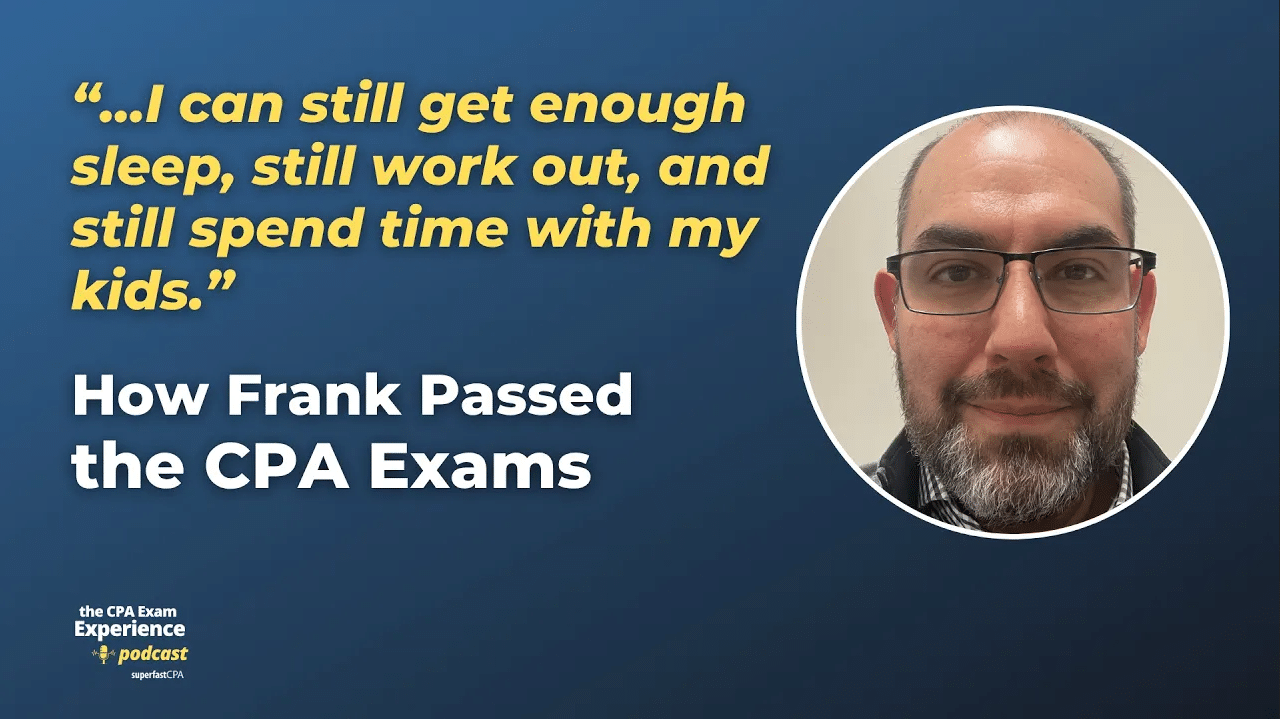
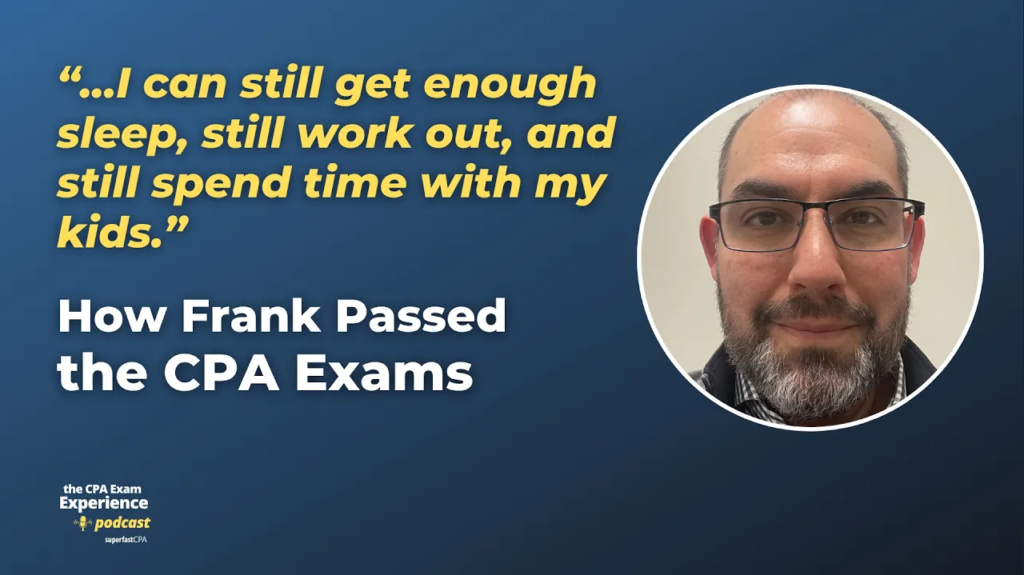
In this episode of the CPA Exam Experience Podcast, you’ll hear how Frank was able to pass the CPA exam while still spending time with his family and exercising. Frank joined the coaching program and absolutely crushed the exams once he got the process figured out.
You’ll hear how Frank was able to go from struggling with the exams on and off for years, to passing them all. He passed them all just in time too, he was about to lose credit for an exam! With some key changes and with discipline, he was able to conquer the CPA exam. Frank has a lot of great tips and advice, you won’t want to miss this one!
IMPORTANT LINKS:
Master your study process by attending one of our free study training workshops:
https://www.superfastcpa.com/study-secrets/
Episode Timestamps
- 00:00 Frank Interview
- 03:34 Frank’s Accounting Background
- 05:11 Took an Exam without Studying to Make Sure He Got the Requirements
- 06:15 Retook BEC to Make Sure Credits Count After CPA Evolution
- 08:51 Took the Tests Multiple Times Before Committing to Pass the CPA Exams
- 10:24 The Reason Why He Only Passed BEC Before
- 12:17 Frank Had All the Study Materials But Didn’t Utilize Them
- 13:49 How Frank Came Across SuperfastCPA
- 15:04 Found SuperfastCPA and Watched the Webinar
- 16:41 Didn’t Finish the PRO Course But Passed FAR in Around Two Months
- 18:32 Deciding to Join the Coaching Program After Passing FAR
- 19:50 The Things That Enabled Frank By Using SuperfastCPA
- 23:38 How Frank Studied in the Mornings
- 25:37 Used the Audio Notes in Traffic on the Way to Work
- 26:06 Would Finish His Study Session for the Rest of the Day
- 29:02 Learning Through the Materials Using Questions First
- 30:41 A Frustration from the Answer Explanations in the Review Courses
- 31:50 Used AI to Help Further Understand a Topic
- 32:33 A Realization After Using the SuperfastCPA Method
- 34:38 How Frank Tackled the Sims
- 38:16 Why Frank Spent More Time on AUD Sims Compared to Other Section Sims
- 41:59 Utilizing Mini Sessions Whenever Had Free Time
- 43:54 Compiled All His Notes and Printed Them Out for Review
- 45:55 Felt More Comfortable with Physical Flashcards
- 47:18 The Contents of Notes He Printed Out for Final Review
- 49:09 Deciding on What to Write on the Flashcards and Notes
- 51:27 The PRO Course Helped Get His Study Process Down
- 53:22 Recommends SuperfastCPA to Colleagues
- 55:29 Family Barely Noticed Him Studying
- 57:04 Top Tips for People Still Going Through the CPA Exams
Interview Transcript
Frank: [00:00:00] And I think that one of the big things for me was realizing that I can, I can do this in, you know, an hour, two hours, three hours a day and still, still get enough sleep and still work out and still spend time with my kids. And, and so I think that was really the, the big, the big changer was just the, the discipline of sticking with it and in doing that, feeling comfortable knowing that because of the consistency, I wouldn’t, uh, you know, I wouldn’t need to, to have these, you know, starts and stops and, and the things that created all of those, uh, you know, really stressful points along the study path.
Logan: Welcome to another episode of the CPA Exam Experience podcast from SuperfastCPA. I’m Logan, and in today’s video, you’re going to hear me talking with Frank.
Frank is someone who I had in the coaching program, but he’s also somebody that did super well in the coaching program, and I didn’t have to help him [00:01:00] that much.
And I think you’re gonna really enjoy listening to Frank’s episode because he has a lot of fantastic tips that he was able to kind of learn and figure out on his own and along with the coaching program, he was able to go from years and years of struggling to pass the CPA exam to passing all of them in a very short amount of time.
Something that I really liked talking to Frank about was his approach to studying. Now, in SuperfastCPA, we usually recommend the two hours in the morning, but Frank had a very volatile schedule. It was different all the time. So instead, he made sure to study as much as he possibly could in shorter increments of time, maybe an hour, maybe a half hour.
Sometimes he did have two or three hours, but it kind of varied. The great thing was that because of the strategies that he was using, every time he was studying, they were effective and efficient. And that’s what SuperfastCPA is really all about, is studying the most effective and efficient ways possible.
So that you [00:02:00] don’t waste months or even years of your time. This is a fantastic episode. I think you’re really gonna like it. Now, before we dive into the episode with Frank, I just want to give one more reminder, as always, about our SuperfastCPA training webinar on superfastcpa.com.
That is a free one-hour webinar where we will teach you the key ingredients to passing the CPA exam so you don’t waste months or even years of your time failing exams. So make sure you check out that webinar, and then from there you’ll have a much better idea of where you want to go, either buying the PRO course or getting the SuperfastCPA study materials, or best would be the total bundle, which gives you the PRO course and the supplemental study materials. So make sure you check out that webinar.
Now let’s dive into the episode with Frank.
Logan: All right. Well, thanks for getting on the call with me today, Frank. I’m really excited to talk to you. How are you doing today?
Frank: I’m doing well. Thank you. How are you?
Logan: Yeah, uh, I mean, I’m doing good, and you must be doing really good cause you’re done with the exams, and that’s what we’re gonna talk about.
Uh, and where, where are you, calling in from today?
Frank: [00:03:00] Uh, I live in a suburb outside of Dallas, So, calling from Texas.
Logan: Texas, okay, nice. Are you from Texas?
Frank: I am.
Logan: Okay, nice.
Frank: Actually originally from Houston, so Dallas is a little bit, little bit different for me.
Logan: Oh, I’m sure. Yeah. Uh, well, let’s get into things just, uh, kind of at, at the beginning, you were somebody that was in the coaching program. Now, honestly, you did exceptionally well, and we didn’t have to do too much together because you just really hit it out of the park. But we’re gonna talk about your whole story today.
Frank’s Accounting Background
Logan: So let’s kind of get started with, you know, the beginning. Where were you in your life, in your career, when you decided you wanted to get, to get the CPA exam or to get the CPA exam done?
Frank: So I, I’ve been working in accounting since roughly the beginning of 2006. Um, and I worked for several companies and, um, did what, uh, all, all industry, [00:04:00] so no, no public or anything. Um, and mostly in what I would call operations accounting.
So, um, you know, a little bit of bookkeeping, a little bit of, uh, you know, public filings here and there.
So just kind of a, a broad array of, of different things. And so, um, in, in doing that and, and working across several companies, i, I got started because it– that that was just, I think, what people did.
Uh, it was just, uh, a thing that kind of separated, uh, folks who would be on more of a kind of a, an ascension track versus those who did probably a little bit more of the, the bookkeeping-type activities.
It, it seemed to be a differentiator. And so, um, at one point, I decided, uh, “I’m gonna take a few extra classes.” I, I had gone to graduate school and, and, uh, and concentrated in finance, so I still needed a couple of classes.
So I decided to do that, and that was roughly, uh, right around 2011. 2010, 2011.
And so the rules were changing [00:05:00] around educational requirements, uh, in, in Texas. And so, um, I wanted to get everything in there, um, and not have to take more school after those couple of classes.
Took an Exam without Studying to Make Sure He Got the Requirements
Frank: And so, um, so I decided to just take a test. And at that point, uh, I took the first one completely cold, didn’t study, was really looking to just be grandfathered in to kind of lock in the, the educational requirements.
Logan: To make sure you could keep taking it. Okay
Frank: Yes, exactly. Um, with- without having to do more school. And so, um, that– like I said, that was probably around 2013. It was, you know, you… at least at the time, I don’t know what the, the rules are anymore here, but, uh, you had two years to test, uh, to, to kind of lock in those educational requirements, or you’d have to go reapply again. And so that, that was about 2013.
And then, um, so took it cold, and I, I picked REG. It was, uh, kind of an eeny, meeny, miny, moe decision. Uh, not, not a lot of, uh, science behind it. I just picked one, um, [00:06:00] from the group, and, uh, yeah, I think I got a forty-four. It was, it was spectacular.
So, uh, after that, I, I thought, “Well, you know, now I’m, I’m kind of in a good place or a good enough place to, to not need to do more school, and so I can come back and do this whenever I’m ready.”
Retook BEC to Make Sure Credits Count After CPA Evolution
Frank: And so a few years went by, and, um, I, I believe that I did Becker, um, at the time and did some of the classes and then kind of fell off and, um- the, uh, life just kind of happens. And so, um, as I was studying, I took BEC, uh, passed it. Um, I think I got an eighty-two. So it was, uh– and, and that was, uh, those– the economics and things like that have always been a little bit easier for me to, to, to, work through.
The, the cost accounting, the economics, um, were, were always, always felt a little bit more natural. So I didn’t struggle too much. And then, um, decided to take REG again and, um, didn’t really put the study effort into it like I [00:07:00] should have, even with paying for, for Becker and all of that.
So, um, had a couple kids in between and, and finally, um, the evolution came along and the, uh, you know, the word on the street was get, get some of these things done.
Definitely take BEC, uh, lock that in because a lot of things are gonna be coming out of FAR and REG that are gonna end up in the new– in the BAR. And so,
Logan: Oh, yeah. Mm-hmm.
Frank: Yes, so for the disciplines. And so, uh, the, you know, kind of the, the, the wisdom at the time was take BEC, lock it in, and then after evolution, go back and take the, the rest of the core.
And they’re good for… they, they extended it from eighteen months to thirty months. So the, the BEC passing score will actually last longer. And so took BEC and then ended up getting really busy with work and doing some other things. I changed jobs from, uh, more accounting to corporate development, uh, at my company.
And so, uh, that, that created a lot more, uh, effort at [00:08:00] work, and so it kind of fell off. And I finally got my letter at the end of October of last year in twenty-five saying, uh, “You got eight months to pass these other three, or you’re going to lose the BEC that you already passed.”
Logan: So,
Frank: And so that was when I decided to finish.
Logan: Sorry, did you end up passing BEC? That would– that must have been at the end of 2023, is that right? And you did end up passing again?
Frank: Yes. Yeah.
Correct.
So I, I had it, it was locked in, and then, uh, a letter saying you basically have eight months to finish because my, the, the, the clock expired and ran out at the end of June. I think it was June. It was either the 28th or 30th was the very last day that I could pass the last of the, of the core tests to, to, to have everything completely finished.
Logan: Mm-hmm. And so, wow, I mean, like, and that’s a long, that’s a long journey up to this point.
Took the Tests Multiple Times Before Commiting to Pass the CPA Exams
Logan: So you took your first exam in 2013, and then kind of just, it seems like that, that was mainly, like you [00:09:00] said, just to kind of make sure that you didn’t have to do the education requirements.
But then after that, did you… was it the kind of thing where you were taking it on and off, or was it more like you only took it like one or two times in the, in the 13 years, and then you kind of got more into it later?
Frank: I, I took several. Um, so that, that first, that first, uh, you know, uh, go-round for REG was the first of four. Uh, I took it a few times and, and, and quite honestly, the, my effort just wasn’t really there. I don’t think my heart was in it. I didn’t have the sense of urgency. Um, you know, I, I probably should have more than I did.
Um, but at the time, there were just so many competing interests. But no, I, I took, I think I took REG, I took it four times. The fourth was, was the pass. Um, I took AUDIT twice. I took BEC twice, and I took FAR once.
So, uh,
Logan: So there were quite a [00:10:00] few interspersed throughout that time. Um, and so it sounds like BEC, was that the only one you passed that you had passed before this eight-month kind of timeline?
Frank: Yes. Yes.
Logan: Okay. And I mean, yeah, you’re right. I mean, not having to deal with the discipline exams was, that is, that was awesome because they were terrible, especially in 2024. That was like the worst year for taking those.
The Reason Why He Only Passed BEC Before
Logan: So, you know, at this point you have eight months left and it sounds like, I guess, what was the way that you were studying when you passed BEC? Like what did your studying look like at that point?
Frank: Uh, to be honest, my study was very, uh, sporadic. It wasn’t really disciplined at all. But I also knew that there were a l- quite a few topics in it that were not problematic.
So I, I kinda did what I ended up doing with the others when I passed them, was just hitting some of the troubled spots. So some of the things around COSO [00:11:00] and some of the controls-related things that were in the exam.
And so really focusing in on those to make sure that I, uh, at least would be, you know, do well enough to, to get through, uh, questions if or when I got them was, was where a lot of my focus was. And then quite honestly, I didn’t concentrate a ton on the things that I felt comfortable with, which like I said, was the cost accounting and the economics and those things.
So BEC was truly the one exam I can say that out of all of them, I really didn’t need to put as much time, uh, you know, before or after, uh, Superfast. Um, it, it just really felt very natural. It’s the only one that I can say that about.
The, the others were, were, were truly rough, but that one was, was not, not the worst, uh, for me personally.
Logan: Yeah, and, and then, and you know what’s so interesting, the contrast is that for me, BEC was my… I hated that exam so much. I, I, that was like my, [00:12:00] my bane, and luckily I passed it first try, but with a 75 by the skin of my teeth, and I was so glad to be done with it.
But yeah, I mean, it, it just depends on the person. Usually there’s at least one exam that’s kind of like a tough exam, but it could be any of them, uh, depending on the person.
Frank Had All the Study Materials But Didn’t Utilize Them
Logan: So you had passed BEC, and at what point did SuperfastCPA come into the picture? Like, did you get that right at the beginning of those eight months, or yeah, when did that come in?
Frank: No. So I had actually, uh, I had actually purchased the– I’m trying to think of the– I, I remember doing the, uh, the, the first, I, I don’t wanna call it a tier, but kind of the study tools for, uh, all four sections, and I did that years ago. That was, that was quite a few years ago. Um, and then I even, um, ended up adding on the, the PRO course, um, years ago.
And I just, it just, uh, you know, so sat on the shelf, so to speak, where it, it really, I [00:13:00] didn’t, didn’t even… I, I looked at it, and I would use the mini quizzes and– but again, it all just felt like something that I, I think of it as almost being on my bucket list, um, of, you know, someday I’ll do the CPA, and it’ll be, you know, the, the timing will be right.
I, you know, if, if such a thing exists. And so, um, so I already had the tools. I had already bought them. They were just… and it was the same thing for my, for my study course.
Uh, my, my main primary, um, study tool, uh, I had purchased that years ago, and it was just there. Um, and, and I used it some. And, and I remember when the, when the evolution, the, the kind of the, the discipline, um, sections came around, um, waiting for those to kind of settle before I was gonna start studying again.
But, but again, it just really wasn’t as serious as, as it probably should have been.
How Frank Came Across SuperfastCPA
Logan: So you already had the study materials, you already had the PRO course, so what made you want to, I guess, what made you start using SuperfastCPA, and at what [00:14:00] point did you want to join the coaching program?
Frank: Yeah. So I, uh, I remember doing a web search, uh, looking for methods to study that would help or that would be different or that would, that– not accelerate or be easy necessarily, but just something, tools or, or tricks or tips that could help, uh, streamline study because there’s so much material. I think, I think coming out of it, one thing that hasn’t changed and probably never will change is there’s just a ton of material and the, the anxiety that I, I assume everyone feels, um, I know I did, is that there’s just this, you know, you’re drinking from the fire hose, so to speak, where there’s just so much information and you just don’t know what’s gonna be included on the test.
So I, I was really looking for something that could help me fine-tune or figure out what to study or how to study. And I think it was on YouTube actually, ’cause I, I, I like videos because I can listen to them when I’m [00:15:00] on the go and, and it’s not something that I have to stop and dedicate attention to, to read.
Found SuperfastCPA and Watched the Webinar
Frank: And so I, I believe that I found, found it on, um, on YouTube. And so the, the– I watched the, the, the one-hour, uh, video that, that, that Nate did, um, and thought, “Oh, well, this is, this, this is cool.” And so I, I thought, well, I mean, you know, it’s, it’s– at the time it seemed like fairly low investment for what it could have done in terms of saving money on all of the exams that you take and then fail and then have to take again, um, or additional study tools because some of the, some of the, the more expensive ones at the time lasted eighteen months.
I, I, I don’t know if it’s still this way, but at one point, Becker, you paid for Becker and you had eighteen months of Becker, and at the end of eighteen months, your, you know, two or three thousand or however many dollars you spent on it just went away. So if you didn’t pass, it was gone.
And so, um, so after that, I, I– that’s when I signed up for the tools, [00:16:00] and I, I honestly don’t remember what year that was, but, but it’s been quite a few years ago.
And so it, it was just by pure luck that, that I, I went on YouTube looking for, for ways to study and found Superfast that popped up and, and seemed to have, uh, quite a few people who, who had, uh, gone through it and who had very, uh, positive experience. And so I, I figured I’d give it a shot.
Logan: Right. Right, so you, so you discovered it, you watched the one-hour webinar, and, uh, yeah, I mean, that’s like usually the best way that somebody can get into it is because it’s just very, you know, it’s only one hour, it’s free, and it kinda like gives you the idea of what it’s all about.
Didn’t Finish the PRO Course But Passed FAR in Around Two Months
Logan: So again, you already had the study materials and the PRO course and everything, and so I guess my question is, once you had the eight months left, is that when you were like, “Oh, okay, I need to actually buckle down,” and is that when you started using, like actually using SuperfastCPA?
Frank: That’s when [00:17:00] I really kicked it, yeah, kicked it into high gear. And, and, uh, and I would say even I, I did what I remembered from the… because I think I really only watched maybe half of the PRO course videos. This is embarrassing that, you know, you tell somebody that you paid money for something, and then I only used about half.
I think I made it halfway through the PRO course videos and took what I, what I knew from that, which was a lot of the, you know, planting the seeds and then the, the, the re-review during each session. And, and so I, I did that and, and I chose FAR for the first exam, which is just, you know, I don’t recommend that for anybody ever.
But I, I, I chose FAR and I, so I, I, I did kind of a shell of what the, the full PRO course, uh, uh, teaches and, and, and went through. And so I, I would say that, you know, for the, for the, the pieces of it that I took and the things that I did in preparing, it, it ended up being about two to two and a half months.
So it was still very [00:18:00] short and, and it was not, like I said, it wasn’t even a full, you know, doing deep notes and, and, uh, you know, kind of looking at everything. And I… It, it was definitely re-review, definitely planting the seeds. I made it through the entire, um, all of the study sessions or sections in, in my review course and then, um, did the, just a ton of re-review all the way up until, uh, the day before I took the, the exam.
But, but it was, I mean, it was about two to two and a half months or so before I tested, uh, and took FAR.
Deciding to Join the Coaching Program After Passing FAR
Logan: And, and so how did the– how did FAR go that time?
Frank: So FAR, and that was the only time I took FAR. Um, I, I ended up passing with a seventy-five. So that was my, that was kinda my BEC, uh, was, uh, I, I got my score back and, and saw that it was, uh, that it was a seventy-five. And I thought, “Well, I mean, that seems like no, not a minute of study wasted there. Um, no, no extra, extra points needed.”
So I, I… Once I, I got that, I was [00:19:00] like, “Okay, well, I, I think this is gonna be my, this is gonna be my thing.” And we had actually– I had already signed up for the coaching, uh, program at that point. But to be honest with you, I was hedging a little bit because I thought, “If, “If, I failed this thing and my timeline gets pushed, I, I’m on, I, I have very little time for, room for error time-wise.”
And so, um, so as I’m thinking about it, I’m like, “Well, I’m just gonna see how I did on this one before I, I push forward with everything else.” And when I saw that I passed, I thought, “Well, this is, you know, this is supposed to be the toughest test.” Um, and, and it was not easy, but… and a ton of information. But I thought, “Well, if I can do this one, um, I’m, I think I’m just gonna go ahead and, and, uh, and get to the one that truly was the bane of my existence, which was REG.”
Um, and so I, I pi- you know, I signed up for REG next and, and, uh, and just kinda went from there.
Logan: Right.
The Things That Enabled Frank By Using SuperfastCPA
Logan: And so what, at, at this point, you know, you had signed up for the coaching program and you had SuperfastCPA for a while, and what [00:20:00] differences did you see it making? Like, I guess, what changes did you make with SuperfastCPA that you think started giving you those passing scores outside of, you know, BE- BEC that you had had before?
Frank: Yeah. So I think that the– well, the, just the, the, the the discipline and, and I– whenever I signed up or whenever we first, uh, when we first kind of traded messages, I had told you that I, I, I rarely have struggled with concepts. Comprehension on a lot of these things has not been an issue. I’ve, I’ve worked in accounting for eighteen years, so, um, I had, uh, uh, quite a bit of practical hands-on experience, which helps and hurts at the same time, uh, for testing.
But, uh, the, uh, the, the big difference in, in kind of between that and, and everything else was the discipline and, and just sticking with it and, and actually doing the no matter what, I’ve, I’ve got to get in every single day. And, and for the most part, [00:21:00] between when I found out I had passed FAR all the way through the very end, I can really only think of there were probably less than ten to twelve days across that six-month span that I didn’t do anything.
And, and a lot of that ended up happening because, um, we had events that we were doing. For example, uh, my niece graduated from college, and she– they– where she went to school is, is not around here, so we ended up traveling and, and, and I was in the kind of the planting the seeds phase where I’m trying to work questions and, and, and take notes off the questions.
And that’s, that’s really difficult, uh, with a tiny laptop or with an iPad or something. Uh, the way that– versus the way that I do it at home, which is on, you know, multiple screens and everything else. And so that… but that, that part notwithstanding, it was just a very dialed in, making sure that I spent no less, no less than an hour, uh, every single day and most days a-a-and it [00:22:00] fluctuated. It could be, and I’m sure we’ll talk about this, but, uh, you know, it could be an hour, it could be two hours, it could be three hours. It just depended on the day and on the, the amount of time I had and how, um, well I felt I had done up to that point or how much more I felt like I could get in for the day.
But, but it was certainly not anything that I felt overwhelmed or, um, you know, where I just feel like whenever I was younger, I would always hear people who were almost basket cases because every minute of their life was consumed with just, you know, “I gotta go home and I gotta study, and then I’m gonna be up till two, and then I’m gonna get up at four, and then I’m gonna study.”
And it just seemed to consume their lives. And I think that one of the big things for me was realizing that I can, I can do this in, you know, an hour, two hours, three hours a day and still, still get enough sleep and still work out and still spend time with my kids. And, and so I think that was really the, the big, the big changer was just the, the [00:23:00] discipline of sticking with it and in doing that, feeling comfortable knowing that because of the consistency, I wouldn’t, uh, you know, I wouldn’t need to, to have these, you know, starts and stops and, and the things that created all of those, uh, you know, really stressful points along the study path.
Logan: Right. Yeah, I mean, and I, I think for me that was personally one of the things that really drew me to it as well, cause, you know, at the time I was, uh, doing my master’s degree, I was doing the CPA, I was working, and we had two babies at home. And yet, because of, like you said, the discipline, it still all worked.
How Frank Studied in the Mornings
Logan: Uh, and I do wanna talk about, like, how that discipline looked for you. So, you know, on a day-to-day basis, you got something in every single day.
And let’s start with, like, the main sessions. So you said that minimum it was an hour, but sometimes it was two or three. How did you determine that, and what did those look like depending on [00:24:00] the time that you had? Like, what did you do during that time?
Frank: Yeah. So, um, my day and I, I think I told you a typical day is, uh, uh, nev– there’s no such thing as a typical day, uh, for me aside from some of the things that I– So I’m, I’m, uh, just where I’m at in life, um, I get up every morning and the first thing that I do is work out.
Um, I’ve tried doing that in the middle of the day, in the afternoons, in the evenings. In the morning is the time that works, just works best for me. Um, getting up at three or four AM does not work, uh, best for me at all. And so I, I know that the recommendation is, uh, get up and do it in the morning, and I think that that’s, uh, that is great advice. And, um, for me, that was less workable for the main session.
So what I would typically do is I would get up, and while I was lifting and/or, um, you know, on the treadmill or whatever, I was either watching videos, they could have been Superfast videos or some of the other videos that are out there [00:25:00] that covered various topics. But I would watch and listen and try and absorb and, and as, uh, you know, whoever it was, whether it was you or whether it was a, another, another, um, course, um, that, that just posted videos on YouTube, um, going through multiple choice, I would be trying to guess the answers as, as we’re going through, even if I’m, you know, jogging on the treadmill or, or doing whatever.
Um, and so it was still– I was still engaged in it and still thinking through and trying to keep my mind active on it. So that is typically how I started out my day, and that would be probably half an hour, forty-five minutes of that.
Used the Audio Notes in Traffic on the Way to Work
Frank: Um, and then I would, depending on the morning, um, sometimes listen to audio notes on the way to work. Um, Dallas traffic is not the most hospitable, uh, for not paying attention. So, uh, trying to really, uh, you know, actively listen and, and, and everything while I’m dealing with, uh, with traffic between my, my house and, and, and work. Um, you know, a lot of [00:26:00] times it would just kinda go straight over and, and not, uh, not necessarily sink in, but, but the effort was there.
Would Finish His Study Session for the Rest of the Day
Frank: And then where I did a lot of it, and, and I did tend to split it, was, um, I would usually spend about an hour at lunchtime at my desk, uh, doing my main, uh, main session of, uh, working through multiple choice questions, taking notes, capturing pillars, those things. And then depending on how far I got, I would usually try to finish up my, my session.
And normally it was one block or one, you know, piece at a time. I’d, I’d, you know, one section, if you will, of, of the study program. Exactly. One topic, yeah. So, so I would typically get through that. And, and if I could get through that, I was usually good because then that meant that I would come home I would do my, my normal evening routine, but before I got into the evening routine, I would typically do my re-review, uh, when I would– first got home when my brain was still semi-fresh.
So, and it gave me a little bit of time and a little bit of space to [00:27:00] not y- be– not use necessarily the things that I just covered in the latest session as a crutch. So I had a little bit of time for it to– for me to understand or know did it sink in or not.
And so, um, I, I honestly didn’t feel like I lost anything in that. So, so that seemed to work for me that I, I wasn’t super worn out mentally or anything yet at that point. Um, but, but, those were– And, and again, that evening session, that could have ended in that, you know, half-hour re-review or, or however long it took. Um, or I might have decided I had enough, uh, enough in the tank to go do another section.
And, uh, sometimes that happened. If, if I was like, “Nah, I still got another hour in me, I think I can do another section and, and then maybe even squeeze in another re-review, even if it’s only, uh, ten or fifteen questions instead of twenty or thirty,” um, I, I would just do that. And so, um, but if it, you know, at the end of the day, if I got to re-review and was exhausted, I would just call it a night at that point and, and just [00:28:00] kinda go do, do the normal family stuff in the evening.
Logan: Yeah, and, and what I’m liking about what you’re saying here is, you know, with SuperfastCPA, we typically recommend, you know, very structured, like do the two hours in the morning, mini sessions all throughout the day, and then things like that.
But what, I think this is really coming down to is that even though you were splitting it up, you were, because you were doing it efficiently, like going to the things that actually mattered, it made it so that any time you spent was worthwhile time.
Uh, cause I think too often, you know, people might do something kinda like what you did, where they’ll split it up, but they’ll spend that hour watching a lecture and not really doing anything, not really learning anything for themselves, not applying it.
But because you had that strategy of going to the questions first and focusing on those, it made any time you were studying effective. [00:29:00] Um, so I, that’s, I’m liking what you’re saying there.
Learning Through the Materials Using Questions First
Logan: And when you were doing the questions, what did it look like during planting the seeds? Was it just like kinda diving into the questions fresh and kinda just clicking through them? Or how did you learn from the questions best?
Frank: Went through and I didn’t spend a ton of time on, on each question. It, it would be just enough for me to actually read the question, understand what it’s asking, read through the answer choices, and if I felt like I had a pretty good guess, then I would, I, I would drop that in. If I had no idea, I would just pick the one that seemed right.
And then, um, you know, all of the study courses have whenever you get it right or wrong, either way, pop- pops up an explanation of some sort. And so I would, uh, whether I got it right or wrong, um, sometimes I would get it right and it was like, yeah, I figured that was gonna be the answer. That’s the only one it could have been.
Or it was like, yeah, I got that right, but not because I actually knew it. It’s because I just happened to get it right. Yeah, exactly.
Uh, and so [00:30:00] then a lot of the time was spent and, and, and I didn’t zip through them. So I– when I went through, I would do that, and then I would read and I, I would try to understand and digest the, the, the reason that the correct answer was correct.
And, and quite honestly, and I know I mentioned this in, um, in one of the, the sessions or in the, in the exchanges that we had, was that the explanations that come with a lot of those study courses vary in terms of quality.
Sometimes they’re really good, and you get a very solid, like definitive at the very beginning of the explanation, “This is, this is how this thing works.”
And if it’s something mechanical or something statute-based, it’s like, well, that makes perfect sense, of course.
A Frustration from the Answer Explanations in the Review Courses
Frank: Uh, where– and, and I think that this was probably true for audit more than a lot of the others. I would see– I would read an explanation, I would think, “Oh, that’s not really hitting.” Like I, I understand what this is saying, but, but every now and then you get… and, and I’ve read on, on, on boards, public, uh, posting boards that, [00:31:00] that this has been a, this has been a complaint for, for some of the, the software prep is that when you read the explanation, it says, “Well, A is right because B, C, and D are wrong.” And so it’s like, well, yeah, I mean that, that makes perfect sense, of course.
Um, but it doesn’t necessarily nail down why A is the, is the right or the best answer. And so, um, I– for, for REG, uh, especially the tax piece and for FAR, there– a lot of those things are, are, are technical to the point where, uh, seeing a process or seeing a calculation that there’s really not a lot of interpretation to be done, right? Exactly. It’s, it’s very straightforward, a very objective, uh, response. Audit, again, because there’s so much judgment based into a lot of that and because the, the test makers are looking for a very specific response to that.
Used AI to Help Further Understand a Topic
Frank: Um, I feel like the, the, the, the need for further explanation or for something that, that I could understand, uh, really ended up being something that, [00:32:00] that I found a need for more, more so than the others, and so, quite honestly, I, I went to Claude. Uh, and I would say, “Claude, here’s the question. Here’s the credited response. I’m really trying to understand this because here’s what I know.” And I would kind of put in some things that I understood, that I actually understood that I thought should have been the explanation but, but weren’t necessarily in the test prep software as the explanation.
And so I would do a little back and forth. So that, that could take a little bit of time on a single question, but there weren’t a ton of those. Like I said, really until I got to audit, there were more. But, but I, I would do that.
A Realization After Using the SuperfastCPA Method
Frank: But I would really try to understand the, the question and the reason that the correct answer was correct and not just say, “Okay, well, you know, you know, XYZ because AB,” and then just, you know, let it just– and then pass because I, I feel like that is where, I know for the way that I studied before versus what I was doing after following more of the Superfast method was a, was a big difference as well, was just really trying to digest and understand why and not just stuff it in my brain because if you’re just trying to [00:33:00] memorize it and move on, it, it’s gonna, recall will fail, uh, at, at the, at the point where you get into the test because it’s– you’re not gonna see the same questions on a test that you see in your practice. They’ll be different.
They may be similar, but they’re always gonna be different. So memorization of test questions and answers is rarely a, a, a winning strategy on, on the test.
Logan: Yep. Yeah, I mean, you’re, you’re basically hitting it, hitting all the points that, that, we like to talk about, and I think you’re exactly right. You know, the, uh, way too often, uh, I have seen that exact thing where people will look at the answer and they’re like, “Oh, okay. That makes sense,” and then they just keep going.
You know, they don’t, they don’t actually try to, like you said, digest it and understand why and really get to the heart of the concept. And that’s what the, it’s really all about, is using the questions to get to the heart of what [00:34:00] you’re supposed to know. Because if you’re just looking at the question being like, “Oh, the answer is A because B, C, D, and wrong, uh, B, C, and D are wrong, so okay, I guess that’s how you do it.”
Be- instead of actually putting in the effort to understand, okay, no matter what the situation is, this is kind of the general idea behind it. Um, uh, I mean, I think you hit it right on the head r- there, there. You have to understand the why because you are not gonna see that exact question on the exam.
You’re just not. If you do, you got super lucky. Um, it’s, I, I just, I like what you’re saying there a lot.
How Frank Tackled the Sims
Logan: And did you find that that was the case with, um, with sims as well? How did you prepare for sims?
Frank: So sims, I spent less time. I think everybody does, and there are fewer sims to, you know, the sims to multiple choice question ratio is obviously very slanted. But I, truthfully, whenever I was [00:35:00] studying, when I studied FAR, I did almost no sims. Um, I did mostly multiple choice. Um, when I got to REG, I was still much heavier on multiple choice than sims.
I think I did some sims in the last couple of weeks of study, so I, I think I, I think I was, uh… oh, gosh Almost, almost four full months between FAR and, and REG. REG I did s- I did more sims, but it, it was really I, I didn’t do a ton of them until the last, like, few weeks and I, and I incorporated them into my weekends, um, where I, I, I mean, I may have done, you know, maybe a, a couple dozen total, uh, for, for REG.
For– I, I did a lot more for audit because audit was my last test and because I had seven weeks to get it done. So there was, there was a lot of time pressure, so I thought I’m doing everything that I possibly can. But, but really and truly the sims I, I feel like and, and I know other [00:36:00] people have said it before, uh, the sims are really just kind of a blown-up version of multiple choice that you, that you, see that are, a lot of them are open-ended, some of them are, you know, you just pick from a list.
But I feel like if you understand it well enough and if you’re doing the process to understand as you go through multiple choice, the, the, the, process of thinking through the questions really translates to the sims.
So sims to me really didn’t feel all that different if you just kind of compartmentalize and just treat them, each one as a separate thing, which it is, and treat each question as though you need, you know, kind of a, a separate, um, you know, what, what are you looking for in each question, um, on a line because sometimes it– you could have a sim that’s got five things on it, and all five could be something completely different.
Or you could have one that’s got five boxes, and they’re all based on the same fact pattern that you get in the question and, and the, the exhibits that you, that you see that, that pop up.
[00:37:00] So, but I feel like if you’re using that and you’re applying the same, uh, the same rigor that you do in a multiple choice question, I just never really saw that big of a difference or think of, thought of it as something that was all that different from the, from the multiple choice.
Logan: Right. And I mean, you’re exactly right there. I mean, of course we, in m- so the way I think about sims, and I kind of have said this a whole bunch of times over the course of different things, is that sims are… you need to know how to approach a sim, l- and it’s less about like knowing the exact material in the sim, because you’re not gonna see a sim that you’ve seen before on exam day.
But where the practice helps is basically not losing your cool. Like you see a sim and you’re like, “okay, I can break this down piece by piece. I’m just gonna go one step at a time.” That’s why I think it’s important to practice sims, but like you said, you, the main [00:38:00] focus is multiple choice questions.
That’s where you gain your knowledge, and then with sims, I do think it’s worthwhile to practice them at least a little bit like you did to kind of have that familiarity with how they work. But yeah, the MCQs really are like the king of what you need to be doing.
Why Frank Spent More Time on AUD Sims Compared to Other Section Sims
Logan: And with, with audit, did you find that you needed to do that many sims, a lot of sims, uh, because it was kind of like so conceptual and a little bit more difficult? Or like why did you do more sims with audit?
Frank: So with audit and, um, you know, everybody, you get a different test every time. So with audit, my… where I wanted to make sure that I wouldn’t get to the test and, and, uh, I don’t want to say choke, but just, you know, have, have that, that that mini freakout moment while I’m sitting there at the computer station, was that the, the multiple choice questions, by and large, it’s asking you things like, in this [00:39:00] circumstance or this scenario, what is, you know, what would this thing, what would apply to this or what would this thing do?
In, in some of the SIM practice, uh, it, it’ll, you know, it’ll throw up a form. It’ll say, “Fill in the, fill in the things from out of, out of these.” You know, you’ll have a, you’ll have an audit letter, or you’ll have a review letter or something like that. Some, some, some report format that you’re, that you’re responsible for.
And again, this is, you know, I’m only speaking to the, to the practice, uh, that I did leading up to the exam.
But, but in the, in the, in the practice software, it, it’ll splash up a report form, and it really puts what the– what’s very conceptual in the mu- in the multiple choice and puts it in a, in a visual format in front of you, where you have to… you actually have to select the language that’s appropriate for that section.
And those can get really tricky because, uh, you know, no, this, you know, this piece or this wording doesn’t go in this paragraph. It goes in the letter or in the report. It just doesn’t [00:40:00] go in this– it doesn’t go in this paragraph.
It goes in this other one. And so that’s where I was concerned for audit about getting tripped up. I, I’ve never worked in audit, um, and so, uh, uh, definitely not public. And so the, um, the idea that I would see something like that on the exam and not be prepared just really, uh, it concerned me to the point where I felt like I needed to make sure that I was ready for that, if that’s what I got on the exam or if I saw something like that.
And so things like that were really where I, I spent a lot of the time, was just the, the reporting components and then, uh, you know, some of the calculation things. Spent time sampling. I, I’ve, I’ve, I’ve had some very, very light, um, exposure to sampling in, in, in, you know, in pr- in my profession in work, um, to the point where I, I knew a little bit.
But as far as how you calculate certain sample sizes or how you select certain things, just not part of what I had any background [00:41:00] in. And so those areas felt a little bit more foreign to me. And so I, I just wanted to spend time making sure that, that if I got those on, uh, for a SIM on the exam, that, that I was ready or had at least seen it and, and was at least a little familiar with it.
Because I– that isn’t something that in my test prep that, that I really saw a lot of in multiple choice.
Um, so much as, you know, in, in a report, do you include this or what, what would be included? And it’s all very conceptual about, well, I would include this in, in this section, or it would go in this section.
But that’s very different, I think, than actually looking at the report itself and deciding what the words are that need to go in there.
Logan: Right. And, and the report could be about, uh, like a specific thing, and so it could have the wording of, you know, some kind of business that you’ve never really thought about that business and you’re like, “Oh, I don’t– I have no idea what, you know, where this is supposed to go.” So the practice of doing that, I think, is very wise.
Utilizing Mini Sessions Whenever Had Free Time
Logan: [00:42:00] Um, so, you know, we’ve talked about how you did your studying, your main session studying, and we talked about how you did your sims, and, um, one thing that we haven’t talked about too much is the mini sessions. How did you– Like, what did those look like for you? I know you mentioned you listen to the audio notes sometimes on the way to work, uh, but, you know, what did the rest look like?
Frank: Right. Yeah, so and I, I didn’t, I didn’t mention this before, but, uh, mini quizzes just walking, getting up if I was going from my desk to the men’s room at, at work or if I was going to take a walk just to, just to get, get my blood moving a little bit or walking to or from my car. Um, the building I work at in is very big and spread out.
There’s a lot of distance that you cover, uh, walking anywhere. So it’s, it’s more, um, spread out than, you know, more horizontal than vertical. And so, um, lots of opportunities to do a lot of walking, uh, in, in the, in the building that I work in. So, um, every [00:43:00] opportunity, every time I got up and, uh, you know, I, I’m sure that I probably seemed very antisocial, uh, for that time because my face was always pointed at my phone and, and, you know, nine times out of ten I was working through mini quizzes and just trying to get through it.
And I mean, I could for a five-question mini quiz from, from Superfast, from the app, um, I could potentially get three in just walking to the men’s room and back. Uh, so I, you know, I, I could– Uh, and so I did that as often as I, as I could. Um, and/or it could have been that I was sitting at my desk and my eyes were a little tired from staring at the, at the computer screen, so I gave it a break by staring at the tiny little phone screen instead, you know?
Uh,
Logan: Yeah.
Frank: And so I, I, I might… yeah. Yeah, exactly. And so I, I, I did that too, where I might, you know, just need a, need a break from staring at the computer and I, I might squeeze in one, you know, five-question quiz or, or something and, um.
Compiled All His Notes and Printed Them Out for Review
Frank: One of the things that I didn’t mention before was that in addition to the Superfast notes, [00:44:00] um, I also, um, when I would– was done compiling all of my, uh, day-to-day based on the multiple choice, I actually, that was another thing that I used Claude for, was I would put all those notes in a, in either an Excel or a Word doc or a, a lot of Excel or Word docs.
So in the PRO course, it talks about, you know, do this stuff in Excel and for anything calculation-based, I was– when I, when I got to, to audit, I– it was all in Word because there were no real calculations to need to, to focus on. But when I would finish each one or whenever I was done at the end of it, I would tell Claude, “Okay, go in here and look at all these and create me a study guide.
And here are the things that are important to me. Uh, you know, here are the, the thing– anywhere where I noted that I was confused about something, be sure you add a little bit more, check it for accuracy, etc., etc.”
And at the end, I, um, would save in, uh, the, the output from that, typically in a Word doc, put it on a thumb drive and take it to the UPS [00:45:00] store and, uh, print it out and have it bound.
And then I would carry that little spiral notebook around with me everywhere I went, and I’d have highlights and tabs and everything else in it. Um, but that was my– that was a big piece of my, my, my late, you know, kind of that final study push was I’m using my own notes that I had created. And I always had time after I got through all the s- the sections to where by the end, my– all of my s- all of my study was just re-review.
Um, and then hitting, you know, maybe ten or fifteen questions on things that I still felt uncertain about. But the– But there was– I would have this whole book that I would carry around with me in my briefcase or, or would slap on my desk or, and just any time that I had a chance, I would pull it out and thumb through it and just pick up just to review.
So there was th-there was always that as well, um, in addition to mini quizzes, you know, kind of walking from here to there. I also had that book with me.
Felt More Comfortable with Physical Flashcards
Frank: And, and I’m a, a bit of a dinosaur. I, I told you, I, you know, my, my [00:46:00] flashcards are, are, uh, are, are still paper cards. That worked better for me. I could– I would actually just carry those around.
I know it’s easy in the phone, but, but it’s really wasn’t that big a deal for me to just pick up my cards and walk with them and just kinda, kinda look at them through there. And then the same thing day of the exam as I was sitting in the parking garage getting ready to go into the testing center, I could just flip through those physical cards sitting there in my car.
And, uh, and, and it really, for me, that, that was a little bit easier, um, than, than the, than doing it on the phone or, or using the, the programs. I did try that and, uh, still, still found that the paper was, was a little bit easier for me to, to deal with.
Logan: Yeah. And I mean that, you know, we recommend digital mainly for ease of use because you can type it on the computer and then boom, it’s on your phone. But, and I, I will, I will admit that I personally like to write things physically.
When I was going through the exams, I did flashcards digitally, but I took my notes [00:47:00] by hand, um, cause there is some, I mean, it is a proven fact by mil- so many studies that writing by hand is a way, a really good way of helping things stick in your brain and helping you process things. So, you know, we definitely aren’t saying never do that.
The Contents of Notes He Printed Out for Final Review
Logan: And so when you did that, so the flashcards were handwritten, and then for your notes, would you more, just to make sure I understand you there, would you more just like type those up in a Word doc and then use Claude to summarize it? And about how big did that usually end up being?
Like, was it like a thick book or was it just like a few pages?
Frank: Uh, it depended on the, uh, on the topic. My REG book, I think, was like eighty-nine pages of, uh, front and back, and my audit book was like a hundred and thirty pages front and back.
Um, but that was the, that was the full comprehensive everything, plus, uh, addendums that I put in there for, you know, traps that, that I had come across, [00:48:00] things that if something was worded a certain way and that tricked me, uh, because I got tripped up on, you know, some, some little wording piece, then that was something that I captured was, you know, just make sure that you pay attention to this type of wording.
Don’t, don’t fall for the trap. And so there was… It wasn’t pure notes. There were some things that were added on that were my own observations that were really more geared toward me and, and just not falling into some of the traps that I had found in my, in my re-review sessions that I just kept falling for.
So, um, so but, but yeah. It was, uh… the, the books were fairly thick, but they were very fact heavy and, and they were worded in a way that made it, I thought, very, very easy to follow. So for me, it, it, it was– it made sense and, and it, it all flowed very well.
But if somebody else, if, if I sent it to you and you picked it up, it may, may seem like, you know, not, not helpful at all, right?
Logan: And you know, that’s kinda, I think that [00:49:00] is kind of the thing that needs to happen. That’s the point of taking your own notes and making your own flashcards is putting them in a way that fit, that works for you.
Deciding on What to Write on the Flashcards and Notes
Logan: Um, and I, one question I had with that was how did you differentiate between what was something that would go in that notebook or what went in a flashcard? Like, how did you decide that?
Frank: Yeah, so everything went in the notebook. That was the kitchen sink. So, um, e-every- everything went in the notes. The flashcards, though, I, I tended to follow the if, if I’m going through and I’m, I’m hitting my re-review, uh, sections e-every day and I’m constantly missing a question about a topic, um, the– th-that was when I would, would create a flashcard because it’s like I, I just– this just isn’t sticking for whatever reason.
I, I just– it’s not that I don’t get it. I get it. It’s just I remember it too late after I’ve already answered, you know, put the wrong answer to a question. And so I, I’m actually– I can see my, my [00:50:00] whole, uh, whole, uh, flashcard deck is actually sitting here next to me and, and the whole thing is maybe this thick for all sections.
So we’re talking about like maybe three or four inches for everything, all, you know, all three of the, the core, core sections. So there, there wasn’t a ton, but, but where, where I did create them or I did make them and write them out, those were the things that truly tripped me up that I just really struggled with, with remembering and it just didn’t stick.
So, um
Logan: That’s exactly– That’s, that’s what I wanted to know because that’s exactly what we tell people to do. So you followed that, you know, like flashcards, they’re not there for any little topic where you’re like, “Oh, this seems important.” It’s for, “Man, I just, I’ve studied this. I know how it works supposedly, and yet I keep missing it.” That’s when you make a flashcard. Uh, so I, I mean, you did that perfectly.
Um, and I mean, we’ve talked about, we’ve talked about, you know, most of the pieces of the process, like the basic pieces of the [00:51:00] process. And like I said at the beginning of this call, like, and this is, you know, nothing against any- anybody in the coaching program, but different people in the coaching program require different things.
And you were one of those people who you kinda just took it and ran. You know, like we did a few things together, but you did exceptional. And, um, so it- it’s been really cool to kind of like hear a lot more of the ev- like even more of the background stuff.
The PRO Course Helped Get His Study Process Down
Logan: Um, is there anything else, like any other part of your journey or your process that we haven’t gotten to talk about yet that, you know, before the call you were like, “I would like to talk about that”?
Frank: No, I, I mean, really the, it was very straightforward. Um, I think I, I really did my best to kind of stick to the, the advi– like I said, the, the timing of one big block first, the early in the morning was really the only deviation from the kind of the suggested process. Um, everywhere else I really tried to follow it.
And so I think that anybody [00:52:00] who, uh, does the PRO course, who signs up for and watches all the PRO course videos and kind of follows them along will ha-will have my process down exactly. Like I said before, the, I think that the, the fact that I worked as many years as I did before I got serious about studying was kind of a, a mixed bag of some things came, uh, I could relate to having done certain things in, you know, professionally that were part of the, the, the exams and that was helpful.
And then in some other instances it, you know, it’s like, “Yeah, we would never do that that way. Nobody really does that. That’s a, that’s a thing they put on the exam, but that’s not really a thing.” Um, and so I, I would say that, that I had, I felt like it was a net advantage and, and I don’t know really how to explain in what ways that’s true other than to just say that, you know, for anyone who is very early in career, which is when I’m going to assume a majority of people typically do [00:53:00] this, and, and I think that’s the smart play is to do it that way, um, that, you know, that there’s, there’s, uh, there’s, there is value in experience and there is also value in being able to kind of put your head down, s-study the things that are gonna help you pass the test and get the experience as, as it comes because the, uh, both are very, I think, important.
Recommends SuperfastCPA to Colleagues
Frank: Um, but the, definitely the, the, the study techniques and, and I’m, I’m a huge fan. I… anyone who, um, I interact with at work who is getting ready to, to, to take the exams, I recommend Superfast to all of them as a method to not spend, I mean, just dozens if not hundreds of hours watching videos and reading books and, and having t- a chance to forget all of the material before, um, you have to go then do a, you know, w- uh, a two or three-day intense cram session, um- but, but yeah, no, there, there really isn’t anything beyond that.
I just kind of stuck to it. I [00:54:00] signed up for coaching, really wanting some accountability. You emailing me when you did and saying, “Hey, what’s going on? How are you doing? Uh, where, where are you at? What’s, what’s the latest?” Um, really was what I needed. Um, that, that was helpful.
Um, I– like I said, I, you know, the concepts and all of the things, I just rarely struggled with any of it, even from watching the, the PRO course videos and being able to follow along, uh, in a way that made sense for me.
Uh, really, I didn’t have questions about that either. So it was, uh… I’m glad to hear that it wasn’t burdensome because, yeah, I, I, I, feel as though, um, you know, the, the, uh, for me, it was just the right amount and, and it’s what I needed. And so I, I definitely got what, what I personally needed from it.
So, um, you know, thanks to you guys, uh, it’s, it’s been, it’s been a really a much less painful journey than I remember it being when I was trying to do more traditional study, for sure.
Logan: Yeah, and I mean, that’s the, [00:55:00] that’s the goal, right? Is to basically make it so that it’s not just absolute misery. There’s a little bit of sacrifice, but overall, I mean, like you said, you were able to still work out, you still spent time with your family, you still had a job that you, like, you were able to do your job normally instead of like stressing and being like, “Oh no, I, I have to be studying instead of working.” You know, it just sounds like it, the str- the strategies really made that a big difference for you.
Family Barely Noticed Him Studying
Logan: Um, and did your, just curious, did your family notice? Like, did they even, cause I, you know, I’ve asked this to different people. Some people it’s like, “Oh yeah, they noticed a huge difference,” and some of them were like, “Oh, I didn’t even know you were still taking the exams.”
You know, like, it just, uh, uh, uh, like how did it go for you and your family?
Frank: Yeah. So it depended on the day. Um, I think probably Monday through Friday it was invisible to them because everybody kind of does their own thing. I, I have, uh, you know, teen/tween [00:56:00] age kids, and so they’re all– they, they don’t pay attention to anything we’re doing anyway. So, uh, especially on weeknights, you know, with, with normal routine.
On the weekends, occasionally they, you know, it’d be like, “Oh, you know, Dad’s in there studying.” Um, so not that they– that made them any more quiet or, or any more accommodating. But, uh, you know, they, they definitely… And, and whenever I was done and I got the last one, I, I did tell them, I’m like, “Yeah, I’m not gonna… and I’m not gonna be having to sit in there, you know, during the weekends and stuff for, uh, you know, for, for, you know, however long, you know, hours or, or whatever.”
And it was like, oh yeah, they, they– it, it was some of the latter there where they’re like, “Yeah, I didn’t even know you were still doing that.” So, so anyway,
Logan: They look up from their phone, “Oh, oh yeah. Okay, cool.” And then, n-n-
Frank: Yeah. Take, take a break from video games to come out and, you know, notice that I’m, uh, you know, sitting in front of the computer doing stuff and, and, you know, grouchy, but.
Logan: Uh, well, I mean, that’s awesome. I, I, I’ve really enjoyed talking to you about your [00:57:00] process and your story, and thank you for, you know, getting on the call today.
Top Tips for People Still Going Through the CPA Exams
Logan: Now, as we’re finishing up, we– I always ask the same question no matter what we’ve talked about, just kind of as a good way of wrapping up. What would be your top two or three tips to people who are still going through the exams?
What would you say to them?
Frank: I would say definitely follow the, follow the blueprint of being intentional about how you’re spending your time. Don’t, don’t waste a, a minute more than what’s necessary. Don’t waste any time. Um, do, do the, do the study in the way that it’s gonna stick and, and make sure that you’re very focused during that time.
Um, the– it’s, it’s tough to try and multitask when you really need some of these things to stick. So set the time, whatever time you’ve got, and really, really dedicate and focus. It, it can be tough depending on the day. It can be tough depending on what people have going on in life. But if you wanna [00:58:00] get this done, I don’t know of another way to do it other than to just carve out the time.
Even if it’s not, you know, you know, hours upon hours every day, just, just make some time and be very intentional and, and very strategic in the study. Um, I think that it’s important to remember whatever the goal is, whatever your reasoning for doing it is, keep that in mind. If it’s career progression, keep it in mind.
If it’s, you know, um, uh, someday, you know, wanting to open your own practice, keep that in mind. If it’s, you know, whatever it is that, that is your motivating factor.
Yeah. So whatever your motivating factor is hang, hang on to that. Uh, n-don’t, don’t forget that, uh, don’t forget that the, uh, that the, that the reason that you’re doing this was one that you picked from the beginning and, and, and stick with it because eventually it’s gonna be over and you’re not gonna ever have to do it again.
You, you pass the exams once, and, and once you’ve passed and you passed all four of them and, and within the window, it’s done. There’s, there’s no more [00:59:00] taking exams. It’s over. So, um, you know, ha-hang in and, and, and just, you know, keep, keep all those reasons in mind as you go through it.
Um, and then, uh, aside from that, uh, I would say, you know, don’t, don’t let it, don’t let it consume every minute. I, I, I’ve known so many people throughout history, throughout my history, you know, professional history, uh, that, uh, they spent a lot of time fretting and just living this thing for years on end. A-and, and I, I really remember feeling bad for, uh, for them and, and how stressed they would always be and how challenged it always seemed.
And, and I would say, you know, that, that there are ways to do this that don’t require you to, you know, to, to, to give yourself a stroke or a heart attack. Um, so, so don’t, don’t kill yourself with it. Take it seriously. Work hard. Um, it’s the only way that you’ll get through it. But, but just don’t, don’t let it consume every [01:00:00] minute, every thought, every, you know, e-every ounce of your being because there, there are ways to do it, um, that, that are not going to require that of you and where you come out the other end not feeling as though you, you know, gave up your, your life for however long it took.
Um, and, and I think, I think for me that-that’s been true and, and that’s, that’s what I– that’s the advice that I would have for anybody if they, if they asked me that question.
Logan: That’s awesome. I, I think that’s some great advice. You know, it takes discipline. It’s gonna be hard work. But, and that’s what this is all about with SuperfastCPA, if you do it efficiently and effectively, like you said, it doesn’t have to take over every piece of your life. So, uh, I’m really glad that, to hear that that was how it was for you in the end.
And yeah, I mean, today, this was a fantastic call, Frank. Thank you for being on the call today, and I think this is gonna be a great episode. Thanks again. Thanks for being on the call and, uh, I’ll talk to you later.
Frank: Thank you.
Logan: All [01:01:00] right. That was the episode with Frank. I really enjoyed talking to Frank, and I really enjoyed having him in the coaching program. Again, he was somebody who basically was able to take what we taught him, and he ran with it and was able to do really well with the exams. I enjoyed hearing his strategies and his kind of different takes on doing the process.
In fact, he did most of the process pretty much normal. The big thing that he changed was, again, because his schedule was so different every day, he didn’t do the two-hour morning sessions, but he still got two or three hours total usually throughout the day by splitting it up an hour here, a half hour there, things like that.
And that could be something that’s useful to hear for a lot of people. Now, of course, most of the time I would recommend the two hours in the morning. But Frank is proof that if you are studying effectively and efficiently, that’s what matters most.
So even if you’re not getting the full two hours straight in the morning, if you can get it throughout the day in half hour or hour increments, and you’re making it efficient and effective, [01:02:00] it can still work. I really enjoyed this episode with Frank, and I’m sure that you did too.
Now, before you go, make sure to check out our SuperfastCPA training webinar on superfastcpa.com. Again, it’s that free one-hour webinar where we’ll teach you the key ingredients to passing the CPA exam, and you’ll have a much better path to learning more about SuperfastCPA after that.
Also, if you liked this episode, make sure to like it and leave a comment in the YouTube video, or leave a rating in your favorite podcast app. This podcast is one of the best free resources out there for people who are going through the CPA exam, so make sure you listen to it and share it with those around you who are going through the CPA exams.
Thanks for watching or listening, and we will see you in the next episode.