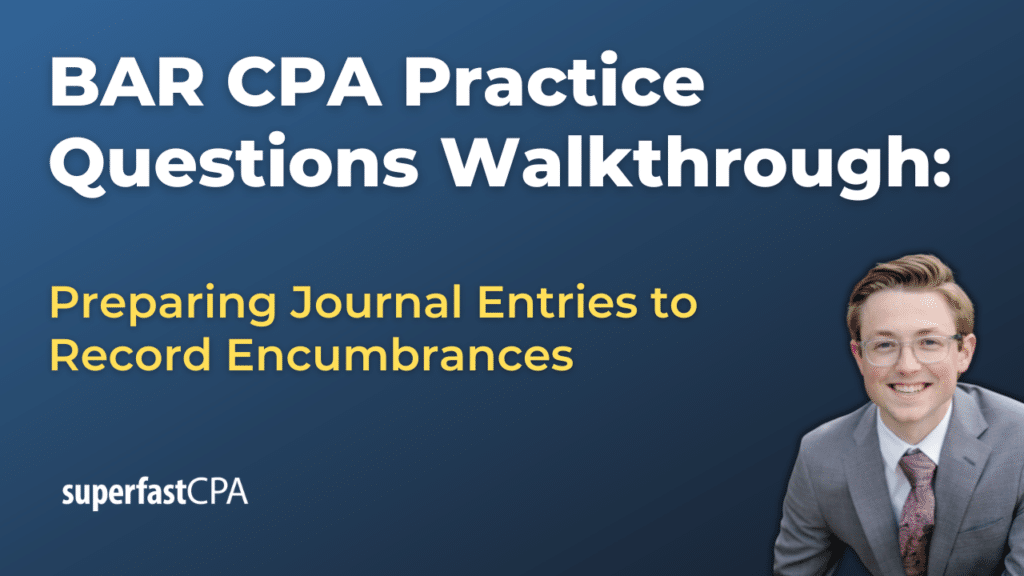
In this video, we walk through 5 BAR practice questions on preparing journal entries to record encumbrances. These questions are from BAR content area 3 on the AICPA CPA exam blueprints: State and Local Governments.
The best way to use this video is to pause each time we get to a new question in the video, and then make your own attempt at the question before watching us go through it.
Preparing Journal Entries to Record Encumbrances
Encumbrance accounting helps state and local governments monitor how much of their authorized spending has already been committed. Although encumbrances are recorded in the accounting system, they are not expenditures, liabilities, or expenses. They are budgetary accounts used to prevent a governmental fund from committing more resources than it has available.
The process is relatively straightforward: record an encumbrance when a purchase commitment is made, reverse it when the related goods or services are received, and then record the actual expenditure.
Where Encumbrance Accounting Is Used
Encumbrance accounting is used by governmental funds, such as the General Fund, to maintain budgetary control. It is not used by proprietary funds, including enterprise and internal service funds, or by custodial funds. Encumbrances are also not recorded in the government-wide financial statements.
A governmental fund generally records an encumbrance when it issues a purchase order or makes another formal purchase commitment. A purchase order is a document sent to a vendor that authorizes the purchase of specified goods or services.
The purchase order indicates that the government intends to spend part of its available resources, but it does not mean that an expenditure or liability has occurred. The goods or services must first be received.
Recording an Encumbrance
Suppose a General Fund issues a purchase order for maintenance equipment estimated to cost $86,400. The fund records the following budgetary entry:
Debit Encumbrances $86,400
Credit Budgetary Control $86,400
This entry identifies the amount of spending authority that has been committed through the purchase order. It does not record the equipment, an expenditure, or an account payable because the equipment has not yet been received.
An internal purchase request generally does not create an encumbrance by itself. The encumbrance is normally recorded when the purchase order is formally issued to the vendor.
Appropriations, Encumbrances, and Expenditures
Appropriations, encumbrances, and expenditures represent different stages of government spending.
An appropriation provides legal authority to spend resources for a specified purpose. An encumbrance shows that some of that spending authority has been committed to an outstanding order. An expenditure is recognized when the governmental fund receives the goods or services and incurs a liability.
For example, approving a $500,000 equipment appropriation does not mean the fund has a $500,000 encumbrance. If the fund later issues a $72,000 purchase order, the $72,000 becomes encumbered. Once the equipment is received, the encumbrance is reversed and an expenditure is recorded.
Reversing an Encumbrance for a Completed Order
When an entire order is received, the fund reverses the full amount originally encumbered. The reversal uses the purchase order amount, even if the actual invoice is different.
Suppose a General Fund issued a purchase order for equipment estimated to cost $82,600. The complete order is later received, and the actual invoice is $77,900. The fund reverses the original encumbrance as follows:
Debit Budgetary Control $82,600
Credit Encumbrances $82,600
The fund then records the actual expenditure and liability:
Debit Expenditures $77,900
Credit Accounts Payable $77,900
The $4,700 difference is not recorded as a separate expenditure or encumbrance adjustment. It simply means the actual purchase cost was lower than the amount originally committed.
Accounting for a Partial Receipt
If only part of an order is received, the fund reverses only the portion of the encumbrance related to the amount received. The remainder stays encumbered if the government still expects it to be delivered.
Suppose a General Fund issues a purchase order totaling $104,500. The fund later receives and accepts $68,200 of the order. It partially reverses the encumbrance:
Debit Budgetary Control $68,200
Credit Encumbrances $68,200
It also records the related expenditure and liability:
Debit Expenditures $68,200
Credit Accounts Payable $68,200
The amount that remains encumbered is:
$104,500 − $68,200 = $36,300
The remaining $36,300 continues to represent an outstanding purchase commitment. If the rest of the order is later received, that encumbrance will be reversed. If the remaining order is canceled, the encumbrance must also be reversed because the commitment no longer exists.
Putting It All Together
Encumbrances help governmental funds track outstanding purchase commitments before actual expenditures occur. A purchase order creates the encumbrance, receiving the goods causes the related encumbrance to be reversed, and the actual amount owed is recorded as an expenditure and liability. When only part of an order is received, the unreceived portion remains encumbered until it is either received or canceled.