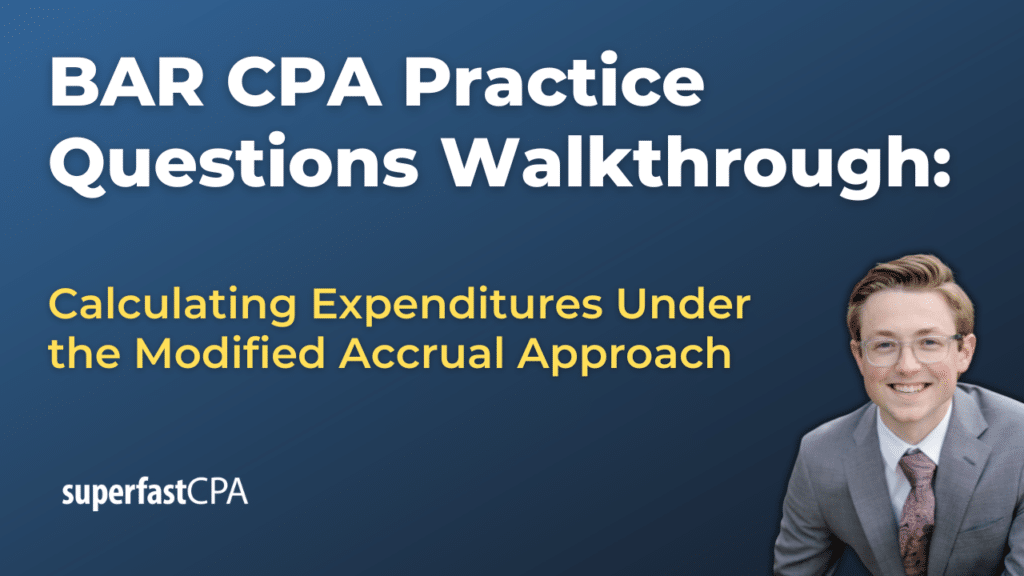
In this video, we walk through 5 BAR practice questions on calculating expenditures under the modified accrual approach. These questions are from BAR content area 3 on the AICPA CPA exam blueprints: State and Local Governments.
The best way to use this video is to pause each time we get to a new question in the video, and then make your own attempt at the question before watching us go through it.
Calculating Expenditures Under the Modified Accrual Approach
Governmental funds use the modified accrual basis of accounting and focus on current financial resources. Government-wide financial statements use the accrual basis and focus on the government’s total economic resources. Because of these different measurement focuses, an expenditure reported by a governmental fund is not always the same as an expense reported in the government-wide financial statements.
Recognizing Governmental Fund Expenditures
An expenditure is a decrease in a governmental fund’s net financial resources, other than through an interfund transfer. Common expenditures include salaries, vendor services, supplies, equipment purchases, short-term lease payments, and principal and interest payments on debt.
Modified accrual accounting is not the same as cash-basis accounting. Expenditures for ordinary goods and services are generally recognized when the related fund liability is incurred, even if payment will occur later. For example, if a city receives road repair services before year-end, it recognizes an expenditure even if the vendor will not be paid until the following year.
However, not every cash payment creates an expenditure. Paying an accounts payable balance from the previous year simply reduces cash and the existing liability. Purchasing an investment with cash is also not an expenditure because one financial asset is being exchanged for another. Interfund transfers are reported as other financing sources or uses rather than expenditures.
Calculating Expenditures Using Accounts Payable
Cash payments must be adjusted when some payments relate to prior-year expenditures or some current-year costs remain unpaid. Current-year expenditures can generally be calculated as follows:
Cash paid
Add: Ending accounts payable
Subtract: Beginning accounts payable
Equals: Current-year expenditures
Beginning accounts payable is subtracted because that amount was recognized as an expenditure in the previous year, even though it was paid during the current year. Ending accounts payable is added because it represents current-year goods or services that have been received but not yet paid for.
Appropriations, Encumbrances, and Expenditures
An appropriation is legal authorization for a government to spend money for a particular purpose. Approving an appropriation does not create an expenditure because no goods or services have been received.
When a government issues a purchase order, it may record an encumbrance. The encumbrance represents an expected future expenditure and helps prevent the government from spending more than the amount authorized. It is not an actual expenditure.
When the ordered goods or services are received, the related encumbrance is reversed and an expenditure is recognized for the actual amount owed. If only part of an order is received, an expenditure is recorded for the portion received, while the estimated cost of the remaining order stays encumbered.
Capital Assets
When a governmental fund purchases a capital asset, such as a building, police vehicle, or piece of equipment, the entire purchase price is reported as a capital outlay expenditure. Governmental funds do not report capital assets or depreciation.
Government-wide financial statements use a different approach. The purchase is recorded as a capital asset rather than an immediate expense. Depreciation expense is then recognized over the asset’s useful life.
This means a governmental fund may report a large expenditure in the year an asset is purchased, while the government-wide financial statements report only that year’s depreciation expense.
Debt and Other Long-Term Liabilities
Governmental funds report principal and interest payments as expenditures when they become due and require current financial resources. In the government-wide financial statements, a principal payment is not an expense. It reduces the outstanding debt liability. Interest is recognized as an expense as it is incurred.
Similar differences apply to compensated absences, claims, judgments, and other long-term obligations. Governmental funds generally recognize expenditures only for amounts that have matured and require current financial resources. Government-wide financial statements recognize the full expense and liability under accrual accounting.
To convert governmental fund expenditures to government-wide expenses, capital outlays and debt principal payments are removed. Depreciation and expenses related to long-term liabilities are then added. These adjustments reflect the difference between measuring the use of current financial resources and measuring the full economic cost of governmental activities.