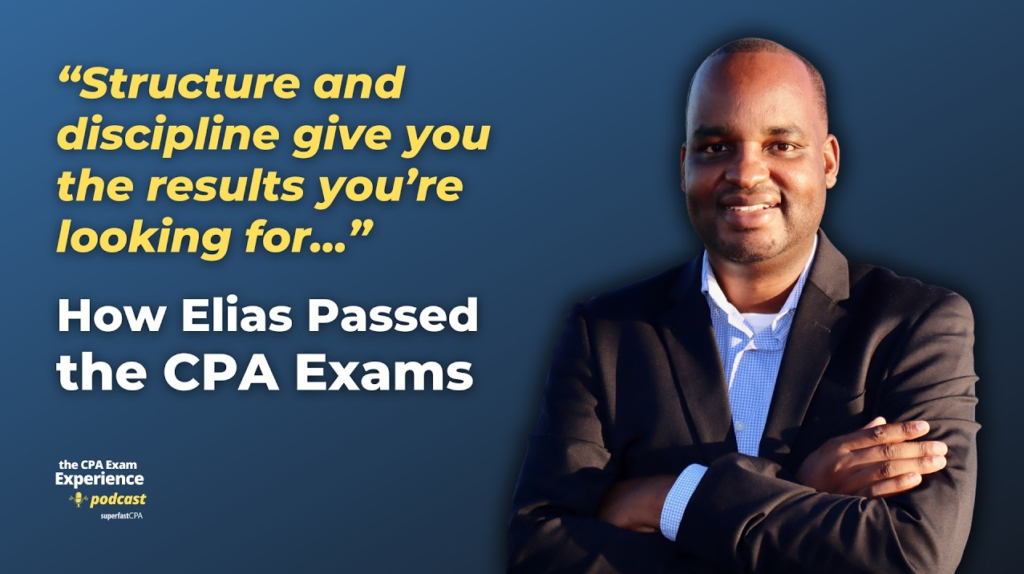
In this episode of the CPA Exam Experience Podcast, you’ll hear how Elias went from struggling during multiple periods of his life to pass the CPA exams (and failing each time), to passing all of his exams in a row once he changed his strategies.
Elias found SuperfastCPA around the time he was studying for a FAR retake. He applied some of the strategies he learned from a SuperfastCPA video on retakes, and while he didn’t quite pass, his score went up by 30%. At this point he knew he needed to dive in all the way, and from there he passed all his exams using SuperfastCPA. Some big difference makers for Elias were studying in the morning and the questions first approach. There’s some good stuff in this interview, make sure you listen all the way through!
IMPORTANT LINKS:
Master your study process by attending one of our free study training workshops:
https://www.superfastcpa.com/study-secrets/
Episode Timestamps
- 00:00 Elias Interview
- 03:28 Dad Was An Accountant, Aimed for the CPA Early
- 04:54 Studied the Traditional Method Before SuperfastCPA
- 06:04 Test Results When He Tried Back in 2013 and 2020
- 06:34 Why Elias Decided to Pursue the CPA Again in 2025
- 07:41 Decided to Follow the SuperfastCPA Advice for His FAR Retake
- 10:05 Signed Up for Class with An Instructor for Foundations in FAR
- 10:44 Bought the Total Bundle
- 12:07 Switched to Studying in the Mornings
- 12:52 Studying in the Mornings Helped A Lot
- 13:49 Saw Results from the Questions First Approach
- 14:41 How He Used the Questions First Approach with His Learning Style
- 16:45 Did 2 Hour Study Sessions
- 17:19 Fitting Mini Sessions Throughout the Day
- 18:22 Utilizing the Audio Notes Even When Working Remotely
- 19:43 Printed Out the Review Notes and Read Them Before Going to Bed
- 21:26 Passing ISC Confirmed That the Process Was Working
- 23:01 Re-Watching the PRO Course After Each Exam
- 23:50 Trusted the Process
- 24:46 Things Elias Realized After Passing His First Section
- 26:17 Used Every Study Tool Available to Learn
- 27:10 How Elias Would Structure His Study Sessions
- 28:47 Just Keep Moving Forward Since
- 29:40 Splitting Big Topics Across Multiple Days
- 30:18 Making Adjustments When Studying for REG
- 33:10 Passed the Last 2 Sections on First Try
- 33:54 Passed All Four for Four After Getting SuperfastCPA
- 35:18 Having the Evenings Off and Being Disciplined
- 36:46 Was Still Able to Maintain a Consistent Gym Schedule While Studying for the CPA Exams
- 39:02 Doing the CPA This Way Makes Studying Way More Manageable
- 40:10 Still Planning the Celebration of Passing the CPA Exams
- 40:55 Wanted to Switch His Gym Sessions in the Mornings
- 41:24 Saved the TBS’s for His Weekend Study
- 43:23 Learning Process for the Sims
- 44:19 Skill Builder Videos from Becker
- 46:33 Practice Using Excel
- 47:20 Using AI to Assist with Learning
- 48:47 Re-Watch the PRO Course to Refresh Yourself on the Process
- 51:08 Top Tips for People Still Going Through the CPA Exams
Interview Transcript
Elias: [00:00:00] Because I think if you don’t have that structure, then the CPA exam just becomes this big monstrous thing that like you’re just like, ” Why am I not getting this? I’m putting like months on end like of preparation and my results aren’t coming out.”
And it just becomes something that you over time start to either resent or like you just feel like it’s something that you can’t overcome, but to your point if you have structure and discipline and, if you do little by little, it just, it gives you the results that you’re looking for.
It gets you to the finish line, in other words.
Logan: Welcome to another episode of the CPA Exam Experience podcast from SuperfastCPA. I’m Logan, and in today’s episode, you’re going to hear me talking with Elias.
I really liked talking with Elias. He had a lot of great tips and a pretty cool story.
Now, Elias is someone who had grown up around accounting. His dad was an accountant, and his dad encouraged him and his sister to become CPAs. so it was something that he kind of was always aware of and that he wanted to get done. But he [00:01:00] tried after he got his bachelor’s and kinda just kept putting it off because of work, and then he tried to buckle down a little bit later, and it just wasn’t working.
He was really struggling, and he would go to the library in the evening. He had a class that he had been doing from 6:00 to 9:00, and then he switched from doing that class once it was over to studying for the CPA from 6:00 to 9:00 in the library.
And he was so tired that he would frequently fall asleep and not really get any studying done, and it was just a big struggle. And then he ran into SuperfastCPA.
And one of the biggest changes that he had from SuperfastCPA was studying in the mornings. Instead of staying up till 1:00 in the morning after trying to study from 6:00 to 9:00 at the library, he would go to bed earlier so that he could wake up a little bit earlier and study before he had work and other obligations. And it made a huge difference for him.
And another thing that really changed the process was the questions first approach. He was someone who really wanted to watch the lectures. He felt like it was wrong to not watch the lectures, and that was something he struggled with at [00:02:00] first.
But as time went on, he noticed the difference that it made to focus on the questions, because that was what he was going to be doing on exam day. So that’s what he focused on, and he saw a big difference in his understanding and how it increased with going to the questions first. And he still sometimes would watch the lectures, but he went in with the idea of what he wanted to know because he had done the questions first.
And you’ll hear lots of great tips and ideas like that throughout this interview with Elias. So let’s jump into that in just a second here. Just before we jump into the episode, I just want to give one more reminder about our SuperfastCPA training webinar on superfastcpa.com. That is a free one-hour webinar where we will teach you the key ingredients to passing the CPA exam so you don’t waste months or even years of your time failing exams.
And after you watch that, you’re going to want to learn more, so make sure you also check out buying our study materials or becoming a PRO member or, of course, getting the total bundle where you get all of our resources. Now, with all that said, let’s dive into the episode with Elias.
Logan: All right. [00:03:00] Thanks for getting on the call today with me, Elias. I, I’m excited to be talking to you. How are you doing today?
Elias: Uh, doing, doing well, Logan. Thank, thank you for having me.
Logan: Yeah, and, uh, it’s just, it’s not too early in the morning for you, is that right?
Elias: Yeah, yeah, it’s not too early. It’s, uh, actually 10:00 AM, so it’s pretty good.
Logan: Okay, not, not too bad. All right. Uh, so yeah, I’m, I mean, again, I’m excited to get on the call with you today, and if I’m not wrong, you kind of reached out to me and said, “Hey, I’d love to share my story,” so I think this is gonna be great. Let’s just kind of dive in like we always do.
Dad Was An Accountant, Aimed for the CPA Early
Logan: Where were you in your career or in your life when you decided to go for the CPA? Like, what made you want to do that?
Elias: I- in- initially, like, uh, the first time or, um
Logan: Y- yeah, like, what, like, I guess what’s your journey before you kind of got to SuperfastCPA?
Elias: Oh, sounds good. Yeah. Uh, so my journey is actually, uh, start- starts back to, like, when I just finished my bachelor’s. Uh, my dad is an accountant as well. Uh, so he always, like, motivated me and my sister to, like, uh, pursue the CPA.
Um, so, like, around– I graduated, uh, in 2012. Uh, [00:04:00] that’s when I finished my bachelor’s. So in 2013, that’s when I started studying for the CPA.
Um, so I, I, I tried, I, I sat, I think, uh, once, um, and because of, like, work commitments and all these things, you know, it’s just something that kind of fell by the side. And I tried again in 2020, um, after I, I did my MBA, uh, and it was also just work commitments and, like, life just gets in the way.
Uh, and then finally I just said, you know, in 2025, like January, just said, “I, I have to try one last time.” So, uh, and that, that’s a bit, uh, in, in a nutshell, that’s like a little bit of my CPA journey. That it’s been like, uh, one of those journeys that’s like
Logan: A little, uh, yeah, it’s been, it’s been kind of, kind of a long journey, but like kind of off and on.
So just to make sure I’m getting you there, so you knew about the CPA pretty early on, of course, because of your dad.
He was pushing you. Uh, but, you know, work commitments and, uh, and things like that got in the way over the years.
Studied the Traditional Method Before SuperfastCPA
Logan: So I’m curious, before you kind of got d- got serious and sat down for it in January [00:05:00] 2025, what was your, what were you doing when you were studying before that? You know, what was your, were you doing the traditional method or what did that look like?
Elias: Sure. Uh, now when I look back after having used Su- SuperfastCPA, I think it really was not a great, uh, approach.
So what I was doing is I, uh, I, I bought like a Wiley, um, at the time, right? Uh, and I had like their textbooks and all. Uh, I even had like RogerCPA at one point. So what I was doing is I would, I would go through like some of the chapters, right?
And I would then, um, at the time, I think like, uh, I would use like the manual questions that they had in the, they had in the printed, uh, book. Uh, and, you know, try to do those questions after work. Uh, and of course, you know, when you study after work, you’re really tired and not much… You’re not gonna get much, uh, uh, there.
But yeah, essentially I was really just using the textbooks. Uh, but, um, you know, like in, in, in reading through the chapters and then going through the questions and, you know, and then, uh, trying to get ready for the exam.
Logan: Right. So kind of the pretty typical approach, you know, doing the [00:06:00] lectures, the main, especially the textbook, and then trying to do the questions, but it just wasn’t really effective.
Test Results When He Tried Back in 2013 and 2020
Logan: Did you say that you all, you did sit for the exam at one point,
Elias: I did, yeah. I did. I, I sat for, I think REG in 2013, uh, and then I also sat for audit in 2020. Uh,
Logan: Okay. And how did those go?
Elias: Oh, they went terribly. In terms of the time I put in, and the results, yeah, they were not good.
Logan: Yeah.
Elias: I, I think i, I got like a 58 in REG and a 60 in, uh, in audit, if I remember correctly.
Logan: Yeah. I mean, not, not too horrible, but, you know, for the time and effort that you probably put in, just not worth it.
Why Elias Decided to Pursue the CPA Again in 2025
Logan: So, let’s now fast-forward to January 2025. What, what changed? Like, did you find SuperfastCPA or was there something else in your life that was like, “I’ve got to get this done”?
Elias: So, um, in terms of like, uh, how I s- how I just, uh, really committed to like re-, uh, studying for the CPA, it, I just felt like, you know, like, um, it, it was the one place in my life that I felt like, man, I, I really haven’t, uh, fulfilled my [00:07:00] potential, you know, like I, I felt like, I had a lot of potential and I could… if I really put my mind to it, I could sit down and get it done, you know, like, so I just, you know, like, uh, of course, like people encouraged me over the years and, uh, it was just like a time where I just thought, man, this is the one thing that I feel like has eluded me, and I can’t figure out why that’s the case, you know?
So i-i… that was kind of like the, the impetus or the thought behind like retrying it for the last time, you know?
Logan: That makes sense. Yeah, it was kind of just like I’ve, this is the one thing that I just have got to get done. So that, and I, I think a lot of people get to that point, you know, they’ve been trying for years and then something just clicks or changes and they’re like, “No, I’ve, I’ve got to get this done.”
Elias: E- e- exactly, exactly.
Logan: Yeah.
Decided to Follow the SuperfastCPA Advice for His FAR Retake
Logan: And so at that point, uh, I, I guess for the, when did SuperfastCPA come into the picture? Was it in January or was it a little bit after that?
Elias: It was a little bit after that. So essentially like, uh, in a nutshell, what, what I did in January is, uh, one of the things that I, I, I thought about is like, you know, when I did the MBA and other programs, I had like a [00:08:00] structure. And like one thing that I identified with the CPA, like every time I studied, I didn’t really have a structure outside of myself.
So, uh, I was looking for like a, a cohort-based class, you know. So I found one of those cohort-based classes for FAR, and I actually took that from January through April. So I sat for FAR in April. Uh, you know, um, I didn’t do well. Uh, I had some issues with, with the testing center.
But es-essentially what, what happened is like, uh, when I gave them my workpapers, uh, they, you know, I don’t know if they threw them out, but, uh, I didn’t write my login. So I needed my login to, to get to like the second part of the exam, you know. And now they’re like, “Oh,” they’re panicking cause they can’t find the papers, and I had to run to my car. I come back and I wasted a lot of time, you know. So anyway, like it was a really hard exam. Uh, it, it was a really terrible experience.
So I, I say all this to say that I was so upset wh-when I was in the car, I was like looking for retake videos, and I remember seeing Nate’s video. Cause I remember like seeing the ads, you know, and I [00:09:00] would always just fast-forward them, you know, I would always skip them, you know. Much like I would do with like, um, RogerCPA or the other reviews, like I would just skip them ’cause I, I already had a review.
So I s- I saw Nate’s video on retakes, uh, and I watched it, and it– and I really liked that video because he was just saying, “Hey, study in the morning, do two sets of 30, uh, MCQs and, uh, and, uh, and some TBSs, uh, and flashcards.” And like it was a short video, but… So I, I, I took all that advice, um, and, uh, for my retake.
Uh, and short– long story short, um, I, I didn’t pass on the retake, but my score went up by 30%, you know. And for me, I said, “Oh, there’s, there’s something to this Superfast, you know, there’s something here,” you know. So that’s what motivated me to then go and buy the PRO course.
Um, that’s how I, I, I was introduced to Superfast.
Logan: That’s kinda how you got there. So you had seen the ads, but had always skipped them, but then with that terrible experience in the testing center, you’re like, I’ve– You immediately… So you were doing it in the car after the
Elias: Yeah, I
Logan: After the test, [00:10:00] is that right?
Elias: But I, but I
Logan: You’re like, “I know I’m gonna fail that.”
Elias: Yeah.
Logan: Yeah.
All right.
Signed Up for Class with An Instructor for Foundations in FAR
Logan: And, and so, and just curious, uh, I would like to just hear a little bit about, uh, the thing you were doing before, like the January to April. What was that? Like, uh, were you working with other candidates? Or how does that work?
Elias: Yeah, so, uh, I found, uh, one of, uh, um, like a, like an instructor, uh, and he, he teaches all four parts. But then, uh, the great thing also was that he actually had more students in the class. So it, it was really like you’re sitting in a class, but it’s really tailor-made to like the CPA exam.
So he teaches all four parts. I just took him for FAR, which was really great cause I needed like that foundation and all those things. Uh, but yeah, like, like he, he was like, uh, an instructor.
Logan: Okay. Okay, that makes sense.
Bought the Total Bundle
Logan: So now you ha- now you get the PRO course and, uh, did you just buy the PRO course or did you also buy the study materials as well?
Elias: Uh, I, I bought the
Logan: Like the mini quizzes and the audio notes.
Elias: Yeah. Yeah, I, I, I, I bought everything, like the mini quizzes, audio notes, uh, and [00:11:00] then of course like the, um,
Logan: And the PRO course?
Elias: And the PRO course, yeah.
Logan: Okay, so you got the total bundle. So you get that, and what was the contrast?
So, you know, compare how you had been studying before to you watched the PRO course, what were the, the light bulbs that came on in your, came on your head?
Elias: Oh, sure. Yeah, it was a night and day difference cause, like, the way I studied is I, I, uh, init– before Superfast, I took the cadence of my class, cause my class was, like, from 6:00 to 9:00, so I just took the same cadence, right? You know, and I said, “Hey, you know, like, I don’t have class anymore, so let me just study 6:00 to 9:00.”
I would go to the library, be there 6:00 to 9:00, you know. And over time, like, I would be there 6:00, 6:00 to 9:00 after work, but then sometimes you’d be too tired and, you know, know, you doze off a little bit in the library, and then you wake up and then you’re like, “All right. Let me just do a half an hour.”
So, uh, before Superfast, I think it was really, I was focusing so much on the qua- on the quantity of, of, of my studying. Uh, but when, when I now, um, started using Superfast, like the total, uh, bundle, uh, uh, package, right, I, I really looked at [00:12:00] those, uh, initial videos that Nate, uh, did, uh, where he’s just talking about, like, how you use Superfast, how do you study, you know, those things.
Switched to Studying in the Mornings
Elias: So I switched from studying in the evening to studying in the morning. Uh, so, uh, I used to sleep really late, so I used to sleep at 1:00, but then now I started sleeping at 11:00 so I could get up at 7:00, right? You know, so 7:00 to 9:00, that was my study time. You know, 7:00 to 9:00 I’ll, I’ll study, and then I would do, like, uh, some mini quizzes.
Um, and then I would try to do, uh, some, uh, audio notes throughout the week.
Uh, but yeah, it was a night and day difference. Night and day difference, definitely.
Logan: And, and, uh, I mean, I think that that’s something that a lot of people pick up is that studying in the morning, uh, it just makes a huge difference cause then you go from being super tired already cause you had a full day of work, and then you’re going to bed super late like you were saying, to you just have it done right at the start of the day.
Studying in the Mornings Helped A Lot
Logan: And did that, did you notice that, that, that alone kind of like helped the process? Like, did, did that alone help even, even [00:13:00] besides how to study?
Elias: I think it really did, you know. Uh, I- I– in, in the time I didn’t see it when I was, uh, taking the first, uh… when I was taking iSC, cause that was my first section that I passed. I didn’t see it up until I passed. You know, that, that’s when I kinda saw like the compounding, like results of all those little changes, you know. Uh, but it, it, it did.
And one of the things, uh, that it helped me was that, um, at work, right? Like during busy season or even like, uh, in, in a regular, uh, like non-busy season, sometimes, you know, like you may just get like a late assignment. You know, you get it at five o’clock, and the… if you’re gonna study at 6:00, you, you might as well just not study that whole night, you know, like, uh, so it really helped in that sense.
Uh, like, uh, like you guys always say that when you do it in the morning, it, you’re locked in and you have it. You know? No matter whatever the day brings, you already have it, you know.
Logan: Yep, it’s done before all the many other things that you have to do.
Saw Results from the Questions First Approach
Logan: And so, and what else stuck out to you about the PRO course as far as like how to study? Did you kind of switch to the questions first approach?
Elias: I, I did. [00:14:00] Uh, I did, uh, and I started that when I was doing FAR. Uh, when I was doing ISC I, I was mostly just doing a lot of lectures. So I was watching a lot of lectures, but I was using the audio notes and I was using the mini quizzes. Uh, you know, and that really gave me great results. So FAR was easier for me because I had already done FAR, so it was easier to then just do the question first approach and just kind of like really… cause, cause when you’re hearing it, man, it just, you’re like, “I don’t know if I can do that,” you know, ’cause I love lectures, you know? So I’m like, “I don’t know if I can just go ahead, go in on the questions,” you know, but it, it works, you know. It works and it, it gives you results, you know. So I, I did, I did start using it for FAR.
Uh, you know, like long story short, yeah, I did start using it for FAR and
Logan: From, from then?
Elias: I saw the, the result there.
Logan: That’s, that’s pretty funny.
How He Used the Questions First Approach with His Learning Style
Logan: So you were, so you’re, sounds like you’re the kind of person who typically would want to watch the lecture, read the textbook, and things like that. Um, but why did, why do you think you saw such a difference when you switched to mainly the questions?
Elias: Uh, oh man, uh, I, I think it’s just, um, you know, like, uh… [00:15:00] I-i-it reminds me a little bit of that, that whole, uh, uh, the, the thing that Nate was, uh, talking about when he was, uh, sharing about, like, that book, um, ” Atomic Habits,” right? Like, and like, you know, like, the– when they– in that first chapter when they talk about, like, how the British, uh, cycling team for 100 years, they, they had just really struggled, you know.
And they brought in somebody new to manage the team, and they just started bringing in, like, little, uh, changes, right? Like incremental changes. So I think from that perspective, like, um, it, it really helped me at least to kind of get into the material, right?
And, um, I struggled, like, with that approach initially until I heard Nate say, “Hey, you know, like, you don’t get tested on how well you watch the lectures.
You know, you get tested on how well you answer the questions.” And, and then, like, you know, I accepted it at that point. But I, I think it really helped that, one, I get in the material in the way that I’m gonna be tested, and then two, um, even if I’m in the material and I’m really not understanding it, uh, I’m able to… when I do go to the lectures for that specific section, I alr- as I’m [00:16:00] listening, I already know how they’re gonna ask the question. So I, I, I can kind of listen in a way that’s more active rather than, like, passive, passively listening to the, um, to the lectures, uh, and not knowing, “Hey, how are they gonna ask the questions?” You know? Um, yeah.
Logan: Yeah, I think that I, I, I love what you said there because, you know, we never– we don’t say never watch lectures. I mean, a lot of people don’t, but what we’re really saying is the questions should be your main priority, and then that makes it, s- like you said, where if you do need to go watch a lecture cause you’re just not getting it, you go in with something already specific in your mind.
You already know kind of what you’re looking for instead of watching the lecture first and having no idea what is important and what isn’t important.
So, I, I really like that you said that.
Did 2 Hour Study Sessions
Logan: And, uh, so, so you switched to studying in the mornings, you’re doing the two hours. Were you also doing the 30-minute review every day?
Elias: Yes, I was. Um, yeah, I was. So I would do like that, uh, you know, hour and a half, uh, of the new material, like a new topic. Uh, and [00:17:00] then, uh, definitely I would, uh, as best as I could. I mean, I, I didn’t do it consistently, but, uh, it definitely like towards like the, like as, as the closer I get to the exam and to like the final review, I really had to tighten up and button down and like really just get that done consis- consistently.
Logan: Yeah. And yeah, the re- the review is another big key part of it.
Fitting Mini Sessions Throughout the Day
Logan: So, so you’d get the mornings done, and then I would love to know how the rest of your day was, cause you kinda mentioned mini quizzes, audio notes. What did the rest of your day, like just kind of describe to me a typical day after you do your two-hour morning session. How did you fit in the mini sessions?
Elias: Sure. Uh, so what I try to do is like, um, so I, I would just wake up, uh, and study seven to nine, and then nine I start work, right? Nine to five or nine to six sometimes. So what I try to do is like anytime that I find, like as I’m doing work, uh, I would just do like… I’ll try to do like one or two, uh, mini quizzes like before lunch and then do the rest like, uh, before five PM. Um, you know, and so, you know, y- uh, uh, give or, give or take. Uh, but then one of the things that I also try to do is like, [00:18:00] you know, if I’m like what you guys always, uh, recommend it, right? You know, if I’m at the supermarket or if I’m somewhere and I’m just waiting in line, right? I would then try to do the– I would just take out my phone and just do like a couple quizzes, you know.
Uh, I, I definitely can say like, you know, my Walmart, like where I live is like so busy, like so the lines are so long I would get like six or seven of those mini quizzes done before I got to the
Logan: Just one line. That’s great. That’s awesome.
Utilizing the Audio Notes Even When Working Remotely
Logan: And, and so, and d- am I right? Do you work from home most of the time? Do you work remotely?
Elias: Yeah, I work remotely.
Logan: Cause, cause I was noticing you said 7:00 to 9:00, and then you start work right at 9:00, so you don’t have a commute. So how did you fit in audio notes without a commute?
Cause usually that’s the easiest time for people to do that. So how did you do those?
Elias: For, so for the audio notes, I realized like that like whenever I’m doing like mundane tasks like, uh, getting ready in the morning, you know, taking a shower, getting dressed and stuff, uh, that’s, that’s a good time to fit that in. That’s a good half an hour, 40 minutes, right? You know, and, uh, when I’m doing the dishes, uh, and then also when I go to the gym, you know, when I’m on the treadmill, so that’s a good ha-half an hour to put that in.
So I try to [00:19:00] find like these mundane tasks where, you know, like when you’re doing like your mundane regular tasks to just fit it in there as opposed to like saying, “Oh man, let me do this at 8:00 PM,” you know?
Whereas you could be just taking the evening off, uh, you know, as you guys usually recommend.
Logan: Yep. I, I love that. Yeah, I mean, the audio notes, if you’re conscious about the typical times that you would maybe be listening to music or a audiobook or a podcast, just replace all of those with listening to the audio notes, and you can fit in quite a bit throughout the day. I, I, I did the same thing where I would do it while I was doing the dishes, while maybe when I went on a walk or just y- you can find lots of different times when you’re doing, like you said, mundane tasks that it’s easy to listen to the audios at that point.
So I really like that.
Elias: Definitely, definitely.
Printed Out the Review Notes and Read Them Before Going to Bed
Logan: And, did you use the review notes very much or was it mainly audio notes and mini quizzes?
Elias: No, I, I use the review notes. I, I would, uh, I would print them out like one unit at a time. Um, so then I would like just, uh, before I go to bed, I would like read the next section of what I’m gonna do [00:20:00] the, in the morning.
So, so then, you know, I would just… It, it really helped me cause like the, one of the reasons why I was leaning and like, uh, initially struggling to like let go of the lectures, um, not necessarily like let, let, let them go completely, but like really let them go in a sense that I can do questions first is cause I, I, I, I, I… Yeah, I’m looking up cause that’s where I have my notes on my shelf. But, uh, essentially it
Logan: No worries. No worries.
Elias: I had to really, when I looked at the notes, I… When I looked at like it further, I then realized that, oh wait, like I’m suppo- I can use this like as a primer, right? I can use this as a way to just kinda get introduced to like the new topic that I’m gonna go into.
So that’s, when I started doing that, it was much easier to kinda like, uh, embrace the question-first, uh, approach. Um, it, it much easier.
Logan: Yeah. For anybody listening, that’s a, I want you, I want you all to listen to Elias there. Yeah, that’s, that’s exactly what we recommend that people do is read the SuperfastCPA review notes for the section that you’re about to study.
You can do it either, like you said, in the evening, the, the day before, or you could do it like just a couple minutes before you start studying.
But it really helps [00:21:00] you know, kind of just be comfortable with what you’re about to see in the questions. Like, it’s not gonna, like, tell you everything, but you’re at least gonna be like, “Okay, I know generally what I’m looking for,” so you don’t feel so, uh, lost or, or worried going into the doing the questions cause, you know, like you said, you’re like, “I, how am I not gonna watch the lectures?” But that kinda seems like it was the replacement. Is that right?
Elias: Exactly. It was, it was. It was a re- really great replacement. Yeah
Logan: Okay.
Passing ISC Confirmed That the Process Was Working
Logan: And so, you know, we’ve talked about kind of how you did your process and things like that, and we’ll talk a bit more about it, but how, what, what happened?
So you, you know, you start doing SuperfastCPA, I think you mentioned that you passed ISC. How did that go?
Elias: Oh man, like, uh, so, uh, when I took ISC, uh, I started studying for it right after I had sat for my second retake for FAR. So, you know, and while I was studying for ISC, I then got the results, and I didn’t do well on FAR, so, you know, I just put in my mind that, you know what, I’m just gonna take [00:22:00] ISC and, and, and, you know, uh, you know.
So I, uh, I, I used like the Superfast, uh, uh, resources, right? Like the audio notes, uh, the, uh, the r- regular notes, right? I printed them out. Uh, and I also used the, um, uh, the mini quizzes.
At the time I wasn’t quite using like the study strategies as… I was using some, but not all. But, uh, yeah, so I think it was really the first– When I got the results, man, I was shocked, you know, cause I, I was, you know, like, I was really shocked, you know. Uh, but I think for me it was really like another thing that kind of cemented that this approach really works, you know. Like, like I was saying before, like when I did my second retake, when I was using the Superfast method, I, I saw the results, you know, and I realized that, you know what? Like this is working, you know.
But when I, when I passed the first section, that was really the first time that I was like, “Yeah, this is really working,” you know.
Logan: And do, do you remember what you, what you scored for ISC?
Elias: Yeah, yeah, I got an 83. I got an 83. Yeah.
Logan: That’s good. It’s, yeah, you’re not, you didn’t just barely pass. You got a good, you got a pretty good score. So, definite- [00:23:00] obviously something was working there.
Re-Watching the PRO Course After Each Exam
Logan: And so once you saw that result where you’re like, “Okay, this is working,” how did the rest of the exams go?
Elias: Uh, yeah, no, like that exam was… I, I’m telling you, it was like really like, uh, it was an eye-opener, you know. I, I… We celebrated with my wife. I looked at her, I said, “Man, I think I’m gonna be on that podcast.” So in other words, I was telling her, “I can s- I can see the finish line,” cause this method works, you know.
So, uh, but like, uh, so the other, uh, uh, exams, uh, it was really, uh… I tried to just refine and like, uh, uh, one of the things that I realized is like it’s really good to go back to the initial videos and watch them again, you know. Because sometimes I think you kind of deviate little by little from the study method, so it’s good to kind of just hear them again and again so that you can really, uh, refine them and just stick as close to, to them as you can.
Logan: And you’re talking about the PRO course videos right there, right?
Elias: Yeah, yeah, the PRO course videos. Yeah.
Trusted the Process
Elias: Uh, so from there I took FAR. Uh, that, that was my retake. Uh, that one I was, uh, you know, I really wasn’t confident, but like I, I was so surprised that I passed, man, you know. But I, I tried [00:24:00] to do like what, what Nate was saying all the time that, “Hey, you know, before you go to bed, read all your flashcards.”
So I, I, I did that, and I know you guys are, you know, were, you know, recommending that, “Hey, you know, try to study every day.” Like, cause on ISC I was taking off like a day a week. Uh, so on FAR I definitely studied every day and was like just looking at, at those, uh, uh, at, at the notes, reading them, and then listening to the audio notes, mini quizzes, uh, and just trying to do everything I could to, to, to kind of clear FAR, you know.
So I was so happy that I passed, you know, but I, I, you know, I, I, yeah, but anyway.
Logan: So, so that was your, so you had taken FAR and had that terrible experience, and then you did the retake with just a few of the Superfast strategies and you improved a lot but still didn’t quite pass. Then you passed ISC, and then you came back and finally passed FAR.
Things Elias Realized After Passing His First Section
Logan: And so what things, just curious, what things were you, like, partially or not fully implementing with ISC that you maybe did start fully implementing as time went on?
Elias: Sure. That’s a great question. Uh, one of the things that I was not, uh, [00:25:00] implementing was the questions first approach, cause I was always just watching the lectures when I did ISC. Uh, so after ISC I started doing the questions first approach. Uh, I was just using the notes to kind of just familiarize myself with the topic.
And I also, uh, used, um, cause I thought I had failed. So I, I, I remember, like you gave me a– I, I wrote you and you gave me like a video where Nate was talking about like how you structure your retakes. So I say that all to say that I started using that for my actual, uh, exams, not the retakes.
I was using that, so I would write the unit in Excel and then all the topics under that unit for all of the units, right?
And then that helped me that, and I– when I started the week, I would just write the days that I wanna cover all those topics. Uh, so that, uh, I would do that one, and I would also use like your, the, the notes, right, to kind of figure out like how long, uh, is this unit, right? If the unit is like a hundred pages, that’s just gonna be a week. If it’s like a hundred and sixty, a hundred and eighty, that’s gonna be two weeks, you know. So I would kind of like structure it long term, you know. I would– As opposed to like just [00:26:00] waking up and then saying, “Oh, what am I doing today?” You know, like I would try to kind of like, you know what I mean? That, that, you know, so I, I would try to kind of like think about it in, in, in a way that’s more, uh, long term, I guess you, you would say.
Uh, but yeah, I definitely used the questions first approach. Uh, that was the last missing, uh, ingredient.
Used Every Study Tool Available to Learn
Elias: And I continued to use like the, um, audio notes. Uh, at, at the beginning of every week, I would go back to the beginning of the audio notes re-regardless of where I was. So I tried to kind of like make sure that if, when, when every week starts, I would go back to the beginning so that I can just keep those topics fresh.
Uh, and i, I continued to use the mini quizzes and, you know, like for the days that I forgot, I would try to compensate the next day. You know, if I forgot one day, I would try to do ten the next day. So I continued to use that. And, uh, I remember one thing you guys were saying too, that, uh, try to engage as many senses as you can.
You know, like, you know, of course do the two-hour, uh, session, then try to read those, those notes, right? And try to also listen to the notes, you know, cause you’re engaging different senses, you know. Uh, so I, I tried to just m-also keep that in [00:27:00] mind, you know. But now I was trying to use the, as many like of the Superfast tools as I could, uh, i-in a way that’s in alignment with like, you know, what, uh, what you guys suggested.
How Elias Would Structure His Study Sessions
Logan: And, uh, something I want to go back to is how did you, how did you split out the days? Like, did you, did you count, uh, how many questions that you wanted to do each day? Or, cause, cause I did something similar where I count, I was like, ” This is how many questions there are in my review course. This is how many I want to get through in a day,” so that I kind of had a timeline.
So what did that look like in a little bit more detail?
Elias: Sure. Uh, what I tried to do is, uh, cause I, I kept listening to the podcast, so I would hear you guys reiterate like some of the key things, right? And, uh, so I tried to like make sure that I do 30 questions, uh, for the new topic. But then to your point, uh, I’ve already said this a couple times, like, so when I would do the re-review, like the comprehensive questions in test mode, I would try to do like minimum 20.
Uh, cause remember you were saying don’t do less than 20. [00:28:00] Make sure if you’re gonna do anything less than 30, it’s, it’s 20. Don’t go be- below that. So I tried to just do like 30, uh, of the new, um, uh, questions, right? And, uh, yeah, 20 of like, just comprehensive, uh, prior, uh, chapters that I’ve covered. Uh, so I tried to do that on a daily basis.
So then I would just do that for e-every new topic. Um, and sometimes if I– And I also had like another column that would tell me how many questions are in the review, uh, uh, program for that topic. So if the topic had like 300 questions in, I had to kinda like do that maybe over two days as opposed to one day.
Uh, but that was mostly just preference, you know. Um, uh, but yeah. I, I, I tried to just structure it so I can see it, uh, like at a– each week I can kinda see what, what I’m doing and kinda review what I’ve done for the week. Yeah.
Logan: Yeah.
Just Keep Moving Forward Since
Logan: And, and so just to kind of d- dig into that just a little bit more, so you would do about 30 questions a day. What would you do with sections where you almost did all the questions but you didn’t quite like, did you [00:29:00] come back and do the rest of them the next day or did you say, ” I learned what I needed to learn from those 30, I’m gonna move on to the next topic”?
Elias: Oh, yeah. Uh, no, so I, I would move on. Uh, I remember… cause I remember you guys saying that too, like, you know, like just do 30 and then you can catch those other questions in like the re-review. So, like, um, that’s one of the things that I think the podcast really helped, uh, you know, k- kind of just hearing it again and again, you know.
Uh, so like any assumptions that I had in terms of like how I should do Superfast, uh, if it was a wrong assumption, it’ll be cleared, uh, by just kind of like hearing that from the podcast or like listening to the PRO course videos. Uh, but yeah, I try to kind of just move on and just go to the next, uh, chapter.
Logan: Okay. Okay.
Splitting Big Topics Across Multiple Days
Logan: So, and would you do that even for sections where there was like a ton of questions, or would you sometimes go back to it the next day if you could tell there was like 100 questions for that topic? Would you still go back to it for those ones?
Elias: Yeah, that’s a great, that’s a, that’s a great point. Uh, no, so yeah, to your point, like if it was like 100 plus, I would, uh, split it into two. So I would, uh, sometimes I [00:30:00] would kind of see if like, uh, they have subchapters underneath, and then I would just do maybe like two of the five subchapters or whatever.
Like, but I would do like, I would do 30 and then 30 in two days, uh, of the same, of the… Yeah, yeah. To your point, if it was a larger, uh, question set, I would, I would split it into two days as supposed to one day.
Logan: That makes sense.
Making Adjustments When Studying for REG
Logan: And so you passed FAR on the retake, and then how did the other… So you still had REG and Audit left at that point, right? So how did those go?
Elias: Oh, uh, so at that point I was really like, uh, honing in like the– I think like the FAR pass really gave me the confidence, uh, more confidence in like the s- the, the approach, right? The study approach. So I just, uh, then studied for REG. Uh, and one of the things I realized early on is like, you know, a lot of times you have to take off your FAR hat and put on your, your REG hat, you know, cause you’re still thinking in FAR terms and my job is like in financial reporting, so those are the terms that I’m thinking.
So, but I had to like put on my REG hat and, uh, but I continued using the same, uh, question-first approach. I think the more I [00:31:00] went into other, uh, sections, the more I was able to really lean into like the question, uh, first approach. And to your point, you know, like you- you guys definitely like recommend like watching lectures if you don’t understand, you know.
If you keep getting a certain, uh, section wrong, then you go and, uh, look at the lectures. But for REG, uh, specifically, I… The– Well, um, UWorld has like five units I think. Uh, so what I did is like for the first two units, no, first three units, uh, I just did the question-first approach. But when I got to the third unit, I w- I really wasn’t, a lot of things were just going over my head.
I wasn’t really grasping it well. So what I did for the fourth and the fifth unit, uh, is that on those ones, I just watched all the lectures. Uh, cause I think I, I, I was traveling at that time, so I had like a lot of time to kind of just watch through.
Uh, so I, I, on those I, I watched all the lectures. Uh, I think Tim Gary was like teaching it.
Um, so it was good cause he, he had a lot of, uh, I think he’s, he, um, he’s also, like his specialty’s tax, so like he was able to give a lot of like information on like, uh, even, even [00:32:00] more than what I needed. But I, I appreciated that because like it, it brought me back into the material, you know, like, uh. But then when I went back to the Superfast audio notes, it really cemented a lot of those topics and, and all the gaps that were missing, even from the lectures, I was able to fill those in with just continuing to do audio notes and just do audio notes to the point where once I finished like, uh, all the units within REG and I was just comprehensively studying and getting closer to like the final review, it was just like, you know, and listening to the audio notes, like all those, like any gaps that I had were just getting filled in, you know, like over time.
Logan: Yeah. That, that’s exactly what we are trying to have, happen with people is, you know, at first you start working on an exam and you don’t know anything, so you’re just kind of building up the pieces. But then by the time you get close to either taking the exam or at least by the time you get to final review, you’re just, you’ve done it all so much that it’s just filling in the cracks, like you said, you know.
And that’s why we have all the mini session types, is to fill in the cracks in different ways. The mini quizzes to help [00:33:00] with your recall, the audio notes to just kind of like be constantly immersing yourself in it, and then the review notes as well. So, I really like what you were saying there.
Passed the Last 2 Sections on First Try
Logan: So, you were struggling with REG a little bit, but, uh, you know, watching the lectures kind of helped you stay a bit more immersed in it, and did you pass REG as well?
Elias: I did, yeah. I did. I passed with, uh, 78.
Logan: Okay, awesome. Awesome. And then, and then if, if I remember right, did, did it take a little longer to get the audit results? Like, you didn’t find out until this year that you passed audit. Is that right? Or, or am I… Let– Just remind me how that went.
Elias: Oh, sure. Uh, audit, it took a little longer. Oh, no, it took like about three weeks, uh, cause I took it like in, in February. Uh, so, uh, yeah, it took a few weeks to kinda like, uh, get the results. I took it like closer to like the end of the test, uh, window, but not at the end.
Logan: Okay.
So you passed REG, and then did you pass audit as well?
Elias: I did, yeah. I did. I did. I wasn’t sure on audit, but I, I did. I did, yeah
Passed All Four for Four After Getting SuperfastCPA
Logan: So it sounds like to me, so, you know, you did a little bit of the process for [00:34:00] your initial FAR retake and you improved but didn’t quite pass. But then from there, once you like started digging into SuperfastCPA and the more and more you applied it, you passed them all four for four from that point. Is that right?
Elias: I did, yeah. I did, yeah. Uh, it really was yeah, I did, yeah. Yeah, I, I think it just was a testament to, like, how the process was working. Um, you know, like a, a side note, I, I, I was in one of those Reddit subreddits, and somebody was like, “Oh, this Superfast thing doesn’t work.” And I’m like, “No, it does work,” you know.
And there were a couple people that also used it that were saying the same. And, uh, the guy was like, “Ah, no,” you know. “Notice how everybody who’s saying this has, like, a one…” ‘Cause, you know, like, you put, like, those, uh, like how many you’ve completed. It’s like, “Oh yeah, look at how everybody who’s, uh, who’s saying this has a one for four.”
But, you know, like, uh, but no, lo and behold, like, you just stick to it, you know, you, you will pass, you know. Like, it’s a really good method.
Uh, it’s a re-really good strat– uh, it gives you, like, a good structure.
Logan: Yeah. And I mean, the, the exams are super difficult, so even with the right strategies, sometimes it takes a couple tries or, or multiple tries to [00:35:00] get, uh, to get through the exams. But, you know, I mean, I love the contrast of, you know, you, you were struggling in 2013 and then kind of just put it off, tried again in 2020, uh, kind of struggled, kind of put it off, and then in 2025, you– things really started cooking and then boom, you pass all four in a row.
Having the Evenings Off and Being Disciplined
Logan: Uh, how, so one thing I like to ask about throughout this journey, what was that like with, uh, you know, family and friends? Were you, like, was there ever a time where the CPA got in the way? And then also, well, yeah, let’s start with that. Like, before you got SuperfastCPA, was it something that was kind of like made it so you didn’t have any social life?
W- was that the kind of thing that happened?
Elias: Yeah, it was. It was. I, I think, yeah, like I, I definitely like, uh, was just studying all the time, you know, like w-with the exception of like a Sunday or something. But like, uh, yeah, it was definitely one of those things where I was just studying all the time and like telling people like, “No, I can’t, I can’t do anything,” you know?
Logan: Mm-hmm.
Elias: Studying in the mor- uh, like studying at night, you know, and working in [00:36:00] the morning and, you know, uh, before Superfast. And then once I got Superfast, I really was able to like, um, you know, have my, uh, nights off, you know? So that was really refreshing, you know? I, we… I was able to like, you know, on weekends I could go to the movies with my wife, you know, like, uh, after, after like a day of studying and stuff, you know?
Uh, but like, yeah, I, I, I definitely had to kind of go through like, uh, some conversations and just, uh, you know, like set boundaries, right? You know? Uh, and, and just reinforce boundaries in terms of time, you know? Like, uh, cause man, it, it, you know, it’s just like everyone like wants to invite you to something, you know, and you know, like, you know?
But anyway, yeah. Yeah.
Logan: Yeah, uh, you never invited me before, but now I’m doing the CPA and you wanna invite… No.
Elias: Exactly. Inviting you or they need a favor from you that’s gonna cost you like your Saturday or something.
Logan: Of course, yeah.
Was Still Able to Maintain a Consistent Gym Schedule While Studying for the CPA Exams
Logan: And, uh, and what did, uh… like, what kind of things were you able to do? Like, what kind of hobbies were you able to maintain or time with people were you able to maintain because you switched to studying in the morning?
Elias: I think it was really great. Like, [00:37:00] I was able to have my family time, right? You know, like I was saying, like, you know, my wife and I would have the evenings off, you know, like, uh, cause w- uh, especially now that I was studying in the morning, in the evening I was off. Uh, and I was also able to, like, just maintain, like, going to the gym, uh, for the most part. But, you know, I cheated a little later on. But anyway, that’s another, that’s another story for another day.
But, like, I was able to, uh, to maintain like, uh, like a consistent, like, gym, uh, schedule, you know, um, which was really important also, like, as you’re studying, you wanna, like, stay healthy and like, uh… cause everything is connected, you know. Like, uh, but, uh, and, um, I was– I’m very active at my church, so I was able to still be active, uh, you know, in a lesser capacity, but like, because of, like, how busy the studying is. But, like, I was still able to really contribute. Um, and also like be– I was able to, like, um, study for FAR in, uh, in a busy season, you know.
And I think, like, if it wasn’t for Superfast, I would’ve been… I don’t know how I would’ve been able to do that, to be honest with you. Uh, you know, like, uh, I remember one of the [00:38:00] weekends we– One of the things that was happening is that we could only use, like, the system, uh, on the weekends up till noon work-wise.
Um, so I had to wake up like six in the morning on one weekend and, uh, get as much as I could done, I could, I could do work-wise by noon, and then from there, from 1:00, I pivot to my study. So I really am grateful for that, uh, approach, you know, like where, you know, like, uh, it’s really, there’s a set structure, you know, because it helps. I think, to be honest with you, if I had tried to, like, study during the busy season, I would’ve just, uh, put it, put the books on the side, you know.
Once the pressure really, uh, amped up, I would’ve just put the books to the side and it would’ve cost me more time, you know?
Logan: Yeah. I think that you just kind of mentioned some things that a lot of people would think would be impossible during, for, while studying for the CPA. You know, like, you were still able to go to the gym, you were still able to go to the movies with your wife, you were still able to be active in your church, and, uh, you know, all those, like, all those things together probably sound…
Oh, and [00:39:00] also you were able to do it during busy season.
Doing the CPA This Way Makes Studying Way More Manageable
Logan: I think that would sound impossible to a lot of people, you know, kind of studying in the, at, when they’re studying at night and they’re like, “How the heck could you possibly do that?” And well, it’s because you had that structure, it’s because you were studying in the mornings and doing the extra studying throughout the day.
It really does just totally flip, it totally s- changes the CPA from being something that’s a nightmare to… It, I mean, it’s still hard, but it’s way more manageable. Would you agree?
Elias: Definitely. Definitely. I, I agree 100%. It’s, to your point, it’s way more manageable. You know, you’re, you’re, you’re, you’re taking– you’re doing it in chunks, in smaller chunks, but consistent, you know. Um, uh, you know, you’re, you’re absolutely right on that because I think if you don’t have that structure, then it, the CPA exam just becomes this big monstrous thing that like you’re just like, ” Why am I not getting this?
I’m putting like months on end like of, uh, preparation and my results aren’t coming out.” And it just becomes something that you over time start to either resent or like you just feel like it’s, it’s, it’s something that you can’t [00:40:00] overcome, you know. But to your point, if, if you have structure and discipline and, you know, if you do little by little, it just, it gives you the results that you’re looking for, you know.
It gets you to the finish line, in other words.
Logan: Yeah, I love it.
Still Planning the Celebration of Passing the CPA Exams
Logan: And did you do anything with your, with your wife or, you know, with friends or family to celebrate finishing?
Elias: Not yet. Not yet. Uh, we did do something for ISC. We went to, like, uh, Niagara Falls cause my wife is in school in Ithaca, so, like, it’s really close to, uh, to Niagara Falls, so we went down there. But we’re definitely, I, I… We haven’t thought through, like, what we’re gonna do, but we’re gonna try to do something big, you know?
Logan: I mean, uh, probably right now you’re just enjoying the fact that you don’t have to study anymore, uh, right? That probably feels great.
Elias: Oh my God, it feels amazing. You know, something– I, I remember like, uh, when I was doing audit, I, I, I started panicking cause I was like, “Man, what am I gonna do with myself when I finish this?” ‘Cause you can see the finish line, you know?
Logan: Yeah, yeah uh, uh, is there– have you– have– I mean, it’s only been a few weeks really, but, uh, have you thought of anything?
Wanted to Switch His Gym Sessions in the Mornings
Logan: Like, like has it changed the way you structure your day, or have you kind of gone back to how you [00:41:00] were doing things before? Do you wake up early in the morning still, or do you, are you kind of like a night owl again?
Elias: I’m a night owl again, but I, I, I’m, I’m, I, I’m gonna try as best as I can to kinda, to kinda go back to waking up in the morning.
Logan: Oh, I mean, it’s, it’s, it’s what, it’s whatever you want. But I, but sometimes I see people that are like, “Oh, now I’m a morning person,” but you know, that no worries at all.
Elias: Yeah, no, cause I wanna squeeze the gym in the morning instead, you know? So I, I definitely wanna like tighten up a little bit. Yeah.
Logan: Yeah.
Saved the TBS’s for His Weekend Study
Logan: Uh, one thing that I just realized, this will probably be one of the last questions that we, that I ask, but, uh, something that I wanted to ask about before was, you know, you would go to the movies with your wife on the weekend or things like that, but that re- that made me think of the weekends.
What did studying look like for you on the weekends? Did you study sims? What, what did that all look like?
Elias: Oh yeah, that’s a great question. Uh, so initially I was just, uh, when I started, I was just like doing both. Uh, well, no, I was mostly doing MCQs, heavy on the MCQs, and then I would, like, start doing sims, like, towards, like, the review, uh, final review. But as I progressed and as, like, just kept [00:42:00] listening, I heard, I heard you say, hey, you know, like, uh, you should, like, uh, really just focus on doing, like, MCQs midweek, uh, in the weekdays and then, uh, task-based in the, on the weekend.
So I did that from FAR, from the third retake for FAR that I passed. And it really helped me, man, because like, uh, I was now getting really like, uh, anxious about the TBS’s cause that’s how… like, I literally failed FAR for, because of one TBS, you know. Uh, it’s been discontinued, and I, I, I saw it online. I showed my wife, you know. It had like eight exhibits. But anyway, I digress.
So essentially, like, it, it, it, it, it kinda gave me like an anxiety over, like, TBSs. So I was happy that I heard you say that, uh, when I was doing the FAR retake, and that, that really helped me to pass because what I would do in the middle of the week is I would just do, like, MCQs.
So I would try to get, like, two hundred MCQs done, and then on the weekends I would just pivot. I would now just be doing, like, uh, TBSs. Uh, and I would try to time myself also over time, like, just try to give me- myself like fifteen to, to eighteen minutes per, uh, [00:43:00] TBS.
Uh, so that really helped, you know, cause it gave me a, a good comfort level.
So whatever unit that I covered, uh, for that week, those are the TBSs that I would do. And then, of course, when I do final review, I’m gonna do like comprehensive, like, TBS’s. But like, um, I would just kinda do like where whatever topics I’m covering on the MCQs, those are, uh, in the weekdays, those are the topics that I’m gonna cover for task-based on the weekends, Saturday and Sunday.
Learning Process for the Sims
Logan: And when you were studying the simulations on the weekends, uh, what was your– I mean, you said you were kind of timing yourself eventually, which that makes sense because you’re kind of trying to get used to about how much time you have on exam day. Uh, but when you were doing the sims, were you, like what was your approach there?
Were you trying to do them fully and then you would submit them, or would you just submit it if you had no idea what you were doing? I’m just curious how you did those.
Elias: Yeah, that’s a good, that’s a good question. Uh, I, I would try to do them, uh, but like to to what you guys were saying, like, uh, if I really didn’t know it, I, I, I wouldn’t even waste any time. I would [00:44:00] just look at the answer and like, uh, I would look at like the Skill Builder, uh, videos cause I had access to Becker.
My main review was UWorld, but I, I had access to Becker as well. So, uh, the only thing is that UWorld didn’t, uh, have like mini videos at that point. Uh, so, but, so I would like lean on the Becker side of things when I was doing task-based, so I could see the, the Skill Builder.
Skill Builder Videos from Becker
Logan: And, uh, just cur- cause I know a lot of people have Becker, what did you like about the Skill Builder videos? Like, why were they helpful?
Elias: Oh man, like they were really helpful. Like one of the things I liked was not just they answered the question, but they also helped on strategy. You know, they would help like, hey, you know, like instead of, instead of just thinking through in this way, we wanna think through in this way, you know.
So it also helped me to change how I would answer certain questions, uh, which helped me to like answer them as quickly as I could. Uh, so it bought me a lot of time on the exam.
Uh, and, uh, yeah, a-a-and I think like they also kinda touched a little bit about like w-what the, uh, writers of the exam are trying to do with the task based.
You know, that when they give you all those exhibits, they’re trying to [00:45:00] overwhelm you, so you have to really just be very systematic in terms of how you look at it, you know?
Yeah, so like those, those strategies as in addition to the, the, the answers of like, what is the answer, uh, that, that helped as well.
Logan: Yeah, and that, that I, I would agree with that, that a big part of practicing the sims and preparing for the sims on exam day is being able to be, like, immersed in a sim and not panic.
Like, you know, you see all these, these, uh, these exhibits and like, “Oh, no.” But if you’ve practiced sims and if you’ve, like, gotten used to how they’re structured, you can just take it one step at a time.
You don’t, you don’t, you’re not worried. You know what they’re asking you to do. You may not know necessarily everything about the specific sim, but you know how to approach the sim. Is that how you– Y- did you feel like that?
Elias: I did, I did feel that way, and I, I think it, it helped in the sense to your point that you may not know the whole sim, but you will know enough to pick up some points from that sim or as many points as you can in like the 18 minutes or whatever time you have to, [00:46:00] to do that sim. Yeah.
Logan: Yeah,
Elias: And you, you don’t panic as much as, uh, to your point.
Logan: Yes. Yeah. And, and that’s actually a big part of why I liked SuperfastCPA is it, I felt like it really prepared me, you know, when I was doing the exams, I felt like when I went into the exam, I had already done this hun- a ton of times, cause I had been doing re-review every day. I’d practiced the sims, you know, I, I had seen it all before. Maybe not the exact questions, but I had done the process, and that helps you be comfortable and not panic.
Uh, so I think that we’ve pretty much covered most of the stuff that I typically like to cover.
Practice Using Excel
Logan: Uh, now as we’re kind of finishing up, last few questions, the one question I like to ask lately is, is there anything that about your process or about your story that we haven’t gotten to talk about yet, but you remember, you know, maybe something in your notes that we haven’t gotten to talk about yet that you wanted to share?
Elias: Uh, that’s a good point. Uh, let me check. I, I did put, like, some, a, a few things down, but, uh, let me see. Oh, yeah, I was gonna say, like, uh, not, not much, uh, but I [00:47:00] was gonna say definitely like, uh, I, I think you talked about this at one point, but, like, it’s important to really, like, uh, if you’re doing sims, uh, it’s important to, like, uh, use, like, Excel, right?
Like that, that Excel, like, um, that they have in the, in the, in the TBS section, uh, especially with, with FAR and REG, you know, cause it, it just helps you to be faster and you’re gonna be more accurate, you know? Um,
Logan: Yeah
Using AI to Assist with Learning
Elias: And another thing I was gonna say was, like, a-a-a lot of these, uh, like Becker and like UWorld, they have like now AI assistants, right?
Like Newt for Becker, right? Like those are really great to use, you know, especially for like really difficult, um, really difficult, like, concepts. Uh, I, I use it personally, so I was using that in addition with, uh, Brainscape. So like if I had like a really hard concept, I would just, you know, like get the definition and then I would throw it, throw all those definitions in Brainscape and, you know, look at them over time, you know, and just, uh, get used to them.
Um,
Logan: Uh, so you liked using the AI to kind of like understand something if you weren’t getting it at first. Is that right?
Elias: Yes, [00:48:00] definitely. Definitely. Uh, a-a-and if it’s something that I– If I’m not getting it at first or if it’s something that I just am consistently failing and, and I, I just can’t understand, you know? Like, so I definitely would use that. Uh, it– And I like those like Newt and like, uh, as opposed to like ChatGPT, because I felt like ChatGPT wasn’t always accurate.
Like, sometimes it would be a little off, you know? So I, prefer that.
Logan: Yeah, I mean, uh, Newt is, Newt is built specifically for the CPA exam, you know? So that makes sense, yeah.
Elias: Exactly, yeah. And, uh, UWorld has one now. They call it Ask UBot, you know, uh, but, uh, it, it, it essentially does the same thing that you– that, that, um, that, uh, Newt does. Um, but yeah, to your point, it’s more tailor-made. Uh, and yeah, I was just gonna say, you know, don’t underestimate like the power of auditory learning.
Uh, we, we talked about it, I think the, about the audio notes.
Re-Watch the PRO Course to Refresh Yourself on the Process
Elias: Um, and I, I would say, uh, definitely like just make sure you go back to the, like th-those initial, uh… that’s in the PRO course.
Right? Like where I think it’s good to go back to that from time to time so that you [00:49:00] can just hear that again, you know.
Whether it’s like you’re listening to like the two-hour review part or you’re listening to how to make flashcards or TBSs, you know, like, you know, like it’s really good to just hear those, tho-those, uh, cause those are all critical elements of like just, uh, preparing, you know
Logan: Yeah. I’m really glad you brought that up because I’m pretty sure that Nate does mention that in the PRO course, like come back and watch these every so often to like keep yourself fresh. And I would bet that a lot of people don’t, but it’s super useful to be reminded, “Oh yeah, I’m, I’m skipping this part,” or, “Oh, maybe I could be doing this part a little more effectively.”
So I really like that you mentioned that. Like, you know, go back to the PRO course videos every so often to make sure you’re on the right track.
Elias: Yeah. And you know, uh, even to piggyback off of you, the, the point that you just made there, I was skipping a really important part, and it was that part where you take off in the evening, you know? So, you know, like, uh, cause I was just now burning on both ends, you know. Like, uh, cause I think one of my exams, I was so close, like, to the, uh, exam date, so I had to kind of like study [00:50:00] in the morning and at night.
But when I started the new section, I just carried that bad habit into the new section until I heard it, until I heard again like, “Hey, if you do in the morning, don’t do anything at night.” So that, that really helped. Uh, ’cause you start to burn out if you, if you don’t do that, you know?
Logan: Y- yep. And I mean, uh, you know, sometimes you gotta do what you gotta do, like maybe if you’re really close to an exam like you said, and you’re like, “I wanna prepare a little bit more,” then yeah, study in the evening. But the hope is that most of the time if you’re studying in the morning and then you’re doing your mini sessions throughout the day, you’ve done pretty much all your studying by the time you get off work, and then you can feel like a normal person.
You can still have some time with your family or go do something with your friends or just watch TV, you know. And I think that that helps you stay a lot more sane. It helps you stay a lot more motivated, you know? So I, I like that you brought, I’m glad that you brought that up.
Elias: Definitely, yeah. In, in a way, I suppose you’re, you’re recharging your batteries, you know? Um,
Logan: Yep, exactly.
Elias: Yeah
Logan: Yeah. And, uh, yeah, I mean, you’ve had some fantastic tips, and I really liked listening to your, your story. I love that [00:51:00] you went four for four. It’s always really exciting to, like, see the changes that people make and then boom, they pass all four of them. I mean, I just love that.
Top Tips for People Still Going Through the CPA Exams
Logan: So as we’re wrapping up here, this is the question I always like to ask everybody at the very end of the podcast, even if it’s something we’ve already talked about.
What would be your top two or three tips to people who are still going through the exams?
Elias: Sure. Oh yeah, that’s a good point. Uh, so my top, uh, tips would be, uh, let me see. Yeah, I-I would definitely say like one of the things I think like, uh, yeah, as best as you can, uh, don’t use like simulated, uh, exams. I, I, at least for me, it didn’t help. I think the Superfast method o-or final review is really important, where you just do like two sets of 30, uh, MCQs, right?
And, um, five to seven TBS’s. Um, you know, like I– that’s really important because you’re attacking all the topics, you know. And, and, and, and tied to that is like, don’t, don’t cherry-pick your, your weak areas, you know, when you’re doing final review.
You know, I remember like you guys just mentioning, hey, if, if, if you wanna hone in on your weak [00:52:00] areas, then make sure that you do those sets, you do the comprehensive sets first, uh, and then you can kind of do like, you know, you can then focus on your, uh, weak areas.
But you don’t wanna like focus on two or three topics when you, when you know, like, uh, FAR has like more than 200
Logan: And then leave everything else to the side,
Elias: Exactly. Exactly. At the expense of everything else, you know, you don’t wanna do that. And, um, I would definitely say like, you know, it’s, it’s good to stay motivated, you know, so if, you know, if you have– if, if you find something that’s motivational, definitely listen to it, you know. Uh, one of the things that I found motivational was like that book Ato-Atomic Habits. I just had one chapter, and I kept, I, I kept repeating that one chapter, you know, cause it really motivated me. But yeah, like it could be anything. It could be a motivational speaker, a, a pastor or something, or a sermon or something that motivates you, you know, like definitely like keep listening to that.
I, I think like that’s just like, um, one of the things that like about this journey, it’s like, it’s a journey where like it’s… you have, uh, valleys and peaks, you know. So sometimes you just feel really demotivated. Uh, I felt that way a lot for FAR, you know. Uh, but, you know, so it’s good to [00:53:00] find like those messages that encourage you, you know. Uh, whatever, you know, whatever the source may be, but like, um, if you find things that encourage you. And you don’t have to find many things. If it’s just one message, you just keep repeating it. Like for me, I just had one sermon that I kept repeating.
But anyway, uh, but yeah, I, I, I think that’s really important. Uh, the podcast I think is really good. Um, and like finding like, uh, like, uh, community. Uh, I think there’s like a– you guys have a forum, right? Superfast has a forum. Um, I know like there’s a, there’s a subreddit for the CPAs. There’s like sixty-five thousand, uh, people, I think. Uh, so just finding communities is also good, that would be my last point. My, my last point, yeah. Just find like a community, um, you know.
Logan: Yeah, those are all, those are all really great points. And, uh, like I said, you’ve said a lot of really helpful things throughout this. Uh, I’m excited to eventually get this out there because I think a lot of people are gonna really benefit. So thank you for being on the call with me today, Elias.
Thank you for sharing all that, and congrats on being done. Are, are you fully done? Are you licensed yet or not quite?
Elias: No, not quite. I’m working with my boss now. Uh, he’s a CPA as well, [00:54:00] so w- I’m working with
Logan: Okay. So you still have to get like the hours and stuff like that
Elias: Yeah. Uh, I, I have the hours, but he’s, uh, he’s doing his part to kind of just like, uh, sign off. Yeah.
Logan: Yeah. Well, again, congrats on being done, and I hope you have a great rest of your day
Elias: Oh, thank you so much, Logan. Uh, thank you for having me, by the way.
Logan: Yeah, of course.
Logan: All right. That was the episode with Elias. Again, I thought it was a great one, just like all of the episodes on this podcast. And I really liked the contrast that he pointed out with studying in the evening compared to studying in the morning.
He went from studying from 6:00 to 9:00 and going to sleep at 1:00 in the morning and, you know, falling asleep while he was studying and not really getting much out of it, to studying in the mornings, questions first, and really starting to see a difference in his understanding and his retention, and obviously he passed the exams by doing that, so it worked.
I’m sure you liked this episode with Elias. If you liked it, make sure to like it and leave a comment in the YouTube video or leave a rating in your favorite podcast app. And before you go, make sure you also check out becoming a SuperfastCPA member by either buying the PRO course or [00:55:00] buying our study materials or, of course, buying the Total bundle where you’ll get access to all of our materials and, of course, the PRO course as well.
And the easiest way to learn about that and become a member is by going to superfastcpa.com and signing up for our free one-hour webinar training. In that one hour, we will teach you the key ingredients to passing the CPA exam so you don’t waste months or even years of your time failing exams, and that will give you a good path to, again, learning about the PRO bundle or the studies bundle or the Total bundle.
So make sure you check that out. Again, I hope you liked this podcast, and I will see you in the next episode.