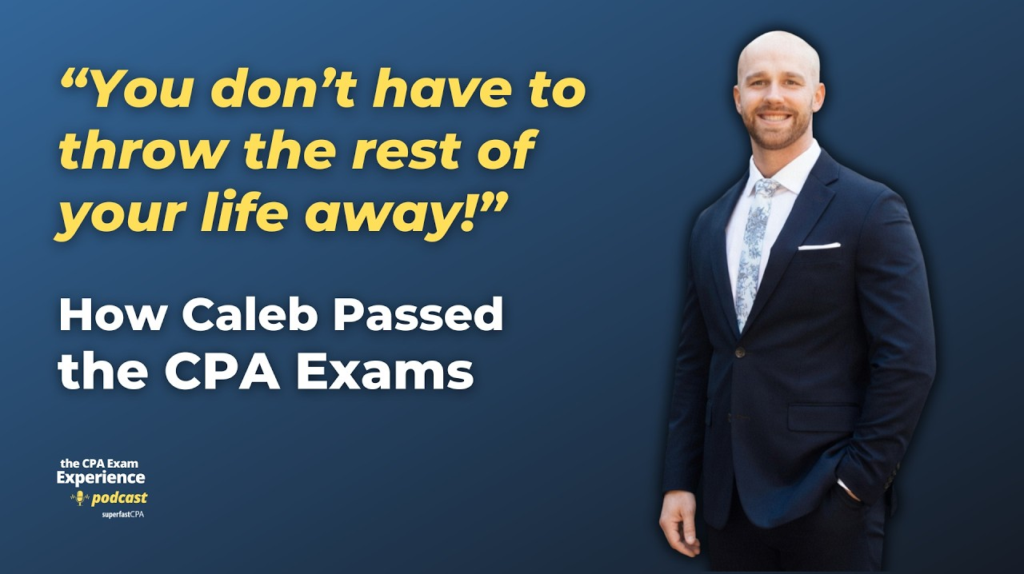
In this episode of the CPA Exam Experience Podcast, you’ll hear how Caleb was able to pass his first three exams on the first try, and his last exam (BAR) on his second try. Caleb was a finance major in college, but decided to switch gears and go for the CPA.
Caleb had SuperfastCPA almost from the beginning, and it was a game changer for him. The biggest help for him was studying first thing in the morning. He knew that if he could get those two hours of studying done everyday, no matter what else happened, he would be progressing. Caleb has a lot of really great tips and advice, a great story, and a good sense of humor. You won’t want to miss this episode!
IMPORTANT LINKS:
Master your study process by attending one of our free study training workshops:
https://www.superfastcpa.com/study-secrets/
Episode Timestamps
- 00:00 Intro
- 02:51 Wanted a Stable Job, so He Pursued the CPA
- 05:47 Considering the CMA Next
- 06:37 His Wife’s Support Throughout the CPA Journey
- 07:09 Getting the Required School Credits
- 08:53 How Caleb Came Across SuperfastCPA
- 10:10 Taking Classes and Picking Becker
- 11:41 Watched the PRO Course Before He Started Studying
- 12:57 Took Audit First
- 14:22 Got An Idea from the Podcast
- 15:16 Caleb’s Daily 2 Hour Main Sessions
- 17:12 A Light Bulb Moment: Switching to Studying in the Mornings
- 17:57 Listening to the Audio Notes While Driving
- 18:44 Studying the SuperfastCPA Way from the Beginning
- 20:55 How the CPA Exams are Different from Typical Studying
- 22:46 Passed His First Three, Then Ran Into BAR
- 25:16 Caleb’s Experience with the BAR Exam
- 26:58 Used AI to Help Study for His BAR Retake
- 28:49 Thoughts About the Study Materials for BAR
- 30:24 The Learning Process During His Morning Study Sessions
- 34:03 Trusting the Process
- 36:13 Flashcards
- 37:32 Used Digital and Physical Flashcards
- 38:40 Caleb’s Thoughts on What Day to Schedule the Exam
- 39:46 Final Review Process
- 40:56 Studied Differently for His Final Review with FAR
- 42:07 The Realization with Studying the Sims
- 46:39 Still Had a Life While Studying for the CPA Exams
- 49:19 You Don’t Need to Get All the Green Check Marks
- 50:53 Grinding MCQs is Better Than the Simulated Exams
- 52:11 Tops Tips for People Still Going Through the CPA Exams
Interview Transcript
Caleb: [00:00:00] So I was able to keep a huge portion of my normal life like intact, which was, which was a huge draw of signing up for SuperfastCPA is like, as long as you’re doing those main two-hour study sessions, like you don’t have to throw the rest of your life away.
Logan: Yeah.
Caleb: Really, all you gotta do is just wake up a little earlier and go to bed a little earlier.
Logan: Welcome to another episode of the CPA Exam Experience Podcast from SuperfastCPA. I’m Logan, and in today’s episode, you’re going to hear me talking with Caleb.
I really enjoyed my conversation with Caleb. He’s somebody that I had been following in the forum. I had kind of been watching his posts to see how he did, and he did really well with the exams.
He was able to pass the first three on his first try, and then he had a little bit of a tough time with BAR, but he was able to pass it on his second try. And he’ll talk about his experience with taking BAR and the discipline exams in general. He [00:01:00] would’ve been done much sooner if he hadn’t saved his discipline exam for last, and so that might be something that you’ll be able to learn from this episode.
Caleb had a lot of really great tips, and one of his biggest tips was consistency with the morning sessions. He always did his two-hour sessions in the morning. He never missed those. No matter what else happened during the day, he always made sure that those two-hour sessions happened, and that made a huge difference for him, obviously, as he passed three for three on the first three exams, and then only took him two tries for his last exam.
I think you’re gonna enjoy this episode with Caleb. Now, before we jump into the episode, I just wanna give one more reminder about our SuperfastCPA training webinar on superfastcpa.com.
That is one hour that will literally save you months and months of struggling with the exams. It’s a free one-hour webinar where we will teach you the key ingredients to passing the CPA exam so you don’t waste months or even years of your time failing exams. And then after that, you’re probably going to want to learn more, so make sure you also check out becoming a SuperfastCPA PRO member or check out getting our Study bundle or our Total bundle, which includes the Study bundle and the PRO [00:02:00] bundle.
So make sure you check all of that out after you watch the webinar. With all that said, let’s dive straight into this interview with Caleb.
Logan: Hey, Caleb. I’m glad to have you on the call today. Welcome to the call. How are you doing today?
Caleb: I’m doing well, man. Thanks for having me on.
Logan: Yeah, of course, and I saw you posted recently in the forum, so this is pretty fresh, right?
Caleb: This is fresh. Yeah, it’s only, hasn’t even been a week since I found out that I passed, so.
Logan: That’s great. I, I love getting, I love getting to people when they’ve passed recently, cause it’s all still right there, cause you forget pretty quick, cause you’re so relieved to not have to do it anymore.
Caleb: Exactly. I still, I’ve still been saying to my wife for the last week, just randomly, I’d be like, “Oh, I can’t believe I passed.” Just in, in random conversation, so it’s still, yeah, the feeling’s still fresh.
Logan: Yep. And, and I remember seeing your post in the forum, so we’ll kinda talk through all of that.
Wanted a Stable Job, so He Pursued the CPA
Logan: So, I always like to start with kinda just getting your background, kinda getting where you were when you wanted to become a [00:03:00] CPA. So, what were you doing for j- work, and when did you start going for the CPA?
Caleb: Yeah. Let me, um, I guess I can take you back to college. So actually, never really planned on being in accounting. Um, like many of us, I guess.
Logan: Yep.
Caleb: No kid really dreams of being an accountant. Um, but yeah, so I majored in finance in college and worked a couple different jobs after college. I worked, uh, I did mortgages for a few years. I worked, um, in professional baseball in the minor leagues, a random job there.
Logan: Cool. What were you doing there? Like, for finance still?
Caleb: So no, I was actually a bullpen catcher for a Triple-A team in, in Columbus, Ohio, where I grew up. So yeah, a very unique position. But then, uh, then COVID came along and they ended up canceling the 2020 minor league season.
And so I was like, “All right, I gotta, gotta find like a more stable job, gotta find some sort, some sort of income.” And so, um, I ended up giving, getting a job in industry as like an inventory accountant. And then [00:04:00] really I’ve, I’ve worked a few, uh, inventory jobs since then, and I’m actually in cost accounting now, so everyone, everyone’s favorite, uh, part of accounting, cost accounting, is somehow where I ended up, but.
Logan: Somehow you got there.
Caleb: Yeah. And so just like in the last couple years, I just, when you look at different job applications, you notice real quick that every single one says like CPA preferred.
And it was the furthest thing from my radar or on my radar and like I never really… I had heard of the CPA. Um, I enjoyed like accounting classes in college, but I never took like, I maybe took one class beyond like financial and managerial, so nothing crazy.
And, um, yeah, even the CPA doesn’t like super apply to cost accountants. The, the CMA is what people would argue like is, is more applicable. Um, which is funny cause when I interviewed for my current job, the guy interviewing me, he asked me, he’s like, “So why are you going for the CPA instead of the CMA?” And [00:05:00] I had actually never heard of the CMA at that point.
Uh, I’m like, “Is he talking like the Country Music Awards or what?” He went– I didn’t know what he was saying. But like in an interview, you know, you just like make up an answer and I was like, “Yeah, you know, I did some research and I just felt like the CPA is more like, it’s more known.” Which is true cause like a lot of people don’t know of the CMA.
Um, and yeah, so just to go back a couple
Logan: He’s like, you’re hired.
Caleb: Yeah, exa- he’s like, “This guy can talk through anything.” Um, and I told him after I got hired, I was like, “Yeah, I have no idea what the CMA was.” But, um, yeah, just a couple years ago, I started to notice it on every job application and I’m like, “I might as well get this thing.”
Um, didn’t know much about it, so that was when, uh, really what led me to where I am today, just, just passed.
Considering the CMA Next
Logan: And, um, so just curious, are you planning on going for the CMA as well? I know a lot of people use the same strategies from SuperfastCPA to pass the CMA. Have you thought about [00:06:00] that?
Caleb: I thought about it. I actually posted in the forum, like I think it was after I passed like my third test and, you know, you’re like, you’re locked in the zone there. You’re like, “Oh, I can take any test at this point.” And so I was like already looking like, um, to the next thing. I’m like, “Well, I might as well keep it going and, and do the CMA.”
Um, but now that I’ve like taken a step back, I’m like, “I’m just gonna breathe for a little bit and, uh, and relax.” So it– I might do it down the line. Um, we’ll see, but not right now.
Logan: Yeah, that makes sense. I mean, especially like how, with how intense the CPA can be, it’s nice to just take a step back and I’m sure, and I remember seeing you post this in your last final post.
His Wife’s Support Throughout the CPA Journey
Logan: I’m sure your wife is very happy that you’re not doing the CPA, so probably best to wait a second for the CMA.
Caleb: Exactly, yeah. She was, she was probably more excited than me and, and honestly, the people that do it like that aren’t married yet, I’m like, shout out to those people. You guys are killing it cause I mean, my wife, my wife carried the team for the last year as I was just like studying and doing what I had to [00:07:00] do on top of working.
So yeah, shout out to her.
Logan: Yeah. That, yeah, I, I felt the same with my wife. I mean, you, you gotta have a good support system when you do this.
Getting the Required School Credits
Logan: And, uh, so, you know, had some kind of, you kind of got into accounting, did a whole bunch of different jobs with that, ended up in cost accounting, wanted to go for the CPA. How did you start doing that?
You know, did you get a review course? What, what was your process there?
Caleb: Yeah. So I, I, at first I had to take, um, a couple more semesters of classes. So I, I went to a community college mostly online in, out here in California. Um, and it was pretty funny cause I’m like low 30s and, and occasionally I’d have to go in on a Saturday to take exams and there’s like a bunch of 18-year-olds y- in the room, and you’re in there with them.
So it’s a, it’s a pretty, uh, humbling experience. Um, yeah, so, so I had to take a few classes and I think I needed like 15, 20 more credits, so it took like two semesters. [00:08:00] Um,
Logan: And was that just to get the 150 credit hours, not a master’s degree, right?
Caleb: Yeah, that was just to get the 150 credit hours. And it was honestly a, a nice refresher ’cause I just took, retook financial and managerial, um, which are like your two main classes to kinda cover what’s gonna be on the exam, at least a good chunk of it.
And so in taking those classes, I was like always reading on like Reddit, like what were other people’s experiences like, uh, with the CPA. And, and honestly on Reddit it’s like nightmare fuel out there of like people’s stories. It’s a, it’s a war zone of, of different opinions. And I think I saw a few times people mention SuperfastCPA, but it didn’t really register. Um, just cause, uh, the name alone, you’re like, “Superfast?” I’m like, “This kinda sounds like a scam.”
Logan: Y- yep. Yeah.
Caleb: And so,
Logan: Heard that before.
Caleb: Yeah.
How Caleb Came Across SuperfastCPA
Caleb: And so like when I was coming up on, within a few months of finishing the credits and knowing I was gonna start the [00:09:00] exams, um, Nate popped up. Nate was like a, like an angel sent from heaven on the YouTube ads.
And us- usually you just skip those, but for some reason his caught my eye. I don’t know what he said in the first five seconds.
I think it was about like how he passed them all in like five months or
Logan: Three months,
Caleb: Yeah, three months. I’m like, “This is, this is, this is crazy. I gotta hear what this guy has to say.” And so, yeah, I, I signed up for the, uh, the webinar, um, sat through that and I think it was actually January I signed up, so I didn’t even start studying until March of last year.
But January I signed up cause there was like a half-off deal for the whole thing, and I’m like, “Oh,” like, “you can’t pass up a good deal.” So, so I, uh, signed up then and didn’t even start using it for a few months later. But yeah, that was how I got dialed in there.
Logan: So you got… saw the YouTube ad and you got the half price, which is what I got too, which if anybody sees that who’s listening to this, like, that is one of the best things you could possibly do, cause, like, getting [00:10:00] SuperfastCPA, you know, I’m biased, but I– everybody should, but getting it for 500 bucks or something like that, that is just, like,
Caleb: It’s a steal.
Logan: It’s awesome.
Yeah.
Taking Classes and Picking Becker
Logan: Um, so, and just curious, how did that work with your job? Were they, like, supporting you through it or was it just kind of your own endeavor?
Caleb: It was kinda, I mean, both. I actually switched jobs, like, in the middle of taking classes.
Logan: Oh, okay.
Caleb: But I, like, the last company I was at, they had, like, a tuition reimbursement program, and then the current one did, so, like, it was never an issue there. Um, they essentially wanted people to, like… or they encouraged people to continue their education.
And so, yeah, it was, it was never a, never an issue there.
Logan: And did you get SuperfastCPA before you got a review course, or did you already have a review course as well?
Caleb: I, I got, um, I don’t remember the exact timeline. I did sign up for Becker,
Logan: Okay.
Caleb: Just cause I, I think I had read online, again, that’s another thing where people are super opinionated on which one to take, [00:11:00] but that one’s kinda like, it seems to be like the old school one, the, like, old faithful.
And so I was like, “Well, that worked for a lot of people. It’ll– I’ll give it a go.” Um, and I think they, they usually are running deals most of the year on their packages, and so I think I signed up for Becker first.
Logan: Okay.
Caleb: Not positive. I, at least I hadn’t started using…
Logan: but you had both Becker and SuperfastCPA by the time you started studying, is that right?
Caleb: Yeah. So from day one, I was, I was dialed into the Superfast method.
Logan: Okay. And so, yeah, I mean, a lot of people, that’s not the case. You know, they kinda struggle for a while, but you’re one of the lucky ones that, uh, you were able to kind of start with this from the beginning.
Watched the PRO Course Before He Started Studying
Logan: Did you– how did you start with it? Did you watch the PRO course? Did you kind of apply everything we recommended, or did it take some time to get used to?
Caleb: Yeah, so since I had a couple months before I actually started studying, I remember I watched every video in the PRO course, um, even that one that’s, like, super long,
Logan: Yeah.
Caleb: A few [00:12:00] hours. Yeah, it was a few hours, and I sat through that on a Saturday one time. Um, so yeah, I went through all the, the PRO course videos, took notes on, like, what Nate was recommending, and then really from day one, um, I was– I had, like, a good structure in place.
I was like, “All right, I don’t need to reinvent the wheel here. Nate already built the framework for us.” It seemed to work well for him, and I think I had listened to a few podcasts as well, um, before I started studying, and so I’m like, “Okay, it worked for other people as well. I’m just gonna do what they say and kinda go from there.”
And so I pretty much followed it to a T to start, and then as the test went on, you kinda find what works for you, what doesn’t.
Logan: Yeah. You kinda modify it just a little bit here and there. I mean, I think most people who are successful, they follow it to a T at first, and then they figure out just a couple small tweaks. Like, they don’t change the whole thing, but just a couple small things that work best for them, and then they’re, they’re cooking.
Took Audit First
Logan: Um, and we’ll talk about, you know, kind of [00:13:00] w- how you did everything. So what, uh, just curious, which exam did you start with?
Caleb: So I started with audit on- only because I was taking, uh, an audit class at the community college.
Logan: That’s exactly what I did.
Caleb: And so I scheduled my audit exam like a week after the audit final at the college
Logan: Okay
Caleb: and, and I was like– And I just stopped studying for like the school class. I was like, “I’m pretty sure if, if I just study for the CPA audit, that’ll cover, uh, plenty of what’s on the, the school one.”
And so, yeah, I did audit first.
Logan: Okay. And just curious, did you feel like that ended up being the case? Like, whatever you studied for the audit CPA exam, did it pretty much, like, help you through the class as well? Was, was it a CPA audit class or was it just like a general…
Caleb: It was just a, it was a general, like beginner audit one. I had never taken anything audit, anything tax-related, [00:14:00] um, nothing pretty much before studying for this.
Logan: Yeah, cause when I was go- I was doing my master’s when I was doing the CPA exams, and there were two classes in the program that were, like, specifically for one of the exams. One was for f- audit and one was for FAR. So I, I had a similar experience where I was like, “Okay, I may as well take audit while I’m studying this audit class.”
Got An Idea from the Podcast
Logan: Um, so how did it feel when you got into actually studying? You know, you were following the framework from the beginning, so does that mean you were doing two hours in the morning and the mini sessions and all that? T- tell me kinda how that looked.
Caleb: Yeah. So I actually, I remember somebody on the podcast mentioned that they made like a, a giant checklist or something for each day, almost like a calendar.
And so I made one. I actually have it here. I’ll hold it up for you, see if you can see it. But it has like, it has each day and it– so it had like different tasks.
It had like morning audio, uh, 90-minute planting the seeds, 30-minute review, and then like, did I do a sim that day? Did I [00:15:00] listen on the drive home, do mini quizzes, whatnot?
Um, and, and it’s funny looking at the audit one, my first one, almost like every box is checked in, and then once you get to the last one for BAR, it’s like the planting the seeds and the 30-minute review, it’s like never missed a day, but the other stuff is a lot more spotty.
Caleb’s Daily 2 Hour Main Sessions
Caleb: Um, so so I did it before work. So I was– I got up at 4:30 every morning, went to bed at 8:30 every single night, like military regimented. Um- and, and so yeah, I would study before work. The days I’m in office, so three days a week I’m in office, I’d get there at like 6:30 and study, study like the, the new material for the day, like that module until 8:00.
And then from 8:00 to 8:30, I’d do a quick review of everything. Um, and so that was, that was my main chunk of studying every day was that two hours in the morning.
And s- and so no matter what happened the rest of the day, um, I always knew like that was like gonna be there and I wasn’t gonna miss [00:16:00] it. Um, if there’s, if there’s one thing I could do, it’s stick to a schedule and a routine, so I, um, knew myself in that way.
And so, um, I w- I was pretty hit or miss with like the, uh, the mini sessions cause I know some people are like, they’re, they’re like robots. They’re amazing. Like they’re able– any break they get at work, they’re like, “Let me do a quiz or something. Let me, let me listen to some notes.” I’m like, “Man, after just grinding out three hours of cost accounting, the last thing I wanna do is take a five-question…”
Yeah. Yeah. And so I was pretty hit or miss on those. Um, but I definitely like listened to the audio to and from work, um, would make my own little flashcards and whatnot and, and mix in some mini sessions where I could. But definitely the bread and butter was the two-hour morning sessions for me.
Logan: And I would say that that, like, if there’s anything that people take from SuperfastCPA, you know, of course I want you to take everything, but if there’s anything you will, you like absolutely will take, it’s doing those two hours in the morning.
Like it, [00:17:00] if you can make those golden, then it just sets the tone for the whole process, because you’re learning really well in the morning, you’re reviewing every single day, and then it’s done for the day.
A Light Bulb Moment: Switching to Studying in the Mornings
Logan: And I bet that felt awesome to be like, “Okay, done with that for the day.” It’s just such a relief, right?
Caleb: It is, yeah. And, and I actually- like it sounds so obvious when you hear Nate say it on the, on the videos recommending it, like do it before work. Um, but like I never in my life had studied early in the morning. It was always end of the day when you’re tired, like after work, after school or whatnot. Um, and even like when I was finishing up the classes, I was always doing it at, in the evening or on the weekends and I’m like, “Oh, this is brutal.”
Like
Logan: Yeah.
Caleb: It, it, like it’s just not, um, for me it wasn’t sustainable. And, and so then when, uh, I heard that Nate like recommends the morning, it’s like the light bulb goes off and you’re like, “Oh, this, this makes a lot of sense.”
Logan: Yeah, exactly.
Caleb: Mm-hmm.
Listening to the Audio Notes While Driving
Logan: And, uh, so you [00:18:00] did the 90 minutes planting seeds, 30-minute re-review, uh, and then throughout the day, so you mentioned the audio notes. Did you, so you listened to those mainly, was it to and from work, or were there other times that you liked to listen to them as well?
Caleb: I would listen, um, mainly to and from work and then Once in a blue moon, I’d get like a bout of inspiration at the gym and I’m like, “All right, I’m gonna lock in.” And I’d make it through like five minutes and I’m like, “This is the worst workout ever. Like I’m, I just can’t do this.” And so, and so yeah, it was, it was mainly on the road or driving when I would do it.
Um, occasionally, like getting– the closer I got to the test, I would, I would listen a lot more. Um, but yeah, it was mainly just while driving.
Logan: Okay.
Studying the SuperfastCPA Way from the Beginning
Logan: And, uh, I guess to kind, I always kinda like to ask this at some point in the, in, in the interview, but, you know, you had SuperfastCPA pretty much from the beginning, but contrast that with maybe how you studied at school or maybe how you were planning on studying before [00:19:00] you got SuperfastCPA What benefits did you see from following the SuperfastCPA process compared to maybe what you’d lived before?
Caleb: Oh man, if I, if I didn’t have it before, I definitely would’ve been like watching all the videos and, and reading the book and whatnot. Um, and so that was just an absolute lifesaver when, when, uh, you guys teach, like just go right to the questions because, um, for Audit, my first test, I did– I never sat down to watch a video, but like in the mornings, I would sometimes play the audio, um, while I was getting ready for the day.
And, and what I quick- quickly realized is they like, they add a ton of stuff in there that you don’t really need to know, like it’s, it’s super detailed. Um, same thing for the textbook. And so I never opened a textbook one time. Not– I had– I got them all from Becker, and so I had them as like a trophy, and I would just like throw it away after each test.
Uh, but yeah, so never did the textbooks. And the audio, um, after Audit, I never really [00:20:00] listened to the audio. It was just kind of a waste of time. And they would always say like, “Oh, you really need to know this.” And so I found it like, it kind of gives you anxiety. You’re like, “Oh no, I gotta know this.” And it was just, it was a little too detailed.
I’m like, I don’t think this is necessary because when you go to the questions, they’re not asking like as much detail or, or the questions focus on like what you need to know, whereas audio has like a lot of extra noise in it.
Logan: Y- yeah, exa- and, and you know, and I watched the videos for my first exam a little bit, uh, even though I had… Well, I had Su- I kinda knew about SuperfastCPA, but then I didn’t really use it, but until I actually started using it. But, you know, they’ll tell you, “Okay, highlight this and highlight this,” and it’s like, that’s not helping at all.
Like, uh, just telling someone to highlight something doesn’t make them learn it.
Uh, maybe they’ve changed that, but I was like, “This is not helpful.” Um, so yeah, I totally get what you’re saying there.
How the CPA Exams are Different from Typical Studying
Logan: And kind of talking about the questions of first [00:21:00] approach, was that, had you ever done anything like that before, or was that kind of new to you? Did it take a while to get used to?
Caleb: Yeah, it did, it did take a little while to get used to. I had never done anything like that. Um, I really no- you really notice like the CPA is so much different from any test I’d ever taken before. Um, just cause like going through like all the way from elementary through high school and college, you’re kinda trained of like teacher’s gonna teach, you’re gonna study the material for homework and then take the test.
But the tests are like a lot smaller. Even in college, like the, the depth of information is, is not that much, so you only need to study like at most a couple days before an exam.
Logan: Yeah.
Caleb: Where,
Logan: You can just cram.
Caleb: Exactly, and you pretty much know what’s gonna be on a test. Um, like people that get straight A’s their whole life, they can attest like, yeah, going in like pretty much I know what’s gonna be on a test.
Whereas the CPA, it’s like cramming is two months and you’re, and there’s just like a, a boatload of information. And so it’s really like a [00:22:00] mental battle the whole time cause it’s a new experience. You’re like, “I’ve never gone into a test with, with like
Logan: No idea what’s going to be
Caleb: Yeah, you have no idea what’s gonna be on there. Half of what you studied is never gonna show up, and so you’re just like going in just trusting the process and hoping for the best.
Logan: Right. Yeah. It is so different than, exactly like you said, like in elem- elementary school, high school, college, most of the time, unless you have a really crappy teacher, you, you know what’s coming up. You know, there might be a little bit of a surprise, but if you f- pay attention, you study, do the homework, you’re probably gonna do well.
I mean, I know that’s probably too broad, but that’s kinda like the general idea, you know.
But CPA is just totally different.
Passed His First Three, Then Ran Into BAR
Logan: And so, you know, you were doing that process. You started with audit, and if I remember right from seeing you posting in the forum, you passed the first three first try, but then, uh, BAR was [00:23:00] the, the one that gave you a little hiccup. Is that right?
Caleb: That is correct. Yeah, BAR, BAR tripped me up. Uh, so I passed, um, yeah, I passed Audit, FAR, and, and REG first try, and then I was going for BAR and I posted on the forum, I’m like, I’m like, “All right, last, last like hurdle or something is BAR.” And a couple people commented, they’re like, “No, don’t take BAR.”
Logan: Yeah.
Caleb: And, and I had actually signed up for BAR not knowing what I was getting myself into.
So at, Becker kinda be- I got a bone to pick with Becker cause they kinda, they give you this, when you’re picking your discipline, it’s like take this mini quiz and see which discipline’s best for you. And it w- it was like five questions and the, what are the other
Logan: BAR for you?
Caleb: Yeah, the other ones are like, “Do you have any tax experience?” I’m like, “No.” The other one is what? Like IT or something, I’m like, “No, I don’t know any, know any of that.” And then it’s like,
Logan: Oh, cost accounting. Yeah,
Caleb: Yeah, cost accounting or, or, or business analysis. I’m like, “Oh yeah, that’s me.” And [00:24:00] so I sign up for that, and then you just Google BAR like CPA and it’s just horror stories. People are like, “Run for the hills. Don’t take this exam.” Um, but I mean, at that point I had passed the first three and I’m thinking, I’m like, “Man, people are talking like these are impossible.” I’m like, “I don’t know. I just keep showing up. Maybe if you just show up and, and fill out all the answers, it seems they let you pass.” Um, which turned out not to be true, apparently.
Um, so yeah, I took it once, did not pass, got a, got a 69, um,
Logan: So you were close.
Caleb: I was close and I would rather get a 69 than like a 73 or 4, um, cause that would’ve just been super painful. So I’m like, “Okay, 69 is close. I’m gonna give it one more try and, and see how it goes.” Um, and so I did, and the second time it, uh, I was able to get by and pass.
Logan: And you just, you just found out about that passing score recently. And so I actually don’t get to talk to very many people [00:25:00] about BAR because, I mean, as you learned, I usually don’t recommend people take BAR just because even if their work experience is around it, TCP and ISC, especially TCP, are just seems like easier exams.
They have way higher pass rates.
Caleb’s Experience with the BAR Exam
Logan: Um, so I wanna kinda hear your experience with BAR. Compare BAR to, you know, the other three, especially compared to FAR, cause FAR is kind of the big beast, whatever. But in my opinion, I actually think BAR is the hardest exam that there is. Like, can you kinda tell us a little bit about that experience?
Caleb: So, so BAR, it, it is a different beast. It’s a little different than all the other exams. Oddly enough, I actually enjoyed the material more than like any other exam. It, it might’ve been because at that point I had the other three done, so there was like no cloud of doom looming over, over
Logan: Like, “This is the last one.”
Caleb: And so like, it, it kind of, so, so studying for BAR, [00:26:00] I’m like, “Man, okay, I’m enjoying this material.” I mean, enjoying in like, you know, as much as you can enjoy studying for the CPA. Uh, and then you kind of get to the end of BAR and you get to government accounting and it’s just like the opposite of everything you’ve ever learned.
And so I’m just in there stud- studying for government, which is only like 10 to 20% of the test, I think is what the blueprint says it is.
Um, but while you’re in there studying for government, you’re like, “There’s no wonder the Pentagon hasn’t passed an audit in like 10 years.” I’m like, “They just gotta get back to the debits and credits.”
I mean, this is, it’s, it’s like a whole new way of accounting.
Logan: Yeah.
Caleb: But compared to FAR, it is, it i- it is a lot different. I did notice on the exam that there’s like a lot of stuff that I had never seen before on both exams. It was more so in multiple choice. They would throw stuff at you and I’m like, I’ve read through Superfast, I’ve read through Becker.
I’m like, I might have been sleeping through that page or something, but there’s some stuff I’d never seen before.
Used AI to Help Study for His BAR Retake
Caleb: Um, [00:27:00] but the biggest, the biggest difference that helped me pass the second time is like you really had to know the why and like the concepts really well to pass it. Um, whereas like the other ones, I mean, you have to know the concepts for every test, don’t get me wrong, but like for BAR you had to know it like the back of your hand.
And so that second time I really slowed down and, uh, Newt, the, uh, uh, AI on Becker.
Logan: Oh, yeah.
Caleb: That guy was like my best friend. And, and all the time I’d be typing in like, “Just explain this to me like I’m five.” And it actually does a pretty good job of explaining stuff to you. And so like, yeah, just it, it’s just a lot.
It’s, it’s a, it’s a lot of information, same as BAR, or not same as BAR, same as FAR, and, and like just going in on exam day, you’re like, “Man, I don’t know what they’re gonna ask.” Like, there’s just so many different formulas and whatnot. And so I, I think I posted on after I passed, I’m like, my number one tip: do not take BAR.
Li- listen, [00:28:00] listen to what everyone’s saying. They’re saying it for a reason. And I, I was actually, I was like, all right, if I didn’t pass again, I’m switching. Like I, I’ll pay whatever I gotta pay just to go to the other ones.
Um, but luckily, luckily I was able to pass. Yeah.
Logan: Yeah. Yeah, BAR, uh, yeah. I, I mean, from, ’cause, you know, I’ve been working on making materials for all the different exams and, yeah, I think BAR has some of the most complicated and, like, nuanced. Like, it’s just so specific, the information that’s in there, that it’s like, how would you know this or why would you even need to know this? But it’s on the exam.
Uh, and but on the, in contrast, TCP I feel like is a really good continuation of REG. Like, it really does feel like you’re just doing more REG.
And then ISC, it’s kind of its own problem.
Thoughts About the Study Materials for BAR
Logan: Uh, just curious, do you feel like BAR, like the Becker material did prep you for BAR? ‘Cause I know I’ve heard from a lot of people about ISC that a lot of [00:29:00] review courses just have struggled to have enough meat, enough info for people to study, and then they go in and they’re like, “What the heck? I’ve never seen this before.” Did you feel like that with BAR or was it pretty good?
Caleb: I would say it was pretty good. I mean, I, I scored an 80 on it and so.
Logan: Okay. That’s pretty good. yeah, that’s good.
Caleb: Yeah, the first time was a 69, second one was an 80. And so I had seen that people say like there’s, um, like they didn’t think Becker did a sufficient job, but I think I’d read that about every other review course as well. It’s like people are just out there with a hope and a prayer on Becker or on BAR, and so I did feel like it did a sufficient job, um, really for every exam and BAR was no different.
Um, one thing that I did that I don’t know if a lot of people do this, but Becker has like outline notes,
Logan: Yeah,
Caleb: They’re outlines. I– for every exam, every section, I would print those off and I reviewed those more than anything else. So even more than like the, um, Superfast book, I would just like [00:30:00] hone in on the Becker one and then the notes that I made in like the 90-minute planning the, planting the seeds, those were the main notes, uh, that I used for every exam.
Logan: Okay. And I kinda wanna, so you’re talking about that. I would love to hear a bit more about kinda your process for learning, cause, you know, we tell people, ” Go to the questions first,” but it really is a skill of learning from the questions.
The Learning Process During His Morning Study Sessions
Logan: So, let’s take a typical morning for you, you know, your 90 minutes, your half-hour review. What did that look like? How did you actually do the learning yourself?
Caleb: Yeah, so I would go straight to skip the video, like I said, and just go straight to the questions and then each question, obviously you’d never seen most of the material before, so you’re just, you’re just guessing. And I would… each one has like a, a answer un- or like an explanation underneath the question.
And so each one I would like take that explanation, kind of put it into my own words, or I would just copy and paste it verbatim, um, [00:31:00] just to keep it moving. And I would put that in the– I started out with Excel, which is what Nate recommends, and then I found myself just copying from Excel to Word and I was like, “Let me just do this right in Word.”
Um, and so like I did, I– if it was an equation, I would just write it on a scratch paper or something. Um, and I knew I was never gonna go back and review like that exact question, so I didn’t really save all my work in terms of like figuring out those long problems. I would just do them on scratch paper and then make sure I wrote down the concept and the formulas, and those were kind of what I hammered, uh, reviewing was those, those questions.
So like if there was 30 on a, on like leases per se, 30 questions, um, I would have like the main bullet point answer for each question and then it wouldn’t always click right away. Sometimes it takes a few weeks or whatnot, like to see it a million times. Um, but I knew myself, so that’s a huge thing is you have to know yourself [00:32:00] really well and know how you learn.
And so I really trusted myself. I was like, “Okay, I don’t know this right now. It’s not making a lot of sense. But sometimes you’ll learn something new in a week or so and it like clicks or you see a video of somebody else, um, cause they have like the little videos sometimes after a question of them figuring it out.
Logan: Like the skill builder or
Caleb: Yeah. Yeah, the skill builder. And so occasionally I’d watch one of those and they’ll make it seem super obvious. I’m like, “Oh man, why did I never see it that way?” And, and so those would help from time to time. And yeah, so my main thing was just make sure to get through that whole module for that day that I needed to, and then put those notes down and then like over the next few weeks or month through the exam, like I, I’m coming back to it, figuring out what I don’t know.
Some stuff I’m like, “Yeah, I’m never gonna remember that.” And I’m like, “There’s no way they’re asking that on exam day.” But sure enough, they do sometimes, where you just kind of have to take your chances there.[00:33:00]
Logan: Wing it a little bit. Yeah.
Caleb: So that was my main thing is I would, I would like bullet point each concept behind a question, um, and then I’d kind of reshuffle them cause they kind of go all over the place in terms of a lesson and I would kind of– and they’ll be redundant too.
And so like I’m not gonna write the same thing down twice. And so you would kind of through reshuffling the notes and kind of rewriting them, you, you’re like, uh, learning it again. And so that, that was like my main process right there.
Logan: So, just to make sure I’m getting you there. So, you would be going through the questions, you would take notes f- usually in Word, and so you would write it out. And I really like what you said there that, you know, sometimes you’d copy and paste, but most of the time you were saying that you were trying to write it out in your own words, which is a big part of the process.
You know, cause you can look at these concepts and look at the exact answer, but until you can say it to yourself and unders- actually understand the concept, you don’t, you don’t really have the concept [00:34:00] down.
So yeah, writing out in your own words is a, is a big thing.
Trusting the Process
Logan: And then to, again, just to make sure I’m getting you there, so would you, like, pull out all the concepts and then would you kind of reorganize it to where, like, it, like, reorder it so that you have the notes in, like, a specific order?
Is that what you’re saying there?
Caleb: Yeah, a little bit. I mean, for the most part I just left it in whatever order they put it in. Um, occasionally– so I would always print these out too, like after I finished a whole section, which say, which took like a week, I would print it out and then like as I’m reading it, I’m like, “Oh, that’s on there three times. Like, let me cross this off.” It’s kind of satisfying to cross it off and be like, “This is already up there.” Um, but the main thing, I think Newt, one of the built-in things you can type is explain this to me in simple terms, and that really helped cause sometimes their built-in explanations under the question are, are a little wordy.
So I’d ask Newt like, “Explain this to me in simple terms.” Um, or explain it to me like I’m [00:35:00] five. And it did a really good job of explaining, and then I would kind of take that and put it in the Word document. Um, but the main thing for me was like, I’m just gonna keep it moving. I trust myself. I’m gonna– once I have the whole thing, it’ll, it’ll make more sense.
And even if that’s like today, I put, I put all these different s- uh, answers down on paper, I have no idea what they mean, but I’m like, I know over the course of the next week or so it’s gonna start to make sense. Um, and so like I really knew how I learned well and I didn’t panic like, “Oh, this is, this is not making any sense.”
Um, so I would like– that was, that was kind of the main thing for me is like the re-review is like what really hammers it home. So I wasn’t worried about m-memorizing it and perfecting it on day one.
Logan: Yep. And that’s exactly what the re-review is for. You nailed it on the head there. You know, you, you’re trying to learn as best you can from planting the seeds. You’re not just blowing through the questions like they’re nothing. But you [00:36:00] know that you’re not gonna like 100% know everything, but that’s why you review it every day, ’cause then after a few weeks, you’ve seen that five more times or seven more times, and then you, you, you’ve got it figured out.
Flashcards
Logan: Uh, did you make flashcards at all for the things that you struggled with, or was it mainly your notes?
Caleb: I did make flashcards. I used Brainscape, I think is the app. Um, and I would– I wasn’t super, like, diligent with reviewing those up until the end. Um, but I would, I would put them in there only like each exam I maybe made up to 100 at most, so it wasn’t a ton. And then stuff that I really was not getting, I would write it out on a flashcard and I was like, I told myself, I’m like, “Before bed every night, I’m gonna review these.”
And I did that like zero times over the, over the, the eight months. It was like up until a couple days before the exam, I’m like, “Well, I got this stack of flashcards that’s been staring at me. It’s time to like lock in and learn [00:37:00] those.” Especially for FAR where– FAR and BAR, they’re like very formula-driven.
You know, you got all like the turnover and whatnot. Um, so I would make flashcards and I would use Brainscape, uh, a little bit, only like 10, 15 minutes a day at most, kind of when I was going, when I was going on a walk at lunchtime, I would kind of do it. Um, but yeah, that was kind of my process with flashcards.
Logan: Okay. And that’s, I mean, I like what you, you were saying there. So really it wasn’t like you didn’t make a ton of flashcards. It was really focused on the things you were truly struggling with.
Used Digital and Physical Flashcards
Logan: Um, and did you, are you saying that you had them in Brainscape and some physical ones, or was it all in Brainscape?
Caleb: I did have both. Yeah, so I would– kind of formulas I wouldn’t really put in Brainscape So I would write those out onto like a, a paper flashcard, and the most paper flashcards I ever had was like maybe 20 or so.
Um, another thing I did the last couple exams, Becker has their own [00:38:00] flashcards. Never in a million years would’ve memorized all of those cause they’re like super detailed.
But I did print them off and I would kind of read them and review them. I never quizzed myself on them, um, just cause they’re, they’re so long and there’s so many of them, and so like the stack for each exam is like a foot high. But I, but I did s- I did kind of review those along with their notes cause I’m like, whatever they’re putting on a flashcard or on an outline, they’re probably putting it there for a reason because it’s important.
Logan: Right.
Caleb: And so I would make sure to review those flashcards they made kind of the last week or so before the exam.
Logan: Okay.
Caleb’s Thoughts on What Day to Schedule the Exam
Logan: And, uh, kind of, I guess kind of leading into that, so your final review, what did that, did that look like? Did you do the final cram? You know, what did you do, I guess, like your final week or two before the exam?
Caleb: Yeah, so final week or two, I would always try to leave about two weeks for final review.
Logan: Yeah, me too.
Caleb: [00:39:00] Yeah, and a good tip, I heard somebody say it on, on the podcast, actually, I don’t remember when, but like taking the test on a Monday and I’m like, “Oh, that, that is a really good idea.” So I did that for like the first few of them.
Actually audit I might have taken on a Saturday, but I took Friday off work.
Logan: Oh, okay. Nice.
Caleb: The last BAR I took on a Saturday. And kind of what I noticed, I’m like 48 hours is a long time to be cramming. And so it would like ruin your whole week and you’re like, “Oh,” like you’re like, “Work’s done on Friday, now I just get to study for like two full days.”
And so for me, um, I kinda, if, I kinda like the Saturday ones if you can take Friday off cause you kinda cram it all into like Thursday night and Fri- and Sat… No. Yeah, Thursday night and Friday.
Final Review Process
Caleb: Um, but yeah, for my two weeks re-review, what I would do is just, I was just hammering multiple choice questions and then I like to break it down.
I didn’t really do it into strengths and weaknesses, [00:40:00] I did it just into each section. So like BAR, for example, has like five sections.
Logan: Modules, I mean, five sections, right? Yeah.
Caleb: Yeah, some five big chunks basically. And so I’m like, “Let me do 20 questions in each one, each day.” And then I would kind of track how I was doing. Um, and the funny thing for FAR, so FAR everyone knows, peop- it’s like famous for like being super hard.
And I remember a couple weeks before the exam, I’m like, “Man, these, these reviews are just killing me, like I am not doing well.” And but I’ve, I felt like, I’m like, “Man, I know these concepts,” but I think the Becker questions are, like, unbelievably wordy and way more difficult than the actual test, which I didn’t realize until afterwards.
I’m like, “Okay, that was nothing like what I was studying. Um, cause sometimes they’ll ask you three, four questions all in one, and it’s, it’s a lot to follow.
Studied Differently for His Final Review with FAR
Caleb: Um, and so for FAR, I actually considered moving my [00:41:00] test out, but I was like, “You know what? I’m just gonna stick with this date. I’ve put in all this work and we’ll kind of see what happens.”
Um, but the, like, the last day or so before the exam, I’m doing all these review multiple choices and my scores aren’t going anywhere, and I’m like, ” Screw this.” I was like, “I’m just gonna read the Superfast notes, like, two, three times over the next couple days and hope for the best.” And I wouldn’t recommend that strategy, uh, but it somehow it worked for me.
And it, and what it did is when you’re, when you’re getting all the review questions wrong, it’s really, like, demoralizing.
Logan: Yeah.
Caleb: And I was like, “I need to go in with, like, vibes at a maximum le- maximum level for this exam.” And reading notes, you’re obviously, obviously thinking, you’re like, “Oh, I know this. Like,
Logan: Oh, that makes sense. Yeah.
Caleb: Yeah, you’re like, “Oh, I would’ve got that multiple choice question right.” And so I just started hammering my notes for FAR, um, and really went that route. But then all the other ones, it was mainly, like, MCQs.
A [00:42:00] little, a little bit of sims. Only– I only did, like, five to 10% of my studying time at the most was sims.
The Realization with Studying the Sims
Logan: Yeah, I was gonna ask about that actually. Like, what was your process with the sims? Did you study them on the weekends or just during final review? What did that look like?
Caleb: Yeah, so I remember Nate says to do, like, do them on the weekends. I think he said, like, six to eight hours or something every weekend. And I’m like, “Man, this guy must be built different.” I’m like, I get into one sim and, and you’re just lost in the wilderness there, and then they got, like, this 30-minute review video.
Logan: Right.
Caleb: And so, and so, they were a little overwhelming so I would save them for the weekends, and then on the weekends I would try to, to do a bunch of them. Never one time did as many as I planned on doing. Um,
Logan: I know the feeling.
Caleb: yeah, so, like, and, and then e-each weekend I’m like, “Well, once I get to the end, like, I’m really gonna hammer them before the test.”
And then you get to, like, the last week or so and you’re like, “Yeah, I’m gonna [00:43:00] focus on multiple choice questions.” And so I would do sims, but then you quickly learn, like, the odds of you getting a sim on the exam that’s, like, the exact same of one that you learned in the review course are so small where I was like, “This is kind of a waste of time.”
And so I’m just gonna– if you can nail the multiple choice questions, it’s the same exact concepts on the sims just with like a bigger problem. Um, and half the sims are just like 10 multiple choice questions in one. And so that’s why I didn’t do a ton of sims. For, for BAR I did a few more than usual just because I had heard everyone saying like, “This is the worst test ever.”
And so I was like, “I better be ultra prepared.” So I did do some for BAR, but when I would do a sim, I’d click into it and you’d see like 10 different, um, what are they? Little, the little things you can click on. Um,
Logan: The boxes or whatever [00:44:00] they’re called.
Caleb: the boxes or whatever, and I was like, “I am not reading all those. This is a beautiful Saturday afternoon.”
I was like, “This is not happening. Let me just submit this blank and watch this guy figure it out.” And so then you kinda watch it and you’re like, “Oh, yeah, yeah, I can do that. No, piece of cake.” Or, or I would know like, all right, if I see that on exam day, I can fight my way through it and, and get like somewhat of an answer.
So I never got bogged down in the sims. I was always like heavy multiple choice questions.
Um, and then I was looking back at my scores yesterday cause each exam they kinda give you like stronger or weaker or whatnot on sims. And every single one, uh, I was stronger on the sims. Uh, and then there was even a couple where I was like weaker in multiple choice.
I’m like, “Well, this is backwards.” But yeah, so that, that approach worked for me, but again, you just gotta find what works best for you.
Logan: Yeah. And, and sims are kinda this own, they’re their own thing. You you gotta practice them at least [00:45:00] somewhat so that you have an idea of how they work. But yeah, uh, we say this all the time that you’ve gotta practice them, but most of your learning is coming from the MCQs, because that’s where you’re learning the concepts, and if you’re really fast at MCQs, that’s gonna give you extra time to do the sims on exam day. So just, it kind of compounds in the MCQs themselves.
Uh, so I mean, we’ve covered most of the stuff that, you know, you kinda typically do in the process. You know, we covered your mornings, your mini sessions, and, uh, you said that the mini quiz and the review notes you didn’t do as much, but you definitely did the audio notes, right?
Um, did you ever use the, either the follow-along notes or did you ever use our, like, MCQ walkthrough videos in the forum? Just curious if you ever used those.
Caleb: I did not use the follow-along notes. And then the videos, like the, the ones that you make where you like you go through the multiple choice, I only watched like a handful of [00:46:00] those and I was like, “I think my time would be better spent learning these on my own instead of watching.” So I didn’t… I, I think I watched like one or two.
Logan: Yeah, and that totally makes sense. And in reality, those videos that I’m making there, they’re like an extra resource for if… usually, my main thinking with them is if somebody’s struggling with a certain topic, they can go and, like, kinda walk through it with me and then hopefully get it.
But I don’t usually expect people to watch every single one, although some people have. Uh, but yeah, I was just curious if you had, if you had used those.
So yeah, I think we’ve covered most of, most of what I like to usually ask, just a couple more questions, I think.
Still Had a Life While Studying for the CPA Exams
Logan: Uh, so, you know, you had SuperfastCPA from the beginning. You had a pretty good regimen, you know, 4:30 wake up, 8:30 go to bed. Were you still able to have some things that you enjoyed, like have some hobbies or have time with your wife, even though you were so, you know, scheduled out?
Caleb: Yeah. So I, I mean, every single night I [00:47:00] was done studying by– if I did study at night, I, I would watch, uh, like a, an episode of something with my wife just to make sure that I was getting some quality time w- in with her every day. So it w- it was always like we would eat dinner together, and then before bed we’d watch an episode of like “The Office” or the “Parks and Rec” or something, something that’s like shorter.
Um, and so I, I was able to do that. I still– like some people delete social media, I kept it going. Um, was still like following along there. I played fantasy baseball the whole time.
Um, still played played fantasy football. Took a few trips. Um, took like a family vacation in the middle of studying for FAR.
Took a trip to like Seattle to see Ohio State play when I was studying for BAR. Um, studying for REG, took like a little beach camping weekend. That one I, I like– I still woke up, on some of these trips, I would wake up early and get a little study session in. Um, not every day. [00:48:00] So I would always, uh, schedule those kind of in the middle of studying, so it wasn’t like right before I was about to take the exam.
So I was able to keep a huge portion of my normal life, um, like intact, which was, which was a huge draw of signing up for SuperfastCPA is like, as long as you’re doing those main two-hour study sessions, like you don’t have to throw the rest of your life away.
Logan: Yeah.
Caleb: Really, all you gotta do is just wake up a little earlier and go to bed a little earlier.
So I was like, I was always leaving places at like 7:30, 8 o’clock. I’m like, ” Sorry guys, I gotta get to bed.” Yeah. It’s– so I was able to keep a lot of my life the same, yeah.
Logan: Yeah, and I found the same thing, like even though I was really busy during the process, I still look back and I’m like, “You know, I still hung out with my m- my kids, with my wife. I occasionally was able to go do something with my friends.”
So, like, it, it– get- doing it in the morning and then doing the [00:49:00] mini sessions throughout the day makes it so that when you’re done with work, you’re done.
Caleb: Mm-hmm.
Logan: You know, you can just g- have a few hours to yourself to recuperate, spend some time with family or with friends or whatever, and I think that’s awesome. Uh, so yeah, I think that that’s pretty much everything. But I always like to ask these final two questions.
You Don’t Need to Get All the Green Check Marks
Logan: Uh, first off, is there anything about your process or about your story that we haven’t gotten to talk about yet that you thought about before that you wanted to share? Just checking.
Caleb: Um, I mean, one thing that, that you kinda get to wear as a badge of honor if you do the Superfast method, especially using Becker, is they like really push exam day ready and they’re like, “If you’re exam day ready, you have this percent chance to pass.” And so it was always great every time you’d pass and you’d be like 50% exam day ready and you get to go and put in your score and I’m like, “Well, take that guys.
Like it’s not, it’s not like a guarantee or like it’s not necessary.” And so, um, that was one thing. That was tough cause like it– you wanna see those nice green [00:50:00] check marks in Becker. They’re so satisfying but like mine was just like red Xs all over. It’s like, “Oh, you didn’t do this. You didn’t do any of this.”
Um, and so that was– yeah. Yeah, so that’s, that’s a huge thing is just like, as long as you follow the plan, like, like you guys build out the plan and then all we have to do is like stick to it and trust the process and from there, like it’s, it’s just like keeping it simple and, and following that and you’ll be all right.
Logan: Yeah, I love it. Yeah. The, I– the same thing for me. My first exam was kind of like this weird hybrid, so I did do a lot of the… I had a lot of the green check boxes. I even remember at one point I went through the videos and, like, fast-forwarded through, like, just had them all, uh, finished even though I didn’t watch them cause I was like, “I want the green check mark.”
But then after that I was like, “I’m not gonna do that anymore.” Uh, but I totally get what you’re saying there.
Grinding MCQs is Better Than the Simulated Exams
Caleb: I was gonna say the simulated ex-exams, I did not– So I didn’t see a ton of b- I tried them out [00:51:00] and, and quickly realized like you’re gonna take these 30 MCQs and then to find the answers, you gotta like go back and essentially do them all again and remember what you were thinking cause you don’t get the answers right away.
And I was like, “This is gonna take twice as long.” So what I would do the first time, I would just submit the whole thing blank, get all the answers, and then I would take it again and on like a separate screen, I’d have the one I just completed and I just wanted access to those different questions. So I would like answer it and then I would go to the other screen and find what the real answer is.
Logan: Oh, okay.
Caleb: Cause I didn’t wanna like circle all the way back and, and have to like basically do them twice.
And, and so I never sat down for like a full simulated exam beforehand. I was like, “I, I’m pretty sure I’m gonna be able to survive four hours, so I don’t need to test myself there.” Um, and so that was kind of my process with those.
Logan: Yeah. Yeah. And the simulated exams, I did them a little bit, [00:52:00] but yeah, I mean, you’ve been doing the re-review the whole time up to that point. So really it’s just a question of going and doing it again. When you go to the exam, you just do the same thing again.
Tops Tips for People Still Going Through the CPA Exams
Logan: Uh, well, it’s been a really awesome call with you today, Caleb. I, I think you have had some really good tips, and I think it’s gonna be a great episode. Now, as we finish up, I always ask the same question to everyone as we finish. What would be your top two or three tips to people who are still going through the exams?
Caleb: Yeah, top two or three tips. Um, I would say, I mean, number one, obviously stick to it. And there’s that famous quote, I have no idea who said it. It’s like the acronym KISS, where it’s like, “Keep it simple, stupid.” And so, and so like just trust the process that, that’s built out and follow that. Like, don’t get some crazy lost in the weeds, whatnot, like overwhelming yourself.
Just trust the process and, and, and go from there. And like, yeah, basically making a plan and stick– and staying [00:53:00] consistent is, is the key. It’s a lot easier said than done, um, but you just have to trust the process there.
And then I was gonna say one, one pro tip I have that I kind of learned the hard way is don’t schedule your, uh, discipline last, which I didn’t, I didn’t really realize that ’cause there’s like… you can only take it quarterly
Logan: Yeah, which is super annoying.
Caleb: Yeah, and the results take a really long time to get back. And so technically like BAR from studying to taking the test to getting the results and then doing it again, it took the same amount of time as the first three combined just because of like the, the weight, so I would definitely recommend don’t do them last.
Logan: Yeah, and the, the problem with the discipline is it’s gonna be like that. It could be like that no matter when you take it, because if you fail it, well, then you still have to wait a few months. But if you take it in the middle, at least you could work on another exam while you’re waiting. So i, I kinda, I, I see your point there.[00:54:00]
But yeah, I– those are some great tips. Consistency especially, like that is just, if you can get that down, the consistency, that’s something I am trying to hammer into people all the time is you have to be consistent.
It’s not easy necessarily, but the more you do it, it gets easier. Would you say that’s true?
Caleb: Yeah, exactly. So it’s, it’s just you have to know yourself. If you’re not gonna stay consistent, like you– it’s just simple, you’re gonna have a harder time passing. But if you can stick to it, um, like the, the recipe is there and you just have to follow it.
Logan: Yep, exactly. Well, again, thank you for being on the call today, Caleb. You had some great tips, and I hope you have a great rest of your day. Congrats on being done.
Caleb: Thank you, Logan. I appreciate it. Thanks for having me on.
Logan: All right. That was the interview with Caleb. Again, I thought it was awesome. He had a lot of really great tips, and I loved seeing his progress in the forum. He posted every time that he passed an exam, and his posts were always really encouraging and a little bit funny. He was always able to point out what went well with each exam.
And again, something that he [00:55:00] talked about during the interview was that consistency. He always was able to get the two-hour study session done in the morning no matter what. And so if that’s something that you’re struggling with, try to figure out a way to make sure that happens. Go to bed early so you can wake up early.
Do whatever it takes to get that two-hour study session done in the morning. And that is something that we talk about in the free one-hour webinar training. So make sure you check out the webinar training to learn more about that and to kind of see what Caleb learned so that you can apply it as well.
Now before you go, make sure to like and leave a comment on this podcast in the YouTube video, or leave a rating in your favorite podcast app. And make sure you share this podcast with anyone you know who is going through the CPA exams. This podcast is one of the best free resources out there for anyone who is going through the CPA exams.
So share it with everyone you know who’s doing that, and that will be really helpful to them. Thanks for watching or listening, and I will see you in the next episode.
[00:56:00]