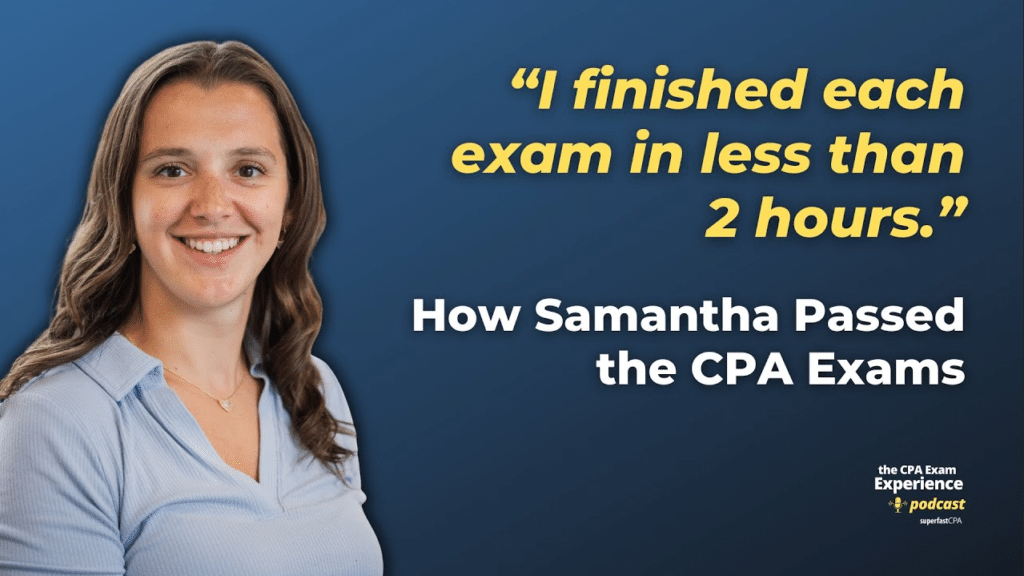
In this episode of the CPA Exam Experience Podcast, you’ll hear how Samantha was able to pass the CPA exams after failing her first three exams. She took AUD, REG, and FAR over the course of 2024 and failed each by only a few points, so she knew something was just a little off. That’s when she found the SuperfastCPA podcast.
You’ll hear how Samantha was able to change her focus on the MCQs and on constantly reviewing what she had already studied. She listened to the SuperfastCPA audio notes all the time, and took tons of mini quizzes. And, not only did she pass all of her exams 4 for 4 after beginning SuperfastCPA, but she finished each exam in less than 2 hours! Samantha has some awesome tips and advice, this is an episode you don’t want to miss!
IMPORTANT LINKS:
Master your study process by attending one of our free study training workshops:
https://www.superfastcpa.com/study-secrets/
Episode Timestamps
- 0:00 Samantha Interview
- 04:06 Choose to Be an Accountant and Knew That She Needed to Be a CPA
- 05:07 Traditional Study with Becker Everyday Before SuperfastCPA
- 05:47 Found She Failed AUD After Taking REG and Studying for FAR
- 06:36 Found SuperfastCPA and Decided to Change Her Study
- 07:37 The Reason Why She Failed Her First Three Exams
- 08:31 How Samantha Studied in the Beginning
- 10:03 Tried to Study from Her Phone After Hearing About SuperfastCPA
- 10:50 Studying After Getting SuperfastCPA
- 11:48 Found the Mini Quizzes are a Big Help
- 12:33 Picking Up Bits and Pieces from the Audio Notes
- 13:38 Learning from Her Morning Study Sessions
- 14:50 The Change in Mindset After Answering so Many MCQs
- 16:35 Passed Four for Four After Getting SuperfastCPA
- 17:58 Studied Less with SuperfastCPA
- 18:53 Still Studied During Busy Season Just to Maintain the Habit
- 19:45 Major Benefits Samantha Got from SuperfastCPA
- 20:18 Made it a Habit to Do a Mini Quiz Everytime on Phone
- 22:24 Utilized the Audio Notes More Than the Other Study Tools
- 22:59 Learning DIfficult Topics with the Help of ChatGPT
- 25:39 Wrote Down Notes But Never Really Got to Review Them
- 28:01 Making Sense of a Difficult Question
- 28:54 Figuring Out Practice Simulations
- 30:38 Kept a Consistent Study Routine Throughout the Whole Week
- 31:32 Still Studied Outside the Two Hours in the Morning
- 32:05 Had Free Time to Do Other Stuff
- 33:36 Made Adjustments in Her Life and Study to Accomodate Events
- 34:17 Having the SuperfastCPA App Made Studying Flexible
- 35:33 Took a Week Off After Each Exam
- 36:40 Utilizing the SuperfastCPA Podcasts for Motivation
- 38:01 Things Samantha Picked Up from the Podcasts
- 38:57 Routine on Exam Day and the Day Before
- 40:47 Had Always Been a Fast Test Taker, Finished in 2 Hours
- 42:49 Cried Everytime Samantha Would Get the Scores
- 43:55 Top Tips to People Still Struggling with the CPA Exams
Interview Transcript
Samantha: [00:00:00] I think it was mainly because I was just trying to check the boxes and I wasn’t taking that time to go back and review and say, okay, what don’t I know? What don’t I fully understand versus what do I understand. Um, not doing review of what I’ve learned like I’d go, I’d say, okay, unit one, check done, unit two, check done.
Logan: Mm-hmm. And then don’t look at it again.
Samantha: Yeah, until the end. And that really hurt me in the beginning and just learning, I think the, maybe one of the bigger things too is I was studying for it like it was a college exam. I wasn’t studying for it like it was the CPA exam. They’re two very different things and the, the way you study is very different for them too.
Logan: Welcome to another episode of the CPA Exam Experience podcast from SuperfastCPA. I’m Logan, and in today’s video, you’re going to hear me talking with Samantha.
I really enjoyed talking to Samantha. She had a lot of really relatable feelings and emotions about the [00:01:00] CPA exam and a very relatable story. She started doing the CPA exams a little bit before she started work, you know, she had just finished college not too long ago and she was trying to do the CPA exams before she started work. And she tried three exams, audit, REG and FAR, and unfortunately she was taking them in 2024 when the exam release dates were horrible. She had to wait, I think almost six months for her audit score, like four months for her REG and FAR scores, and she found out after all that work that she had failed all three, but she had gotten really close. She had gotten in, you know, 72, 73, maybe 68, and she was just like, what is going wrong?
What am I doing wrong here? And luckily towards the end of her FAR study process, like two weeks before she took FAR, she had found the SuperfastCPA podcast. And she listened to that and started trying to change a few things, but you know, didn’t really have very much time.
And once she found out she failed all of those exams, she went and bought the total SuperfastCPA bundle and changed a lot of her study habits and [00:02:00] mainly changed her emphasis. You’re gonna hear her talk a lot about this in the interview. She changed her emphasis on the multiple choice questions, which is of course a big part of what we emphasize at SuperfastCPA.
So, I think this is gonna be a great interview. You’ll see how she changed her process, how she changed the way she thought about studying and she was able to go past the exams, if I’m not wrong, she passed them all first try after that. If not, then you know, maybe only missed one, but I’m pretty sure she passed all of them first try. And she just has a great story. A lot of great tips. So you’re gonna want to listen to this whole interview.
Now before we dive into the interview with Samantha, just a quick reminder as always about our SuperfastCPA training webinar on superfastcpa.com.
It is a one hour webinar where we will teach you the key ingredients to passing the CPA exam so you don’t waste months or even years of your time failing exams. And then after that you’re going to want to learn more. So make sure you also check out becoming a SuperfastCPA PRO member. PRO members get access to a lot of great stuff.
They get access to our PRO course where Nate goes super in depth on how to pass the exams. Basically a much more in depth version of the [00:03:00] webinar so that you know how to pass the exams. And they also get access to our multiple choice question walkthrough videos, our full versions, because we have five question versions of those multiple choice question walkthrough videos on YouTube, but we have 10 question versions for most of them on our SuperfastCPA PRO forum.
So if you want a little bit of extra help and a little bit of extra understanding, those are a great resource that you can get by becoming a SuperfastCPA PRO member. So again, make sure you check out becoming a SuperfastCPA PRO member.
Now, with all that said, let’s dive into this great interview with Samantha.
Logan: So thanks for hopping on the call today with me, Samantha. Uh, how are you doing today?
Samantha: I’m good. I’m enjoying my day.
Logan: Oh, good. Uh, are you taking a break from work or something right now?
Samantha: Yeah, I, now that busy season’s passed, we get half days on Fridays, so.
Logan: Oh, that’s awesome. That, hey, that’s, that’s something right, to make up for those busy seasons. So are you in tax then? Is that right?
Samantha: I’m in tax. I started in audit and then I switched over the summer to tax.
Logan: Okay. Um, well, [00:04:00] let’s just kind of get, maybe we’ll talk a little bit about that, but let’s just get into, you know, your story, your journey.
Choose to Be an Accountant and Knew That She Needed to Be a CPA
Logan: So, you know, you were mentioning that you were in audit. Where were you when you were deciding to go for the CPA exam? What were you doing?
Samantha: Yeah, I was, I mean, I kind of knew once I decided I wanted to become an accountant, that I would take my CPA exam. And then my college was really like, you guys really, everyone should take this exam.
So I just, from the beginning, I knew I would, um, and then I was able to start it, thankfully, my senior year before getting into work, but then had to finish it while working.
Logan: Okay. Okay. So, and then was that, um, were you somebody who did kinda like the 150 credit hours instead of getting a Master’s? Is that right or?
Samantha: Yes, that’s correct. So I was able to get a bunch of credits in high school and then I just overloaded my courses a little bit during, um, college.
So I was able to complete it still in four years but get the 150.
Logan: 150, yeah, that’s smart. Hey, that’s a good way to do it, for sure. [00:05:00] I always, I always wish that I had done a little bit more college classes in high school cause I was just like, eh, whatever, but you know, I regretted it later.
Traditional Study with Becker Everyday Before SuperfastCPA
Logan: So you finished school, but then you were working when you started the CPA. So how did you start that, like did you get a review course? What did that look like?
Samantha: Yeah, so through my work, I was actually able to get Becker and so I was able to use that to study and, yeah, so I was, I was just using Becker every day.
Logan: Yeah. And did you just kind of do it the way that Becker told you at the start? What did that look like?
Samantha: Yeah, I kind of started studying it like I would study for an exam in college where it was like, okay, I go through the material, I take the practice quizzes, I like do all the check boxes that they have, and then I was like, okay.
Logan: And that’s it.
Samantha: Yep.
Logan: Yeah.
Found She Failed AUD After Taking REG and Studying for FAR
Logan: And how did that go? What? What happened when you went and did you go in and take an exam?
Samantha: Yeah, so I, so I was actually taking, started my exams in 2024 when it was the, you get your scores. Yep, so I [00:06:00] actually went in and I took audit and before I got my scores, I had taken, uh, REG because I was
Logan: Cause it was such a long wait.
Samantha: Yeah, cause I didn’t wanna wait six months to see what happened. And so then I just went on to, um, REG. Took REG, I was almost through studying for FAR.
When I got my audit score back that I had failed and I was like, shoot, okay, I gotta do something else. And in my head I was like, I definitely failed REG, because I studied for it the same way like I felt more confident going in, but I was just like I felt like I pass, or like I failed.
Logan: Mm-hmm.
Samantha: Um, and I was, I had scheduled my FAR exam, it was like two weeks away.
Found SuperfastCPA and Decided to Change Her Study
Samantha: And at that point is when I found the Superfast podcast and I was listening to it and I was like, okay, how are all these people studying? What can I do to change? And so for the rest of FAR, I mean I only had two weeks to, until my exam date and so like I couldn’t do a ton to get for it, but I started studying a little bit differently towards the end.
And then I took [00:07:00] FAR and I found out then like four months later that I failed both REG and FAR. And I was like, okay, what’s going on and how do I fix it? And I think the day I got those scores back is when I got, um, when I purchased the SuperfastCPA,
Logan: Like the, the total bundle?
Samantha: Yeah, the total bundle. And I watched all the videos, I downloaded the app and I just completely changed cause at that point I was restudying for audits. I was like, okay, I’m going to get this one done. I’m going to pass. It’s going to happen. And so I started and that’s kind of when it really switched how I was studying.
The Reason Why She Failed Her First Three Exams
Logan: Okay, so I, I wanna get into that, but let’s just kind of talk about what do you think went wrong or what was not effective? The first three exams, like why do you think you failed?
Samantha: I, I think it was mainly because I was just trying to check the boxes and I wasn’t taking that time to go back and review and say, okay, what [00:08:00] don’t I know? What don’t I fully understand versus what do I understand. Um, not doing review of what I’ve learned like I’d go, I’d say, okay, unit one, check done, unit two, check
done,
Logan: Mm-hmm. And then don’t look at it again.
Samantha: Yeah, until the end. And that really hurt me in the beginning and just learning, I think the, maybe one of the bigger things too is I was studying for it like it was a college exam. I wasn’t studying for it like it was the CPA exam. They’re two very different things and the, the way you study is very different for them too.
Logan: Yes. That’s definitely.
How Samantha Studied in the Beginning
Logan: So, were you kind of just, and I guess just kind of to flesh that out a little bit, were you studying in the mornings? Were you studying in the evenings? Were you watching the lectures?
Samantha: Yeah, so I was thankful because I was able to start studying while I was still in college. So I’d get up and I’d study in the morning for like two hours, and then I’d go to class and I’d come back and I’d study a little bit more. Usually be done by like five o’clock at night and have my nights still, um, and I was watching the [00:09:00] videos and then doing, they had like the multiple choice that you do with each video.
Logan: Right.
Samantha: Um, and that’s kind of what it was, just checking the boxes. And then once I started working, I had to work around my work schedule. And so I’d usually study in the morning. I’d get usually two hours cause I’m very much a morning person.
Once five o’clock hits, I’m like, I can’t do anything right now. Um, and then usually try to get an hour or two after work as well.
Logan: Okay, so, so you naturally kind of gravitated towards studying in the morning already. So that probably sounded, that probably clicked with you when we talked about that in the PRO course. Um, and I kind of want to get into that so, you know, you were watching the lectures, doing the que, you’re doing everything that Becker told you to do, failed the three exams.
And just curious what, what were the scores? Were you like kind of close or were they low?
Samantha: I was close on all of them. Like I think I was like 73, 72, and then FAR was like a 68 or something like that.
Logan: So yeah, you, you, you understood the [00:10:00] stuff pretty well. It just, there was just a little bit of something missing.
Tried to Study from Her Phone After Hearing About SuperfastCPA
Logan: Um, and actually just before we get into the full switch, what were you, cause you were mentioning that for those two weeks so FAR, you kind of heard the podcast and what did you start trying to change at that point?
Samantha: Yeah, so I started doing just a lot of the 30 question quizzes that you guys talked about, and then there’s the idea of the five, the five question quiz that your guys’ app has, and I was like, oh, I can just do that with Becker and I’d go online and do that. You cannot do that from your phone
Logan: It’s a lot harder.
Samantha: Yeah, it worked fine with audit, but like studying for FAR with that, I was like, that’s not the move to do that.
Logan: Mm-hmm. Yeah. ’cause they’re just, they’re full force questions, you know, which, that’s why they’re good for the morning, but when you’re on the go, it makes it very difficult.
Samantha: Very difficult.
Studying After Getting SuperfastCPA
Logan: Um, so you kind of started implementing the re-review. Basically you started kind of trying to add that, but you know, a few months later you find out you fail. You failed all [00:11:00] three.
So at that point you purchased SuperfastCPA and what changed that point? What I kind of wanna know what, did you revamp everything?
Samantha: A little bit. It was more, I added a lot of the 30 question quizzes and really emphasizing those multiple choice and learning the why behind the simulations. I remember I watched the multiple choice video of like, okay, how did you study for this? How do you actually review and look? Cause I’d take the quiz and then I wouldn’t fully dive into why was this wrong and why, what is the right answer and why?
And, so after watching that I was like, okay, I really need to emphasize that and emphasize understanding the multiple choice questions more. So that’s what’s changed on the studying side of it. And I watched less videos like I, when I felt like I understood a topic, I was like, okay, let’s check out these multiple choice more, like focused on that more.
Found the Mini Quizzes are a Big Help
Samantha: And then the biggest thing that changed was those five question quizzes cause I could be at work and I’d be like, okay, I am going to take two minutes. I’m just gonna go on my phone and take these five questions. And that really helped me [00:12:00] understand, cause I felt like those questions are more conceptual.
It’s not, can you solve the problem? It’s do you know what you’re studying? And so I was able to take those quizzes and then be like, okay, this is what I need to focus on because this is what I keep missing so then in my morning sessions, I’d be like, okay, let’s go back and figure out what I’m not understanding.
Logan: Right, and, and yeah, we do purposefully build those questions as best we can to where it’s something that you pick up. You do it and you’re more just kind of reinforcing something really quickly. Um, you know, the calculations are simple too.
Picking Up Bits and Pieces from the Audio Notes
Logan: So you were doing the quizzes, did you also implement the review notes and the audio notes?
Samantha: Yeah, so at work when you’re doing audits and tax, like it’s, it’s fun. But then I’d also, on top of that, have the audio playing in my brain and I knew, like I wouldn’t pick up a hundred percent of what was being read to me, but like every so often I’d be like, oh wait, I need to know more about that. And I’d pause and I’d be like, okay, let’s listen to that.
Or like, I’d [00:13:00] get up and I’d go fill up my water and I’d be listening to that and then I can focus more on what was being said. So just kind of hearing the same stuff over and over again. And then same thing in the car, I’d always play the audios.
Logan: Yeah, that’s perfect. I mean, that’s exact, and, and that’s impressive that you could listen to them at work. I, I struggled to listen to the audio notes at work just ’cause I like couldn’t focus on work if I was listening to the audio notes. But, um, and you were doing audit at the time, is that right?
Samantha: And it really, the audio notes would be like, depending on what I’m working on cause some things are a little more mindless you can do and listen, but yeah.
Logan: Yeah, that makes sense.
Learning from Her Morning Study Sessions
Logan: And, so I kind of wanna, you know, we, maybe you talked about it a little bit, but what did your morning study sessions look like? Did you go straight into the questions? I just kind of wanna know your process in the mornings.
Samantha: After purchasing.
Logan: Yes. Yep.
Samantha: Yeah. So I would get up and usually each day I was like, okay, I need to get through this section or these sections, depending on the day and how [00:14:00] much time I had, how long the sections were. I’d usually start by watching the videos in the morning and then do a section of like 30 questions, multiple choice and two to three simulations depending on the section and how much conceptual they had.
I’d also, every morning or every other morning, I also tried to get a 30 question set in of multiple choice. Just really focusing on that and doing that for, say I’m in unit two, then I’m focusing, okay, let’s do 30 questions from unit two. And just see, and some of them like, especially when you’re just starting, it’s like, okay, I haven’t learned this stuff, but let’s get a little bit.
So I kind of understand it for when the videos do come up.
Logan: Right. Okay so, would you do cumulative for all of the unit, even if you hadn’t reached it yet? Is that what you’re saying?
Samantha: Yeah.
Logan: Or, okay. Okay.
The Change in Mindset After Answering so Many MCQs
Logan: Um, and what difference did you start seeing because, you know, you switched it up and did you feel different about studying?
Samantha: I [00:15:00] felt so much better. It, it definitely is really hard when you’re doing the, um, cumulative stuff and getting like 20, 30%, but then you start seeing it go up and up and up the more you do it. And I got to the point before my exams where. For some of those exams, I was getting a hundred percent on these multiple choice questions.
And for some of them too, like especially audit and TCP, I got to the point where I’d seen all the questions and I saw the question pop up and I was like, I know this answer cause I’ve seen this before. And that’s, I did have to change my mindset of, okay, why is this the right answer? Like, I know this is right, but why is it right?
Which I think also really helped me just conceptually understand what’s going on cause you’re not necessarily gonna see the same exact question on the exam.
Logan: Exactly. Yeah. That, that, and that actually what you’re just talked about right there, you may have, maybe you’ve heard me talk about this. In my opinion, there’s two kinds of memorization for the exam. When you’re studying, you know, there’s the, [00:16:00] what you were just talking about where you’ve seen it so many times, you just know that’s the answer without having to think about it.
And, but that hurts you because you don’t actually know the concept, and so you’re not gonna see that question on the exam day, and then you’re not gonna understand it. And then there’s the good memorization, or however you wanna say it, where you’ve seen it so many times that you understand the concept to the point where no matter how you see it, you know how to do it.
And it sounds like that was a big switch for you. Is that right?
Samantha: Yes. Just focusing on how to actually solve the problem.
Logan: Why is this the actual answer? Yeah, that makes sense.
Passed Four for Four After Getting SuperfastCPA
Logan: So what happened? So you started studying for audit, did you pass? How did that go?
Samantha: So then I passed the next four all in a row once I started. Yep, so I was able to get audit, tax, and REG passed before, um, before busy season hit. And then busy season hit and I still had FAR, but I knew, I was like, I can’t stop studying because if I stop studying. I’m [00:17:00] going to struggle to start again.
So even through busy season, like I was doing 30 minutes to an hour a day, but still just doing more review questions, multiple choice question type stuff.
Logan: So you passed and was it, you said you took TCP, is that right? For the, for your discipline. Okay. And it was a little bit better towards the end of the year with the release dates. Uh, but did you still have to wait like a couple months or something like that, sometimes?
Samantha: Yeah. I, I’m trying to think. I think I still had to wait like a month or two for most of them.
Logan: Yeah. Yeah. And uh, what were your scores? Do you remember your, your scores for each of them?
Samantha: Let’s see, so audit was like a 78 and then I passed TCP with an 86 REG with a 76, 78, something like that. And then FAR I got a 75, so I studied the perfect amount.
Logan: Yes, that, that, hey, that’s per, and you did it during busy season too. That’s, I mean, that’s awesome.
Studied Less with SuperfastCPA
Logan: So [00:18:00] you, I mean just a total switch around, you know, you were, you studied for, well, actually a quick question, how long did you study before you had SuperfastCPA for each exam? And then how long did you study when you did have SuperfastCPA?
Samantha: In total or?
Logan: Yeah, like like per exam, like how many weeks kind of a thing?
Samantha: Oh, okay. Um, well before I didn’t have schools or, I mean, I just had school. I didn’t have work.
Yeah. So I was taking that like every two months. And then once I started working, it was still about every two months, but I was studying less because of, um, SuperfastCPA. I just was doing more of the multiple choice and like less on Becker, more through the app, more multiple choice type of a thing.
Logan: Okay, so still roughly about eight weeks usually, is that about right? Okay.
Still Studied During Busy Season Just to Maintain the Habit
Logan: And then for FAR, did you still do it in eight weeks or did you kind of expand it because you were busy season?
Samantha: That one was, [00:19:00] I think I studied for five months, but the busy season, I really, it was more of a, let’s maintain this studying.
Logan: Yeah. Maintain the habit. Yeah, that makes sense.
Samantha: I wasn’t learning a ton during busy season. Just more trying to maintain.
Logan: Survive.
Samantha: Yeah. Yep.
Logan: And, uh, was that, was that an audit busy season or had you switched to tax?
Samantha: So I was actually doing both, so I, I wasn’t a hundred percent sure if I wanted to do audit or tax. And so they, my firm was amazing and they let me do a little bit of both, and so when I slowed down on one, I was like, okay, I’ll go help this other side.
Logan: Mm-hmm. So you were kind of always busy for a while there, is that kind of accurate?
Major Benefits Samantha Got from SuperfastCPA
Logan: Uh, so if you could kind of summarize based on what we’ve talked about so far, what were the major benefits that you saw when you did start using SuperfastCPA?
Samantha: The most beneficial was the five question [00:20:00] quizzes. That saved my life. That helped me understand conceptually what I was doing versus just trying to solve the problem that Becker throws at you. And I just feel like that really helped me understand the concept more of what I was learning.
Logan: That’s awesome.
Made it a Habit to Do a Mini Quiz Everytime on Phone
Logan: And how many of those were you, I mean, you said you would take a break for like two minutes and do one. How many of those would you do a day, maybe?
Samantha: I tried, so I’d set a reminder on my calendar to do at least one every hour. And then I also, I think someone on one of the other videos mentioned they deleted all social media from their phone, and I don’t know if it was the same person said every time they turned on their phone, they had to do that. So I did something like that where I removed the social media from my home screen.
So it wasn’t the first thing I saw. And I put Superfast, like right in the center where I would always see it. And whenever I turned on my phone, I said, okay, before I can do anything, I have to do a five question quiz. So if I wanted to go scroll [00:21:00] on social media, I have to do a five question quiz first.
If I wanted to text my friend or roomie, I had to do a five question quiz first, and so it kind of varied day to day how much I would actually do that or do the quizzes, but it just helped me get a lot of them in.
Logan: Yeah, you like, you kind of changed the, the focus of your phone from maybe entertainment to more, this is a tool. Uh, and so I’m just curious, did you like take everything else off the front screen and just have that right in the middle or uh, or not quite like that?
Samantha: Not quite like that, just all my social media that I have, I put that off and then put that down right by my phone. And the texting app, like right at the bottom of your
Logan: Like on the bar, were you on the I iPhone? I’m guessing. Yeah, that makes sense. Okay. Uh, yeah, I, I love, I mean, I personally, I, I don’t like social media, but especially when it comes to specifically studying for the CPA exam, I really strongly recommend what you were saying, like [00:22:00] have some way of just not using social media either at all, or make it much more difficult to use because that’s kinda like a big premise behind SuperfastCPA that Nate really wanted to push was if you, you’re, you’re looking at your phone all the time, why not turn that into study time? Cause that makes it so that you have an extra two hours of studying or something every day.
Utilized the Audio Notes More Than the Other Study Tools
Logan: Um, were you also reading the review notes on your phone or maybe not quite like that?
Samantha: Not quite. I, I don’t learn the best when I’m reading material cause sometimes I’ll be reading and like
Logan: And just zone out. Yeah.
Samantha: So that’s why I would usually play the audio.
Logan: Okay.
Samantha: Yeah. Okay.
Logan: And did you ever use the follow along notes or Mainly just
Samantha: Sometimes, but usually just the audio, I’d listen to it while I drive or something like that. Yeah.
Logan: So mini quizzes were a big help. You listen to audio notes quite a bit, and then you were studying in the mornings, you, you said that you did re-review almost every day.
Learning DIfficult Topics with the Help of ChatGPT
Logan: What did you do [00:23:00] for, like, for topics that you really were struggling with? Like how did you do notes? How did you do flashcards?
Samantha: So I ended up using ChatGPT a lot, actually. And I’d say, okay, this is a topic I don’t understand. Please explain it to me like I’m a third grader and would explain it so well using easy examples and then eventually you can say, okay, I understand that. Give me some practice. Okay, help me with these specific areas within that.
Oh, can you explain that a little bit more? And it just gives you answers so easily.
Logan: Yeah. And so was that ChatGPT or was that Newt? Because I know that Becker has their own AI.
Samantha: Yeah. That was ChatGPT cause it before they had Newt.
Logan: Okay, okay. And so I actually kinda wanna talk to you about this because, so I have, I’m willing to change my mind, but I, I’m of the opinion that you gotta be careful with using AI when you’re learning because I, I, I’ve, I always come back to this.
[00:24:00] I remember watching a video, uh, I was helping somebody in the coaching program where I watched them ask Newt about, you know, help me learn about this. And Newt gave them like a ton of extra information and then they learned the complete wrong thing from the question. And I like went back to the question, I was like, that’s not even what this question is about.
Um, and you know, that maybe was an extreme example, but I was recommend being careful cause I don’t, I want people to learn it themselves, you know, I want them to understand it. So maybe could you talk about why that was so helpful for you to like. So that other people can maybe know a good way to use it.
Samantha: Yeah. So I didn’t use that as like my primary source of learning. It was more, okay, I keep missing this question and I can’t figure it out, and the videos I’m seeing, the text I’m reading, it just isn’t making sense. And I needed broken down a little bit more. And so the topics and questions I was asking, it was very specific of, okay, this is a question I missed.
Why is it wrong? How do I understand this specific topic a little [00:25:00] bit more and understanding like the answer I needed to get to, just not understanding how I got there,
Logan: Right. No that and that actually, that makes a lot of sense. Like, and I think that is probably more what I would lean towards when using AI like it’s not your main teacher, where it’s like simplify every single question I ever see so that I can like cause you need to be able to read through a question and understand it, like that’s a skill that you need.
But I like that you were saying that for topics that you’re like, okay, I just keep missing this. I don’t understand it no matter how hard I try. That’s when you were kind of using the AI, is that right?
Samantha: Yes, that is.
Logan: Okay. Okay.
Wrote Down Notes But Never Really Got to Review Them
Logan: And did you ever use that to help yourself make flashcards or did you ever, because I was kind of asking about notes and flashcards, but did you ever really do that?
Samantha: So I had to write down notes, but I, I’m not, okay, maybe it’s just I don’t fully know the right way to do flashcards, but my brain just when I do flashcards doesn’t really help me. [00:26:00] So I focus more on the multiple choice side of it, and then taking notes from that, taking a few notes from the lectures, just to have that, the, whatever the science is behind actually writing something down.
So like I’d have that, but, yeah, I was really bad about actually going through those notes.
Logan: Yeah. And you know, I actually, uh, from all the people that I’ve worked with and when I was doing it myself, I think there’s something to be said for just taking the notes, even if you don’t review them very much. It, the action of writing it down and having to put it in your own words really solidifies things.
Uh, so are you saying that you would write them down physically?
Samantha: Yes, I’d pen to paper write it down so that I could have that. And then if there were things, it’s like, okay, again, another topic I can’t figure out, I’ll write that down a lot more and kind of rewrite it. Write in depth what am I researching, what I’m, or like figuring out from [00:27:00] looking deeper into the topic.
Logan: Okay, so act, maybe walk us through that just a little bit. So let’s say, you know, you had a topic that you’re really struggling with, maybe you use ChatGPT a little bit. What would you do? Did you have like a specific process for how you would work through it when you wrote it down? Or was it more just writing definitions?
Like how did that look?
Samantha: Yeah, a little bit of definitions, A little bit of, okay, this is, oh, I’m trying to think of an example, um.
Logan: I mean, like, would you walk through an example on paper, like doing the calculations or,
Samantha: Yeah, especially with calculations. Just right now, okay, this is what I’m doing. This is like, this is, I don’t even, I can’t think of an example right now.
Logan: Something to do with a lease or something like.
Samantha: Like this is the lease, this is the right-of-use asset, like whatever it is, yeah.
Logan: Yeah. Okay. And did that seem to kind of help solidify things in your mind?
Samantha: A little bit. Yes, it helps. Yeah, just a little bit. Again, the writing the stuff.
Logan: But the most thing was [00:28:00] MCQs. That was like the biggest thing.
Making Sense of a Difficult Question
Logan: So you kind of already talked about this, so, you know, maybe there might not be anything new, but when you were working through the multiple choice questions, what did you do when you ran into a topic that you just didn’t really understand. Did you like stay in the multiple choice question until it made sense, or did you try to go somewhere else?
Samantha: Yeah, so usually I try to watch some of them have the videos that you can watch
Logan: Yeah, like skill builder, is that right? Mm-hmm.
Samantha: I do that. Um, if it was a specific topic I was struggling with, I’d say I’d go back and narrow it down as much as I could to that topic from like it’s unit A to what? Yeah, whatever those things are, and try to see how I’m doing with other questions related to that.
And then if I was still struggling so much, that’s when I would go to ChatGPT and dive a little bit deeper.
Logan: Okay.
Figuring Out Practice Simulations
Logan: Uh, and then kind of along the same lines, we haven’t talked about it very much yet. What [00:29:00] was your strategy with the sims? How did you learn and prepare for those?
Samantha: Yeah, that was a challenge to figure out how to learn those. Um, I would do the sim and then I’d watch the learning video associated with it, of how did they solve this, because, and I just always go through them, so eventually I kind of had them memorized. But the understanding how this is solved, and I remember listening to the podcast of “You Have to Know How You Solve a SIM” because the odds of you getting a sim even remotely close to the ones you practice are so low that you have to understand how to read the question and how to determine what they’re looking for in their answer.
And so, I would watch those learning videos after solving it to see, okay, how did they break down how to solve this? How did they figure out what the exam is looking for?
Logan: Right, and, and yeah, that’s exactly right. Like sims are so different than multiple choice [00:30:00] questions. A lot of times people compare it to a whole bunch of multiple choice questions kind of mashed together, and that is true, but there’s also just this skill of being able to kind of immerse yourself in that specific sim and figure out what the heck it’s even talking about.
Cause a lot of times sims will have completely irrelevant information. You have to know how to sift through. So is that something that you felt like you kind of learned and as you practiced?
Samantha: Yeah, and just how to easily say, this is the wrong answer, and I know it because of this word.
Logan: Right. Yeah. Kind of understanding, you know, just by how they’re talking about something, what they’re actually looking for. Uh, that makes sense.
Kept a Consistent Study Routine Throughout the Whole Week
Logan: And you said that you were studying sims kind of every day, so you didn’t really study them extra on the weekends. Is that right?
Samantha: Right, I was trying to, I definitely on the weekends focused more on the review side of, okay, everything I’ve learned, we’re gonna do a review of everything from start to end and every day I had a little checkbox cause I like to make lists [00:31:00] and checking things off.
Logan: You’re an accountant.
Samantha: Yep, makes, makes it easier to get done and makes you feel better.
And so I’d say, okay, each day I need to do 30 questions from the unit I’m doing. 30 questions from all the units I’ve done. And depending on the day, two to three simulations, and then also one, one to three simulations of what I’m doing as well.
So like I had that checkbox that these are the things I need to do, and so I kind of did that just throughout the whole week so that it wasn’t always on the weekends that I’m diving into that, yeah.
Logan: Yeah.
Still Studied Outside the Two Hours in the Morning
Logan: So, and with that, was that all happening within two hours or were you doing two hours and then were you still studying a little bit after work like you did before?
Samantha: Yeah. So I would do usually two hours in the morning focusing on my current units and then sometimes I’d need a brain break during the day, so I’d take like 15 to 30 minutes and do some kind of studying, and then after work I’d do another 30 minutes, maybe an hour, depending on how I was feeling.
Logan: [00:32:00] Okay, and this is something that I don’t always ask, but I’m kind of thinking about it right now.
Had Free Time to Do Other Stuff
Logan: I mean, outside of busy season, were you still able to kind of have a life? Like were you still to do stuff with friends? What did that look like? What
Samantha: Yeah, so I’m a morning person, so I would get up at crazy times, but I would get up at 4:30 so I can get to the gym, get a workout in, then I’d study, go to work, come home, and I’d still have like two or three hours at night to do what I want. Whether that was seeing a friend, whether that was relaxed on the couch or going on a walk, like whatever that is.
Uh, so I was still able to have that good balance, and then over the weekends I’d be done studying by like noon, so then I’d have the whole afternoon to myself to do what I want.
Logan: Perfect. Yeah, and that, that’s what you just said right there. That’s exactly what we hope people, that’s kind of the whole idea. Get all your, get that stuff done in the morning.
I mean, yeah, you’re definitely a morning person.
I, I’ve become a morning person, but [00:33:00] 4:30, that’s pretty, I mean, I wake up at 5:15, but man, anything below five for some reason just feels so early.
Uh, do you still do that or have you kind of toned it back a little bit? Okay.
Samantha: Yeah, I do. Because then I can get to work by like seven and get done a little earlier or during busy season. Get more hours in and be done earlier.
Yeah.
Logan: yes. I, I mean, I. I fully, like, that’s what I do too. I, I work at seven every day because I’m, then, I’m done by like, the afternoon and can actually do stuff. So I, I totally, I agree with that, with, with doing stuff like that. Um, but that’s awesome.
Made Adjustments in Her Life and Study to Accomodate Events
Logan: So did anybody, like, did you have to miss very many things throughout?
Like were you still able to kind of do family stuff and friend stuff?
Samantha: Yeah, I made it, made it a priority to still see friends and family and be able to go to all the things. And if that meant, Hey guys, I gotta get up an hour or two earlier. And I’m just gonna study, or I’m gonna miss the first hour of the day and be studying or two or [00:34:00] however long it would be, because I knew that that was something that was important to me that I needed to continue to do in order to survive taking these exams.
Logan: Yeah. So you made consistency, a really big priority, like no matter what I’m going to get this studying in.
Having the SuperfastCPA App Made Studying Flexible
Logan: Do you have any examples, like were there any like weekend trips you went on or any kind of thing that you did where you’re like, I’m still gonna study?
Samantha: Yeah, I, so like I’d go home and visit my family and in the morning they’d all get up and they’d go walk and I’d say, okay, I’d love to go on the walk, but I think what I’m going to do is I’m gonna get up an hour before and I’m gonna study that hour and the hour while you guys are walking. And then when you get back, I’ll hang out with them.
And what was nice is I had then throughout the day, I’d use a Superfast app and be like, okay, I’m gonna just get on my phone and do a quick five question quiz. No one talk to me real quick, while I do that.
Logan: Hold up. Wait. I’m gonna do this.
Samantha: Hold on, let me, hold that thought. Um, and I think that was really helpful cause then I could still, it [00:35:00] wasn’t that ideal getting a deep dive of studying on the weekend, but having the app, I was able to do the questions and still have that social time that I needed with my friends and family.
Logan: Yeah. And there is something really big to be said about that. Like I think that that’s why the CPA exam is such a beast, is because so many people don’t study efficiently, and so they lose all that time. They don’t get to hang out with friends, they don’t get to spend time with their family. They’re sacrificing all this time and it’s miserable.
Took a Week Off After Each Exam
Logan: Uh, so would you say that, you know, of course it was hard, but you were able to still kind of feel, I don’t know, like feel happy, like still be able to have that social aspect you’re saying?
Samantha: Yeah, there were definitely times that were harder, like especially when the exams get closer. It’s like no one can talk to me right now.
Yeah, but then I made a priority, like after each exam I took a week off and I did whatever, like I [00:36:00] think one of the exams was like, okay, we have spring break coming up.
I gotta take it before spring break, and then I’m taking through spring break off cause I just wanna enjoy the time and reset my brain. And then I think we had another one after I took FAR, it was like the next day we left and I was like, okay, I just gotta take it before we leave, so.
Logan: Yeah, I, yeah, that, I think that there, that’s a good idea. Like if, you know you have a big trip coming up, uh, it’s probably easier to just take the exam before the trip if it’s possible. Um, I mean, it’s possible to still study when you’re on vacation. I’ve seen some people do it, but. It’s easier to, not to. Um, so we’ve, we’ve talked about a lot of your process.
Utilizing the SuperfastCPA Podcasts for Motivation
Logan: Oh, actually one quick question, what benefits did you get from the podcast? You’ve mentioned listening to it a few times. Did you listen to it a ton? Like did you ever replace it with audio notes? What did that all look like?
Samantha: So initially when I first found it, I just listened to it a ton. I was like, let’s hear all these people. How are they studying? What am I doing wrong? What were they doing that they changed, that I [00:37:00] could implement into my studying? And then eventually I was like, I just need to get this. And so then once I got it.
I stopped listening to the podcast as much and I switched more to audio notes. But then whenever I felt lack of motivation, like I just feel like this is never ending. I’m never gonna get there. I feel like I keep failing. I am studying all the time, I’m getting nowhere. I’d listen to a podcast episode and I’d be like, okay, this person did it.
This person did this with kids. They did it while working. They did it with whatever challenges they faced, they failed. I’m not the only one who is failing cause I felt like everyone around me had passed on the first try for all of their exams. I’m like, that’s great for you. Good job, I’m proud of you.
Logan: Talk to me.
Samantha: Yeah. I’m just gonna go, go home and cry real quick.
But um, so it felt good to know other people were kind of going through what I was going through and also struggling and that I wasn’t alone. And so when I felt a lack of motivation that was like, it’s just never ending. Then I would listen to an episode and be like, okay, I can do [00:38:00] it.
Logan: Awesome.
Things Samantha Picked Up from the Podcasts
Logan: And were there any you, I think you mentioned one, but were there any tips or things like that that you can remember picking up from the podcast?
Samantha: Yeah. I mean, the biggest one was the getting rid of the social media and doing the, like every time I turn on my phone, you gotta do a question and then, um, the multiple choice, listening, doing multiple choice over and over and over again, and really nailing that because I think that’s what really helped me was going into exam.
I knew I was getting 90 to a hundred percent on multiple choice, and so if I could do that on the exam, I could get a bad score on simulations and be fine.
Logan: Mm-hmm. Yeah. Yeah.
That’s definitely a big part of the strategy, like crush the MCQs and then hopefully that will make up for, if you do have any lack in sims, that might hopefully will make up. And it, I mean it obviously did, cause you know, you got in the seventies, which is perfect. Who, who cares, you know, and you passed the exams.
Routine on Exam Day and the Day Before
Logan: Um, I, I do have one. I [00:39:00] think we’re, I don’t think I have too many more questions, but I do have one more, uh, for, like on exam day, did you have any strategies for exam day, any rituals anything like that?
Samantha: Yeah, the biggest thing I had to get up and get a workout in. I had to get my brain moving and have that time to wake up cause I always took the 8:00 AM exam. Like I said, my brain doesn’t work as well in the afternoon and I was just so used to studying in the morning. I was like, I’m gonna get up and we’re gonna study at eight.
And then I do, usually I try to do the night before, I would have to get a perfect um, I can’t remember if I did 20 or 30 question MCQ and then before I could go to bed I’d had to do three perfect of the five question quizzes. And so then I knew I know what I’m doing and know what I’m talking about.
And then, yeah, like I said, in the morning I had to work out. I’d get up, I’d eat some kind of food. And then I’d go take the exam and then after the exam I got an, I rewarded myself [00:40:00] with coffee. I’d go to some coffee place.
Logan: Okay.
Samantha: Yeah.
Logan: Okay. That’s, I don’t think I’ve ever talked to anybody who actually worked out on the day of, so it seems like that was something that really helped you throughout your whole process. Like, you don’t have to go into detail, but is there, do you do weights? Do you run, like, what do you do that helps you?
Samantha: Yeah, I mainly do weights and then I run a little bit, but every morning I would do weights before I went in.
Logan: Kind of get pumped up.
Samantha: Yep. And half of it, I’d listen to the, um, audio notes and half of it I’d listen to music.
Logan: Okay. And was that, that was just on the, the day of, okay. And did you like listen to like metal or just your favorite song? So what, what you listen to?
Samantha: Whatever I was listening to that day.
Logan: Yeah. Okay. Nice.
Had Always Been a Fast Test Taker, Finished in 2 Hours
Logan: And uh, did you find that when you were in the exam, it wasn’t like, were you able to manage your time pretty well? Like, how did that feel?
Samantha: I’ve always been kind of a fast test taker, which isn’t good. But [00:41:00] I, I mean, I was done with all of them within two hours, with the exception of FAR. I mean, I think I did TCP in an hour and I left and I cried ’cause I thought I failed it.
Logan: You’re like, there’s no way I passed with just a so wait, wait, You, you took all of them in two hours out of the four. Wow.
Samantha: Or yeah, like within two hours for each of them. And I remember I left TCP, I called my dad. I said, yeah, I failed that, that was so bad. And then I got it back and it was an 86.
Logan: That was the, and that was your highest score.
Samantha: Yeah, I was like, I guess I didn’t fail, so.
Logan: I don’t that, it’s pretty rare to see, um, somebody like do it. So you must have been doing, how quickly were you doing the MCQs? Like were you doing those in like a half hour? All of them? Or how did that look?
Samantha: I think it was more the simulations that went fast. Cause I, my MCQs would be done within an hour
Logan: Okay.
Samantha: And then, yeah, the simulations just, I do it. I was like, if I go back, because I’ve learned just from other exams I take, if I go back and re-read a question, I change it to the wrong answer. The odds of me [00:42:00] changing a right answer or a wrong answer to a right answer is
Logan: Very low?
Samantha: Yeah.
Logan: Yeah. Yeah, that, that’s actually definitely a strategy that’s like, I think it’s across pretty much all exam taking where usually if you know what you’re doing, at least, you know, if you have no idea, then there is, this isn’t true. But if you have an idea of what you’re doing, your gut is usually right.
So just go with your initial instinct. Um, so yeah, that, I mean, those are all, and then you reward yourself with coffee afterwards. Did you get like a special coffee or did you just get like black coffee or just something basic?
Samantha: Yeah. Just a special latte. I mean, nothing too crazy, but something
Logan: But like, kind of a nice tradition, a nice tradition afterwards.
Um, so yeah, I think that we’ve hit most of the stuff that I usually like to cover.
Cried Everytime Samantha Would Get the Scores
Logan: Uh, I guess just the last couple things that I usually like to ask. The first thing is, is there anything about your process that you were thinking about before the call and you’re like, I would like to talk about this, that we haven’t [00:43:00] gotten to talk about yet.
Samantha: I think we talked about everything. I, I mean, the only thing would be I cried after every exam and I cried whenever I got my scores and I just, I would get the score at work. I’m like, I gotta go home real quick to
Logan: Did you live close by?
Samantha: Yeah.
Logan: Okay.
Samantha: Was pretty close. Yeah.
Logan: Yeah, I mean, it’s pretty emotional. I, I remember when I took, when I got my last score, I was expecting to cry, but I was just like it’s done. Like, I just felt like so relieved.
Um, and I, I guess, have you done anything to celebrate being done like in the past few months? Anything big?
Samantha: Besides not having to study nothing big.
Logan: Yeah.
Samantha: Just enjoying my time and having my time back.
Logan: Just work and then life, you know, like that. Yeah. I, yeah, being done with school, being done with CPA, it’s one of the best feelings, so, uh, if that makes sense.
Top Tips to People Still Struggling with the CPA Exams
Logan: So last question that we always ask everyone, even if it’s something we’ve already talked about [00:44:00] throughout this interview, what would be your top two or three tips to somebody who’s still going through these CPA exams?
Samantha: Get the multiple choice figured out. If you can be so confident in the multiple choice going in, it just, it helps a ton and especially with some of them, like with multiple choice. Sometimes you do see very similar questions, worded very similar ways and that I felt like that helped me a ton during the exam.
And then also if you’re using the app, those five question quizzes can save your life with understanding what you’re doing and just understanding the material better.
Logan: Right.
Samantha: Mm-hmm.
Logan: So yeah, focus on the questions, everybody. Uh, so yeah, I mean, I think that’s just about everything. Uh. Congrats on being done. Have you gotten your license yet?
Samantha: I have, yes.
Logan: Okay, awesome. So yeah, congrats on being done. Being licensed, you don’t have to study anymore. Uh, and yeah, thanks for being on the call today.
I hope you have a great rest of your day, Samantha.
Samantha: Yeah. Thank you. You too.
Logan: Thanks.
All right, that was the interview with [00:45:00] Samantha. Again, I really enjoyed her story. I really enjoyed that, you know, she was already a morning person and she was already doing some of the stuff pretty close to what we tell people to do, but it just wasn’t quite enough, you know, she was just missing a few of the strategies and she went from failing three exams over the course of multiple months to passing her exams by focusing on the multiple choice questions and learning how to study the sims and a whole bunch of things like that.
One of my favorite things that I found really impressive was that she finished every exam in two hours or less, which is just crazy to me.
I’ve only talked to a few people who have ever done that and, uh, you know, that’s, that’s crazy. But she passed them even with two hours or less, so it just goes to show if you really know what you’re doing, if you’re using the right strategies and you’re being efficient. You can go into these exams and totally crush them and be really quick and efficient with them.
And you know, that might sound crazy to some people who have struggled with the exams for years, but you really can get good at the multiple choice questions, get good at the sims, and get good at [00:46:00] taking these exams. And that’s what this SuperfastCPA podcast is for. That’s what the SuperfastCPA is about, is helping you learn how to get good at these multiple choice questions. Get good at taking the exams.
So make sure you check out becoming a PRO member. Make sure you check out our free webinar because we will teach you the key ingredients to passing the CPA exams. Now if you liked this episode, make sure to like it and leave a comment in the YouTube video or leave a rating in your favorite podcast app.
I hope that you enjoyed this episode and I will see you in the next one.