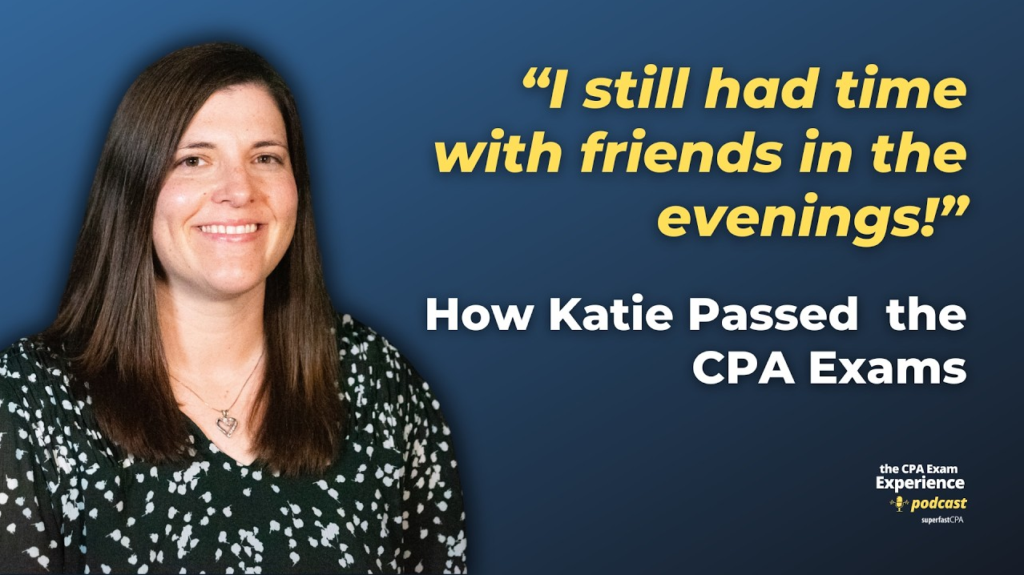
In this episode of the CPA Exam Experience Podcast, you’ll hear how Katie was able to go from failing the exam multiple times 12 years before, to passing each exam first try. All it took were some key shifts in her strategy and how she studied.
You’ll hear how much of a difference studying in the morning made, as well as how helpful the SuperfastCPA mini quizzes and audio notes were. The best part was that Katie was still able to have her evenings! She was still able to spend time with friends, with family, and be active in her church. Katie didn’t have to sacrifice her evenings, and neither do you. Listen to the full episode to see how she did it!
IMPORTANT LINKS:
Master your study process by attending one of our free study training workshops:
https://www.superfastcpa.com/study-secrets/
Episode Timestamps
- 00:00 Katie Interview
- 03:09 Katie’s CPA Journey Started 12 Years Ago
- 04:24 Had a Goal to Get Her CPA Before She Turned 40
- 05:51 SuperfastCPA Was the Game Changer
- 06:30 Finding SuperfastCPA on Google
- 07:45 Why Katie Decided to Get SuperfastCPA
- 08:39 Getting SuperfastCPA Because of the Success Stories and Podcasts
- 09:58 Changes from Studying Before
- 12:12 Studying in the Mornings Is a Big Game Changer
- 13:19 Mini Sessions Throughout the Day
- 14:44 Used a Notebook to Review
- 16:45 Using UWorld’s Built-In Flashcards
- 18:34 Used Excel for Difficult Topics
- 19:57 Planting the Seeds in the Morning and Throughout the Day
- 22:13 Practicing Multiple Choice Questions Helped with the Test Taking Process
- 23:11 Studied Six Weeks or Less for Each Section
- 25:50 Test Day Experience Compared to 12 Years Ago
- 28:06 Working in Local Government Helped with Government Accounting
- 29:28 Only Took a Break from Studying In Between Sections
- 30:49 The Best Christmas Present
- 32:20 You Have to be Disciplined and Not Distracted
- 34:59 Katie Didn’t Have to Sacrifice a Lot
- 36:41 Why Katie Decided to Pursue Her CPA
- 38:33 Celebrating Each Milestone with a Family Dinner
- 39:26 Getting Licensed in Arkansas
- 41:31 Katie’s Test Day Experience and Rituals
- 45:01 Top Tips for People Still Going Through the CPA Exams
Interview Transcript
Katie: [00:00:00] And so that was like such a huge relief to be done and just okay, I did this. Like it’s possible. And I’m almost 40 and I have two kids and they’re busy and we’re really involved in our church and my job and, just, life. And, and with friends, like I didn’t take, I mean, still had time with friends in the evenings and just to have your evenings free to be available and still, it was, I’m very thankful I found SuperfastCPA cause I, I don’t think I could have done it without it so, actually, I know I couldn’t have.
Logan: Welcome to another episode of the CPA Exam Experience podcast from SuperfastCPA. I’m Logan, and in today’s episode, you’re going to hear me talking with Katie.
Now Katie has a very similar story to a lot of people. She tried to do the CPA exam years before and it just didn’t work out. She even got really close to passing the exams, but was never quite [00:01:00] there, and it was really frustrating and really discouraging, so she kind of put it on the back burner and moved on with her life for a while.
She got married, she had a family, she had a career and she was moving on. But 12 years later, she still wanted to get the CPA done. So she decided it was time to do it, and that’s what you’ll hear about in this podcast episode is when she decided to do it and how she was able to pass all of the exams first try this time around.
One of her goals was to be able to pass the CPA exam before she turned 40, which she did accomplish. And again, she was able to do all of the exams first try and you’ll hear about a lot of big things, a lot of big switches that she made that led to her passing the exams.
One of them was starting to study in the mornings, the audio notes from SuperfastCPA, the mini quizzes from SuperfastCPA, and other things like that made the difference in her passing the exams.
And the awesome thing about this was that she was able to still maintain her life. She was still able to be active in her church. She was still able to spend time with her family, still able to spend time with [00:02:00] friends. Maybe a few small sacrifices. But overall, she was still able to have a life because she was able to be so efficient and effective with her study process.
So make sure you listen to this episode all the way through because she has a lot of great tips that will help you do the same thing.
Now before we dive into the episode, as always, just one reminder about our SuperfastCPA training webinar on superfastcpa.com. That is a free one hour webinar where we will teach you the key ingredients to passing the CPA exam so you don’t waste months or even years of your time failing exams.
And then you’ll probably want to learn more after that and you can learn about becoming a PRO member. PRO members get access to the PRO course where basically it’s a much more in depth version of the one hour webinar. Nate goes very in detail about each step of the process to pass the CPA exams and exactly how you should be doing it.
So again, check out the webinar, check out becoming a PRO member, and with all that, let’s dive into the episode with Katie.
Logan: Thanks for being on the call today with me, Katie. I’m really excited to talk to you. You [00:03:00] passed not too long ago, the exams, so this is decently fresh. Uh, so we’ll just kind of get started with, you know, how we always start.
Katie’s CPA Journey Started 12 Years Ago
Logan: Um, you know, we don’t have to know like everything, but where were you roughly in your life, in your career when you were like, I want to go for the CPA, you know, what were you doing?
Katie: Well, I probably need to back up a little bit. So, um, I started the exams like over 12 years ago and I took, um, I was at a CPA firm at the time and I had got my extra hours that I needed and I was studying the original way, the, like, the normal way.
And, um, I passed one section and I got on the other three, I got between 70 and 74 on all of those. And I counted up, I had seven fails and um, I was like, I, I, this, this is not working. Like I can’t, I just needed a break from it.
And, um, so, had kids and kind of focused on some other things in life and um, this year, [00:04:00] well actually I think in 21 is when I found SuperfastCPA. I was going to go back and take it then. I had scheduled one exam. I scheduled BEC cause that’s the, when I had passed. And, um, my, I actually got COVID and so I didn’t get to take the exam I had studied. And so I was like, okay, so, kind of failed attempt there as well, at the beginning of 22, I think is whenever I was scheduled to take it.
Had a Goal to Get Her CPA Before She Turned 40
Katie: But this year, or well, now last year in 25, um, since Happy New Year, um, in, in March, I was like, okay, it’s time. I need to, I, I need to, to do this. Uh, my goal was to do it before I turned 40, which is next year, now or well this year. And so, um, I was like, okay, I’m, I, I can do this. And so I had the materials I had bought that when I was going to go back, I had bought Roger and or UWorld now and then the Superfast, and so they didn’t expire and so I was like, okay, I’m doing it this year.
And um, like I said, that was my [00:05:00] goal, but I, my first test was in May and then I found out my last was in October and I found out in December that I had passed the last one. I passed ’em all for the first time this time, so that was a huge relief.
Logan: The, oh, I, that, that’s exactly that. I mean, that’s awesome. So just to kind of make sure, make sure I am kind of getting your story there. So, you know, years ago you try to take it and, you, you get super close every single time, but never, never quite there. And that probably was super discouraging.
Uh, and so then you kind of just like, I’m gonna save this for later, come back to it. You were gonna take it, got sick. Finally started going for it in 2025. And if I’m not wrong, you went March to October. So that’s like what, like, uh, seven months-ish. You passed them all first try. I mean, that’s a huge contrast right there.
SuperfastCPA Was the Game Changer
Katie: Yes, yes and I couldn’t have done it without Superfast. That was, that was the game changer for me. And, um, just, and I’m sure we’ll get into some of the [00:06:00] details of the study part, but just not studying, not watching the lectures. I watched every single lecture before and I never retained any of it.
And so it was the constant review of the multiple choice and the audio notes were, and getting up early, which I wasn’t a fan of at first, but that was the only quiet time I could find in my house, was before everyone else got up.
Logan: Yep, yep. I definitely understand that. I still, I still do that. I still get up before everybody else cause I’m like, this is my only time.
Katie: Yes, same.
Finding SuperfastCPA on Google
Logan: So, before we kind of dive into your studying, how did you find SuperfastCPA a few years ago? Do you remember how you found that?
Katie: So when I had first thought, okay, I want to do this again. I remember Googling something about like how to pa, because I was like, I don’t wanna do this same process again. And so I remember Googling something about passing these CPA, something on you, somehow I found out you, found Nate’s, I don’t, I don’t remember you being in the picture at that point, but I remember
Logan: No, not yet.
Katie: Okay. But I remember Nate and [00:07:00] watching, I signed up for the webinar and I think it was a Black Friday deal I got. I just went ahead and bought it all the whatever, the bundles.
Logan: The total bundle.
Katie: Mm-hmm. With everything cause I was like, well, I’m gonna need this for all four of them. So I’m gonna, I didn’t buy it section by section.
And um, so I had that and that was, yeah, that was just the changes of the study process and not, and working through the multiple choice and everything and not feeling like I had to complete every single little thing in the study course. Um, I feel like that was the huge game changer for me.
Logan: Yeah, I, I, that’s how I felt when I was doing it as well like, being able to not watch the lectures and be like bored out of my mind and not really learn anything. I was actually like engaged.
Why Katie Decided to Get SuperfastCPA
Logan: Um, just curious, was that, I mean I don’t usually ask this, but a lot of times people who really click with SuperfastCPA, that’s actually kind of how they naturally studied in school.
Was that ever how you studied in school? Like you went straight to the [00:08:00] questions or anything like that? Or was this like a totally new thing that you’d never done before?
Katie: Um, probably cause I don’t remember reading my textbooks a lot in school. And even with the, the, the review notes that y’all have, I, I tried like the first, so I did FAR first and I, I got, I ordered the book from Roger or UWorld and I was like, Imma that. And then I printed out y’all’s notes, even had ’em bound and everything.
And then, then I didn’t do, like, I didn’t do that after that cause I didn’t actually, I’m just not a big reader. I, but I needed those, those audio notes and the constant, multiple choice questions are what, um, what really I feel like stuck for me.
Getting SuperfastCPA Because of the Success Stories and Podcasts
Logan: And is that what drew you to SuperfastCPA, when you heard about us? Was that like, ooh, I want the audio notes, or was there anything else that kind of stuck out to you when you heard it the first time?
Katie: I think so. And just hearing all the success stories of like, okay, these people can do this. Um, it is possible. I think just getting that confidence and it, and like, okay, this is [00:09:00] possible. You can ha, they’re so hard. The exams are extremely difficult, um, but like just hearing the success stories, I listened to the podcasts a lot and, um, there was actually one I listened to before every exam, cause it was a guy, I think his name was Josh, that, and he was also from Texas and he was around 40. And I was like, I related to him. And so before every test I would listen to that interview again and think, okay, I can do this. And, um, but, and all the new ones that y’all would post as well. It was very helpful and encouraging to me anytime I was, would get a little discouraged, I was like, okay, I’ll, I’ll listen to one of these, remind myself it’s possible.
Logan: Right, right and, and Josh, I’m pretty sure that he, is he the one who would fast for like a day or two before the exam?
Katie: Yes. Yes, I did. I, I did not do that.
Logan: Did you do that? Okay, okay.
Katie: No.
Logan: I thought that was crazy. But, but yeah, okay. That’s, yeah, he had a great story as well, so that’s cool that he, that was able to be an inspiration to you.
Changes from Studying Before
Logan: So let’s kind of [00:10:00] break down, what changed. So, you know, before you were doing it the normal way, you’re watching the lectures, reading the textbook, maybe reading the textbook, and, um, the, when you got SuperfastCPA, did you just completely change to doing all of those strategies? You know, what did it look like after that?
Katie: Yes, so like years ago when I studied, I remember listening to every lecture and I would zone out and, and I study for hours and hours and I would study like after work then in the afternoons and on the weekends, or excuse me, the evenings and the weekends. But this time, um, I, total, like I have kids in the picture now and we’re real involved in different things, um, and sports and other extracurricular activities for the kids.
And so I was like, okay, I’m gonna get up every morning. And that, yeah, that’s what I changed and started doing the, I would set my, um, like the study planned within UWorld where I would do the modules and you can pick what, what you wanna add, whether it’s multiple [00:11:00] choice sims, I think flashcards review, whatever the other options were.
But all I would do is the multiple choice and sims and I would pick my date range, you know, and then I would follow through that every day. To stay up on my study plan. And, um, I would only, I would get up at five in the morning and study till, which was, which was a little hard at first, but once I got into that rhythm, you know, I, I didn’t skip a day.
That was the other thing that I had listened to people say is, don’t take a break. I mean, I think there might’ve been a one-off, like if we got, had a sick kid or I was sick or something but, um, for the most part I did not. And, um, so just doing that one and a half and sometimes, some in the mornings it was only an hour and a half if I woke up late or need something with the kids or something else going on.
But an hour and a half to two hours in the morning before having to get them up for school and myself ready for work and everything. ’cause I work full time during all this as well. And um, so, yeah, I would say that’s, I don’t, I don’t, I’m sorry, I don’t, I think I went [00:12:00] off a little bit. I don’t know if I answered your exact question, but, um, yes, the study process definitely changed for how I was doing it.
Logan: Exactly. Yeah, and you, you definitely touched a lot of the different points there.
Studying in the Mornings Is a Big Game Changer
Logan: So, uh, something that, that you touched on a lot there was the morning, studying in the morning. So sounds like the benefits there, uh, and maybe we can talk a little bit more about it, was the ability to be able to study before all of your other obligations cause you had work, you had kids and other things going on and being able to get the studying done first thing, that seems to be, have been a big game changer. Is that right?
Katie: Absolutely. Because then if my, the rest of my day, if it went off the rails, something unexpected to happen, I at least got most of that done and then, you know. I would catch up on the weekends if for some reason I wasn’t able to do all of my stuff, I would leave Saturday and Sunday to kind of catch up.
I did not, I did not study extra on the weekends. I just kept my two hours in the morning and [00:13:00] then, you know, if I needed to catch up, um, on my plans and still throughout the day, of course, doing the mini quizzes and the audio notes, but I didn’t have any other like, designated time. Um.
Logan: Yeah. It was just, I mean, the two hours was like the most you could do in one sitting, and then the rest was the mini sessions.
Mini Sessions Throughout the Day
Logan: And what did looking, sorry, what did the mini sessions look like, were you, uh, do you work from home? Or were you commuting? What, what did that look like?
Katie: I am only about 10 minutes away from my job. So not, not too much, but a lot of times in the car I was listening to the audio notes. Um, and if I was cooking dinner or folding laundry or getting ready, just any moment of time I’d put in my AirPods and be listening to, uh, you or Nate? Listen, I, I think I’ve put it on like 1.25 or something to try to get through it a little faster.
Anytime I was waiting at the grocery store in line to check out or anything, I would pull up my phone and do those mini quizzes. Anytime I would try to open my phone [00:14:00] before I would get on any social media, I would like, okay, I have to do at least one quiz. And um, so just any moment or break, I would try to do those mini quizzes, even if it was just one with those five questions, but I would try to do more than that if possible as well.
Logan: And just curious, um, if you can kind of guesstimate, uh, roughly how much throughout the day was that, you know, would you say you got 10 quizzes, 20 quizzes, half hour, hour of audio notes? What did that look like?
Katie: Uh, probably close to like 45 minutes of audio notes, I would guess sometimes longer. Um, and then, yeah, probably at least 10, probably about 10 mini quizzes. And then that, that’s a, that’s a guesstimate, you know, it varies from day to day.
Used a Notebook to Review
Logan: And, uh, but not really the review notes cause that just wasn’t, uh, wasn’t something that you’re, that you usually use for other things either.
Katie: Right. I tried to read it and like I said, I had printed it out and I never even cracked that Roger book that I, I was like, man, I wish I had that money back, [00:15:00] I don’t, but for me, that’s, and some people, I mean, I know that works great. But for me, I’m just not a, I needed to hear it.
And I, I did use a notebook, some, especially on FAR, I took FAR first. Um. I, I, I, my strategy was to take them in order of like the pass rates, the hardest ones first, and, cause I figured I would kind of lose steam as I went through the process.
Logan: Mm.
Katie: Um, so I did FAR first and, um, and especially there’s so many calculations and, and everything with that. I remember, well through all the sections I would write down in my notebook anything that, um, like I was having trouble understanding, or if there was a lot of different things going on. I used like some colored gel pens like to kind of differentiate it and kind of make it a little fun for myself. But, um, FAR was the one I wrote the most and that just kind of stuck it in my brain somehow, like the constant, um, one thing that I did was when I was working through the questions, if there was something that I kept getting [00:16:00] wrong and Roger, there’s a way you can like add a flashcard, like a or a chart, or you can do whatever. So I would do those while I was studying, add the flashcards. I didn’t use any physical flashcards, but just the digital ones.
And so then like later in my study process, I would go back and see those and then like rewrite all that information in my own words and then kind of consolidate ’em. Like if there were multiple ones where they kind of went together in my notes to try to. I don’t know, just make it make sense. I remember you or Nate saying that, like, just make it make sense to you in your own words.
And so that really helped to get it. And then I would look at those like on test day, um, or sometimes in the evenings, you know, just to kind of try to get that into my, to learn those things that I was struggling with.
Using UWorld’s Built-In Flashcards
Logan: So just to kind of make sure I’m getting you there, so for, you would take notes, especially for FAR, but you took notes like in a notebook throughout the exams, and then if there was anything that you were particularly struggling, struggling with, you would make flashcards [00:17:00] in Roger now, or I guess UWorld. So what does that mean? Does that mean you would make your, that mean you would make your own flashcard or was it a flashcard from UWorld?
Katie: Well, I think I remember like, there might have been like a, a graphic or something, or a chart. Like if they, if it explained out different things and you can like right click and put add to flashcard or something like that. And then like you could copy the text or type in your own words like, it was basically just me like saving those without having to write it out at that moment in time.
And so then I would go back to my flashcards, like in there. I never wrote out like index cards or anything. Um, just go back more of like a note taking system, I guess in UWorld. Um, like, okay, these are the ones I need to, to hit. And then I would go back through those and like, will just study them too but then also the ones that I was really struggling with, I would, that’s where I would write everything out, um, in my notebook that I would go [00:18:00] back and review at times. Especially, I remember audit with all the, the different reg, uh, boards, like p uh, the different, um, regula regulatory boards and everything.
Like I remember doing that and then like FAR for some of the, um, calculations and different things.
Logan: Okay, so that’s kind of how you compiled your, your trouble areas was kind of that narrowing down from the flashcards, uh, that you had kind of used in UWorld and then writing it out on your own words with a notebook. Um, and when you, so that, that kind of makes me curious.
Used Excel for Difficult Topics
Logan: So when you were in the moment, you know, you’re doing the planting the seeds, um, what would you do when you were learning maybe a difficult subject?
Would you write it out in that moment, or would you just kind of put it into that UWorld flashcard and come back to it later? What, how did that look?
Katie: Sometimes, uh, especially like with FAR, I remember it, it, I was a little more, well, and it was my first one, my first exam, and I didn’t know [00:19:00] what to expect. Um, you know, and it had been so long since I had taken the exams before. Um, so I, uh, I would write out some while I was studying and I remember having the Excel sheet up, like, like y’all showed in your videos, um, in the process.
Do my own calculations and work back through that, for those that were more difficult and take notes with that, I would always have that excel, uh, split with my study course whenever I was doing the multiple choice. Um, so yeah, I, I, I did, uh, I did do notes on that, but I, for the rest of the exams, I don’t think I did as much, like while I was studying.
It was mostly just in my review course with the multiple choice questions was where I was at the most.
Logan: So you were, so most of your learning and retention, at least in the moment was just from the multiple choice questions, like just diving into those and learning from them. Um, and then maybe later coming back with the flashcards and the notes.
Planting the Seeds in the Morning and Throughout the Day
Logan: But when you were, so in the [00:20:00] mornings you would do the planting the seeds, and then did you also do the like 30 minute re-review?
Most of the time.
Katie: I did if I got through the questions that I needed to do in my study course, and then yes, then I would add like a 30, uh, multiple, 30 set multiple choice just for the ones I had made it through to that cumulative, to that point in the course, I wouldn’t go forward, but I was still, like with them the Superfast multiple choice questions, the mini quizzes, I was planting the seeds like for further on, you know, and, and you know, whenever I would do those, since those you can’t, you don’t know what’s, what sections you’re getting there.
Um, but I think that was good too cause it kind of plants the seeds further beyond. And, and, and hearing the ex, seeing the explanation in a different viewpoint than maybe my course did.
So it was, and I think the audio notes really helped with that too, to just hear it summarized. And then also, um, just maybe a set in a different way to where it sticks better the. [00:21:00] And read it differently. But yeah, I would just plant those seeds with the multiple choice, go through it. And, you know, it’s, it’s a little intimidating at first because you’re like, oh, I don’t know.
Well, I’m supposed to watch the lectures, but, no, but it, it, it seems so odd for the first time you hear it, but it really does work to where you can. And, and because I’m not a reader, so it felt less, um, intimidating to see just that section in the explanation. Like, okay, I can just go through, it’s not a whole book, it’s not a whole chapter I’m having to go through.
It’s, it’s just a paragraph and to understand it. So I think that’s what really helped me too, is it was smaller sections and not as overwhelming.
Logan: Yeah like, being able to take the material in those bite-sized pieces in the multiple choice questions like, okay, I’m gonna learn one concept, most likely, one concept from this question, and then I’m gonna move on to the next question. I learn either the same concept over again or I learn a new concept and you know, just doing that one multiple choice question at a time is just so effective [00:22:00] at helping you know how to dissect multiple choice questions and also helping you know, what you actually need to know for the exam.
There’s no extra fluff or anything, it’s just I need to know what’s in these questions, you know?
Practicing Multiple Choice Questions Helped with the Test Taking Process
Katie: Exactly. And so that, that really did help. And also learning how to, I mean, just the test taking process, just learning that I needed to, um, reread over those multiple choice where they make it, where it could be one word, where it could be a different answer, or there’s a couple where it, um, could be possible answers.
Just going back over and read, like maybe picking the one that I think’s the right one and then going back and reading it like to make sure, uh, especially to that on test day with audit, because it was, there weren’t as many calculations and I, the wording on all that was a little bit harder for me with that exam.
I remember on test day, like going back through and reading my multiple choice questions or the sims, like I would, I would select it and then go back to through the question and, word by [00:23:00] word, like slow it down to where I would make sure that I was picking the correct answer or what I thought was the correct answer.
Logan: Yeah, I mean you must have picked correct enough times cause you passed all the exams.
Studied Six Weeks or Less for Each Section
Logan: So you mentioned that you were studying two hours every day and just the two hours even on Saturday and Sunday.
So that, uh, brought up a question for me, like, how did you study sims and about how long was your study process for each exam since you weren’t doing like, too much extra on the weekends.
Katie: Oh yeah, I wrote that down cause I was curious. So I, I studied for FAR and audit six weeks and then four weeks for, um, then I did REG and TCP. I only did four weeks for each of those. Um, but on the week, like the sims, I mean, I, it, they were in my study plan, so I would try, try to take a stab at some of those.
And honestly, sometimes I would just skip them because they are so, I, I, I knew that if I could nail them at. Yes. And if I knew that, if [00:24:00] I could like just ke kept doing the multiple choice like that also helps you in the sims too. Um, so I knew that if I could just get those concepts like so solidified that, um, that it would translate into the to sims as well.
So I wasn’t as worried about that, especially after I got my first pass and started getting some like, okay, this is possible. Um, like get that confidence built up with the study process and realize that it works. Um, I wasn’t as worried about the sims I, I would throw in sometimes just cause I didn’t want it to be too foreign or too scary one on test day.
But I didn’t do, I never did like the practice exams or anything like that. I just, just kept redoing the same things. Um, I would, I would leave like probably a week or so, week to two weeks after finishing my study plan to just the constant re-review of the, of, of everything altogether. But I still just kept doing the same, like one and a half, two [00:25:00] hours in the morning and any extra time I had for the audio notes, um, and the multiple choice, uh, mini quizzes. Thank you.
Logan: Uh, so you were, were you doing sims every day or just kind of, sometimes you do them, sometimes you wouldn’t. Uh, but overall, you just kind of did them throughout your process. Is that right?
Katie: Right. Not every day, just throughout the process as they popped up in my study course, in my plan, and then, and then they end for the, um, the final review.
Logan: Final review, yeah. Were you doing them every day for the final review?
Katie: Maybe one or two, maybe, uh, I would try to, but, um, but yeah, I would only set ’em up like two at a time because I didn’t wanna do more than that. And, and, but I, I was mostly hitting the multiple choice, uh, quizzes or test.
Logan: Yeah. Yeah, that makes sense.
Test Day Experience Compared to 12 Years Ago
Logan: And so, you know, we’ve talked about lot of the different things that you did, and we’ve talked about how you passed all the exams, but I kind of wanna know a little bit about [00:26:00] how did it go on exam day? Like compare your exam day experience 12 years ago to how it felt now. Did you feel different? If you can remember.
Katie: I did, um, I would, uh, I, I did feel more prepared and I, I got into a rhythm and I didn’t change anything. So i, um, like previously, I think I went to a couple different test centers. This time I found the first one and I knew the process, like I knew the check-in process there. I knew where everything was at. I knew where the restroom was, like down a long hall, and so I, I didn’t wanna change that up.
And so I, I did feel better going into it and not as overwhelmed and I just kept thinking, well, if I don’t pass it. It’s fine. I’ll just retake it. I wasn’t on any, any kind of pressure for my work. I didn’t need it for my current job or anything. This was for me like, just like, okay, I wanna, I started this, I need to finish this.
So I wasn’t feeling the pressure of that. I was like, well, I’ll just. Just do it. I’ll just retake. It’s not a big deal. I’ll [00:27:00] just, I mean it, yeah, I mean, it stinks. It would stink to have to pay that money again, but, um, but like that kind of took some of the pressure off for me too. It was like, okay, just do your best.
And I mean, every test, I think I felt like I could have failed or passed it. I didn’t really know which way it went.
Logan: Yup, I, I felt, the only exam that I felt pretty confident about was my last one, which was REG. And I was working in tax, so I was kinda like, ah, I think I did it. But yeah, the other ones I totally like, I was like, I have no idea. I have no idea if I passed.
And, um, yeah, it’s just, I mean, they’re just so hard. There’s no way that you can tell, you know, even if, I’ve talked to a lot of people who were like, I feel like I did really good, and I have them move on, and then they get in like the fifties or something like that, and it’s like, so, you know, it’s, it’s super hard to tell.
Katie: Yes, for sure. Yeah, I never, I never knew, well, the last one I felt better about just cause I did work in tax for a while and so that, and that was kind of why I pushed REG and [00:28:00] the TCP to the end too.
Um, and I felt a little bit better about that, uh, so anyways.
Working in Local Government Helped with Government Accounting
Logan: I’m just curious, what, what do you work in now? Do you not work in tax anymore?
Katie: I don’t, I’m in local government, uh, for the city, city here.
Logan: Okay. Okay, so, so did that, just curious, did that translate into, did that help at all for any of the FAR or audit portions that were about governmental accounting?
Katie: Yes, so to understand now, I understand what, how fund accounting works. That really helped me and with the different types of funds, because previously I didn’t have any experience in that, and I do think having experience in accounting for, cause I did tax and audit at the, previously, at the, when I worked at the CPA firm.
So just having more exposure to that and like real world, um, experience. I think that helped me in the exams this time too, to where I’m like, oh, okay. That make that clicks a little bit more than just the textbook knowledge of it.
Logan: Yeah, I, I felt the same way about, um, [00:29:00] I mean the, the exams are just completely different than anything else but, I did feel like my work experience when I was working in tax helped me at least, like I understood the flow of like the deductions and how things worked. So that helped me kind of imagine like the worksheet. While I was doing the question, and I, i’m guessing that it was kind of similar, you know, like, I know how I, I work with this fund every day. So, you know, you probably kind of have those examples.
Only Took a Break from Studying In Between Sections
Logan: So when you passed the first one, when you passed FAR, um, you know, you, you just kept going and you said you didn’t take any breaks throughout the process. Is that right?
Katie: Well, I would take, so I’d take the exam and I tried to schedule my exams to where closest where I wouldn’t have to wait as long for my results.
And so I have to wait a couple weeks. And in that time period, um, I would take, I wouldn’t study. Uh, cause I was like, well, if I have to go back and study I’m gonna restudy it anyways. I need a mental break and to be, [00:30:00] um, so I did not keep studying.
And then once I found out I passed, then I would schedule my next one and get, um, maybe the next week after I would get going on the next study process and, or study, um, plan and, uh, and then go, I, I did on my last one, because I took REG in September and then I did go ahead and schedule TCP, because since you have to schedule it a little bit different, I didn’t realize that you could only test in the first month of the quarter. So I went ahead and scheduled that. So I did do those back to back. I didn’t, I maybe just took a few days off in between. I didn’t, I don’t think I knew my, my REG score yet at that point, but I was just like, well, I’m just going for it.
I’ll just take it. I’ll retake it if I have to. But thankfully it worked out.
Logan: Yeah, so, so you took REG and yeah.
The Best Christmas Present
Logan: That, that is something that I think is still frustrating. Is that the, uh, what are they, the discipline exams are only available once a quarter. It’s just, [00:31:00] it’s just, well, not even, I guess they have it like January, April. Then they maybe have like June and July. But anyway, it’s just, you don’t, you can’t take it very often, which is just frustrating. Uh, but it worked out for you in October, is that right?
Katie: Yes, but I did have to wait on that one the longest. I had to wait almost two months to get my score back, which was brutal. But it was the best Christmas present because I found out like on the 15th, I think. And so that was like so, such a huge relief to be done and just like, okay, I did this. Like it’s possible. I had, um, and I’m almost 40 and I have two kids and they’re busy and we’re really involved in our church and um, you know, my job and, you know, just, life. And so, and with friends, like I didn’t take, I mean, still had time with friends in the evenings and just to have your evenings free to be available and still, um, it was, I’m, I’m very, very thankful I found SuperfastCPA cause I, I don’t think I could have done it without it [00:32:00] so, actually, I know I couldn’t have.
And just that discipline of getting up every morning like it, I know it sounds hard. I’m not like a natural morning person, but it just, like that made a huge difference for me.
Logan: Mm-hmm. Yeah, I, uh, I I’m really glad that you said that cause, and I actually was gonna ask about that.
You Have to be Disciplined and Not Distracted
Logan: Uh, to me, if, like, for me, and it seems like this was the case for you, you know, studying in the morning and then kind of just studying it throughout the day allowed me and allowed you to have time in the evening, you still were able to have time with family, have a life. Uh, did you feel that that was the case? Like you didn’t feel like you had to give up too much because of, cause you were studying this way?
Katie: Right, exactly. Because before I did, like I would take like study almost all day on a Saturday on my day off. And like that just, it’s so hard. Like for quality of life, it was really difficult. And now that I have kids, I did not, I didn’t wanna sacrifice that or the time with friends. And [00:33:00] so, um, when I knew I was on my own pace, like I was, didn’t have to pass this by a certain time.
It was a goal, but, um, but yeah, I don’t feel like I had to really sacrifice anything other than my, my sleep in some days just to get up that early. But I got to where, I mean, I got in a rhythm to where I’d get up and it was quiet. I’d make my coffee and I would sit on my a recliner and just have my laptop and just have everything set up.
And it was just kind of my own, like real, it was quiet. And, um, just had my, and, and I, you know, of course I got distracted, like I’m sure some people do too. And I didn’t realize this and so I wanted to make sure I say this like, an hour and a half to two hours. I was, I mean, I took breaks in there sometimes, you know, or I would get distracted and have to do something on my phone or while I was thinking about it for kids’ school or add something to my grocery cart or, you know, whatever the thing is, you know, like distractions are gonna happen.
Like, that’s normal life. But, you know, I, it wasn’t like I was glued to my seat and couldn’t get [00:34:00] up. You know, you stuff’s still gonna happen throughout that process. There’s gonna be distractions, but you just keep going, and I think it’s just that discipline. Being disciplined, like that was like huge and just such a confidence builder too, to be like, okay, I can do this.
Logan: Yep. Yeah, I, I felt, I, and that’s why you do it in the morning before everybody else is up, because like you said. You can still get distracted, but there’s way less distractions happening at that time of the day, you know, especially if you have kids. I mean, for me personally, I literally couldn’t study at home.
I studied at work every day because I had two, I had a 20 month old and a three month old, and I was like, there’s no way I’m staying here to study cause that the, the three month old’s gonna wake up. And my wife was awesome, you know, she took care of that luckily. But yeah, I mean, it, it, you have to eliminate as many distractions as you can and doing it in the morning really makes a big difference for that. And um, and I’m glad that you didn’t really have to sacrifice, you know, your evenings with your family or anything like that.
Katie Didn’t Have to Sacrifice a Lot
Logan: [00:35:00] Uh, were there any hobbies or anything like that that you were able to maintain throughout the process?
Katie: Well, I mean, I think through most of that it was just, I’m going to see my kids do both my boys play selects, like competitive soccer. And so like, I did not miss any of their games on the weekends and I wasn’t going to, I was like, well, this, my kids are more important than this. I’ll just take the test at end if I have to.
But, um, I’m still spending time with my husband and other friends and, um, my husband was very supportive too, and would help a lot with their responsibilities. You know, I might not go to all their practices so I could stay home and catch up studying or whatever needed to happen, but, so he was, um, my biggest cheerleader and could helping with that.
Or if I was exhausted from getting up so early, you know, he’d help put them to bed or, or whatever was needed. So, um, but I’m very thankful to be done with it and yeah, it’s just, it’s, um, yeah, so I, I’m thankful [00:36:00] that I didn’t have to sacrifice any of my.
Logan: Yes,
Katie: Time, like that was a huge thing. And um, before, when I was doing it in the afternoons and the evenings, you’d be exhausted from work.
Like that’s was a huge thing to have it done and know that it’s over. Even if I don’t get to do as many of my many quizzes or audio notes at, at least done, done something. And some days, you know. You know, it might just be a crazy day where everything just blew up or, you know, whatever an expected thing happened, um, you at least just do something, even if it’s just a few, uh, mini quizzes.
Logan: Yes. Yeah, the, I, I couldn’t agree more. I think that, you said it perfectly there.
Why Katie Decided to Pursue Her CPA
Logan: And, uh, I actually did have a question that I had forgotten what it was before but, um, if you don’t mind me asking, why did you want to get the CPA? Cause you know, you’re not, you’re in government accounting and, uh, you don’t need the CPA right now.
So what was [00:37:00] the, what was the catalyst for that?
Katie: I think it was just like, okay, I’m, I, I, it’s always been there like nagging me like I should have finished this. I was so close before and, um, I, I always had told people, you know, if they were thinking about getting it, and I said just, I would say do it before you have kids. Not that kids are a bad thing, but they just bring more
Logan: They make everything a lot harder.
Katie: Yes. It makes the responsibilities and the, you wanna be present for them. And, um, so I always kicked myself that I didn’t finish it before I started having kids. And, um, so this year I, I don’t know, I just, some, I just decided, okay, it’s, it’s time. And it also opens up possibilities for the future if we, know, if I ever wanted to change course or do something different. Um, there were a lot more possibilities.
And so that was just, that was a lot of it. And just like, okay, I’m gonna do this. And my, my boys are older, so they’re uh, [00:38:00] nine and 12 now. So just having them back, I couldn’t have done it when yours, like with you, with the littles, when mine were that little, it was just not possible.
But, um, so I think that helped a lot too, that they were independent and I thought, I wanna do this before they get out of, cause I’m getting older and I don’t wanna, like, I’m not gonna do it like 10 years from now. So I just, I just wanted to do it and be done with it and I’m so, I’m so thankful that I did.
Logan: Yeah. I, I mean, yeah, I, I love it and it is one of the best feelings in the world to be done with it.
Celebrating Each Milestone with a Family Dinner
Logan: Did you, have you done anything to celebrate being done?
Katie: Not, not really. I mean, we traveled some for Christmas to see family up to Arkansas. But, um, a after every exam when we found out, we’d always like go out to eat and have a nice special dinner or something. Um, just something to celebrate that. But not really doing anything like major trips or anything. I mean, maybe one day, but I’m.
Logan: Maybe someday.
Katie: Yeah, but just [00:39:00] something, just something to celebrate, like having something special for a dinner, restaurant or something like that.
Logan: Was there anything in particular that you had each time or was it different each time?
Katie: It was different each time. Like one time we got to go with a, another couple on a double date to celebrate. So that was fun. And then it’s just usually just been with my family here, but, um, but yeah, just some, just something to be like, Hey, there’s another one done. It’s down. Keep going.
Logan: Exactly.
Getting Licensed in Arkansas
Logan: Uh, and have you gotten your license yet? Like did you
Katie: I am in the process. I, I’ve got it started, but I’m kind of waiting on the process and, you know, with the holidays and everything, I’m not sure how long that will take.
Logan: Yeah. Yeah. You still, did you already have like the hours compiled or like did you reach out to somebody? Okay, nice. So, and in Texas do you have to, do you have to do the ethics of course, but is there any other test or is it just the ethics exam?
Katie: Well, technically I’m actually getting my license through Arkansas still. So, um, I had already done all the paperwork years before and [00:40:00] whenever I decided to go back and sit back in 21 or 22, like they still had everything. I contacted them and they said I didn’t have to redo anything. So I was like, well, I’m sitting under Arkansas because I, that’s the only thing I’m missing with Texas cause I was living there whenever I started this and, um, Texas, I, I checked now to see, to try to get licensed in Texas, but I’m missing that three hour semester ethics course and I’m like, I don’t wanna go back and do that. I’m done with studying, so I’ll just be licensed in Arkansas and if I ever actually need it, I can get the reciprocal license in Texas.
Logan: Yes, yeah. It, it, it’s quite a process. I mean, even after you’re done with the exams, there’s still other pieces of it, which is, but at least the hardest part is done, right?
Katie: Yeah, so I’m like, I can just sit back and wait now on the, the board and all that, like, and figure out what I need to learn there. But, um, yes, so I’m hopefully within the next month or two, I don’t know what the process, you know, like how long that actually takes, but, um, but yes, I, I’ve have applied for my [00:41:00] license and or things are rolling there.
Logan: Nice. Yeah, it, for me, when I sent in everything, it, I think it was literally like two days later, they sent me my license, but I, they just sent it in an, in an email. I didn’t get any like, anything in the mail.
Um, but I mean, I, you’ve, you have a cool story and I love that you were able to pass them on I mean, six weeks, six weeks, four weeks, four weeks. That’s a great timeline.
Um, now we’ve talked about a lot of different things. You know, we’ve talked about your studying and the sims and the mini sessions throughout the day and everything.
Katie’s Test Day Experience and Rituals
Logan: Um, as we kinda start wrapping up here, is there any other part of your process or your story that we haven’t gotten to talk about yet that, you know, beforehand you were thinking, I would like to share that. Is there anything like that that you’d wanna share?
Katie: Uh, sure. I would say like on test day, I don’t, I don’t know that I talked too much about that. Um, I did kind of do the same thing each time where, um, I didn’t cram and like stay up late or anything. I tried to make sure I got a good night’s rest cause I had to, I drove [00:42:00] from the Houston area, so I would drive like an hour to the same testing center.
And so, um, I would have to leave here at like 6:00 AM and, but I would always listen to my audio notes on the way there. And then once I was at the parking lot, um, when I was waiting to go in, I would always look back over my notes, um, like my notebook that I had.
I always wore the exact same thing, same shoes, same shirt, same, same pants. I wore my Arkansas Razorback shirt. Like, I don’t know, I passed in the first, the first time in that. So I was like, I’ll, I will keep, I’m not changing anything.
And um, I took my, found out. I could take my own little, like I, the first time I wore those, the muffs, the earmuffs they had in there. And I was, I didn’t really love that.
So I found out I could bring those little foam earplugs, um, the little squishy ones. And so I would always take those cause that I just needed it to be quiet, um, to focus on everything.
And, um, then afterwards, I would always make, I would always go to Trader Joe’s [00:43:00] and Home Goods to go shopping because since they’re not in my area, so, and try, try a new place to eat that was kinda like my treat.
Like, okay, I finished the exam. Um, so I’ll go to those couple places that I don’t get ever. Hardly ever get to go to. So just kind of to make it like, okay, you’ve, you at least finished, made it through the exam whether you passed or not. Like that was something I could look forward to. And um, and like I said, I didn’t go back and study, um, till I found out my scores.
I, I mean, I, I’ve heard people do that and that’s great, but that just for me, I was ready to take a break mentally, and I thought if, if it comes to that, I’ll, I’ll start over.
Logan: Yep. Yeah, and I love, I love hearing people’s different, uh, traditions. Uh, I, I did the same thing as in, I wore the same shirt every time. Uh, I wore my, uh, Metallica ride the Lightning shirt. That’s my favorite band. Um, I wore that every single time. And you know, hey, yeah, that’s probably why I passed, right.
And that’s probably why you passed is the [00:44:00] Razorback shirt.
Katie: I dunno. It’s just like that you’re, you get those superstitions and like, hey, like, hey, it works. I’m just gonna keep doing it. And, um, but yeah, I’m. It’s, it’s a, it, it’s hard to, I kept hearing people say on these calls and everything like how relieved they were to be done. But I like, once you get there, it almost feels surreal.
Like, is this real? Did I really? And then when I got my letter from the board that says, congratulations, you passed all four exams. It’s like, this is real. Like, it’s possible. And so it’s such a huge, and, and to ha hear people that know how hard it is, um, like. because some people, you know, some of my friends, they, they’re not accountants.
They don’t know how hard, it’s hard to describe and explain to them, but it’s, it’s a, it’s awesome feeling.
Logan: Yeah. And I’m glad that you’ve been able to be on this call today cause, uh, being able to share your experience and be a part of that is so important to, you know, other people who listen and they’re encouraged so I’m really glad that [00:45:00] you’re willing to come on today.
Top Tips for People Still Going Through the CPA Exams
Logan: And, uh, as we wrap up, uh, I’m gonna ask the same question that I always ask everybody, uh, even if it’s something we’ve already talked about, but what would be your top two or three tips to people who are still going through the exams?
Katie: I would say just keep, just be, believe that it’s possible. It is possible. I mean, even if you’ve had a bunch of failing scores and, and even if you’re older like me, that are not fresh outta school, like it’s possible even with kids and all the different. Thing, whatever you have going on in your life, but get up early in the morning, like if I had to do it over again, I would definitely do that.
And, um, just keep, keep, even when it doesn’t feel like it’s clicking, just keep doing those mini quizzes and the audio notes because I feel like somehow, or whatever it is that, but especially those two things, it helps you You understand it in different ways and to where it solidifies that, that understanding.
Uh, just keep, just keep going even though, even when it doesn’t, [00:46:00] like, especially when I would get back into it, go back to studying, it took a little while to get back in that rhythm and, and for things to start clicking, but just, just keep going. Keep persevering that discipline. It, it, it, uh, it really, it really does work even when you don’t feel like it is.
Logan: Yeah. I love it. I, I, I think those are fantastic tips and, uh, this has been a great call, Katie. I’m really glad that I was able to talk to you today. Uh, thanks for being on the call and congrats on being done.
Katie: Thank you so much.
Logan: All right, that was the episode with Katie. Again, I thought it was a great one. Just like always. I love the contrast of her struggling 12 years before not being able to pass the exams, even though she got close and then 12 years later she goes for it and passes them all first try in about seven months.
Just think about that contrast and think about, you being able to experience that contrast. It’s a big deal and I hope that you got a lot of great tips from this interview with Katie.
Study in the morning. Do the SuperfastCPA mini [00:47:00] quizzes. Use the SuperfastCPA audio notes. And persevere, that was something that Katie talked a lot about at the end there is staying dedicated, persevering until the end so that you’ve passed all the exams. Don’t give up.
I hope you found this interview helpful. Again, one last reminder before you go. Make sure to check out our free one hour webinar training on superfastcpa.com so you don’t waste months or even years of your time failing exams.
And also, if you liked this video, make sure to like it and leave a comment in the YouTube video or leave a rating in your favorite podcast app.
Thanks for watching or listening, and we will see you in the next episode.